


Login to Track Your Live Crypto Portfolio
Sign Up and Track Your Live Crypto Portfolio for Free
Forgot your password?
Illinois Imposes 0.2% Crypto Transaction Tax Starting 2027

This article has been reviewed and verified for accuracy by our editorial team. All claims, data points and platform details are cross-referenced against primary sources.
Some links on this page are affiliate links. Datawallet may earn a commission when you sign up through them, at no extra cost to you. This never influences our editorial ratings, rankings or recommendations.
Some links on this page are affiliate links. Datawallet may earn a commission when you sign up through them, at no extra cost to you. Ratings and rankings reflect our own testing and assessment criteria.
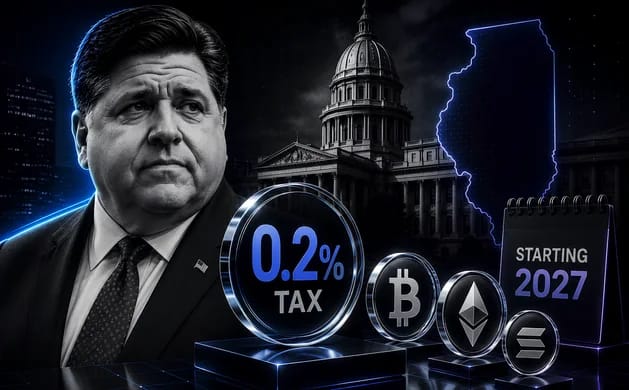
GM. Illinois Governor JB Pritzker signed a new law that will impose a 0.2% tax on digital asset transactions within the state starting in 2027.
Meanwhile, Kentucky sued Kalshi and Polymarket over sports betting, U.S. regulators proposed new customer-identification rules for stablecoin issuers under the GENIUS Act, and World Liberty Financial nears federal approval for a national trust bank charter.
Here are the details on new state tax policies, jurisdictional legal fights, and federal bank charter developments. 👇
Illinois Imposes 0.2% Crypto Transaction Tax Starting 2027
Illinois Governor JB Pritzker signed the Digital Asset Tax Act, creating a 0.2% charge on digital asset transactions or services for state customers. The levy takes effect on Jan. 1, 2027, and targets exchanges, custodians, brokers and wallet-service businesses rather than peer-to-peer transfers under state budget law.
Industry groups including the Crypto Council for Innovation, Digital Chamber and Illinois Blockchain Association opposed the measure as discriminatory. They argue the law could tax transfers, conversions or custody at full asset value even without realized gains, making compliance costly and unclear across routine activity.
The law applies to businesses with a physical Illinois presence or more than $100,000 in annual gross receipts from state customers. Andreessen Horowitz policy chief Miles Jennings called it one of the most anti-crypto laws in the US because no comparable tax hits stocks, bonds or derivatives.
Supporters framed the measure inside broader FY2027 budget planning, following Illinois rules for exchanges, crypto businesses and kiosks passed in 2025. Opponents say the tax echoes the repealed federal broker rule, singling out digital assets and risking an innovation exit from Illinois by service providers.
Kentucky Sues Kalshi and Polymarket Over Betting
Kentucky sued Kalshi and Polymarket, accusing both platforms of running illegal sports betting operations without state registration. Attorney General Russell Coleman said the companies violated gambling laws statewide. The platforms argue their event contracts fall under CFTC oversight as federally regulated swaps, not state-licensed wagers.
The case joins a growing state-federal fight over prediction market jurisdiction, with the Trump administration backing federal control. Kentucky said the platforms avoided gambling safeguards, including addiction resources. Courts in the Sixth Circuit have already split on similar disputes, increasing the odds of Supreme Court review.
GENIUS Rules Push Stablecoin Issuers Toward Bank Checks
US regulators proposed customer-identification rules for stablecoin issuers under the GENIUS Act, bringing them closer to banks and brokerages. The Federal Reserve, Treasury, OCC and FDIC issued the draft jointly for review. Issuers would verify identities, keep records and screen users against terrorism lists.
The proposal opened a 60-day comment period after earlier Treasury feedback drew 450 responses from market participants nationwide. Fed Governor Michael Barr said he remains concerned about secondary-market stablecoin activity. He warned bad actors can transact without detection if identity duties stop at issuer relationships.
World Liberty Nears Federal Trust Charter Approval
World Liberty Financial is reportedly close to OCC approval for a national trust bank charter, despite political scrutiny over Trump family interests. The charter would let the project issue and redeem USD1 directly under oversight. It could also manage reserves, custody assets and process conversions federally.
The application has drawn backlash because Donald Trump and his family hold major financial interests in the firm. Lawmakers have raised conflict and national-security concerns tied to World Liberty’s stablecoin business. Scrutiny also surrounds a reported UAE-linked investment and a $2 billion Binance settlement involving USD1.
Data of the Day
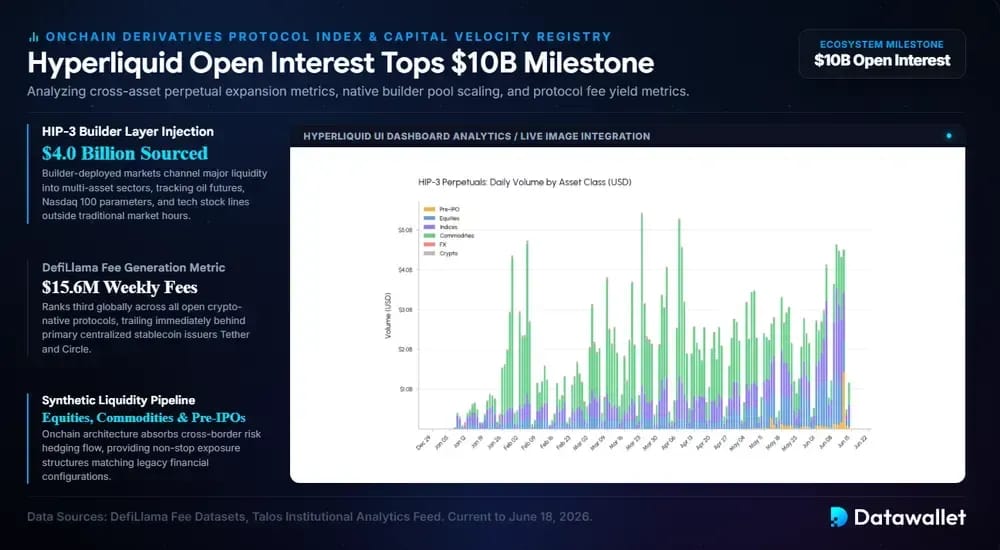
Hyperliquid perpetual futures open interest exceeded $10 billion as the platform expanded beyond crypto into equities, commodities and synthetic pre-IPO markets. Talos said about $4 billion came from HIP-3 builder-deployed markets. Oil, Nasdaq 100 and technology stock contracts ranked among active products there recently.
The milestone reflects growing demand for round-the-clock onchain derivatives and traditional-market exposure outside legacy trading hours. Hyperliquid also generated more than $15.6 million in weekly fees across the platform. That ranked third among crypto protocols behind stablecoin issuers Tether and Circle, according to DefiLlama data.
More Breaking News
- Senators Rubén Gallego and Cynthia Lummis introduced a bipartisan resolution opposing any pardon for Sam Bankman-Fried, saying the FTX founder earned no clemency after conviction.
- The US housing bill deal includes a Federal Reserve CBDC ban through 2030, reviving Republican anti-surveillance language while preserving stablecoin carveouts for private dollar tokens.
- Ethereum Foundation co-executive director Hsiao-Wei Wang stepped down after several leadership exits, extending a reshuffle around research, governance and protocol priorities inside Ethereum’s foundation.
- Ireland named crypto misuse among top financial-crime threats, adding a 30-point plan for stronger checks on digital funds and gambling-linked money flows across regulated firms.
- Aztec suffered a second deprecated-contract exploit within days, losing about $2.15 million and renewing concerns over abandoned infrastructure still holding legacy user assets onchain.
- CME plans to sue the CFTC over crypto perpetual futures approvals, arguing the products are swaps rather than futures under Dodd-Frank rules for exchanges.
- Bhutan sent 533 Bitcoin worth $34.5 million to Binance, pushing state-linked holdings below 1,750 BTC after months of tracked outflows from national mined reserves.
- Estonia proposed national IDs for AI agents, aiming to limit permissions, audit actions and separate machine authority from human or institutional accounts in government systems.
For the latest updates on digital asset markets, follow us on X @Datawalletcom.
For the latest updates on digital asset markets, follow us on X @Datawalletcom.
Get tomorrow’s issue in your inbox