
Can You Add 0G to MetaMask?
Yes. 0G is an EVM-compatible Layer 1, meaning it executes the same smart contract bytecode as Ethereum, so MetaMask treats it as a standard custom network with no extension required. Your existing 0x address carries over unchanged, although every balance on 0G starts at zero because each chain keeps its own ledger.
0G spent its early life as a testnet paying gas in a placeholder token called A0GI, and the Aristotle mainnet that went live on 22 September 2025 replaced it with the 0G token. Any tutorial mentioning A0GI or Chain ID 16600 predates the launch and should not be followed.
How to Add 0G to MetaMask
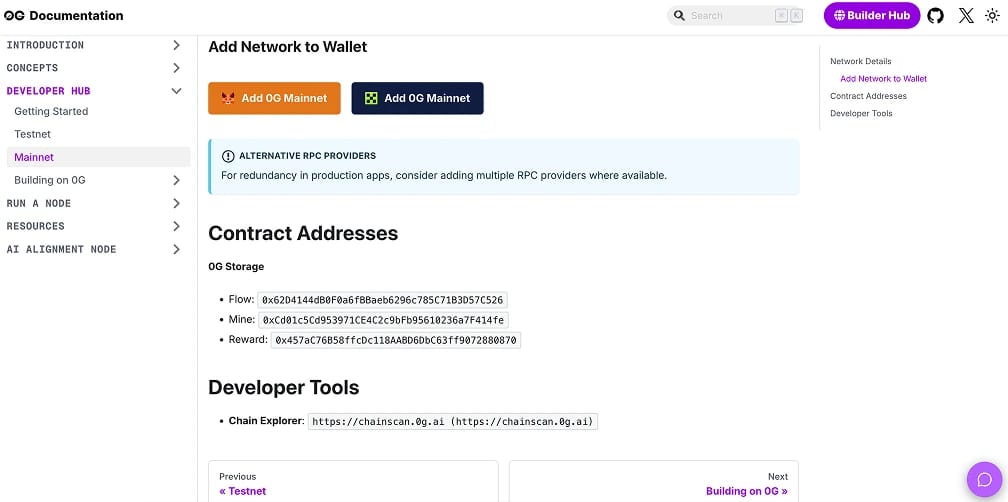
We suggest starting with 0G's own documentation, since its connect button removes any chance of mistyping an RPC URL, the address MetaMask uses to talk to the network. ChainList and manual entry save the same result.
Follow these steps to connect through the official docs:
- Open the mainnet page: Go to the 0G Mainnet overview and confirm the address bar reads docs.0g.ai before touching anything.
- Trigger the prompt: Press the "Add 0G Mainnet" button under the MetaMask logo and wait for the pop-up.
- Inspect the fields: The pop-up must show Chain ID 16661, the 0G currency symbol, and https://evmrpc.0g.ai. Reject the request if any value differs.
- Approve and switch: Confirm the network, then select 0G Mainnet from MetaMask's network menu.
ChainList suits anyone adding several chains in one session. Search for 0G, ignore the deprecated Newton testnet entry that still appears in results, and add the mainnet listing after checking the Chain ID. Our general MetaMask network guide covers the setup screen if this is your first custom chain.
Never accept network parameters posted in Telegram groups or under viral threads. A hostile RPC endpoint sits between MetaMask and the chain, where it can fake balances or disguise a malicious transaction as a routine one.
0G Mainnet RPC and Chain ID
Manual entry sits under "Add a custom network" in MetaMask's settings. These values match 0G's official documentation and should be entered exactly as written:
- Network Name: 0G Mainnet
- RPC URL: https://evmrpc.0g.ai
- Chain ID: 16661
- Currency Symbol: 0G
- Block Explorer: https://chainscan.0g.ai
The public endpoint suits everyday wallet activity. For production applications, the documentation recommends dedicated providers. QuickNode, Thirdweb, and Ankr all serve 0G with higher rate limits and archive access.
0G Galileo Testnet RPC and Chain ID
Galileo is where contracts get trialled before touching real funds, and its current configuration uses these values:
- Network Name: 0G Galileo Testnet
- RPC URL: https://evmrpc-testnet.0g.ai
- Chain ID: 16602
- Currency Symbol: 0G
- Block Explorer: https://chainscan-galileo.0g.ai
Delete any older 0G testnet entry before saving this one, because the retired Newton network used Chain ID 16600 and an earlier Galileo build ran on 16601. The docs flag this cleanup, and a stale entry pointing at a dead endpoint is a common reason transactions silently fail.
Free test tokens come from the official faucet or the Google Cloud faucet, each capped at 0.1 0G per wallet per day. Testnet balances carry no market value and cannot be moved to mainnet.
How to Get 0G for Gas
A saved network with an empty balance cannot send anything, so some 0G must arrive before the wallet becomes usable. 0G's documentation lists the main funding paths.
These are the practical ways to fund a 0G wallet:
- Exchange withdrawal: Buy 0G on a major exchange, then withdraw with 0G Mainnet selected as the destination network. Double-check that selection, since a transfer over the wrong chain is painful to recover.
- XSwap bridge: XSwap is the network's official bridge, built on Chainlink's CCIP messaging protocol, which relays verified transfer instructions between chains.
- 0G Hub: Once assets sit on the network, hub.0g.ai handles swaps into native 0G alongside portfolio tracking.
- Third-party bridges: Aggregators quote transfers from dozens of source chains. Our best crypto bridges guide compares fees and security models across leading options.
- Keep a reserve: Approvals and swaps each burn a little gas, so leave a margin rather than converting the entire balance.
Bridge exploits have cost the industry billions, so a small trial transfer before the main one is cheap insurance.
About 0G
0G, short for Zero Gravity, is a Layer 1 built specifically for artificial intelligence workloads. Founders Michael Heinrich and Thomas Yao raised roughly $290 million from backers including Hack VC, Delphi Digital, OKX Ventures, and Samsung Next to build what the team calls a decentralized AI operating system.
The design splits responsibilities across four modules. 0G Chain handles execution and consensus, 0G Storage holds large files such as model weights and datasets, a data availability layer publishes proof that transaction data exists, and 0G Compute connects buyers of inference with GPU operators who serve it. Separating these jobs lets each layer scale on its own, which matters when a single AI model can weigh hundreds of gigabytes.
The Aristotle mainnet launched on 22 September 2025 with more than 100 partners on day one, including Chainlink, Google Cloud, and MetaMask itself. The token generation event ran the same day, distributing part of the fixed 1 billion supply while team and investor allocations remain locked for 12 months followed by 36 months of vesting.
Development since launch has been rapid. The execution layer migrated to the Reth client in March, and Sealed Inference arrived the same month, using trusted execution environments, secure hardware enclaves that prove code ran untampered, to keep AI queries private. Open models from Alibaba's Qwen family and MiniMax now run on 0G Compute, and native support for ERC-8004, the standard giving AI agents portable onchain identities, landed in June.
Staking is live as well, with validators such as Google Cloud and Figment securing hundreds of millions of delegated 0G tokens. Where the network sits among competing projects is covered in our best AI crypto coins ranking.
Common 0G Setup Mistakes
Four different Chain IDs have belonged to 0G networks, which makes this chain unusually easy to misconfigure.
Watch for these issues when setting up:
- Wrong Chain ID: Only 16661 is mainnet. The IDs 16600 and 16601 belong to retired testnets, and 16602 is the live Galileo testnet where balances hold no value.
- Stale ChainList entries: The dead Newton testnet still appears on ChainList, so read the entry name and Chain ID rather than clicking the first 0G result.
- A0GI confusion: Older guides reference the A0GI testnet token. Mainnet gas is the 0G token, and nothing labelled A0GI exists on Chain ID 16661.
- Empty balance: MetaMask cannot broadcast a transaction without gas, so an inert wallet usually signals missing funds rather than a broken RPC.
- Missing tokens: Assets bridged onto 0G may need importing by contract address before they show in MetaMask's asset list.
- Fake claim sites: New AI chains attract impersonation pages promising token distributions. Verify such offers through 0G's official channels, and our top crypto airdrops tracker shows what legitimate programmes look like.
Final Thoughts
Adding 0G to MetaMask takes about a minute through the documentation button, ChainList, or manual entry with Chain ID 16661. Fund the address with a small amount of 0G and the network is ready for use, whether that means trading, staking, or interacting with the AI services the chain was built around.
Treat the Chain ID as your anchor, since it cannot be spoofed by a lookalike network name. With two retired testnets still echoing around search results, verifying against docs.0g.ai before every approval prevents nearly every setup problem on this chain.