

%25201%25201.png)
What is Blockchair?
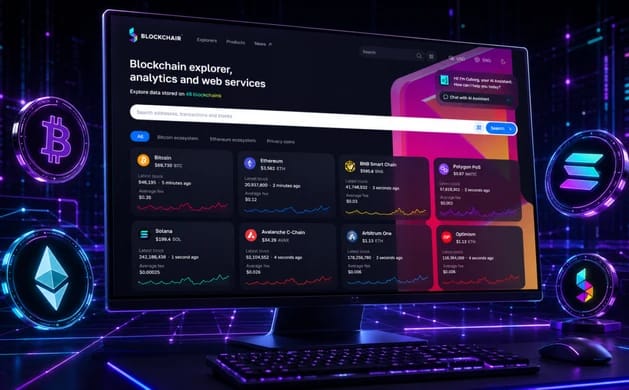
Blockchair is a multi-blockchain explorer that lets users search, analyze, and track transactions across dozens of networks from one unified dashboard. It surfaces detailed data on blocks, addresses, transactions, and network statistics, positioning itself as a research-grade alternative to single-chain explorers for anyone working across ecosystems.
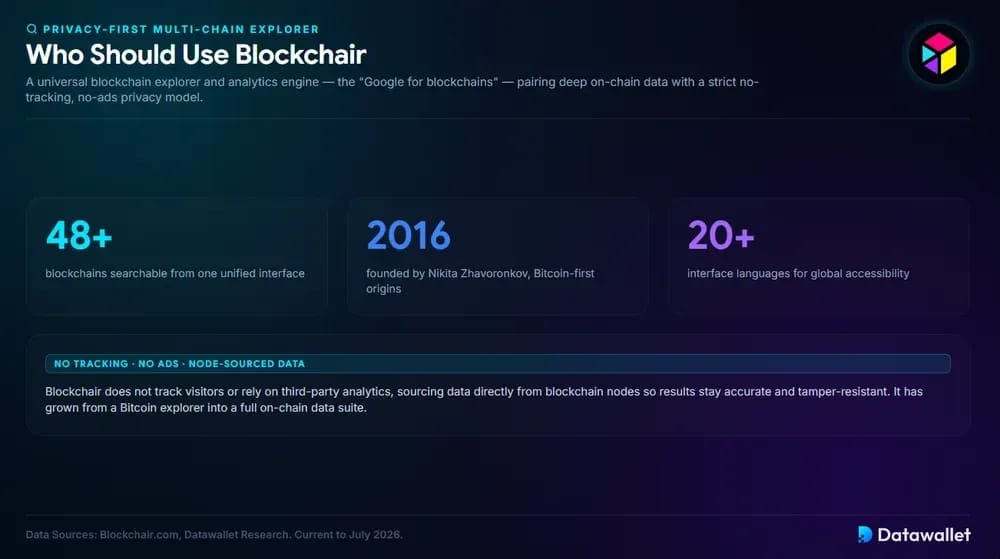
Founded in 2016 by Nikita Zhavoronkov and often nicknamed the "Google for blockchains," Blockchair has grown from a Bitcoin-focused tool into a comprehensive analytics engine. Its expansion into the Bitcoin Layer 2 ecosystem and chains like Solana, Base, TRON, and Arbitrum reflects a deliberate strategy of broadening coverage while keeping its privacy-centric roots intact.
What sets it apart is a commitment to user anonymity. Blockchair does not track visitors, run third-party analytics, or serve ads, and it sources data directly from blockchain nodes. This makes it a trusted resource for developers, forensic analysts, academics, and everyday users who value both depth of data and discretion in equal measure.
Supported Blockchains
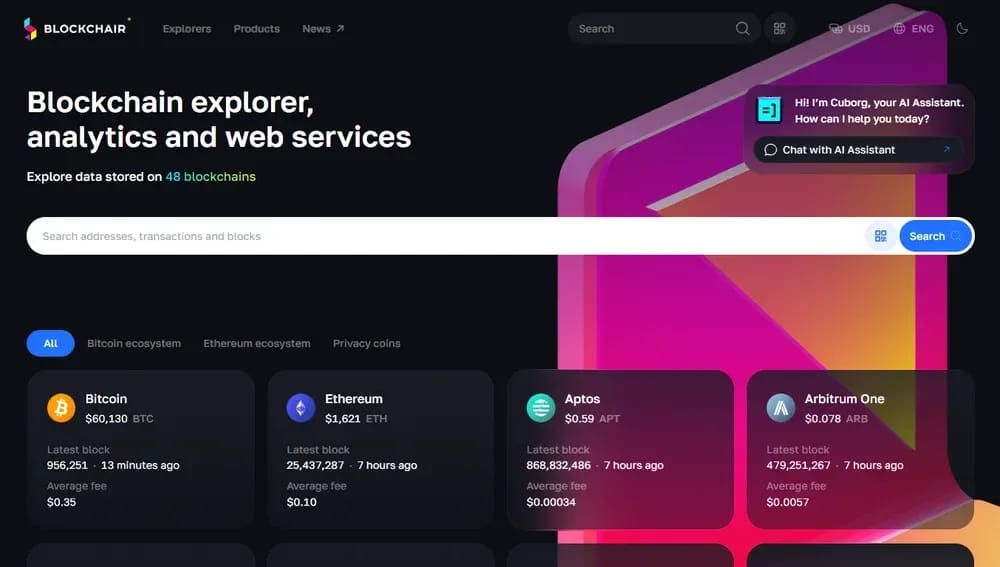
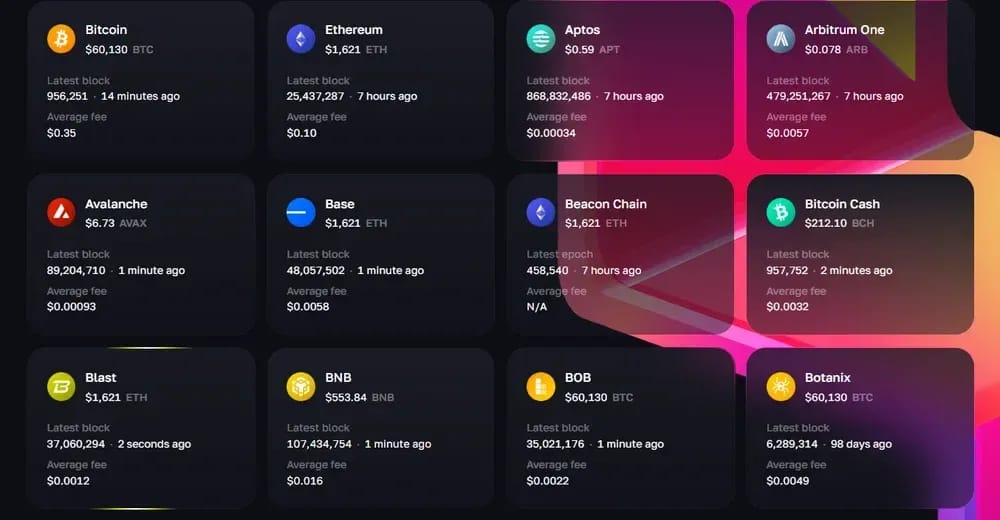
Blockchair's explorer supports 48+ blockchains as of 2026, giving users a single window into transactions, addresses, and blocks across radically different ecosystems. The list spans Bitcoin forks, EVM networks, rollups, and alternative Layer 1s.
The supported networks break down into these categories:
- Bitcoin & Its Forks: Bitcoin (BTC), Bitcoin Cash (BCH), Litecoin (LTC), Dogecoin (DOGE), Dash (DASH), DigiByte (DGB), eCash (XEC), Groestlcoin (GRS), and Peercoin (PPC) all get dedicated UTXO-style explorers.
- EVM Chains: Ethereum (ETH), BNB Chain (BNB), Ethereum Classic (ETC), Polygon (POL), Avalanche C-Chain (AVAX), Fantom (FTM), Moonbeam (GLMR), Gnosis Chain (xDAI), and Sei EVM are covered with smart contract and token tracking.
- Layer 2s & Rollups: Arbitrum One (ARB), Optimism (OP), Base, zkSync Era, StarkNet, Blast, Linea, Mantle (MNT), Polygon zkEVM, and Scroll extend coverage into Ethereum's scaling landscape.
- Alternative Layer 1s: Solana (SOL), Cardano (ADA), Polkadot (DOT), Kusama (KSM), Stacks (STX), Rootstock (RBTC), Botanix, Merlin, and Handshake (HNS) broaden the platform well beyond EVM ecosystems.
- Enterprise & Payment Networks: XRP Ledger (XRP), Stellar (XLM), Hedera (HBAR), TRON (TRX), TON, and Liquid Network target high-throughput and institutional-grade payment rails.
- Privacy-Focused Chains: Monero (XMR) and Zcash (ZEC) round out coverage for users exploring shielded and privacy-preserving transaction models.
It's worth noting that explorer coverage is broader than API coverage. The API currently supports a smaller set of blockchains (16 mainnets and 2 testnets), including Bitcoin, Ethereum, Litecoin, Bitcoin SV, Dogecoin, Dash, Groestlcoin, Zcash, Monero, Cardano, Tezos, Mixin, Ripple, Stellar, and EOS. For a broader look at how these networks differ, our EVM chains explainer is a useful companion.
Blockchair Features
Beyond exploration, Blockchair packages more than 15 tools spanning financial reporting, portfolio management, developer access, domain lookups, and bulk data. Below are the standout features that make it more than just a block explorer.
1. Wallet Statements & Financial Reports
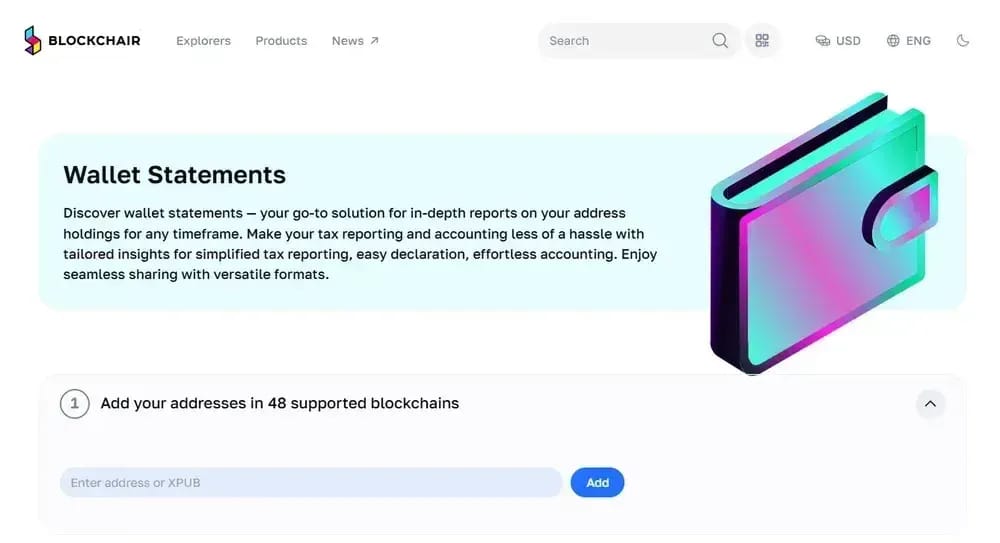
Blockchair's wallet statement generator compiles detailed transaction histories and balance summaries for any address, and users can combine multiple addresses and XPUBs into a single portfolio-wide view. This makes it a practical tool for tax preparation, accounting, and compliance workflows where audit-ready records matter.
Reports come in three formats: PDF for general use, CSV for accountants, and extended CSV for researchers who need granular fields. Each report includes a QR code for verification, so the data can be independently validated against onchain records rather than trusted blindly.
2. Anonymous Portfolio Tracker
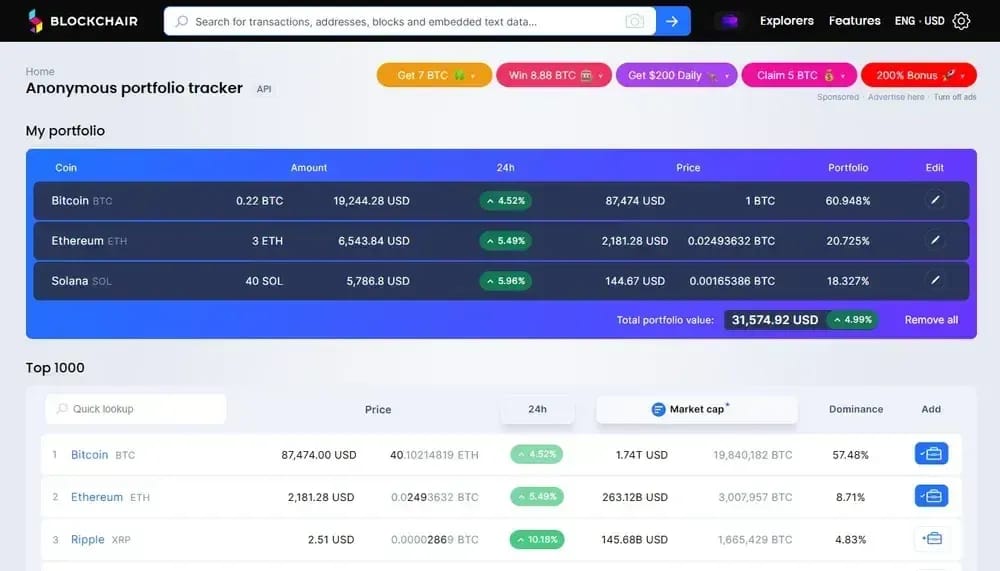
The portfolio tracker lets users monitor holdings in real time across supported chains without ever creating an account or connecting a wallet. It displays live valuations, percentage changes, and historical performance, giving traders and long-term holders a private snapshot of their positions.
Because it requires no sign-up and no wallet connection, it functions as a fully anonymous alternative to account-based trackers. If you want a dedicated tool, Datawallet's own crypto portfolio tracker offers a complementary way to keep tabs on your assets.
3. Blockchair Browser Extension
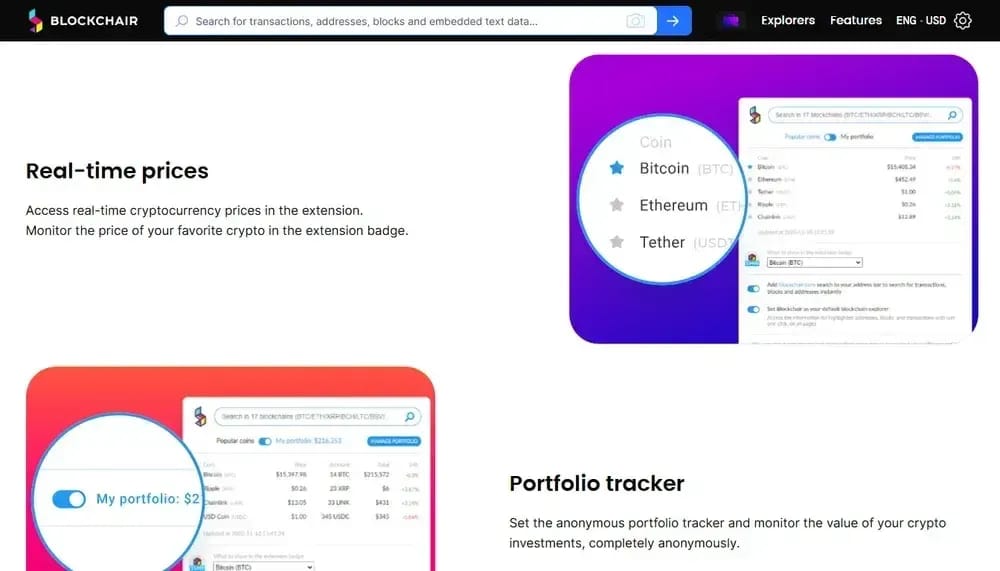
The Blockchair browser extension for Chrome, Firefox, and Safari brings real-time price tracking, transaction search, and blockchain lookups directly into your browser. Users can set Blockchair as their default explorer, converting addresses and transaction hashes into clickable links across any website they visit.
This is especially handy for researchers and analysts who trace activity while browsing platforms like X (Twitter). The extension turns passive reading into an interactive investigation surface, cutting down the friction of copying identifiers back and forth between tabs.
4. Blockchair API & Developer Tools
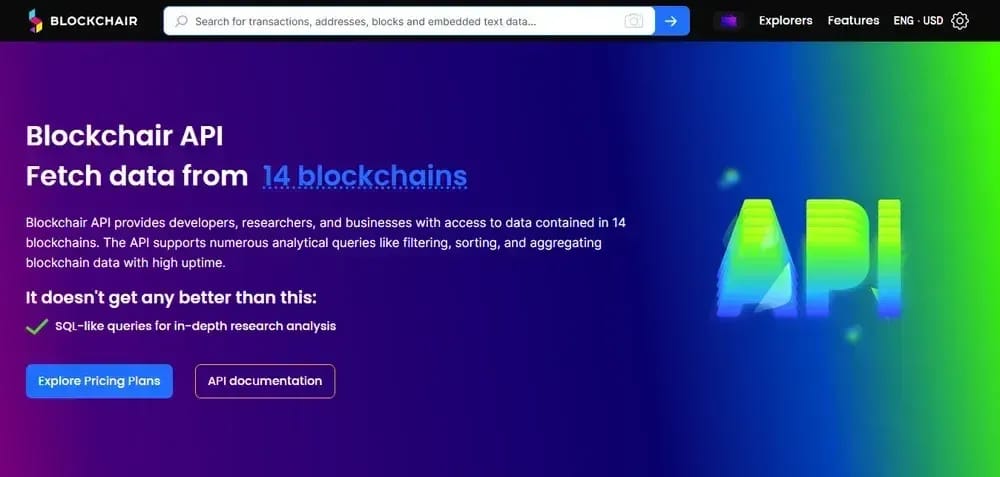
The Blockchair API delivers programmatic access to blockchain data, letting developers query transactions, addresses, mempool activity, and historical records. Its defining strength is analytical depth, as it supports numerous analytical queries like filtering, sorting, and aggregating blockchain data, which suits monitoring and research at scale.
Typical use cases include building multi-chain wallets, powering analytics dashboards, and tracking the integrity of cold wallets. A free testing tier allows up to 1,000 calls per day without an API key, with paid plans unlocking higher limits and dedicated infrastructure for production applications.
5. Data Dumps & Release Monitor
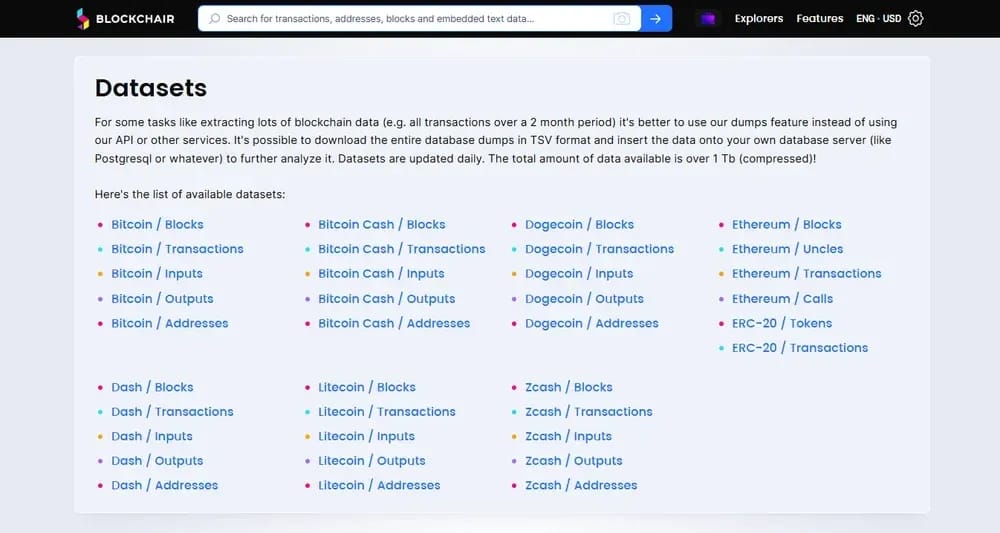
For heavy-duty analysis, Blockchair offers Data Dumps: bulk exports of blockchain data in TSV format ideal for academic research and large-scale studies. Full node dumps for select chains can dramatically compress node sync times, turning what might take weeks into roughly a day of downloading.
The Release Monitor complements this by tracking upcoming hard forks and core client updates across networks. Together these tools serve infrastructure teams and researchers who need both the raw historical record and forward visibility into protocol changes on the chains they depend on.
Pricing & Subscription Plans
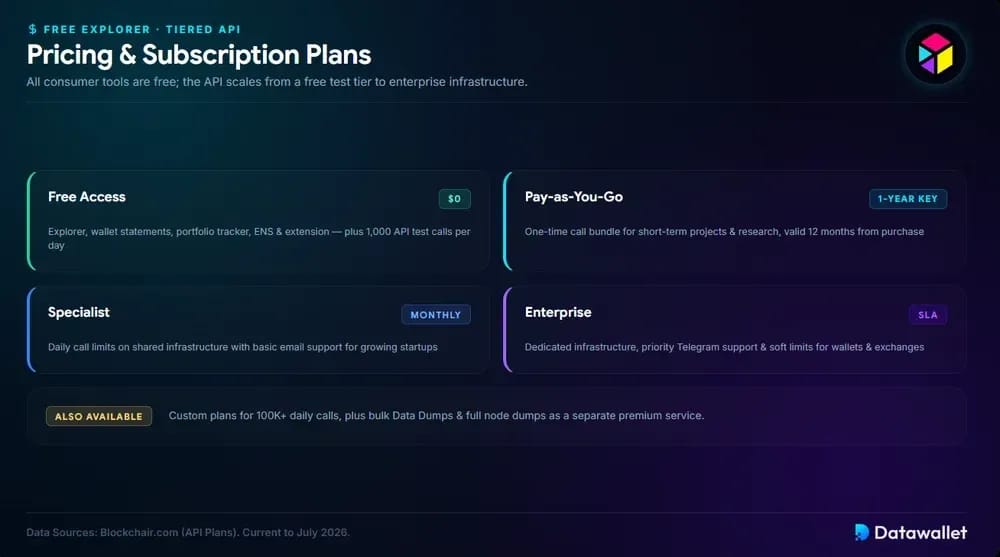
Blockchair keeps its explorer and consumer tools completely free, monetizing instead through tiered API access and premium data services. Developers can pick between one-time and recurring plans depending on volume and use case.
Blockchair's pricing is structured across the following tiers:
- Free Access: The blockchain explorer, wallet statements, portfolio tracker, ENS lookup, and browser extension are all free, alongside an API testing tier capped at 1,000 calls per day.
- Pay-as-You-Go API: A one-time key for short-term projects and research, purchased as a fixed bundle of calls that remains valid for one full year from purchase.
- Specialist API: A monthly subscription aimed at developers and startups, offering set daily call limits on shared infrastructure with basic email support included.
- Enterprise API: The best-value tier for wallets and exchanges, featuring dedicated infrastructure, an SLA, priority Telegram support, and soft limits you can occasionally exceed.
- Custom API Plan: Tailored pricing for large market players needing more than 100,000 calls per day, specialized requirements, or a dedicated support channel with Blockchair specialists.
- Data Dumps: A separate service for bulk data and full node dumps, with free downloads throttled to 10 kB/s and premium high-speed keys available for faster access.
Payments are currently accepted primarily via PayPal, with cryptocurrency accepted in specific cases. GitHub Student Developer Pack members can also claim discounted API access through Blockchair's education program.
Who Should Use Blockchair?
Blockchair casts a wider net than most explorers, serving everyone from curious newcomers to institutional teams. Because its tools scale from one-click lookups to programmatic queries, different user groups extract value in very different ways from the same underlying platform.
The platform fits several distinct user profiles particularly well:
- Everyday holders: Casual users verifying a pending transaction or checking a balance benefit from the clean interface and one-click search across chains without any account setup.
- Traders & investors: The anonymous portfolio tracker lets active traders monitor valuations and historical performance across ecosystems privately, with no sign-ups or wallet connections required.
- Developers: Programmatic API access with filtering and aggregation lets engineers build multi-chain wallets, dashboards, and monitoring services on structured, reliable on-chain data.
- Analysts & researchers: SQL-like querying and bulk TSV Data Dumps support forensic investigations, academic studies, and large-scale analysis that manual scraping simply cannot handle efficiently.
- Accountants & tax teams: Verifiable wallet statements in PDF and CSV formats produce audit-ready records, streamlining compliance, bookkeeping, and tax reporting for individuals and firms alike.
- Privacy-conscious users: Tor access, no-JavaScript mode, and zero user tracking make Blockchair ideal for anyone researching wallets while minimizing their own passive data footprint.
Because the same data layer powers all these workflows, teams can standardize on Blockchair across departments rather than stitching together separate single-purpose tools for each use case.
How to Get Started with Blockchair
Getting up and running on Blockchair takes minutes because most tools require no account, no download, and no wallet connection. The workflow differs slightly depending on whether you want casual exploration or programmatic API access for building applications.
For everyday use, simply visit the Blockchair explorer and enter any address, transaction hash, or block number into the universal search bar. Results appear instantly, and you can switch between supported chains, apply filters, or export a wallet statement directly from the interface without registering.
For developers, start with the free testing tier that permits 1,000 daily calls without a key, then request a paid API key once you need higher limits. Consult the documentation for endpoint structures and analytical query syntax before integrating the data into your application or dashboard.
Is Blockchair Safe?
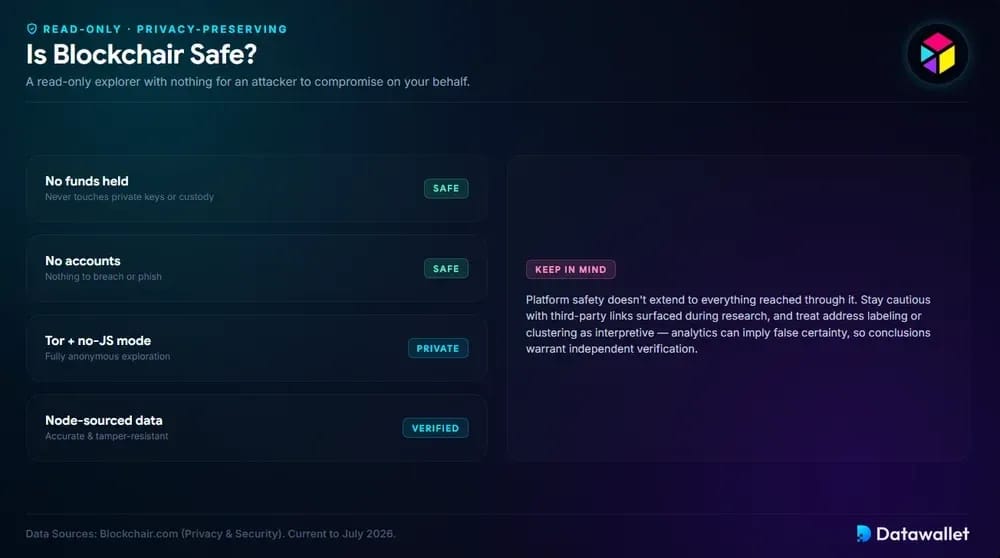
Yes, Blockchair is safe to use. It operates as a read-only explorer that never holds funds, requires accounts, or touches private keys, which eliminates the most common vectors for loss on interactive platforms. There is simply nothing on the platform for an attacker to compromise on your behalf.
Its privacy architecture reinforces that safety. Blockchair does not collect personal data or rely on third-party analytics, and it offers a Tor-accessible version plus a no-JavaScript mode for fully anonymous exploration. Data is pulled straight from blockchain nodes, ensuring results are accurate and tamper-resistant.
That said, safety on the platform doesn't extend to everything you might reach through it. Users should stay cautious with any third-party links or external services surfaced during research, and treat address labeling or clustering as interpretive rather than definitive. Analytics can imply false certainty, so conclusions warrant independent verification.
Blockchair vs Competitors
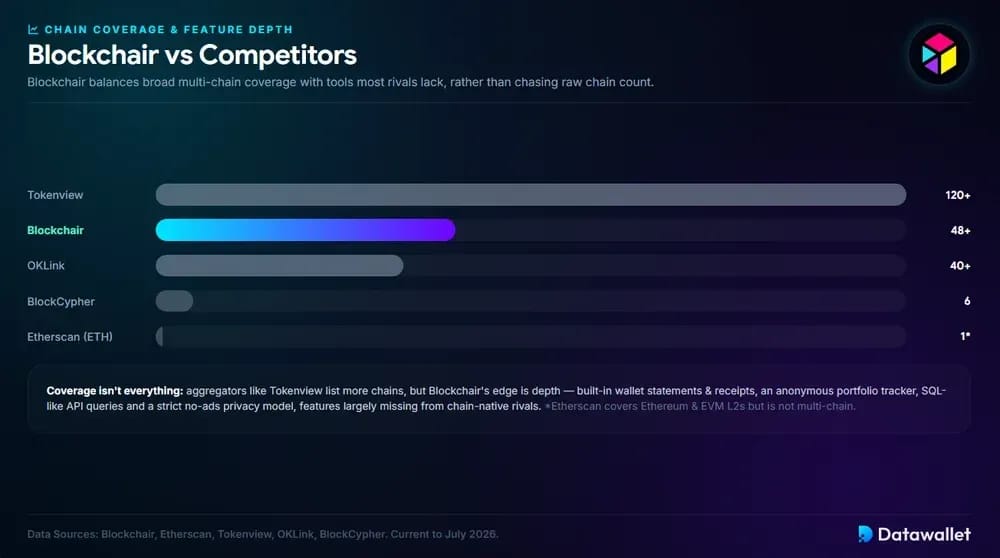
Blockchair competes with explorers like Etherscan, Blockchain.com, Tokenview, and BlockCypher, each strong in its own niche. Its edge lies in breadth, privacy, and analytical tooling rather than deep single-chain specialization.
Here's how Blockchair measures up against its main rivals:
- Multi-chain coverage: Blockchair spans 48+ chains in one interface, whereas Etherscan focuses on Ethereum and EVM networks, forcing users to juggle separate explorers per ecosystem.
- Privacy-first design: Blockchair serves no ads and tracks no users, unlike many competitors that monetize through aggressive tracking and advertising partnerships.
- Financial reporting: Wallet statements and verifiable transaction receipts are built in, features largely absent from Etherscan, BscScan, and similar chain-native tools.
- Analytical querying: Blockchair's SQL-like filtering and aggregation outclass basic lookup explorers, making it far better suited to research and forensic workflows.
- Flexible pricing: Pay-as-you-go API keys valid for a year offer more flexibility than the subscription-only models common among competing data providers.
- Deeper specialization elsewhere: For verified smart contract code and internal transaction detail, Etherscan still leads, so Blockchair works best as a complement rather than a total replacement.
Blockchair is also available in over 20 languages, including English, Spanish, French, German, Russian, Chinese, Japanese, Korean, and Arabic, making it one of the most globally accessible explorers available.
Final Thoughts
If you need a multi-chain explorer that prioritizes privacy, advanced search, and financial tracking, Blockchair remains one of the strongest options heading into 2026. It excels as a research and monitoring layer for users who need more than a simple address lookup.
It's especially well-suited to analysts, developers, and everyday users who want a reliable, ad-free platform with deep data access and a clean interface. Whether you're verifying transactions, tracking a portfolio, or integrating onchain data into an application, Blockchair delivers serious capability.
Just pair it with chain-native tools where you need the deepest smart contract detail, and it becomes a genuinely powerful addition to any crypto toolkit.