



Which Countries Does CoinEx Restrict?
CoinEx currently restricts over 40 countries and regions, plus any jurisdiction under comprehensive embargoes or sanctions. Its Terms incorporate a separately maintained List of Prohibited Jurisdictions and ban access from those places.
CoinEx’s June 2026 update says products and services are unavailable to residents or users from the United States, Canada, Mainland China, Hong Kong SAR, European Union, United Kingdom, Switzerland, Kazakhstan, North Korea, Iran, and Cuba.
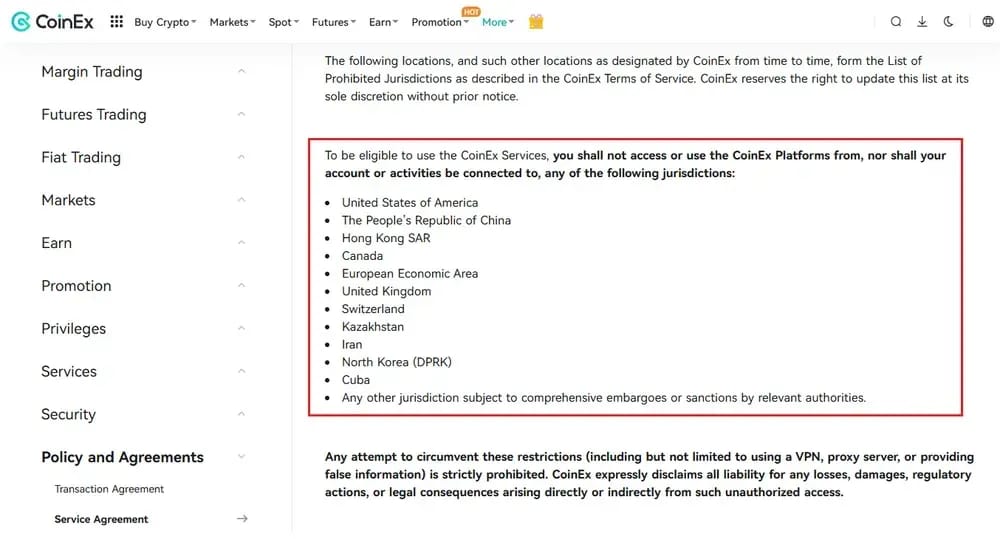
CoinEx Restricted Countries List in 2026
Below is the full table of CoinEx prohibited jurisdictions, grouped by region, including the EEA states and the sanctions catch-all currently named by CoinEx:
Why Does CoinEx Restrict These Countries?
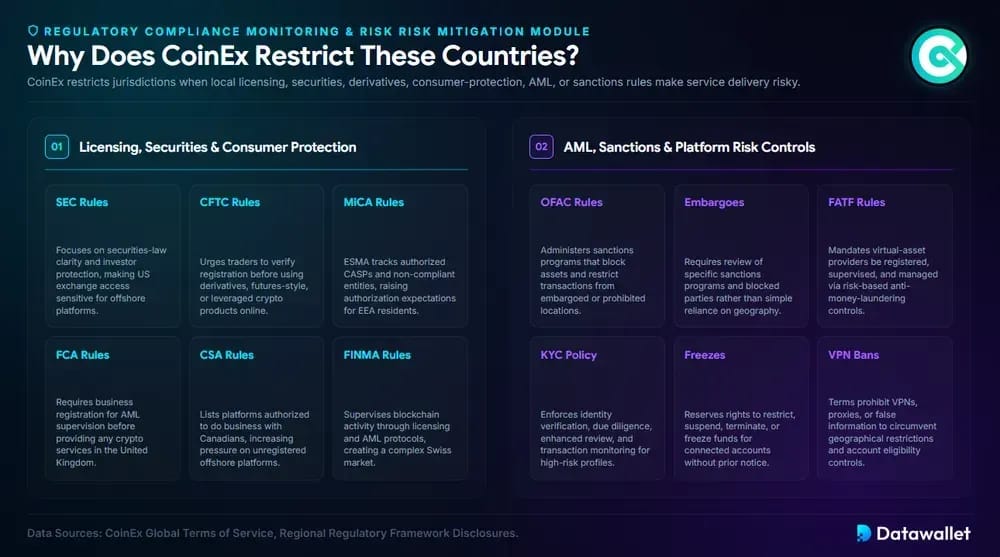
CoinEx restricts jurisdictions when local licensing, securities, derivatives, consumer-protection, AML, or sanctions rules make service delivery risky. Its policies connect availability to compliance checks, customer risk scoring, monitoring, and account controls.
1. Licensing, Securities, and Consumer Protection
Many blocked markets require formal registration, authorization, or supervisory approval before an exchange can offer trading, custody, fiat access, leverage, or derivatives locally to residents.
Key licensing and investor-protection reasons behind CoinEx restrictions:
- SEC rules: The SEC focuses on securities-law clarity, innovation, and investor protection, making US exchange access especially sensitive for offshore platforms serving American residents.
- CFTC oversight: The CFTC urges traders to verify registration before using derivatives products, which matters when exchanges offer leveraged or futures-style crypto markets online.
- MiCA approval: ESMA maintains MiCA information on authorized CASPs and non-compliant entities, raising authorization expectations for exchanges serving EEA residents across the single market.
- FCA registration: The FCA requires in-scope cryptoasset businesses to register for AML supervision before providing crypto services in the United Kingdom to local users.
- Canadian authorization: The CSA lists crypto platforms authorized to do business with Canadians, increasing pressure on offshore exchanges lacking Canadian registration or dealer status.
- Swiss supervision: FINMA supervises fintech and blockchain activity through licensing and anti-money-laundering expectations, making Switzerland a complex market for unlicensed global exchanges seeking users.
2. AML, Sanctions, and Platform Risk Controls
Sanctions and AML rules also shape access because crypto platforms must screen locations, identities, transactions, counterparties, and suspicious behavior before allowing services to continue safely.
Main AML and sanctions triggers behind CoinEx restrictions:
- OFAC sanctions: OFAC administers sanctions programs that can block assets and restrict transactions, creating exposure when users come from embargoed or prohibited locations worldwide.
- Country embargoes: OFAC’s country-list guidance says businesses must review specific sanctions programs, blocked parties, and activity restrictions rather than rely on simple geography alone.
- FATF standards: FATF says virtual-asset providers should be licensed or registered, supervised, and managed through risk-based anti-money-laundering and counter-terrorist-financing controls in each jurisdiction they serve.
- KYC checks: CoinEx’s AML/KYC Policy allows identity verification, due diligence, enhanced review, transaction monitoring, and extra controls for high-risk countries or customers during onboarding.
- Account freezes: CoinEx’s Prohibited Jurisdictions page says it may restrict, suspend, terminate, freeze funds, and cease services for connected accounts without prior notice or liability.
- VPN bans: CoinEx’s Terms prohibit VPNs, proxies, false information, or other circumvention methods used to bypass geographic restrictions and account eligibility controls on the platform.
CoinEx Supported Countries
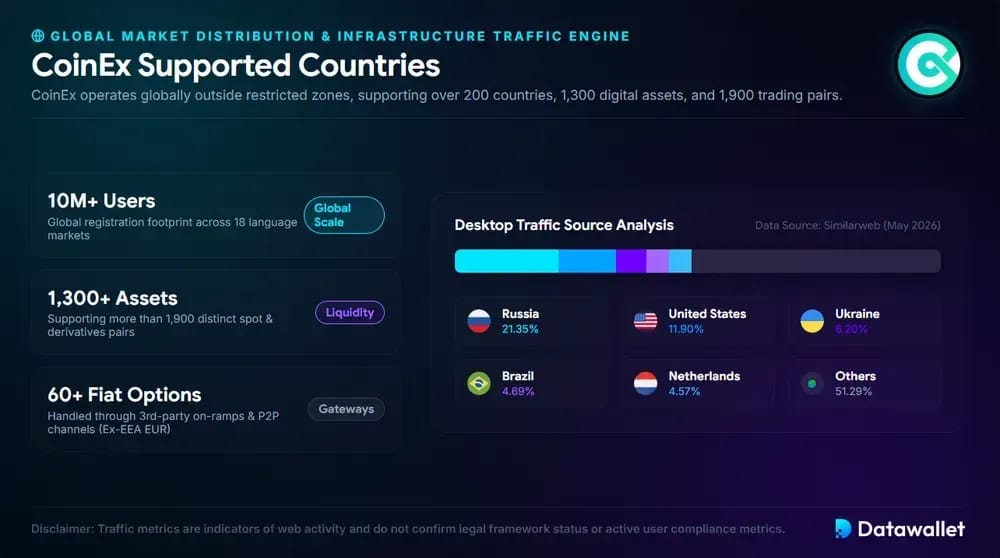
CoinEx remains broadly available outside the markets listed in its restricted-jurisdiction policy. The exchange is currently serving 10-million-plus users across more than 200 countries and regions, with over 1,300 crypto assets and more than 1,900 trading pairs across 18 language markets today.
For fiat access, CoinEx uses third-party on-ramp and P2P partners rather than operating as a bank. Its fiat trading page says users can buy mainstream cryptocurrencies with more than 60 fiat currencies, although EUR routes changed after the EEA service stoppage and subsequent access restrictions.
According to Similarweb’s traffic data, May 2026 desktop visits came from Russia 21.35%, the United States 11.9%, Ukraine 6.2%, Brazil 4.69%, the Netherlands 4.57%, and Others 51.29%; traffic share does not confirm legal availability in restricted or supported markets, or prove active user residency on CoinEx.
Does CoinEx Have MiCA License?
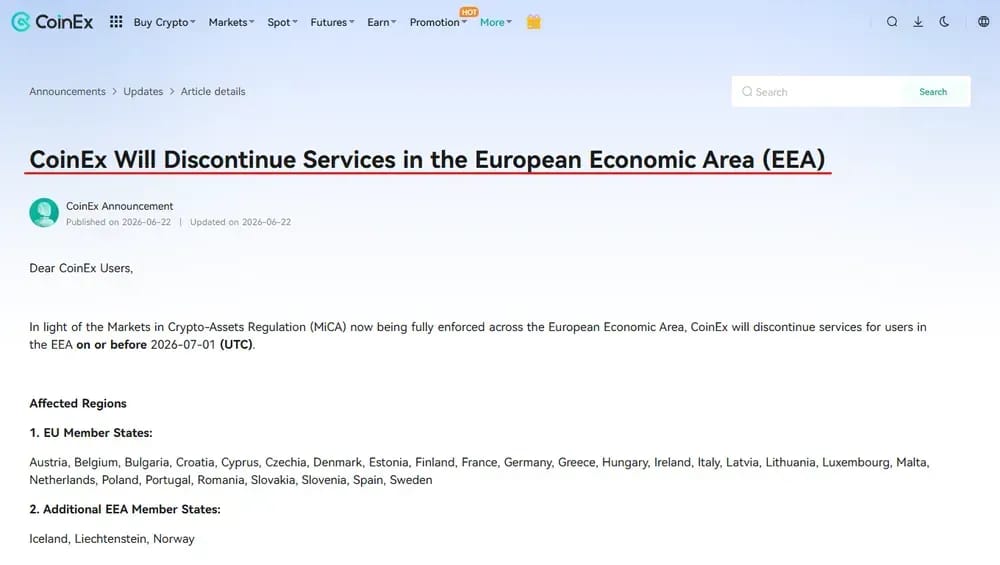
CoinEx does not appear to have MiCA authorization for EEA service continuity. Its June 2026 EEA announcement says MiCA was fully enforced across the European Economic Area and CoinEx would discontinue services for EEA users on or before July 1, 2026, UTC under the transition.
The same notice lists EU member states plus Iceland, Liechtenstein, and Norway as affected regions. It says new EEA registrations were suspended, CoinEx would keep operating normally elsewhere, user assets remained safeguarded, and withdrawals were not affected during the adjustment period for impacted accounts and balances.
Users in the EEA should look for crypto exchanges authorized under MiCA instead of trying to access CoinEx. ESMA’s MiCA page explains that the framework includes registers for authorized crypto-asset service providers, white papers, and entities that may operate outside compliance inside the European Union market.
Can I Use CoinEx in the USA?
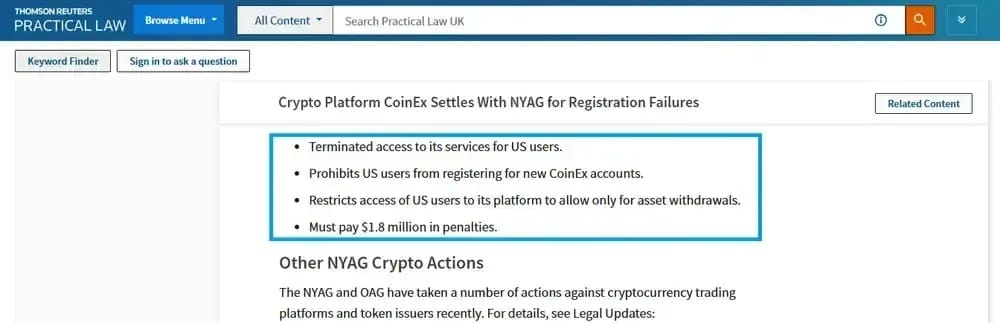
No. CoinEx lists the United States of America as a prohibited jurisdiction, and its Terms of Service says services are unavailable where CoinEx restricts access. It also bans VPNs, proxies, false information, and other methods used to bypass geographic controls from restricted locations or accounts.
As a result of a legal settlement in June 2023, CoinEx agreed to block all US users, enforce geo-restrictions, and pay $1.8 million in penalties. The platform does not allow any workarounds, and attempts to access CoinEx from the United States may result in account restrictions.
US users should consider locally available alternatives such as Coinbase, Kraken, and Gemini. The best option depends on state availability, trading fees, supported coins, custody preferences, staking access, and whether the user wants a beginner-friendly or advanced trading interface for compliant domestic use today in practice.
Does CoinEx Require KYC?
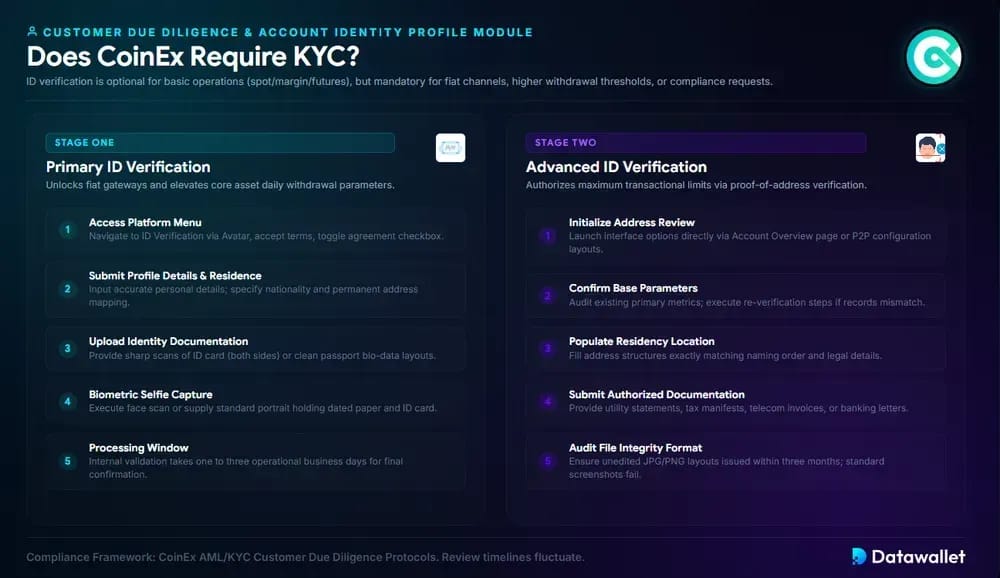
CoinEx does not require ID verification for every basic feature. Its Primary ID guide says unverified users can use spot, margin, futures, and Earn, but fiat trading and higher withdrawal limits require verification.
Still, CoinEx’s AML/KYC Policy allows the platform to request verification anytime for security incidents, suspicious activity, regulatory requirements, compliance review, or access to certain products and services during ongoing customer due diligence.
How to Complete Primary ID Verification
Primary verification increases withdrawal limits and unlocks fiat trading. CoinEx provides web and app flows, with document requirements based on nationality and residence status.
Complete CoinEx Primary ID Verification with these steps:
- Access: Log in, open the avatar menu, select ID Verification, read the reminder, check the declaration box, and click “I’m all set for ID Verification.”
- Details: Enter basic information correctly, then confirm whether your nationality matches your residence country or whether CoinEx requires both nationality and address verification instead.
- Residence: If address verification applies, enter a full residence address that exactly matches the proof-of-address document you plan to upload later for review online.
- Documents: Upload a valid ID card, driver’s license, or passport; CoinEx requires both sides for cards and the first page for passports during verification.
- Selfie: Complete facial recognition in-frame, or upload a selfie holding your document and a handwritten declaration with the date and “CoinEx” clearly visible inside.
- Submit: Send the application and wait for CoinEx’s email result; the official guide says review usually takes one to three business days after submission.
How to Complete Advanced ID Verification
Advanced verification adds proof-of-address review after Primary approval. CoinEx asks users to confirm existing identity details before submitting current residential documentation for higher limits.
Complete CoinEx Advanced ID Verification with these steps:
- Open: From the avatar menu, Account Overview, or P2P Trading page, enter ID Verification and choose the Advanced Verification option to begin address review.
- Confirm: Double-check nationality, residence country, and name from Primary verification; if anything is wrong, use “Verify again” before continuing with the application process safely.
- Address: Enter the residential address exactly as it appears on the proof-of-address document, keeping name order, region, and residence consistent with Primary verification records.
- Upload: Submit an accepted utility, housing, telecom, tax, bank, financial, or government document showing your name, full address, issue date, and authority clearly visible.
- Format: Use clear JPG, JPEG, or PNG files issued within three months, unedited and unobstructed, with screenshots avoided when CoinEx rejects them as unsupported.
About CoinEx
CoinEx was founded in December 2017 by Haipo Yang under the ViaBTC ecosystem. CoinMarketCap’s profile says ViaBTC established CoinEx, while CoinEx’s own anniversary article says Yang founded the exchange on December 24, 2017, after building ViaBTC Pool as a user-focused trading platform for global crypto markets.
CoinEx Global’s official LinkedIn company page lists headquarters in Seychelles and a 2017 founding year. Public CoinEx materials also describe Haipo Yang as an early Bitcoin participant who entered the community in 2013 and launched ViaBTC Pool in 2016 before CoinEx’s later global exchange debut.
As of CMC's current exchange profile, CoinEx supports over 1,300 cryptocurrencies and more than 1,900 trading pairs. Its ecosystem spans spot, margin, futures, Mining, One-click Swap, Pre-token Trading, AMM, AI Analysis, Academy, CoinEx Wallet, CoinEx Smart Chain, Proof-of-Reserves, Explorer, and Charity for trading education and blockchain services.
Final Thoughts
CoinEx is a legit global exchange, but its 2026 restrictions are broader than many older reviews imply. Always check the official Prohibited Jurisdictions page before registering or depositing any crypto assets.
The key 2026 adjustment is regulation-driven: EEA services stopped around MiCA enforcement, EUR access changed, and users in the US, Canada, UK, Switzerland, China, and Hong Kong remain restricted under CoinEx policy.
Eligible users can still access broad asset coverage, partner fiat routes, and optional verification tiers. Restricted users should choose locally registered or MiCA-authorized platforms instead for safer, compliant trading access.