

What Countries Does MetaMask Restrict?
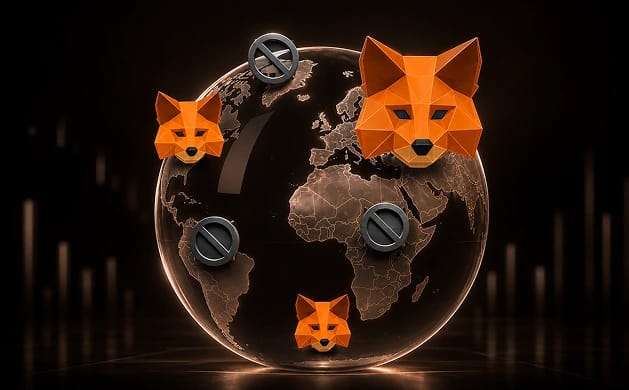
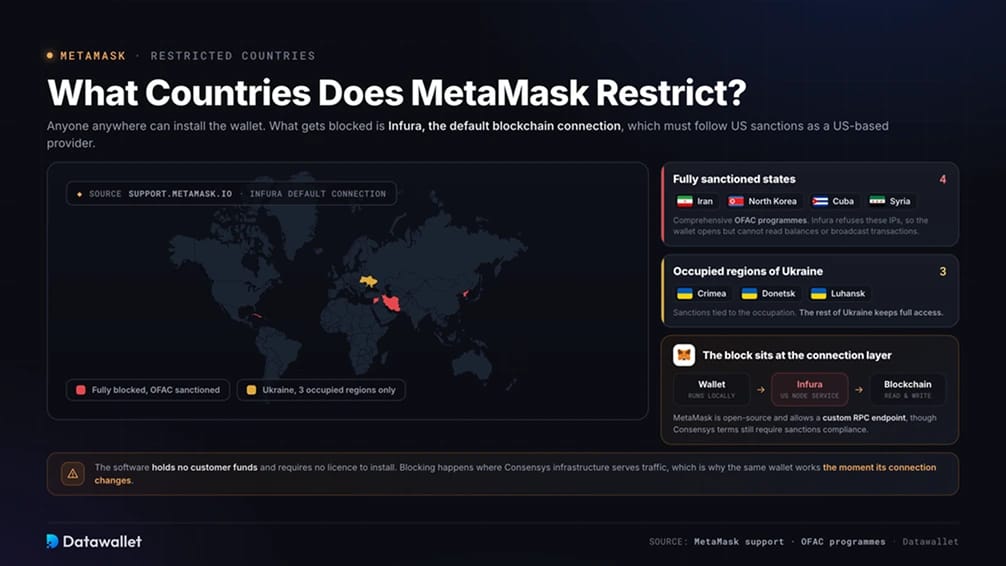
MetaMask lists its geographic limits on its official support page, and the wording matters. Anyone anywhere can install the wallet, because the software runs locally and holds no customer funds. What gets blocked is Infura, the Consensys node service that reads and writes to the blockchain for MetaMask by default, and Infura must follow US sanctions as a US-based provider.
The regions cut off from Infura's default connection are:
- Iran: Under a comprehensive OFAC sanctions programme, so Infura cannot serve traffic from Iranian IP addresses and the wallet cannot broadcast transactions out of the box.
- North Korea: Fully sanctioned, which removes default network access along with every feature that depends on Consensys infrastructure, from token swaps to price data.
- Cuba: A long-standing US embargo obliges Infura to refuse connections, leaving locally installed wallets unable to reach Ethereum through the standard settings.
- Syria: Blocked at the infrastructure level, so a Syrian user opening MetaMask sees the app but cannot read balances or send funds without changing the connection.
- Crimea (Ukraine): Covered by the sanctions programme tied to the Russian occupation, with Infura required to deny service across the peninsula.
- Donetsk (Ukraine): The occupied oblast falls under the same OFAC designations, cutting default access for any wallet connecting from the region.
- Luhansk (Ukraine): Treated identically to Donetsk, meaning the standard MetaMask setup cannot reach the blockchain from there.
The block sits at the connection layer rather than inside the wallet. MetaMask is open-source and lets anyone swap Infura for a different RPC endpoint, which is the address of the server a wallet talks to when it reads the blockchain. Consensys states this openly on the same support page, though its terms still require users to comply with sanctions law wherever they are.
Which MetaMask Features Have Their Own Restrictions?
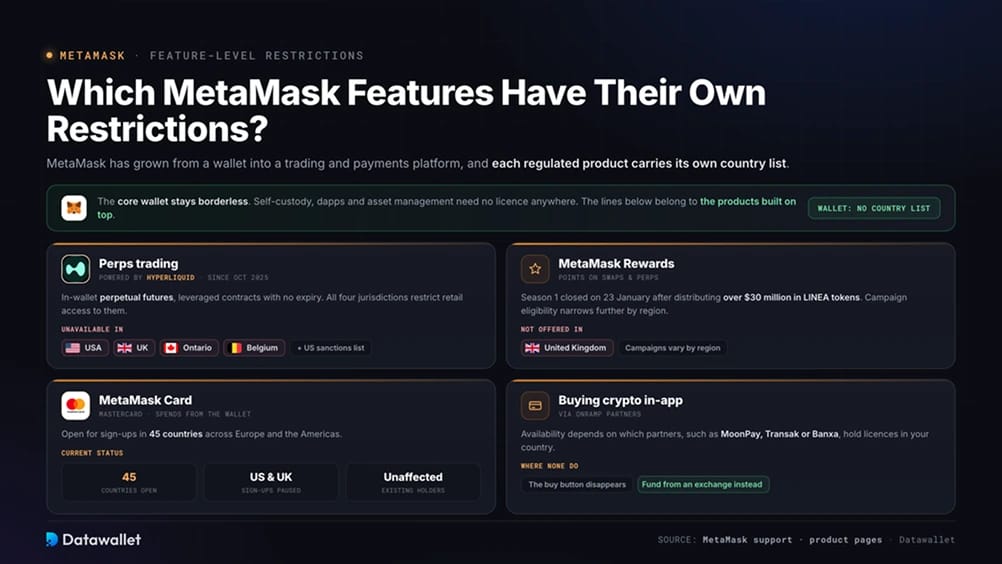
The bigger story since our last update is that MetaMask has grown from a wallet into a trading and payments platform, and each new product carries its own country list. The core software stays borderless while the regulated features around it do not.
Here is where each product currently draws its lines:
- Perps trading: In-wallet perpetual futures, powered by Hyperliquid since October 2025, are unavailable in the USA, UK, Ontario in Canada, Belgium, and every country on the US sanctions list. Perpetual futures are leveraged contracts with no expiry date, and those four jurisdictions all restrict retail access to them.
- MetaMask Rewards: The points programme that pays users for swaps and perps trades is not offered in the UK, and campaign eligibility narrows further region by region. Season 1 closed on 23 January this year after distributing over $30 million in LINEA tokens.
- MetaMask Card: Sign-ups are open in 45 countries across Europe and the Americas, while the US and UK are temporarily paused for new applications. We cover the full list below.
- Buying crypto in-app: Onramp availability depends on which payment partners, such as MoonPay, Transak, or Banxa, hold licences in your country. Where none do, the buy button disappears and users fund the wallet from an exchange instead.
This tiered structure mirrors what we see at centralised platforms like OKX, where the base service reaches most of the world and individual products retreat to wherever regulation allows.
MetaMask Supported Countries
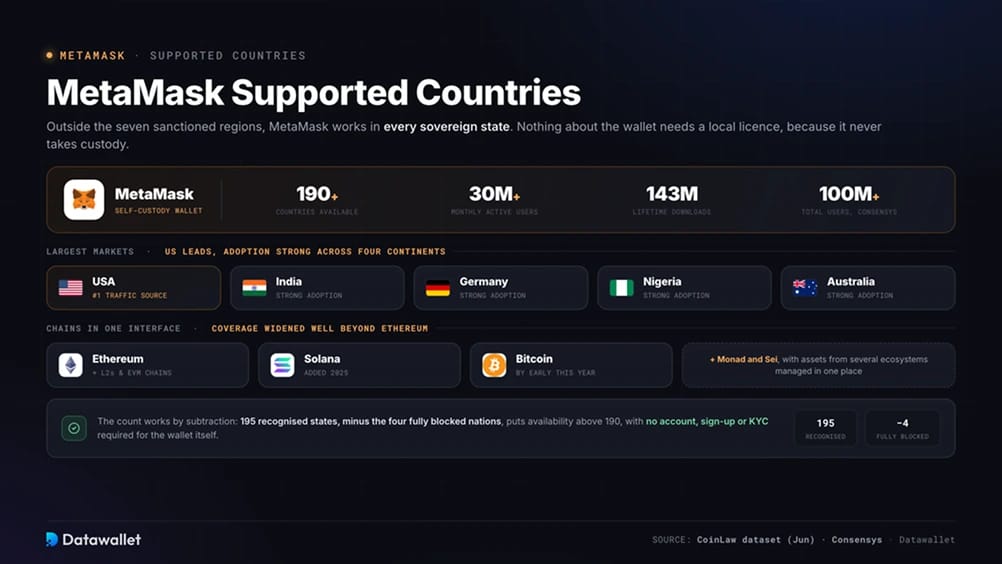
Outside the seven sanctioned regions, MetaMask works in every sovereign state, which puts availability above 190 countries once the four fully blocked nations are subtracted from the 195 recognised worldwide. Nothing about the wallet requires a local licence, because it never takes custody of user assets.
The user base reflects that reach. CoinLaw's dataset, refreshed in June this year, records more than 30 million monthly active users and 143 million lifetime downloads, with the United States the single largest traffic source, followed by strong adoption across India, Germany, Nigeria, and Australia. Consensys cites over 100 million total users when counting lifetime installs.
Coverage has also widened across chains. Alongside Ethereum, its layer 2 networks, and the broader set of EVM-compatible chains, MetaMask added Solana in 2025 and Bitcoin, Monad, and Sei by early this year, letting users in any supported country manage assets from several ecosystems in one interface.
MetaMask Licensing and Regulation
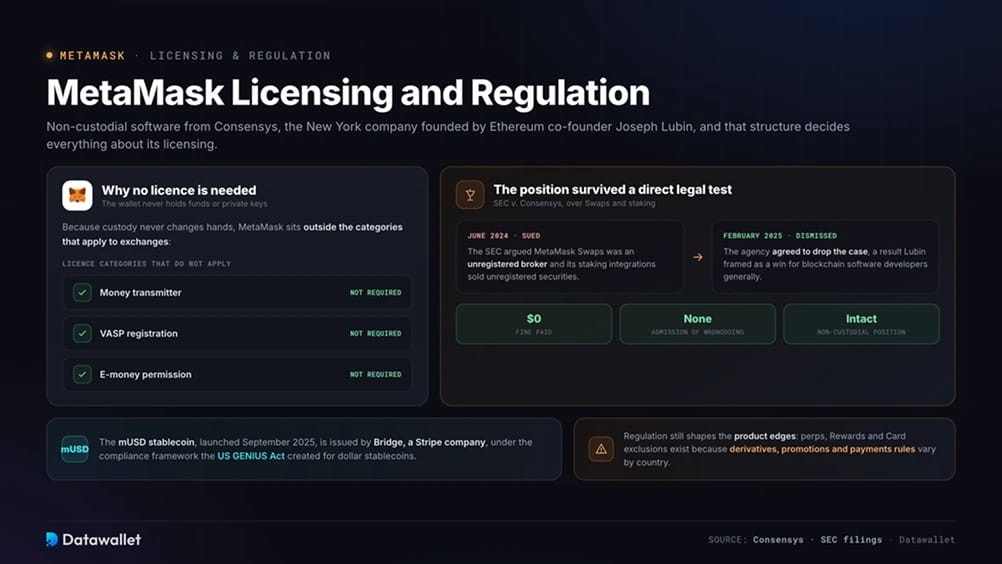
MetaMask operates as non-custodial software from Consensys, the New York company founded by Ethereum co-founder Joseph Lubin. Because the wallet never holds user funds or private keys, it sits outside the licensing categories that apply to exchanges, such as money transmitter, VASP, or e-money permissions.
That position survived a direct legal test. The SEC sued Consensys in June 2024, arguing that MetaMask Swaps operated as an unregistered broker and that its staking integrations sold unregistered securities. The agency agreed to dismiss the case in February 2025 with no fine and no admission of wrongdoing, a result Lubin framed as a win for blockchain software developers generally.
Regulation still shapes the product edges. The mUSD stablecoin, launched in September 2025, is issued by Bridge, a Stripe company, under the compliance framework the US GENIUS Act created for dollar stablecoins. And the perps, Rewards, and Card exclusions above exist precisely because those products touch derivatives, promotions, and payments rules that vary by country.
Does MetaMask Require KYC?
No, the wallet never asks users to verify an account, and any message claiming otherwise is a phishing attempt. Setup involves generating a secret recovery phrase on the device, with no name, email, or ID collected at any point.
Identity checks appear only when regulated partners enter the picture. Buying crypto through an in-app onramp means completing KYC with that provider, and the MetaMask Card requires full verification, including government ID and a selfie, because a Mastercard programme cannot be issued anonymously. In each case the partner handles the data, and the requirements follow that partner's licences rather than anything MetaMask imposes.
Can I Use MetaMask in the USA?
Yes, the wallet is fully available across all US states, and Americans can store assets, connect to dapps, swap tokens, and use every core self-custody feature without restriction. The Consensys headquarters and the largest share of MetaMask's traffic are both in the United States.
The gaps are product-specific. Perps trading is closed to US users because retail crypto derivatives remain restricted domestically, and new MetaMask Card sign-ups are paused nationwide while existing cardholders keep spending. In-app crypto purchases work in most states through licensed onramp partners, and anyone who hits a state-level gap can buy on a US exchange and transfer coins across.
Where is the MetaMask Card Available?
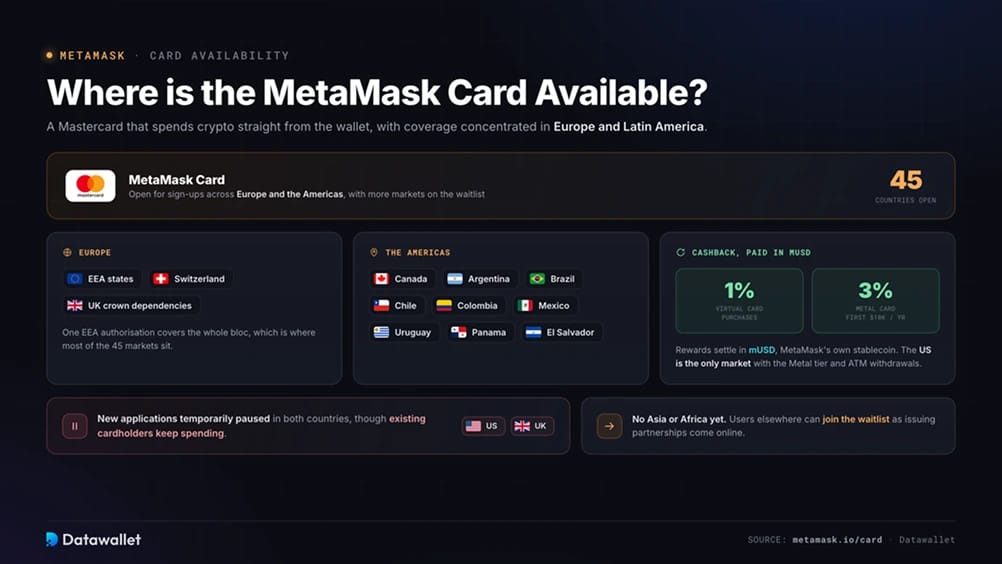
The MetaMask Card, a Mastercard that spends crypto straight from the wallet, is open for sign-ups in 45 countries. Coverage concentrates in Europe and Latin America, spanning the EEA states plus the UK crown dependencies, Switzerland, Canada, and markets including Argentina, Brazil, Chile, Colombia, Mexico, Uruguay, Panama, and El Salvador.
The current rollout works as follows:
- US and UK paused: New applications in both countries are temporarily closed, though existing cardholders are unaffected and the US remains the only market with the Metal card tier and ATM withdrawals for virtual cards.
- Cashback paid in mUSD: Virtual card purchases earn 1% back and Metal cards earn 3% on the first $10,000 spent each year, with rewards settled in MetaMask's own stablecoin.
- No Asia or Africa yet: Users outside the supported regions can join the waitlist, and MetaMask has flagged further expansion as issuing partnerships come online.
About MetaMask
MetaMask launched in 2016 and remains the most widely used self-custodial crypto wallet, spanning a browser extension and mobile apps. Our full MetaMask review covers the wallet features in depth, and we have tested the swap, bridge, and perps functions across both platforms during this update.
The past year transformed the product. MetaMask shipped perpetual futures through Hyperliquid, a Polymarket prediction market integration, the mUSD stablecoin, and, this June, a Money Account paying up to 4% variable yield on stablecoin balances. Consensys has confirmed a native MASK token is coming and is preparing an IPO now targeted for late this year, with JPMorgan and Goldman Sachs engaged as underwriters.
Final Thoughts
The MetaMask restriction picture has split in two. The wallet itself remains as close to borderless as regulated infrastructure allows, with only OFAC-sanctioned regions locked out of the default connection, and even those blocks operate at the node layer rather than inside the software.
The regulated features tell a different story, and that list will keep moving. Perps, Rewards, the Card, and onramps each answer to separate rulebooks, so a user's real access depends less on where MetaMask works and more on which products their country permits. For anyone in a restricted market, funding the wallet from a licensed local exchange remains the cleanest path in.