


Login to Track Your Live Crypto Portfolio
Sign Up and Track Your Live Crypto Portfolio for Free
Forgot your password?
Aerodrome and Velodrome Merge Into Aero Across 7 Networks

This article has been reviewed and verified for accuracy by our editorial team. All claims, data points and platform details are cross-referenced against primary sources.
Some links on this page are affiliate links. Datawallet may earn a commission when you sign up through them, at no extra cost to you. This never influences our editorial ratings, rankings or recommendations.
Some links on this page are affiliate links. Datawallet may earn a commission when you sign up through them, at no extra cost to you. Ratings and rankings reflect our own testing and assessment criteria.

GM. Aerodrome and Velodrome merged to launch Aero, a spot exchange across seven networks that together handle about $120 billion a month in DEX trading.
Elsewhere, Solana switched on Alpenglow with 150-millisecond finality, Starknet holders backed researching a post-quantum Layer 1 with 93.5% support, and Uniswap aggregator hooks went live on Ethereum.
Make yourself comfortable, the full rundown is waiting below. 👇
Aerodrome and Velodrome Merge Into Aero Across 7 Networks
Aerodrome and Velodrome, the leading DEXs on Base and OP Mainnet, merged to launch Aero, an onchain spot exchange spanning Ethereum, Base, Robinhood Chain, Ink, OP Mainnet, Arc and Arbitrum. Those seven networks together handle about $120 billion a month in DEX trading, according to the project.
Aerodrome carried 58% of Base DEX volume in the third quarter and Velodrome 60% on OP Mainnet, with Aerodrome also leading all DEXs in bitcoin-dollar trading. Existing AERO and VELO tokens will migrate to a new AERO, while veAERO and veVELO convert into staked sAERO.
Alex Cutler, CEO of developer Dromos Labs, said 100% of Aero's revenue will flow to AERO stakers, arguing that any institution distillable into code will move onchain. Its Predictive Allocation feature lets stakers direct the liquidity rewards budget toward markets they expect to generate revenue.
Metaswaps will connect trading across all seven networks using Aero's existing onchain liquidity pools, while its Slipstream V3 upgrade adds dynamic fees that rise automatically when markets move fast. It also brings MEV capture, the value extracted by reordering transactions, on supported Layer 2 networks.
Solana Alpenglow Goes Live, Cutting Finality to 150 Milliseconds
Solana's Alpenglow consensus protocol went live on mainnet-beta, retiring TowerBFT, used since 2020, at slot 459,653,000 around 14:00 UTC after validators switched systems on the running network. Finality, the point a transaction becomes irreversible, fell from about 12.8 seconds to roughly 150 milliseconds, core developer Anza said.
Anza CEO Brennan Watt called it the most ambitious blockchain upgrade since Ethereum's Merge, delivered from white paper to mainnet in under 18 months. Quantumglow, a hash-based design to make Solana quantum-secure, and the Rotor data layer are planned next, though neither has a committed date.
93.5% of Starknet Voters Back Post-Quantum Layer 1 Research
Starknet holders overwhelmingly backed researching a move from an Ethereum Layer 2 to an independent post-quantum Layer 1, with over 93.5% of voting power in favor across more than 2,800 wallets. StarkWare did not vote, and any actual transition would require a second STRK holder vote.
StarkWare CEO Eli Ben-Sasson plans a whitepaper draft for public review in November and targets quantum safety in 2027, calling Ethereum's 2029 goal too late since deadlines slip. STRK stays the native token with no new one introduced, and Ethereum bridges to Starknet will remain open.
Uniswap Aggregator Hooks Go Live on Ethereum, Base, Robinhood Chain
Uniswap Labs launched aggregator hooks on Ethereum, Base and Robinhood Chain, letting Uniswap v4 route trades through liquidity held on external platforms such as Fluid, Curve and PancakeSwap. The hooks work through both the Uniswap web app and API, after debuting in March on Stripe and Paradigm's Tempo.
Each hook wraps an outside source so routers treat it as a Uniswap v4 pool, comparing prices and settling the trade in one transaction. Trades routed externally still pay Uniswap protocol fees that feed UNI token burns, on a protocol that has processed over $4.5 trillion in volume.
Data of the Day
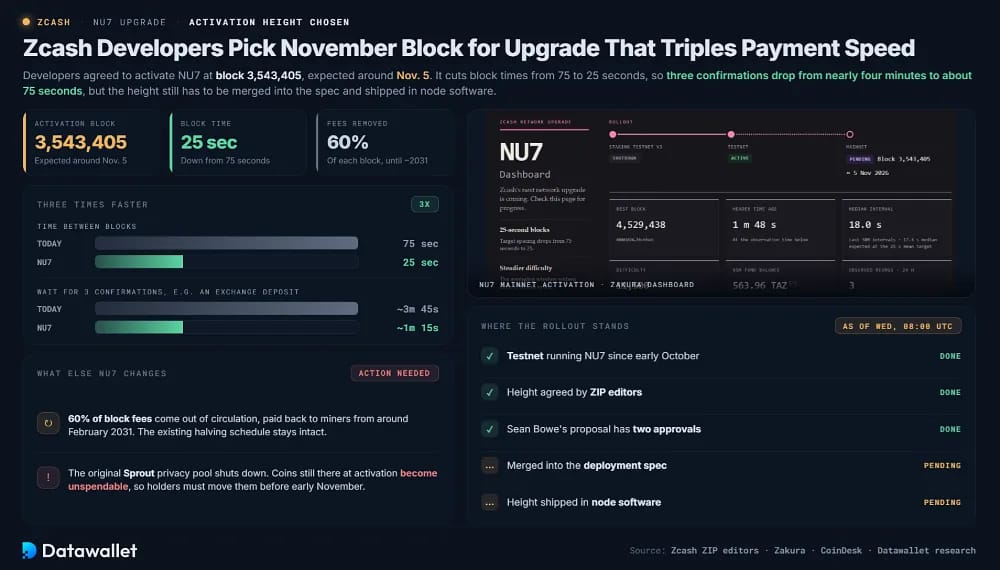
Zcash developers set block 3,543,405 for NU7, expected around November 5, cutting the privacy coin's block times to 25 seconds from 75 seconds. Exchanges waiting for three confirmations before crediting a ZEC deposit could see delays shrink from nearly four minutes to about 75 seconds, a threefold speedup.
NU7 also pulls 60% of each block's fees from circulation until around February 2031, when they return to miners. It shuts down Sprout, Zcash's original privacy pool, making any coins left there unspendable, while the activation height still awaits merging into the spec and node software.
More Breaking News
- Ireland's central bank fined Coinbase Ireland €3.25 million, about $3.6 million, for safeguarding and outsourcing breaches, including daily customer fund shortfalls that reached €5.2 million in 2024.
- Chinese prosecutors sought 61,800 BTC tied to Qian Zhimin's $5.7 billion fraud, as a Tianjin court opened a six-month window for victims to join the confiscation case.
- Fireblocks denied an Axios report that Visa is in late-stage talks to buy the crypto custody firm for about $2.5 billion, calling it not true at present.
- Bybit wants a US broker partner such as Interactive Brokers to challenge Robinhood, CEO Ben Zhou said, sidestepping state-by-state licensing that would take two to three years.
- Dune launched real-time onchain trading feeds covering over 200 venues across 12 networks, delivering trade data about one second after execution, with perpetuals coverage spanning Hyperliquid and Lighter.
- South Korea's crypto bill nears completion, FSC chair Lee Eog-weon said, as pressure mounts to delay a crypto tax due January 1, 2027, already postponed three times.
- Italian police arrested 30 people over a mafia-linked secret bank near Milan that moved about €68 million abroad, partly through crypto exchanges, seizing €21 million in assets.
- Cloudflare saw millions of exploit attempts after two critical PHP vulnerabilities went public, CEO Matthew Prince said, with thousands detected before disclosure as the FBI urged immediate patching.
For the latest updates on digital asset markets, follow us on X @Datawalletcom.
Get tomorrow’s issue in your inbox