


Login to Track Your Live Crypto Portfolio
Sign Up and Track Your Live Crypto Portfolio for Free
Forgot your password?
CFTC Orders Kalshi to Keep Operating in New York

This article has been reviewed and verified for accuracy by our editorial team. All claims, data points and platform details are cross-referenced against primary sources.
Some links on this page are affiliate links. Datawallet may earn a commission when you sign up through them, at no extra cost to you. This never influences our editorial ratings, rankings or recommendations.
Some links on this page are affiliate links. Datawallet may earn a commission when you sign up through them, at no extra cost to you. Ratings and rankings reflect our own testing and assessment criteria.
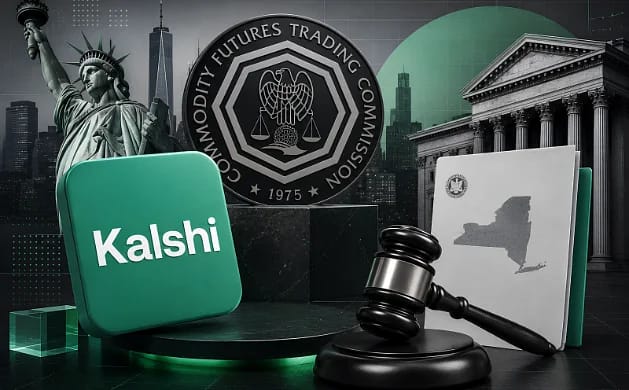
GM. The CFTC invoked emergency authority ordering Kalshi to keep operating prediction markets in New York, escalating a jurisdictional clash after the state sued to shutter the platform.
Elsewhere, Harmony confirmed an exploit that minted 4 billion ONE tokens, a Plan B Network director said BIP-110's failure showed Bitcoin is unreproducible, and a Trezor shipping partner leaked customer data.
Read the full issue below. 👇
CFTC Orders Kalshi to Keep Operating in New York
The Commodity Futures Trading Commission used emergency authority to require Kalshi to continue offering prediction markets in New York, acting after the company sought help against Attorney General Letitia James. The state sued at the end of July seeking to shutter the platform.
Chairman Mike Selig said Congress never intended derivatives exchanges to face a patchwork of state gaming laws, arguing these venues match bids and offers across state lines and clear through a national clearinghouse. New York, he added, has no business regulating interstate financial markets.
The state alleged Kalshi violated gambling statutes by offering sports contracts without a Gaming Commission licence, sidestepping taxes that fund schools and problem gambling treatment. Kalshi moved to shift the case to federal court, with New York pushing back and rulings pending.
The venue meanwhile began distributing real-time order book data through DoubleZero Edge, covering sports contracts and crypto perpetual futures. Institutional head Andy Ross said participating firms increasingly mirror top-tier names in traditional markets seeking equivalent infrastructure.
Harmony Confirms Exploit Minting 4 Billion ONE Tokens
Layer 1 blockchain Harmony confirmed it had been exploited after an X user reported an attacker minting 4 billion ONE tokens using empty blocks. The token slid 34% within a day to around $0.0008, valuing the haul near $3.2 million.
Roughly 97% of the minted supply had already reached exchanges or sat in deposit wallets ready to sell, according to the researcher. Harmony said it is working with exchanges to freeze funds while developing a patch and weighing rollback options for the affected network.
BIP-110 Failure Shows Bitcoin Is Unreproducible, Zucco Says
Plan B Network director Giacomo Zucco called the failed fork educational, arguing the conditions surrounding Bitcoin's early development would be almost impossible to replicate. Luke Dashjr's attempt to randomly select a new proof-of-work algorithm collapsed when participants generated testnet blocks to interfere.
That forced Dashjr to restart the process from Discord, which Zucco described as the highest imaginable level of centralization. He called the proposal a moral panic while criticizing Dashjr's removal as BIP editor as retribution likely to fuel capture theories.
Trezor Customer Data Exposed in Shipping Partner Breach
A breach at fulfillment provider ShipMonk exposed personal data belonging to 13,689 Trezor customers, with full names, phone numbers, emails, and shipping addresses taken for 11,742 of them. Those affected ordered between May 10 and August 8 across seven countries.
Trezor said its own systems went untouched and no device, private key, or backup was compromised, crediting a policy requiring partners to anonymize order data after 90 days. The firm is accelerating an anonymous delivery option using locker pickup and neutral packaging, as buyers reweigh Ledger against Trezor.
Data of the Day
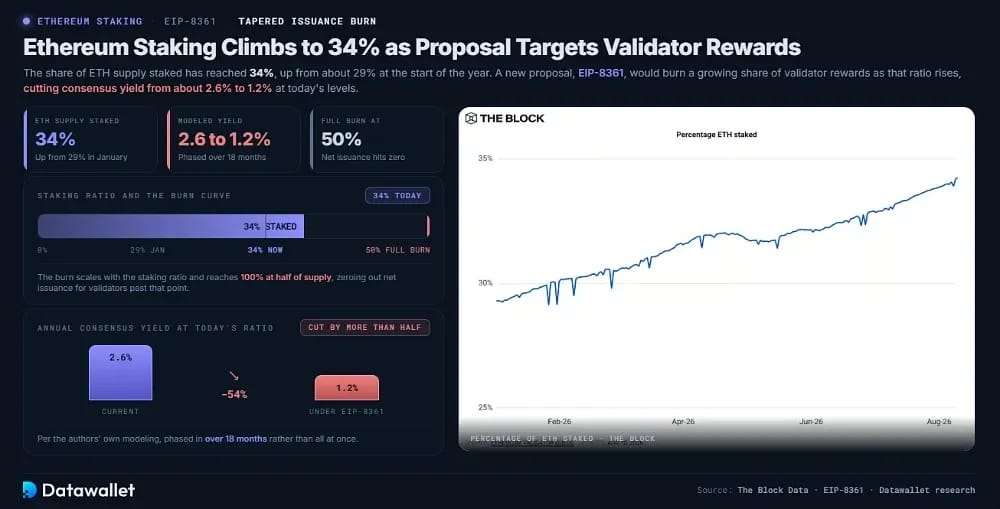
The share of ETH supply staked has climbed to 34%, up from roughly 29% at the start of the year. Researchers including the Ethereum Foundation's Justin Drake filed EIP-8361, a tapered issuance burn destroying a growing share of validator rewards as that ratio rises.
Modeling puts annual consensus yield falling from about 2.6% to 1.2%, phased over 18 months. ETH treasury companies like Bitmine and Sharplink face halved staking revenue, narrowing the structural case that differentiates them from bitcoin counterparts.
More Breaking News
- Trump was sued over Truth Social's paid early-access feed, which delivers his posts to trading firms for up to $100,000 monthly as the company weighs licensing data to prediction markets.
- The Bank of England is testing whether a digital pound can share a cross-border payment flow with stablecoins, letting exporters draw an advance before UK importers settle.
- Figure more than doubled quarterly revenue to $226 million as blockchain loan marketplace volume jumped 132% to $4.3 billion, lifting net income nearly threefold to $87 million.
- Robinhood Chain hit 11.6 million daily transactions with total value locked up 32%, though USDe now makes up 43% of its stablecoin float while active accounts stagnate.
- Hawaii will ban cash deposits at crypto ATMs from October, after investigations found more than 93% of transactions at examined kiosks were scams targeting older adults.
- Bullish shares surged 14% despite a $280 million net loss, as record subscription revenue of $62.7 million offset a $244.6 million markdown on its bitcoin holdings.
- Metaplanet's CEO shut down sale speculation after moving 5,014 BTC worth $322 million between custodial addresses, insisting the Asian Bitcoin treasury leader still holds 43,000 coins.
For the latest updates on digital asset markets, follow us on X @Datawalletcom.
Get tomorrow’s issue in your inbox