


Login to Track Your Live Crypto Portfolio
Sign Up and Track Your Live Crypto Portfolio for Free
Forgot your password?
Crypto Clarity Act Heads to Senate Without Enough Support

This article has been reviewed and verified for accuracy by our editorial team. All claims, data points and platform details are cross-referenced against primary sources.
Some links on this page are affiliate links. Datawallet may earn a commission when you sign up through them, at no extra cost to you. This never influences our editorial ratings, rankings or recommendations.
Some links on this page are affiliate links. Datawallet may earn a commission when you sign up through them, at no extra cost to you. Ratings and rankings reflect our own testing and assessment criteria.

GM. The Clarity Act heads into its opening Senate vote without the support it needs, after Republicans declared a final offer and Democrats answered with what negotiators called an unchanged position.
Elsewhere, Balancer proposed winding down and distributing its treasury, Ethereum and Base abandoned efforts to align account abstraction, and CoinEx is shutting after nine years.
Read the full issue below. 👇
Crypto Clarity Act Heads to Senate Without Enough Support
The Senate has not locked down enough support for the Digital Asset Market Clarity Act as its opening vote approaches, with both parties airing frustration. Republicans released a version over the weekend and declared it their final offer.
Senator Cynthia Lummis said the Democratic counter offer looked identical to their opening position, complaining they had not budged an inch while Republicans moved substantially. Senator Elizabeth Warren countered that the Clarity Act was negotiated between Republicans and the White House rather than across the aisle.
TD Cowen's Jaret Seiberg put failure odds at 60%, a scenario where crypto-friendly Democrats judge the changes insufficient and several Republicans defect over stablecoin yield. Banks confirmed the final text had not resolved their worry that rewards programmes threaten interest-bearing deposits.
Industry groups urged senators to vote yes purely to keep debate alive, since cloture opens amendments rather than settling passage. Should the vote fail, the saga likely ends this session, with Democrats favoured to retake the House and set future agendas.
Balancer Proposes Winding Down and Distributing Treasury
Balancer proposed an orderly wind-down of the protocol, ending business development and closing the DAO while distributing at least $9 million in treasury assets pro rata to holders who burn BAL. Treasury council member Marcus Hardt posted the governance proposal.
Pools would move to withdrawals-only on October 30, with the first redemption window opening at the end of May 2027 for six months. Balancer tried, Hardt wrote, noting April's profitability plan cut costs and ended emissions yet never converted into sustained revenue for the DeFi protocol.
Ethereum and Base Abandon Account Abstraction Alignment
Ethereum and Base developers stopped collaborating on aligning EIP-8141 and EIP-8130, pursuing separate standards after priorities diverged. Ethereum emphasised censorship resistance, privacy, and security while Base optimised for scale, customisation, and compliance, Ethlabs developer Derek Chiang said.
Every technical solution identified required one side to compromise on core goals, leaving wallets to absorb the fragmentation. Both proposals let users pay fees without holding ether and sign with passkeys, and wallet developers may now support two native transaction formats.
CoinEx to Shut Down After Nine Years of Operation
CoinEx announced it is closing after nine years, halting new registrations from September 15 and ending most services by September 29. Withdrawals stay open until December 22, after which remaining USDT moves to independent custody charging 5% monthly.
Founder Haipo Yang said security and compliance risks had become increasingly difficult to contain, and he rejected a sale in favour of a clean ending. The Seychelles-based venue left the US in 2023 after settling with the New York attorney general.
Data of the Day
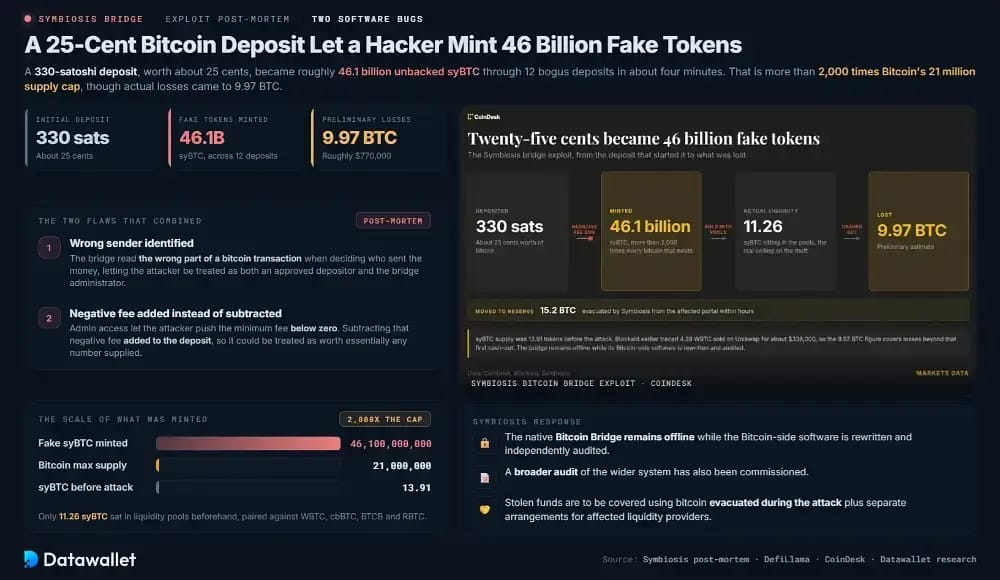
An attacker turned a 330-satoshi deposit worth 25 cents into roughly 46.1 billion unbacked syBTC across 12 bogus deposits in about four minutes, more than 2,000 times Bitcoin's 21 million supply cap.
Two flaws combined: one granted administrator privileges, another treated a negative fee as an addition. Symbiosis put losses at 9.97 BTC or $770,000, since minting tokens creates no redeemable assets, and took its bridge offline for a rewrite.
More Breaking News
- The ECB called on euro zone merchants to join a digital euro pilot starting in late 2027, driven by concern that dollar-backed stablecoins threaten monetary autonomy.
- Bitmine added 27,180 ether to reach 5.96 million tokens worth $15 billion, with adviser Tom DeMark forecasting a sharp advance and 85% of the ether treasury staked.
- Solana more than tripled its transaction size limit to 4,096 bytes, giving SOL developers room for zero-knowledge proofs and multi-signature operations in a single transaction.
- House lawmakers will mark up a bill exempting crypto fees of $10 or less from capital gains, alongside stablecoin basis rules and ordinary-income treatment for staking, as filers weigh low-tax jurisdictions.
- Kraken launched onchain yield vaults for tokenized Nvidia and index ETFs, lending xStocks through DeFi markets while excluding US and UK clients.
- Strategy repurchased 1.42 million STRC shares for $139.3 million, leaving its bitcoin treasury untouched at 845,050 coins for a second consecutive week.
- The DOJ is seeking forfeiture of $61 million in USDT allegedly tied to sanctioned Iranian oil sales, with Tether having frozen the tokens across ten Tron addresses.
- MetaMask added warnings for lookalike addresses and romance scams, as the MetaMask wallet begins automatically reverting transactions that differ from their onscreen previews.
For the latest updates on digital asset markets, follow us on X @Datawalletcom.
Get tomorrow’s issue in your inbox