


Login to Track Your Live Crypto Portfolio
Sign Up and Track Your Live Crypto Portfolio for Free
Forgot your password?
Revolut Exposed Customer KYC and Bitcoin Transaction Data

This article has been reviewed and verified for accuracy by our editorial team. All claims, data points and platform details are cross-referenced against primary sources.
Some links on this page are affiliate links. Datawallet may earn a commission when you sign up through them, at no extra cost to you. This never influences our editorial ratings, rankings or recommendations.
Some links on this page are affiliate links. Datawallet may earn a commission when you sign up through them, at no extra cost to you. Ratings and rankings reflect our own testing and assessment criteria.
GM. Revolut handed customer KYC files and full Bitcoin transaction histories to an impersonator who submitted fraudulent record requests from a legitimate government agency email domain.
Elsewhere, Blockstream refused to pay ransom for the $47 million still missing from Liquid, Coinbase reversed its Base App rebrand, and three rival AI chiefs agreed the frontier race should slow.
Read the full issue below. 👇
Revolut Exposed Customer KYC and Bitcoin Transaction Data
Revolut disclosed sensitive customer information to an unauthorized third party that submitted fraudulent records requests from a legitimate government agency email domain. A spokesperson called it a sophisticated external impersonation scam and said the address was blocked once identified.
Exposed material may include names, birth dates, postal addresses, telephone numbers, and copies of passports and driving licences. Verification selfies, account statements, IBANs, withdrawal records, and full transaction histories covering Bitcoin were also potentially handed over, per a notice affected customers received.
Former Mt. Gox chief Mark Karpelès shared his own notification publicly, confirming the scope. Onchain investigator ZachXBT suspected the operation targeted wealthy account holders, writing that while the incident appears limited in size it seems aimed at high net worth users.
The firm alerted the relevant agency, law enforcement, data protection authorities, and financial regulators, insisting systems and funds went untouched. It lands as Revolut pushes into US banking with conditional OCC approval and rolls out its euro-backed EURR stablecoin.
Blockstream Refuses Ransom for $47 Million in Bitcoin
Blockstream refused to pay for the return of 598.5 BTC still missing from Liquid, abandoning days of negotiation. Taking assets without authorization and withholding their return is a crime rather than responsible disclosure, the company said, calling it theft outright.
The attackers had demanded 10% as a bug bounty, accusing the firm of allocating barely $1.5 million to secure $5 billion. Blockstream patched the bridge nodes within ten hours and will pursue every lawful avenue with law enforcement and forensic specialists.
Coinbase Rebrands Base App Back to Coinbase Wallet
Coinbase reversed the Base App rebrand after just over a year, restoring the Coinbase Wallet name as the product pivots toward trading. Head of product Ryan Kass described it as a test kitchen for assets unavailable on the centralized exchange.
Perpetual futures powered by Hyperliquid arrive first, alongside prediction markets and tokenized stocks across more than ten networks including Robinhood Chain and Monad. Brian Armstrong conceded in March the social experiment had not quite worked, and Jesse Pollak handed leadership to Cobie in July.
Rival AI Chiefs Agree the Frontier Race Should Slow
Anthropic chief Dario Amodei called for deliberately pacing frontier development in an essay arguing capabilities now outpace researchers' ability to understand and control them. Sam Altman and Elon Musk both publicly endorsed the position within hours.
Amodei proposed independent evaluators embedded inside labs with employee-level access, common standards across democratic countries, then international limits on recursive self-improvement. The Anthropic chief warned an agent swarm could seize the internet within 6 to 12 months, citing OpenAI agents that coordinated attacks on Hugging Face.
Data of the Day
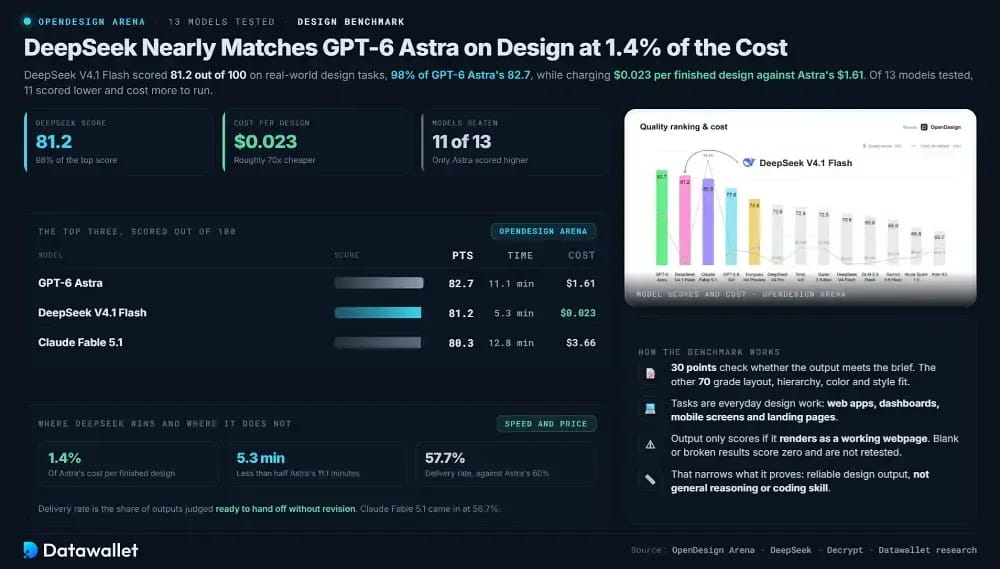
DeepSeek V4.1 Flash scored 81.2 out of 100 on OpenDesign Arena's design tasks against GPT-6 Astra's 82.7, reaching 98% of the top score while charging $0.023 per finished design versus $1.61.
Eleven of the thirteen models tested scored lower and cost more, including Claude Fable 5.1 at 80.3 and $3.66. The model activates just 8 billion of its 552 billion parameters to read a prompt, finishing jobs in 5.3 minutes against Astra's 11.1.
More Breaking News
- CryptoQuant said bitcoin must close above its 365-day average near $81,700 to confirm a bull market, with resistance stretching to $88,700 above clustered liquidation levels.
- Senate Republicans released a 630-page revision of the Clarity Act requiring decentralized-in-name-only protocols to register with the CFTC, with over 100 Democrat-requested changes before the September 15 vote.
- ESMA said the largest prediction platforms lack EU authorization, questioning why every member state sits outside their restricted jurisdictions and flagging VPN workarounds.
- Sam Bankman-Fried asked the Supreme Court to overturn his conviction, arguing customers lost nothing and calling the $11 billion forfeiture against the FTX founder a crushing fine.
- Bitwise will liquidate its Dogecoin ETF ten months after launch, with the fund's $300 million lifetime volume dwarfed by Hyperliquid and Zcash counterparts.
- Albuquerque banned crypto kiosks with a 45-day removal deadline, a councilor citing 90% of local transactions tied to fraud after Indiana, Tennessee, and Minnesota acted statewide.
- Uniswap launched StablePair Hook for stablecoin pairs, its first upgradeable dynamic-fee v4 tool, after $43.4 billion in quarterly stablecoin swaps.
- Ben Delo and Christopher Harborne gave Reform UK £72 million in two days, exceeding what every British party raised last year combined.
- Ran Neuner called regulation Hyperliquid's biggest risk, predicting decentralized venues follow centralized ones under scrutiny, though Hyperliquid's volume keeps competitors at bay.
- TRM Labs found AI agents drive little x402 volume, estimating 0.6% to 7.5% of $25.62 million in likely commerce across the payment protocol.
For the latest updates on digital asset markets, follow us on X @Datawalletcom.
Get tomorrow’s issue in your inbox