


Login to Track Your Live Crypto Portfolio
Sign Up and Track Your Live Crypto Portfolio for Free
Forgot your password?
Bitcoin BIP-110 Supporters Split Onto Minority Chain

This article has been reviewed and verified for accuracy by our editorial team. All claims, data points and platform details are cross-referenced against primary sources.
Some links on this page are affiliate links. Datawallet may earn a commission when you sign up through them, at no extra cost to you. This never influences our editorial ratings, rankings or recommendations.
Some links on this page are affiliate links. Datawallet may earn a commission when you sign up through them, at no extra cost to you. Ratings and rankings reflect our own testing and assessment criteria.

GM. Bitcoin's blockchain split into two branches as BIP-110 nodes began rejecting non-signaling blocks, though the minority chain has already fallen seven blocks behind the main network.
Elsewhere, the Senate pushed its Clarity Act vote to September, a BTCPay flaw drained merchant Lightning nodes, and Trump Media abandoned its CryptoCom treasury and prediction market ventures.
Read the full issue below. 👇
Bitcoin BIP-110 Supporters Split Onto Minority Chain
Bitcoin's blockchain split into two branches when nodes running BIP-110 began rejecting blocks that failed to signal support for the contentious anti-spam proposal. The rupture began at block 961,632, opening a two-week window demanding every new block signal.
AntPool mined the first block without that signal, which most of the network accepted while BIP-110 nodes refused it, later following an alternative block produced through Ocean. The main chain soon stood seven blocks ahead of the splinter branch.
Miner backing never approached the 55% threshold the proposal set. Just 51 blocks signaled support in the final period before the split, equal to 2.53%, leaving supporters separated from the network without the hashpower to keep pace.
The rules would restrict Ordinals inscriptions and cap OP_RETURN outputs at 83 bytes for roughly a year, though they lock in only if the branch reaches block 963,648. Michael Saylor opposed it, arguing Bitcoin needs guardians of neutrality rather than purity.
Senate Delays Clarity Act Vote Until After Recess
Senate Majority Leader John Thune confirmed the chamber is pushing back its procedural vote on the crypto market structure bill until September, saying Democrats remained insistent against voting. Lawmakers depart for a month-long recess and return to Washington mid-September.
The delay grants several more weeks to secure the 60 votes needed, with sources citing Democratic reluctance ahead of midterm elections. Ethics provisions covering Trump's holdings remain the central sticking point, alongside stablecoin rewards and illicit finance concerns dogging the Clarity Act.
BTCPay Flaw Drains Merchant Lightning Nodes
Attackers drained Lightning nodes running behind BTCPay Server after exploiting a critical flaw exposing the credentials protecting them. The project urged anyone running LND to update immediately to version 2.4.2 or take servers offline entirely.
The vulnerability let unauthenticated remote attackers grab macaroon files granting control over a node and its channels. Hardware maker Foundation had its node swept overnight, though standard onchain wallets generated inside BTCPay escaped untouched.
Trump Media Abandons Treasury and Prediction Ventures
Trump Media scrapped plans for a Crypto.com-backed CRO treasury company alongside a broader digital asset services agreement, with all parties citing prevailing market conditions and shifting stakeholder priorities. CRO slid sharply on the news toward a $2.4 billion market capitalization.
Interim CEO Kevin McGurn said the treasury company market grew crowded over the past year, making separation timely. Plans to embed prediction markets into Truth Social also died, replaced by a marketing deal promoting CryptoCom products to users.
Data of the Day
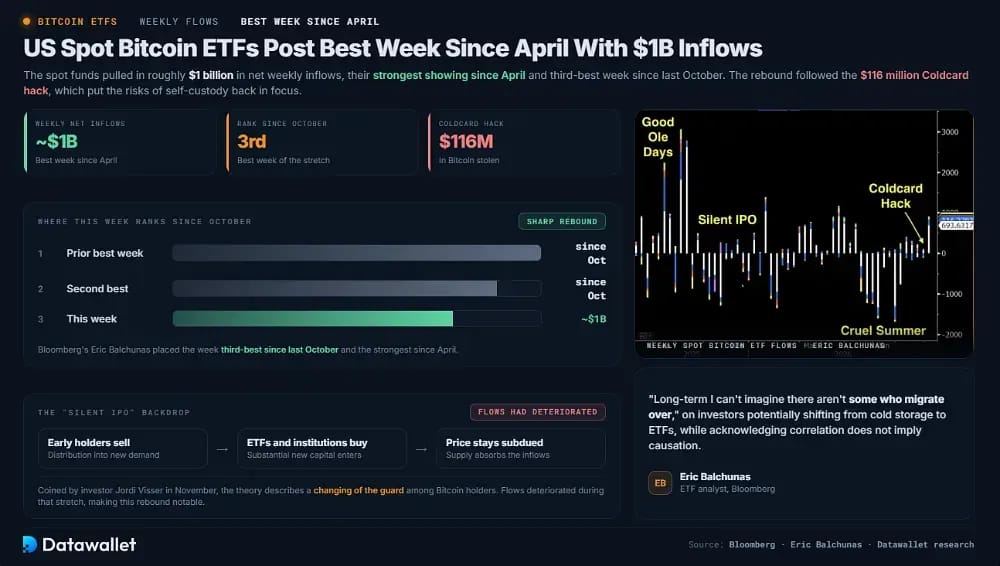
US spot bitcoin ETFs attracted roughly $1 billion in weekly inflows, their strongest showing since April and third-best week since October. Bloomberg's Eric Balchunas flagged the rebound as notable after months of uneven demand.
The surge followed the Coldcard exploit that drained about $116 million, prompting speculation that investors uneasy with self-custody responsibilities are migrating toward regulated products. Balchunas cautioned correlation is not causation while conceding some will likely shift.
More Breaking News
- Bybit sued North Korea and the Lazarus Group over last year's $1.5 billion heist, with the exchange securing a preliminary injunction freezing identified stolen assets.
- Brazil's central bank will impose a 24-hour hold on transfers to self-custody wallets above $10,000 from January 2027, giving local providers time to assess fraud risk.
- Japan's FSA asked exchanges to impose withdrawal delays and address pre-registration to curb scams, though the measures remain non-binding guidance for platforms to interpret.
- Hackers are using BNB Chain contracts to spread malware through fake CAPTCHA prompts, with Microsoft warning that blockchain-stored instructions resist conventional takedown efforts.
- Sui will add two post-quantum signature schemes approved by NIST, letting SUI holders adopt quantum-safe keys derived from recovery phrases they already hold.
- Circle launched native USDC on X Layer, extending the stablecoin and its cross-chain transfer protocol to the Ethereum rollup built by OKX.
- Hyperliquid's real-world asset perps boom is eroding revenue backing the token, as builder-deployed markets now capture half of platform volume while gross revenue fell 43%.
- Stripe-owned Bridge joined the EU register after Luxembourg approval, bringing authorized MiCA electronic money token issuers across the bloc to 42.
For the latest updates on digital asset markets, follow us on X @Datawalletcom.
Get tomorrow’s issue in your inbox