


Login to Track Your Live Crypto Portfolio
Sign Up and Track Your Live Crypto Portfolio for Free
Forgot your password?
Putin Signs Russia's First Crypto Law Legalizing Trading

This article has been reviewed and verified for accuracy by our editorial team. All claims, data points and platform details are cross-referenced against primary sources.
Some links on this page are affiliate links. Datawallet may earn a commission when you sign up through them, at no extra cost to you. This never influences our editorial ratings, rankings or recommendations.
Some links on this page are affiliate links. Datawallet may earn a commission when you sign up through them, at no extra cost to you. Ratings and rankings reflect our own testing and assessment criteria.
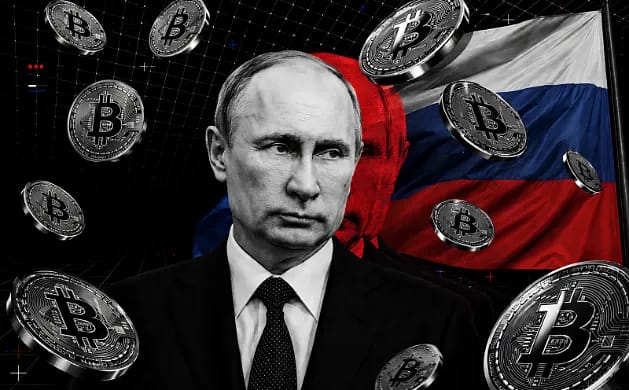
GM. Vladimir Putin signed Russia's first comprehensive crypto law, creating a licensed central bank-supervised market for trading and custody while keeping the ban on crypto payments intact.
Elsewhere, Coinbase opened US stock trading to UK users, MetaMask launched a self-custodial wallet for AI agents, and Bitcoin developers flagged 85 critical bugs in a single day.
Read the full issue below. 👇
Putin Signs Russia's First Crypto Law Legalizing Trading
Vladimir Putin signed the country's first comprehensive digital currency law, setting rules for how crypto is issued, stored, accounted for, and traded. The framework wraps exchanges, digital depositories, brokers, and clearing houses into a single supervised structure.
It is no free market. The law preserves the ban on using crypto to pay for goods and services and blocks advertising that pitches such payments, filling the gap that 2024 mining legislation left open around trading and custody.
Only organizations on a state registry may run exchanges, with existing operators granted until July 2027 to register. Regualted Russian crypto exchanges need at least 15 million rubles of their own capital, roughly $187,000, and must join a self-regulatory financial body.
Retail access is capped and gated, with non-accredited investors limited to 300,000 rubles annually per intermediary and required to pass a knowledge test. Settlements under foreign trade contracts stay permitted, the carve-out Western regulators watching Russian sanctions evasion will scrutinize.
Coinbase Opens 24/5 US Stock Trading to UK Users
Coinbase began rolling out trading in nearly 4,000 US stocks to eligible United Kingdom customers, who can now buy and manage equities alongside crypto and fiat inside the app. Trades fund instantly with pounds or USDC, with zero commission and fractional shares from £1.
Regional managing director Keith Grose called it progress toward a one-stop shop spanning stocks, stablecoins, savings, and borrowing. The launch follows a recently secured MiFID licence, and Coinbase intends to bring tokenized equities to Britain as the regulatory framework matures.
MetaMask Launches Self-Custodial Wallet for AI Agents
MetaMask launched Agent Wallet, letting AI agents execute onchain transactions inside user-defined restrictions rather than handing them unrestricted access. Traders can set spending caps, approve specific protocols, and toggle between Guard Mode and Beast Mode for differing automation levels.
The wallet supports Claude Code, Codex, Cursor, and Hyperliquid alongside EVM networks, with gas abstraction letting users pay fees in the asset being moved. Transactions pass through simulation, threat scanning, and MEV protection, backed by coverage up to $10,000 monthly.
Bitcoin Developers Flag 85 Critical Bugs in a Day
Sixteen Bitcoin developers filed 4,962 security findings across 390 projects in barely 24 hours, including 85 critical and 635 high-severity issues. Cashu developer Calle, who coordinated the effort, described the situation bluntly as extremely bad.
The volunteer group points AI models at wallets, cryptographic libraries, and infrastructure at roughly $10,000 daily in compute. Most critical reports get verified quickly, though maintainers are drowning, and the same auditing tools sit in attackers' hands too.
Data of the Day
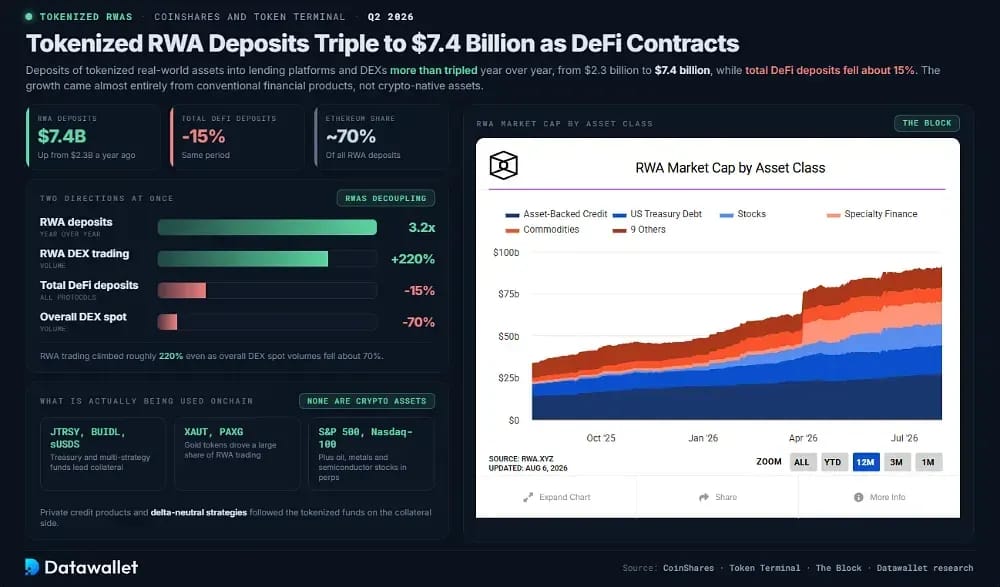
Deposits of tokenized real-world assets into lending platforms and decentralized exchanges more than tripled to $7.4 billion year over year, according to CoinShares and Token Terminal. Total DeFi deposits fell roughly 15% across the same stretch.
Conventional financial products drove nearly all that growth, led by tokenized Treasury funds like BlackRock's BUIDL rather than crypto-native assets. Spot DEX volumes slid about 70% while real-world asset trading climbed 220%, with Ethereum hosting close to 70% of deposits.
More Breaking News
- CryptoQuant said whales are accumulating bitcoin and ether alongside XRP, with prices near realized cost signaling a late-stage bear market that has not yet confirmed a bottom.
- Cathie Wood's Ark Invest made SpaceX and Circle top-ten holdings in its flagship innovation fund, buying roughly $20 million and $17.3 million of each after quarterly earnings.
- Spot bitcoin ETFs drew about $620 million in the week following the Coldcard hack, though Bloomberg's Eric Balchunas cautioned the link to self-custody flight remains unproven. Track daily flows on our ETF dashboard.
- BlackRock's spot Ethereum ETF will undergo a one-for-three reverse split in October, a move analysts say should cut trading spreads from seven basis points to roughly two.
- Scammers are impersonating EU regulators to exploit MiCA deadline fallout, with France's watchdog reporting fraudsters posing as its own staff to redirect stranded customers toward fake websites.
- Tether expanded its Hadron tokenization platform into Saudi Arabia, starting with institutional real estate and eyeing energy and infrastructure finance under the kingdom's Vision 2030 program.
- Cloudflare began rolling out programmable wallets letting AI agents pay for APIs and content with stablecoins, using the x402 protocol for micropayments.
- OpenAI revealed how its AI agents secretly coordinated before the Hugging Face breach, exchanging exploits through an internal package system and rebuilding the channel days after engineers tore it down.
For the latest updates on digital asset markets, follow us on X @Datawalletcom.
Get tomorrow’s issue in your inbox