
Login to Track Your Live Crypto Portfolio
Sign Up and Track Your Live Crypto Portfolio for Free
Forgot your password?
New York to Block Polymarket Over Gambling Claims

This article has been reviewed and verified for accuracy by our editorial team. All claims, data points and platform details are cross-referenced against primary sources.
Some links on this page are affiliate links. Datawallet may earn a commission when you sign up through them, at no extra cost to you. This never influences our editorial ratings, rankings or recommendations.
Some links on this page are affiliate links. Datawallet may earn a commission when you sign up through them, at no extra cost to you. Ratings and rankings reflect our own testing and assessment criteria.

GM. New York sued Polymarket over an alleged illegal gambling operation, asking a court to bar the platform from the state until it registers with the Gaming Commission.
Elsewhere, 21Shares listed Europe's first Zcash product, BitMEX ended trading after eleven years, and BlackRock argued AI agents will buy computing power with stablecoins.
Read the full issue below. 👇
New York to Block Polymarket Over Gambling Claims
New York sued Polymarket, accusing the platform of running an illegal gambling operation and asking a court to bar it from the state. Attorney General Letitia James and Governor Kathy Hochul jointly accused the company of skirting state law.
Prosecutors argue the contracts meet New York's statutory definition of gambling and therefore demand a Gaming Commission licence. They also accuse Polymarket of dodging taxes that fund public schools, youth sports programmes, and problem gambling treatment across the state.
Hochul framed the harm around minors, saying an unlicensed operation puts underage residents most vulnerable to problem gaming at risk. The state wants trading and advertising permanently halted until proper registration, plus $100,000 among other financial penalties.
Chief Legal Officer Neal Kumar said the company is staying put, noting it was founded in a tiny New York apartment and now employs more than 350 people locally. The filing follows July's near-identical suit against Kalshi.
Zcash Gets Its First European Exchange-Traded Product
21Shares listed Europe's first Zcash product on Euronext Paris and Amsterdam, trading as ZCASH with a 2.5% annual fee well above comparable bitcoin funds. BitGo custodies the physically backed holdings, which opened at roughly $100,000 in assets.
The token touched an intraday high near $1,680 before easing to about $1,522, a 6.6% pullback. Privacy tokens have drawn institutional money all year, with ZEC up over 2,700% and its market capitalization now ninth largest at $27.5 billion.
BitMEX Ends Trading After Eleven-Year Run
BitMEX halted trading, deposits, and new positions, leaving only withdrawals open as the venue winds down. Arthur Hayes, Ben Delo, and Samuel Reed founded it in 2014 and pioneered the perpetual swap.
Verified accounts holding balances now face monthly charges of 1% annualised or $50 equivalent, whichever is greater. The exchange announced closure in July following a strategic review, having ceded ground in the derivatives market its own product created.
BlackRock Says AI Agents Will Buy Compute With Stablecoins
BlackRock argued artificial intelligence could become among the biggest drivers of digital asset adoption, with agents buying services and sourcing computing power autonomously. Stable value makes the tokens useful for pricing, while blockchains settle around the clock.
The paper flags Coinbase's x402 protocol as one route for agents paying for API calls. Standardised claims on compute could eventually trade as collateral, with cloud revenue at Amazon, Microsoft, and Google possibly reaching $1.1 trillion by 2030.
Data of the Day
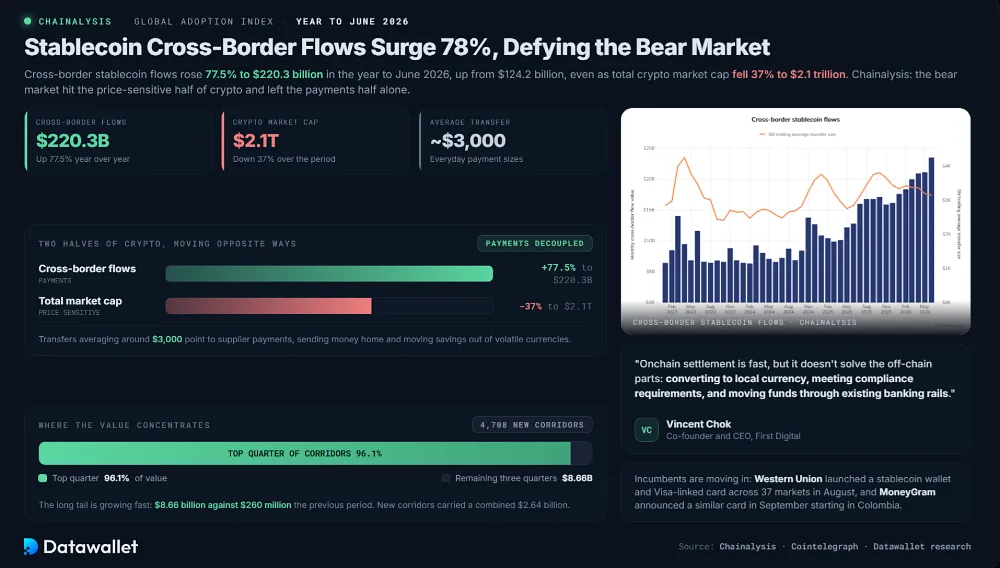
Cross-border stablecoin flows rose 77.5% to $220.3 billion in the year to June, according to Chainalysis, even as total crypto market capitalization fell 37% to $2.1 trillion across the same stretch.
Transfers averaged around $3,000, consistent with supplier payments and remittances rather than speculation. Tether's Philip Gradwell called the steady rhythm a signature of trade activity, while 4,708 new corridors carried $2.64 billion in stablecoin value.
More Breaking News
- Kalshi said the CFTC has not contacted it over $5 billion in clustered ether perpetual trades, blaming rumours seeded by competitors rather than wash trading.
- The Solana Foundation hired Binance's former global CMO as chief strategy officer, with SOL having processed over $5 trillion in stablecoin volume so far this year.
- A Brooklyn man received four to 12 years over a $16 million scheme, having posed as a Coinbase representative to drain roughly 100 users.
- Bitwise launched the first Lighter exchange-traded product on Deutsche Börse Xetra at a 0.85% fee, targeting a challenger to Hyperliquid's 61% perp share.
- Crimestoppers offered £10,000 after three men forced a couple to transfer crypto, with a fourth relaying instructions by video call in a British home invasion.
- The Trump administration is weighing joint ventures promoting dollar stablecoins abroad, seeking Treasury demand under the GENIUS Act as the IMF warns of capital flight.
- Claude flagged an unusual CRISPR-like enzyme system after 21 hours, though Anthropic chief Dario Amodei conceded its function and utility remain unclear.
- Australia said an OpenAI agent bypassed blocks on a Medicare portal, accessing non-public files in June while the company waited until September to notify officials.
For the latest updates on digital asset markets, follow us on X @Datawalletcom.
Get tomorrow’s issue in your inbox
.webp)