


Login to Track Your Live Crypto Portfolio
Sign Up and Track Your Live Crypto Portfolio for Free
Forgot your password?
Ethereum Delays Glamsterdam Test Over Gas Risk to Contracts

This article has been reviewed and verified for accuracy by our editorial team. All claims, data points and platform details are cross-referenced against primary sources.
Some links on this page are affiliate links. Datawallet may earn a commission when you sign up through them, at no extra cost to you. This never influences our editorial ratings, rankings or recommendations.
Some links on this page are affiliate links. Datawallet may earn a commission when you sign up through them, at no extra cost to you. Ratings and rankings reflect our own testing and assessment criteria.

GM. Ethereum developers postponed Glamsterdam's Hoodi testnet activation after ChainSecurity showed proposed gas rules could let existing smart contracts permanently record failed operations.
Elsewhere, an Argentine judge cleared President Javier Milei in the LIBRA case, Keystone disclosed a breach exposing customer shipping data, and a16z renamed its crypto fund a16z Frontier.
Settle in with a coffee and read on below. 👇
Ethereum Delays Glamsterdam Test Over Gas Risk to Contracts
Ethereum developers called off the Glamsterdam upgrade on the Hoodi test network, set for October 26 at 17:42:48 UTC, after security researchers flagged how proposed gas changes could alter existing smart contracts. The postponement came during the All Core Devs Execution call, and no replacement date has been announced.
The concern centers on EIP-8037, which changes how Ethereum charges for creating new database records to curb state growth as throughput rises. ChainSecurity's October 13 analysis found that, combined with EIP-8038, it could leave contracts with more or less gas than expected when a called contract runs dry.
Because gas spent creating records can be restored when changes are undone, a contract might finish a failure-handling step that once reversed, making errors permanent. Conversely, creating a new storage slot could cost 110,020 gas instead of 22,100, causing otherwise valid operations to fail on fixed budgets.
ChainSecurity demonstrated the mechanisms but has not shown that any major production protocol is exploitable. Glamsterdam, which activated on Sepolia on October 6 and adds new builder selection plus support for larger blocks, now has its Hoodi rehearsal and 200 million gas limit increase on hold, with mainnet still unscheduled.
Judge Clears Milei Over LIBRA Token That Crashed 95%
Argentine federal judge Marcelo Martínez de Giorgi dismissed the criminal case against President Javier Milei over his LIBRA promotion, clearing him, his sister Karina and nine others including Hayden Davis. His 60-page ruling found no criminally relevant deception, following prosecutor Eduardo Taiano's request to drop the case.
Milei posted about the meme coin in February 2025 before its market cap topped $4.5 billion and then crashed about 95%, with eight team-linked wallets cashing out $107 million. Opposition deputy Maximiliano Ferraro called the ruling a cover-up, while investors seek reinstatement as plaintiffs to appeal.
Keystone Users Say Breach Exposed Data Past 180-Day Pledge
Hardware wallet maker Keystone said a third party obtained customer names, contact details, shipping addresses and order details from its Shopify-powered store after detecting unauthorized access on October 20. Payment cards, recovery phrases and private keys were not exposed, and the company has not disclosed how many customers were affected.
Keystone long marketed deleting shipping data 180 days after each order, yet several customers say information from purchases over two years old was exposed. Its breach follows leaks at Trezor partner ShipMonk and SafePal, plus the CryptoBilis implants tied to more than $86 million in losses.
a16z Crypto Becomes a16z Frontier, Adding AI Bets
Andreessen Horowitz renamed a16z Crypto to a16z Frontier, widening its mandate to AI, autonomous machines and biology while continuing to invest in crypto and push for sensible regulation. General partner Chris Dixon will lead it with Marc Andreessen, Ben Horowitz, Eddy Lazzarin and Guy Wuollet.
Dixon argues blockchains have faded into the background of Wall Street and fintech products, so companies should be defined by what they do rather than the technology they use. He still sees crypto enabling machine-to-machine payments between AI agents, while the firm's backing spans Coinbase, Solana and Uniswap.
Data of the Day
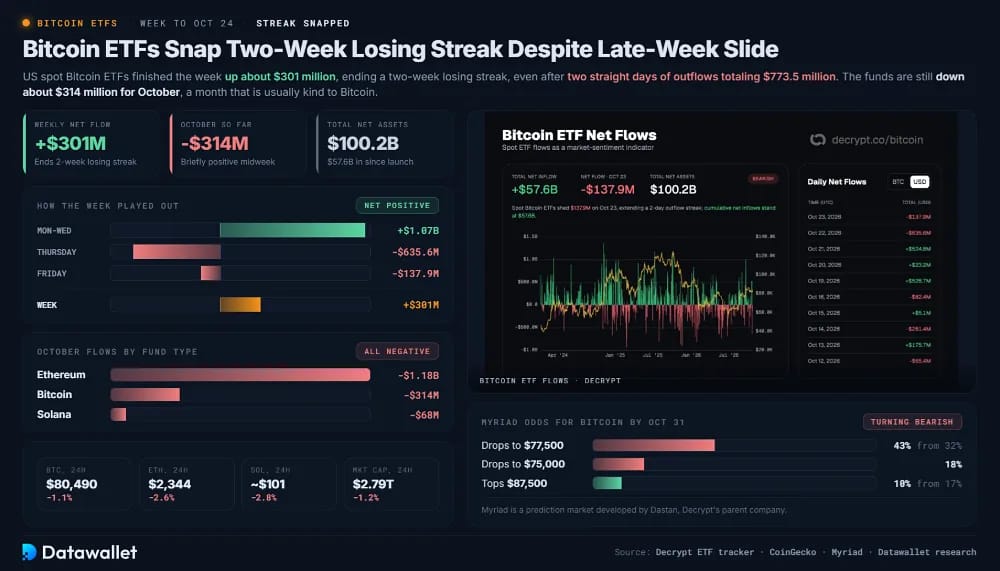
US spot bitcoin ETFs ended the week up $301 million, snapping a two-week losing streak despite a two-day $773.5 million slide that ate into a $1.07 billion inflow run. Thursday's $635.6 million exit, October's largest, left the funds about $314 million down for the month.
Ethereum ETFs lost about $221 million on the week and roughly $1.18 billion for October, while Solana funds are down about $68 million. Bitcoin slipped 1.1% over 24 hours to around $80,490, and Myriad traders now give it a 43% chance of dropping to $77,500 before month-end.
More Breaking News
- HSBC launched its first stablecoin, RedCoin, a Hong Kong dollar token rolling out to over 3.3 million PayMe users, who can pay at more than 100,000 merchants.
- Bybit won a full Dubai license for spot trading from VARA after earlier in-principle approval, though it must still meet launch requirements before serving Dubai customers.
- Six more companies objected to OKXICE, including Wells Fargo, Cisco and Intuit, lifting the total to 22 issuers opposing tokenized stock trading of their shares on the venue.
- Netanyahu called blockchain a sanctions alternative, floating crypto to shield Israel's economy ahead of October 27 elections, while the Bank of Israel said crypto cannot bypass sanctions.
- Consumers filed over 10,000 complaints about crypto transfer curbs at UK banks in 90 days, Stand With Crypto said, led by Lloyds with 2,297, then Barclays and NatWest.
- The IRS plans lower disclosure penalties, including for crypto, aiming to launch a revamp before December that resolves cases within 120 days and allows installment plans.
- Interpol recovered over $105 million in an African cybercrime sweep across 21 countries that made 1,462 arrests and shut two illegal Angolan crypto mines with over 2,000 devices.
- Malaysia and Thailand joined Singapore's BLOOM initiative as policymaker members, backing cross-border payments with stablecoins and tokenized deposits alongside participants such as Mastercard, Ripple and Visa.
For the latest updates on digital asset markets, follow us on X @Datawalletcom.
Get tomorrow’s issue in your inbox