


Login to Track Your Live Crypto Portfolio
Sign Up and Track Your Live Crypto Portfolio for Free
Forgot your password?
Meta Tests Prediction App as 11 States Sue Rivals

This article has been reviewed and verified for accuracy by our editorial team. All claims, data points and platform details are cross-referenced against primary sources.
Some links on this page are affiliate links. Datawallet may earn a commission when you sign up through them, at no extra cost to you. This never influences our editorial ratings, rankings or recommendations.
Some links on this page are affiliate links. Datawallet may earn a commission when you sign up through them, at no extra cost to you. Ratings and rankings reflect our own testing and assessment criteria.

GM. Meta began testing Takes, a prediction market app where employees wager cred points instead of cash, as Louisiana became the 11th state to sue real-money rivals.
Elsewhere, OpenAI launched a ChatGPT wallet with Visa, Mastercard and Amex, Kava Lend lost $3.8 million to a hack, and Trump named four SEC and CFTC nominees.
Get comfortable, the full rundown is waiting right below. 👇
Meta Tests Prediction App as 11 States Sue Rivals
Meta began testing a prediction market app with employees, letting users wager cred points rather than cash on the outcome of events, The Wall Street Journal reported. Called Takes, the app rewards correct calls with more cred and docks points for misses, mirroring its money-based rivals.
The trial follows June reports that CEO Mark Zuckerberg ordered staff to build a standalone points-based prediction market app, then called Arena, without ruling out real-money betting. The Journal did not say whether cash contracts remain on the table, and Meta declined to offer a launch timetable.
Meta enters a fight that has engulfed Kalshi and Polymarket, with Louisiana becoming the 11th state to sue prediction markets and a judge ordering 31 affiliated entities to geofence the state. The CFTC answered by suing Louisiana, its 12th such case, arguing federal law preempts state gambling rules.
CFTC Chair Michael Selig attacked states for pursuing criminal charges against prediction market executives, saying the clash belongs before the Supreme Court. Whether a contract counts as gambling or a derivative is a genuine dispute, he argued, and settling it should never carry the risk of jail.
OpenAI Debuts ChatGPT Wallet for Agentic Commerce
OpenAI introduced a ChatGPT wallet that lets AI agents buy goods on users' behalf through American Express, Mastercard and Visa, with each purchase approved by face or fingerprint. Card networks generate tokenized credentials for every transaction, so merchants and agents never see the actual card details.
The service is rolling out to US ChatGPT Pro subscribers, with preset spending limits planned to remove per-purchase approvals later. Crypto rivals chase the same prize through Coinbase's x402 protocol and Circle's Agent Stack, as Juniper Research sees agentic commerce reaching $1.5 trillion by 2030.
Kava Lend Hacked for $3.8 Million, KAVA Drops 39%
An attacker drained about 55.2 million KAVA from Kava Lend, worth roughly $3.76 million, after inflating deposits in a dormant BUSD market and borrowing against them. A rounding flaw multiplied BUSD deposits about 243,000-fold, turning the attacker's stake into roughly 1.25 billion BUSD of phantom collateral.
The attacker borrowed KAVA 127 times, then bridged about 49.2 million tokens to BNB Chain through LayerZero and sold them for roughly $2.09 million. KAVA slid about 39% to $0.042, while Kava paused its Axelar bridge and insisted the incident was not an infinite mint.
Trump Names Four Nominees to Fill SEC, CFTC Seats
President Trump named four nominees to the SEC and CFTC, his first picks for either agency since 2025, recommending former CFTC Commissioner Kristin Johnson and attorney Steven Levine for the SEC. Nathan Anonick and Matthew Rowland were tapped for the CFTC, where Chairman Mike Selig sits as the sole commissioner.
The slate appears bipartisan, a break from Trump's push to remove Democrats, as Johnson is a Democrat who served at the CFTC until last year. The Senate Agriculture and Banking committees must approve the nominees before full Senate votes, with Congress now in its lame duck session.
Data of the Day
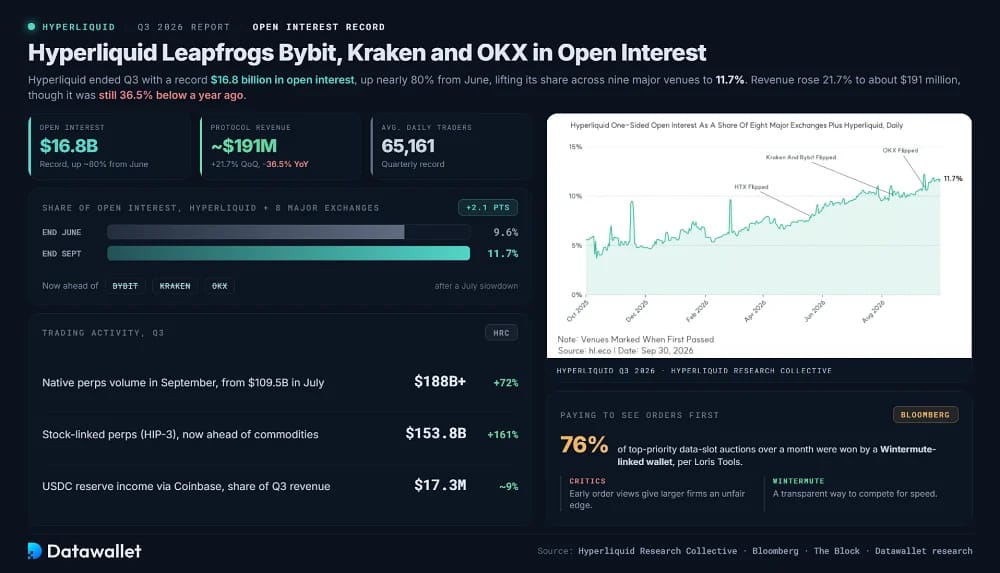
Hyperliquid closed the third quarter with record open interest of $16.8 billion, up nearly 80% from June, overtaking centralized rivals Bybit, Kraken and OKX. Its share of open interest across itself and eight major exchanges rose to 11.7% from 9.6%, as daily traders hit a record 65,161.
Protocol revenue climbed 21.7% quarter over quarter to nearly $191 million, including $17.3 million from a USDC reserve arrangement with Coinbase, though it stayed 36.5% below last year. Stock-linked perpetuals volume jumped 161% to $153.8 billion, overtaking commodities on HIP-3, which lets third parties launch perps.
More Breaking News
- MEGA cut 20% of its workforce in a restructuring days after rebranding from the MegaETH Foundation and committing $30 million to AI inference, sparing founders and core engineers.
- Spot bitcoin ETFs bled $2.1 billion in November across a seven-day outflow streak, cutting total net assets to $94.9 billion as bitcoin sank near $64,500.
- Three central banks completed a trial linking traditional and tokenized FX settlement, testing Partior's prototype as the Bank of England readies a live interface for 2028.
- Kazakhstan plans tokenized government bonds in the first quarter of 2027 after selling 10 billion tenge, about $22.3 million, of tokenized central bank notes using Solana.
- Twenty One Capital posted $1.09 billion in third-quarter net income, almost entirely from gains on its 43,514 BTC treasury, as its CEO pledged to build operating businesses.
- Thailand's SEC proposed a daily cap of 5 million baht, about $147,750, on stablecoin transfers, limiting moves to wallets owned by the same person to curb laundering.
- The DOJ won approval to seize over $1.2 billion from the $6.3 billion Binance hack and dismantled servers behind North Korea's $400 million FaceStealer deepfake scheme.
- Louisiana's attorney general called Michael Selig an obsequious standard bearer for prediction markets after the CFTC sued the state to block an order freezing Kalshi and Polymarket there.
For the latest updates on digital asset markets, follow us on X @Datawalletcom.
Get tomorrow’s issue in your inbox