


Login to Track Your Live Crypto Portfolio
Sign Up and Track Your Live Crypto Portfolio for Free
Forgot your password?
Polymarket Launches Crypto Perpetual Futures Trading

This article has been reviewed and verified for accuracy by our editorial team. All claims, data points and platform details are cross-referenced against primary sources.
Some links on this page are affiliate links. Datawallet may earn a commission when you sign up through them, at no extra cost to you. This never influences our editorial ratings, rankings or recommendations.
Some links on this page are affiliate links. Datawallet may earn a commission when you sign up through them, at no extra cost to you. Ratings and rankings reflect our own testing and assessment criteria.
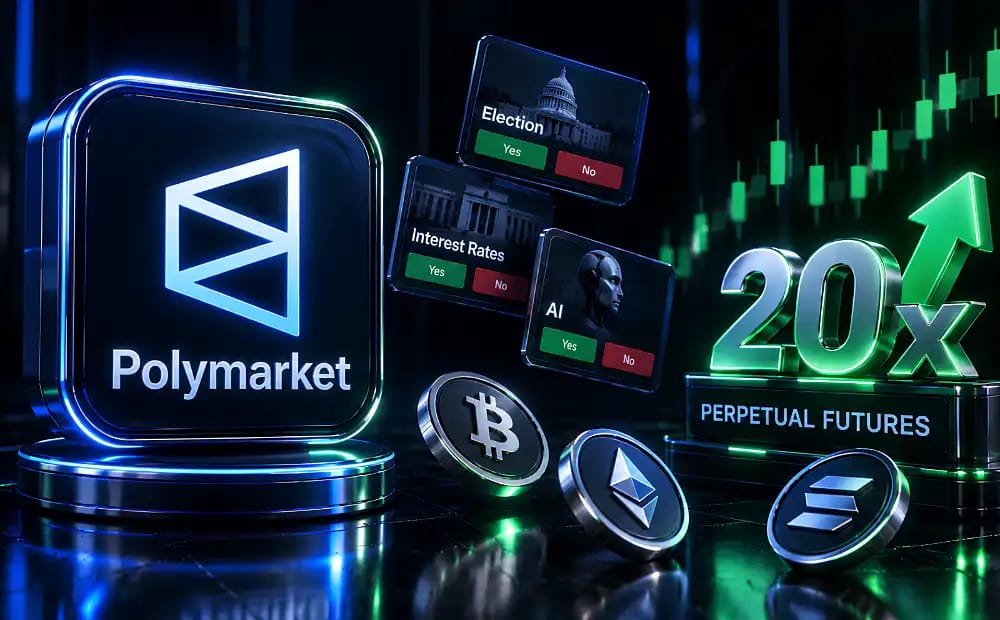
GM. Polymarket launched crypto perpetual futures, opening 24-hour leveraged trading on Bitcoin, ether, and solana to eligible users as the prediction market widens beyond event contracts.
Elsewhere, Zcash topped $1,200 as ETF inflows accelerated, the IMF confirmed El Salvador's Bitcoin growth came from private donations, and Trezor said another 67,000 customers were exposed.
Read the full issue below. 👇
Polymarket Launches Crypto Perpetual Futures Trading
Polymarket rolled out perpetual futures on Bitcoin, ether, and solana, letting eligible users take leveraged positions around the clock without expiry dates. The launch marks its clearest step beyond the event contracts that built the platform.
The products arrive as prediction markets and derivatives venues converge on one another's territory, with rival Kalshi already listing Bitcoin perpetuals after winning approval earlier this year. Both now compete for traders who want event wagers and leveraged price exposure in a single account.
Perpetuals dominate crypto volume precisely because they never settle, letting positions run indefinitely while funding rates tether prices to spot. That structure has made them the most traded instrument in the asset class, dwarfing spot activity in the latest perpetual futures statistics.
The move lands as Polymarket pursues fresh capital at a $20 billion valuation with annualized revenue above $1 billion. Regulatory pressure continues mounting elsewhere, with more than 30 jurisdictions now restricting access to the platform.
ZEC Tops $1,200 as Zcash ETF Inflows Ramp Up
Zcash climbed above $1,200 for the first time, extending a rally powered by inflows into Grayscale's newly converted fund and a surge of miners pointing hashpower at the network. The privacy asset has roughly doubled across recent weeks.
Institutional demand for financial privacy is proving durable rather than speculative, with the vehicle drawing steady subscriptions since listing. Miners piling in tightens security while shrinking available supply, reinforcing the move as ZEC pushes deeper into the top twenty by market capitalization.
IMF Confirms El Salvador Bitcoin Growth Came From Donations
The International Monetary Fund confirmed that growth in El Salvador's holdings came from private donations rather than public spending, resolving a dispute that had shadowed the country's $1.4 billion lending programme with the fund.
Officials had questioned whether purchases breached commitments barring further state accumulation, since the stack kept expanding despite the pledge. The finding clears President Nayib Bukele of violating terms while leaving the national Bitcoin treasury intact.
Trezor Says Breach Affected Another 67,000 Customers
Trezor disclosed that a further 67,000 customers had personal data exposed through the ShipMonk fulfillment breach, sharply expanding an incident first reported as affecting fewer than 14,000 people last month.
Names, emails, phone numbers, and shipping addresses were taken, while devices, private keys, and recovery seeds remained untouched. The company warned buyers to expect impersonation attempts, joining SafePal and Ledger among hardware makers hit through third-party logistics partners.
Data of the Day
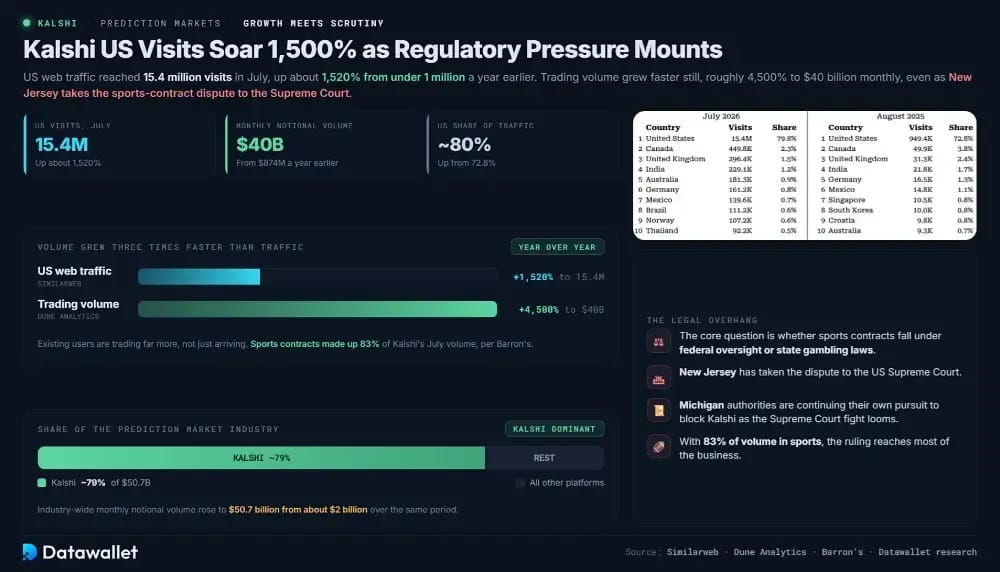
Kalshi’s US web traffic surged 1,520% in less than a year, reaching 15.4 million visits in July, according to Similarweb estimates. The jump highlights the prediction market’s rapid expansion, with US users accounting for nearly 80% of total traffic as regulatory challenges intensify.
Trading growth has been even stronger, with Kalshi’s notional volume climbing to about $40 billion in August from $874 million a year earlier. Sports contracts represented 83% of July volume, while courts and regulators continue examining whether contracts fall under federal oversight or state gambling laws.
More Breaking News
- LeBron James teased a Polymarket partnership in a social video, signaling a mainstream marketing push as rival platforms chase sports audiences.
- South Korea targets February 2027 for a full tokenized securities market, giving Korean investors a regulated route into onchain equities and bonds.
- Ripple struck a sponsorship deal with Florida athletics, putting XRP branding in front of college sports audiences as issuers court mainstream visibility.
- Analysts mapped how Hyperliquid could enter the US after Trump's remarks, with registration or a licensed affiliate the likeliest routes for a venue currently offshore to Americans.
- Traders are pairing memecoins against tokenized stocks on Robinhood Chain, an unusual structure now driving a meaningful share of equity-linked volume.
- A British investor recovered $4.5 million in Bitcoin he assumed lost since 2012, when the $2,000 stake sat forgotten on an old machine.
- OpenReserve won OCC approval for a full-service national bank, clearing it to hold deposits and lend rather than operate under the narrower trust charters the GENIUS Act created for stablecoin issuers.
- Coinbase asked the SEC to greenlight 24/7 equity perpetuals, a filing that would let Coinbase offer round-the-clock leveraged stock exposure onshore.
- Utah will require websites to detect VPN use during age verification, a mandate critics say pushes platforms toward deeper surveillance of ordinary visitors.
For the latest updates on digital asset markets, follow us on X @Datawalletcom.
Get tomorrow’s issue in your inbox