


Login to Track Your Live Crypto Portfolio
Sign Up and Track Your Live Crypto Portfolio for Free
Forgot your password?
Bitcoin Clears $81,000 With CPI Report Looming Large

This article has been reviewed and verified for accuracy by our editorial team. All claims, data points and platform details are cross-referenced against primary sources.
Some links on this page are affiliate links. Datawallet may earn a commission when you sign up through them, at no extra cost to you. This never influences our editorial ratings, rankings or recommendations.
Some links on this page are affiliate links. Datawallet may earn a commission when you sign up through them, at no extra cost to you. Ratings and rankings reflect our own testing and assessment criteria.

GM. Bitcoin climbed above $81,000 for the first time since May, clearing its 50-week moving average as September rate-hike odds tumbled below 50% on dovish Fed remarks.
Elsewhere, Coinbase launched regulated derivatives in Canada, World open-sourced its zero-knowledge identity toolkit, and a memecoin launchpad on Robinhood Chain outearned the network hosting it.
Read the full issue below. 👇
Bitcoin Clears $81,000 With CPI Report Looming Large
Bitcoin pushed above $81,000, its highest since mid-May, clearing a 50-week moving average at $81,041 that it last traded over in late 2025 before the slide from $126,000 toward $60,000.
Fed Governor Chris Waller supplied the catalyst, saying he would favor holding policy steady this month should August inflation data show continued progress toward the 2% goal. September rate-hike odds promptly fell to 48% from nearly 70% a day earlier.
Crypto equities rallied alongside, with Robinhood up 13%, Circle 12%, and Strategy nearly 10%, while semiconductor names slipped. A weakening dollar helped, the index dropping below 99 as the Japanese yen surged and eased pressure on risk assets.
Long-dated yields retreated, the ten-year easing to 4.75% from 4.82%. Attention now turns to next week's consumer price data, which Waller framed as decisive, leaving the world's most important central bank, and the bitcoin price, hostage to a single monthly print.
Coinbase Launches Regulated Crypto Derivatives in Canada
Coinbase began offering crypto derivatives to eligible Canadian traders, spanning 23 perpetual and dated futures tied to bitcoin, ether, and solana, plus five commodity contracts and its own index. The products run through a CFTC-registered futures commission merchant under dealer exemptions.
Access is restricted to customers holding at least $5 million in net financial assets or registered advisers, with nano-sized positions and leverage capped at 10x. The launch lands as rivals crowd in, with Canadian crypto ownership climbing to 25% from 10% in 2023.
World Open-Sources Zero-Knowledge Identity Proving Toolkit
World released ProveKit as open source after using it inside World ID since April, letting users generate cryptographic proofs directly on phones or browsers. The toolkit proves claims like age or nationality without exposing the underlying document data.
Local proof generation keeps sensitive information off external servers, completing proofs in seconds on typical handsets. Head of blockchain Remco Bloemen argued identity documents should only be authenticated this way, days after reports of 153 million licence scans selling on the dark web. See our guide to World and its identity network.
Memecoin Launchpad Outearns the Chain Hosting It
Pons generated nearly $6 million in fees over 24 hours, ranking fourth among all tracked protocols behind only Tether, Uniswap, and Circle. That topped Pump at $4.64 million and exceeded the roughly $4 million Robinhood Chain itself collected.
Almost 25,000 tokens launched through Pons in a single day as volume reached $544 million, with its token surging 300% weekly on protocol-funded buybacks. Roughly a fifth of the chain's lifetime fees arrived in that one session.
Data of the Day
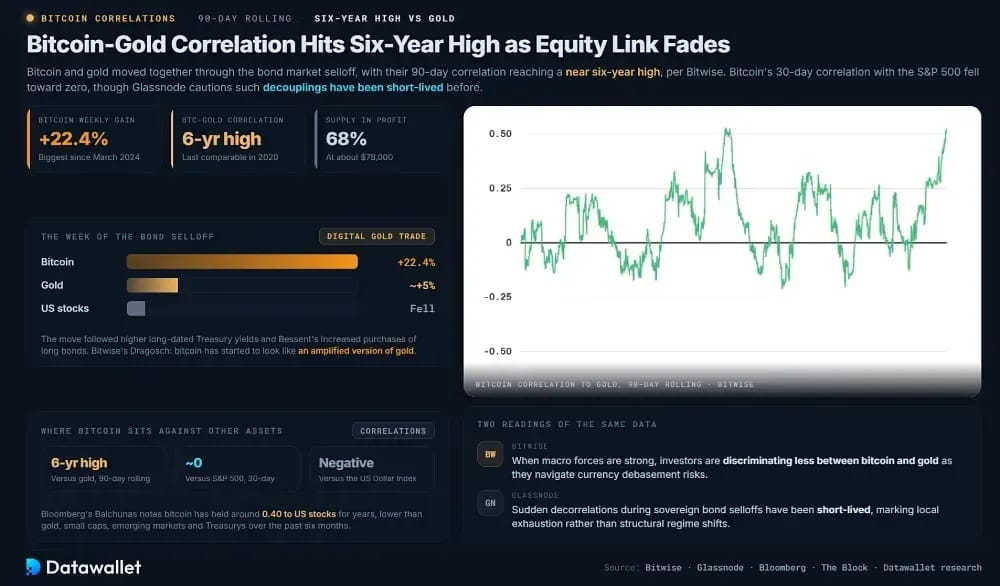
Bitcoin's 90-day correlation with gold reached a near six-year high during the latest bond selloff, according to Bitwise. The token gained 22.4% over the following week, its best since March 2024, while gold added 5% and stocks fell.
Bitwise's André Dragosch said investors discriminate less between the two when debasement risks rise, calling bitcoin an amplified version of bullion. Glassnode is warier of the equity decoupling, noting similar divergences during sovereign bond selloffs have historically proved short-lived rather than structural.
More Breaking News
- A Coldcard hacker began swapping stolen bitcoin for ether through THORChain, moving about 10% of third-wave proceeds in the first onchain movement from any original attacker address, routed through a cross-chain bridge.
- A Michigan court ordered Kalshi to keep blocking sports contracts, converting a June restraining order into an injunction that fines Kalshi $500,000 per day for violations.
- Australia's regulator warned firms to seek licences by September 30 or risk fines reaching 10% of turnover, with 45 businesses already applying across Australian markets.
- Arbitrum DAO reported $6.19 million in first-half income, with licensing fees from Robinhood Chain accounting for 35% of July revenue in its debut mainnet month.
- Strategy's CEO said selling bitcoin near $60,000 was the right trade, arguing cost of capital rather than price drove decisions before the bitcoin treasury bought back above $80,000.
- The CFTC moved to dismiss CME's lawsuit over crypto perpetual futures, calling it much ado about nothing since the exchange is free to list perps itself.
- Two Thai businessmen sued Tether over an alleged unlawful freeze of $42.4 million in USDT, claiming it acted on an informal request months before any warrant.
- Nvidia agreed to buy Hugging Face for $12.93 billion, gaining a platform hosting three million models and 18 million developers a month after its agent-driven security breach.
- OpenAI's Astra became its first model rated critical for hacking, scoring 100% on ExploitBench and chaining two unknown zero-days without a human guiding each step.
For the latest updates on digital asset markets, follow us on X @Datawalletcom.
Get tomorrow’s issue in your inbox