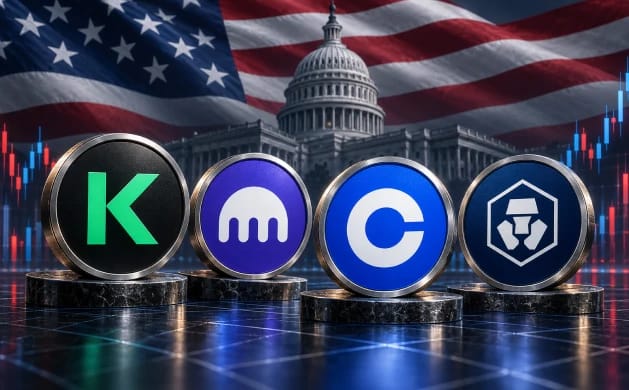

Compare the Best Regulated Perpetual Exchanges in the USA
1. Kalshi
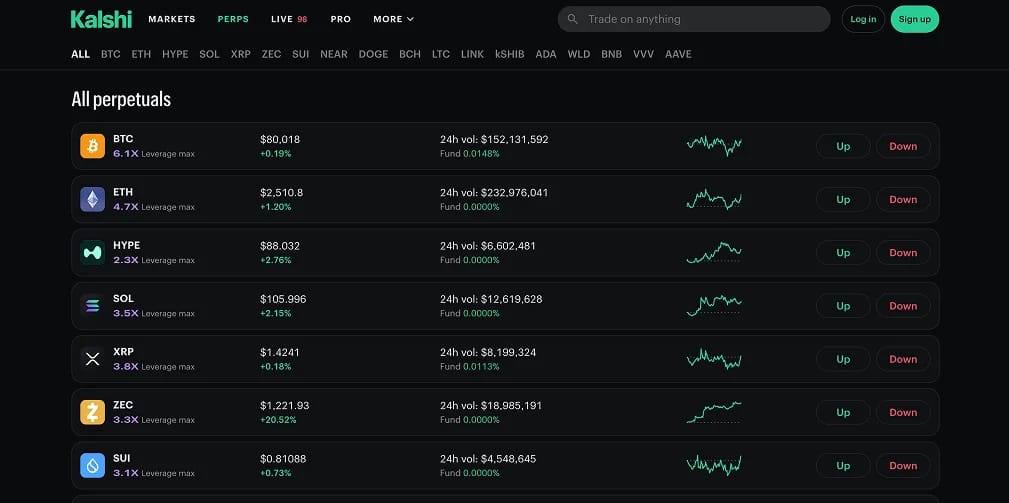
Kalshi ranks first because its perpetual is the only US contract cleared through a formal Commission review instead of self-certification or a staff letter. On May 29, 2026, the CFTC issued an Order for Approval for BTCPERP on the KalshiEX designated contract market under Regulation 40.3. Bitcoin trading began on June 3. Ether and XRP followed within a week, and 13 crypto assets are now approved, including Solana, Dogecoin, Chainlink, and Sui.
Leverage varies by asset. It reaches approximately 5.7x on Bitcoin but falls below 2x for the smallest names. Positions use isolated margin, which prevents a liquidation from consuming collateral assigned elsewhere. Funding settles every eight hours and is capped at 2% per period. Liquidations use an aggregated mark price rather than Kalshi’s last traded price. Our Kalshi perpetuals explainer examines these mechanics in more detail.
Under the published fee schedule, base-tier takers pay 12 basis points and makers pay 5. Both rates apply to the full notional value of each leg. At more than $3 billion in trailing volume, they fall to 2.6 and 0.6 basis points. Kalshi also pays roughly 3.25% APY on idle margin once the average daily balance exceeds $250, which no other venue in this ranking offers.
ACH transfers are free in both directions, and Kalshi does not charge for wire deposits. Debit cards cost up to 2%. Kalshi Prime, the group’s futures commission merchant, keeps margin in a customer-segregated account apart from the prediction-market balance. A liquidated perpetual position therefore cannot draw from your event-contract cash.
Pros
- The only US perpetual approved by Commission order, with 13 crypto assets cleared through the same process.
- Idle margin earns about 3.25% APY, helping offset funding costs on quiet positions.
- Isolated margin and mark-price liquidation limit the impact of a losing trade, while funding is capped at 2%.
- ACH is free both ways, and the margin account is separate from the prediction-market wallet.
Cons
- Bitcoin leverage is limited to about 5.7x, while smaller coins offer less than 2x, well below offshore norms.
- Before volume discounts, the 0.12% base taker fee is the highest percentage rate in this ranking.
- Wire withdrawals require at least $500,000, leaving ACH as the practical cash-out method.
- CME Group’s lawsuit challenges the approval supporting Kalshi’s product. The exchange also closes for maintenance on Thursdays from 3 to 5 AM ET.
2. Kraken
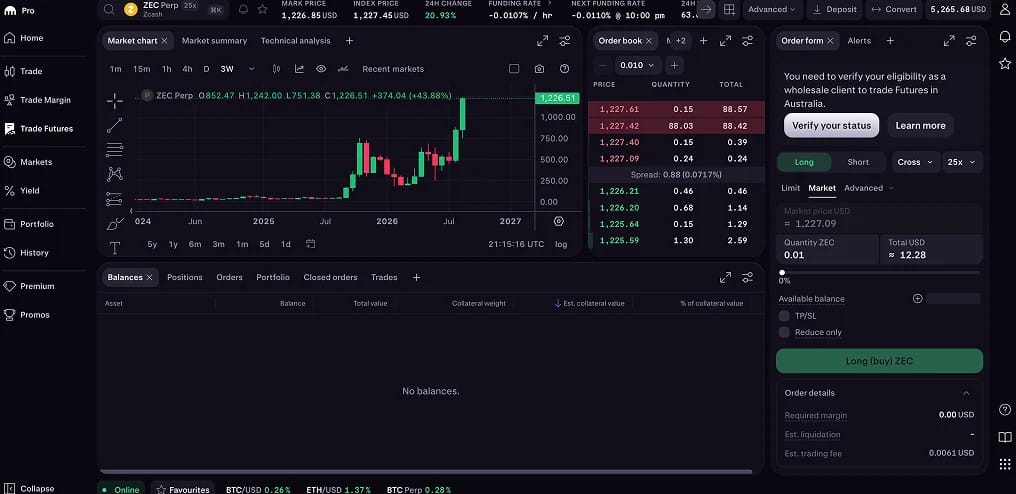
Kraken takes second place with the broadest onshore contract selection. It is also the only platform where US perpetuals appear beside spot, spot margin, and CME futures on one screen. The contracts trade on Bitnomial Exchange, a Chicago venue whose CFTC registrations cover exchange, clearinghouse, and brokerage activities. Parent company Payward acquired Bitnomial in the spring, and the contracts became available to eligible US clients through Kraken Pro on June 15. Kraken’s US perpetual futures page lists 16 USD-quoted markets, covering Bitcoin and Ether alongside assets such as Cardano, Hedera, Tezos, and Shiba Inu.
Kraken Derivatives US charges a flat $0.15 per contract per side, including exchange, NFA, and clearing fees. Contract sizes are 0.01 BTC, 0.5 ETH, or 5 SOL. If Bitcoin trades at $100,000, one BTC contract represents $1,000 in notional value and costs 15 cents to open. That equals roughly 1.5 basis points and is cheaper for small orders than every percentage-based venue listed here. Funding accrues across eight-hour windows, then settles through one daily cash adjustment at 3:00 PM Central.
Rather than displaying a leverage multiplier, Kraken quotes a dollar margin requirement for each contract. Intraday rates are lower, while initial margin rises from fifteen minutes before the session closes. Liquidation of a perps-only account incurs a $10 fee. For now, USD is the only accepted collateral. NinjaTrader Clearing, LLC operates as Kraken Derivatives US and serves as the brokerage. It is a CFTC-registered FCM and NFA member that holds customer funds under segregation rules.
Accessing perps requires the US futures unlock in Kraken Pro, including a suitability questionnaire in addition to standard KYC. The service is unavailable in New York and Maine. Our Kraken review covers the wider platform, while our margin trading comparison assesses the US spot margin product offered alongside these contracts.
Pros
- Sixteen CFTC-regulated perpetuals, the largest onshore selection, available through the same account as spot and CME futures.
- The flat $0.15 contract fee undercuts percentage pricing on small Bitcoin and Ether positions.
- Bitnomial holds exchange and clearing registrations in-house, while an NFA-member FCM keeps USD margin segregated.
Cons
- The product is unavailable in New York and Maine, and unlocking futures requires a second application.
- Only USD can be posted as collateral at launch, so crypto must first be sold.
- During our tests, smaller contracts had considerably less order book depth than Bitcoin and Ether.
3. Coinbase
Coinbase places third. It has the longest history with US-regulated perps and is the only product available across all fifty states. Coinbase launched its perpetual-style futures on July 21, 2025. They trade on the Coinbase Derivatives exchange through Coinbase Financial Markets, a CFTC-registered FCM. The nano Bitcoin contract represents 1/100th of a BTC, while the nano Ether contract equals 1/10th of an ETH. Trading runs continuously, and intraday leverage reaches 10x.
These instruments technically expire after five years, making them close substitutes for perpetuals rather than true perpetual contracts. Funding accrues hourly and settles twice per day. Coinbase Derivatives reports the activity on Form 1099-B, and fees start at roughly 0.02% per contract. Because the futures account is integrated into the standard Coinbase app, ACH, wire, and debit funding work much like they do for spot purchases.
On May 29, CFTC staff stated in Letter 26-17 that qualifying perpetuals traded on Deribit FZE may be treated as foreign futures under Regulation 30.1 and offered to US customers through Coinbase Financial Markets. Coinbase acquired the options exchange in 2025. The same letter includes a no-action position covering stablecoins and crypto posted by customers as margin. Institutional onboarding started immediately, but retail access was not available when we published. Most readers will therefore use the domestic product. Our Coinbase review covers the rest of the platform.
Pros
- Available in every state, including New York, which Kraken and Crypto.com do not serve.
- Nano contracts of 0.01 BTC and 0.1 ETH, paired with fees from 0.02%, work well for smaller and more frequent positions.
- CFTC staff guidance allows a regulated FCM to connect US clients with Deribit’s perpetual and options liquidity.
Cons
- The domestic contracts mainly cover Bitcoin and Ether and have a nominal five-year expiry.
- Deribit perpetuals remain limited to institutions, with no confirmed date for retail access.
- Coinbase Advanced charges 0.40% maker and 0.60% taker on spot, making an unleveraged hedge expensive.
4. Crypto.com
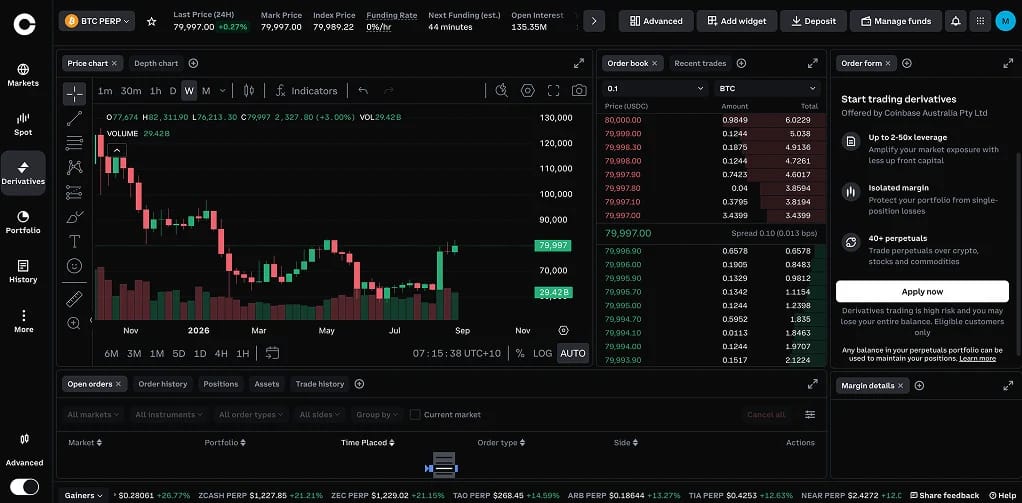
Crypto.com completes the ranking primarily because of its licensing structure. Crypto.com Derivatives North America maintains a full set of CFTC registrations as an exchange, clearinghouse, and futures commission merchant. This is the same regulatory stack Bitnomial provides for Kraken. Crypto.com’s US educational materials also confirm that CDNA offers regulated crypto perpetuals to eligible American customers through the US app. A conditional OCC trust charter approval in February added a federal banking layer.
Through one login, customers can access spot crypto, US stocks offered by the broker-dealer, prediction markets, and CFTC-regulated derivatives. ACH and wire deposits are free. Kalshi requires a separate margin account, while Kraken uses a dedicated futures unlock. Crypto.com handles its eligibility checks within the existing app.
The main weakness is disclosure. Public information about the US perpetuals’ contract specifications, leverage limits, and funding schedule is thinner than at the other venues reviewed here. New York residents cannot open an account. Check the instrument details inside the app before choosing a position size. Our Crypto.com review explains the fee tiers across its app, exchange, and card.
Pros
- One US affiliate holds exchange, clearinghouse, and FCM registrations, alongside a conditional OCC trust charter.
- ACH and wire deposits are free, with spot, stocks, prediction markets, and derivatives available in one app.
- Derivatives eligibility is managed through the existing account instead of separate onboarding.
Cons
- Public leverage disclosures and contract specifications are less detailed than those of the other three venues.
- New York residents cannot use the platform.
- Accessing the lowest fee tiers requires holding CRO, which turns a trading-cost decision into a token position.
How Perpetual Futures Are Regulated in the USA
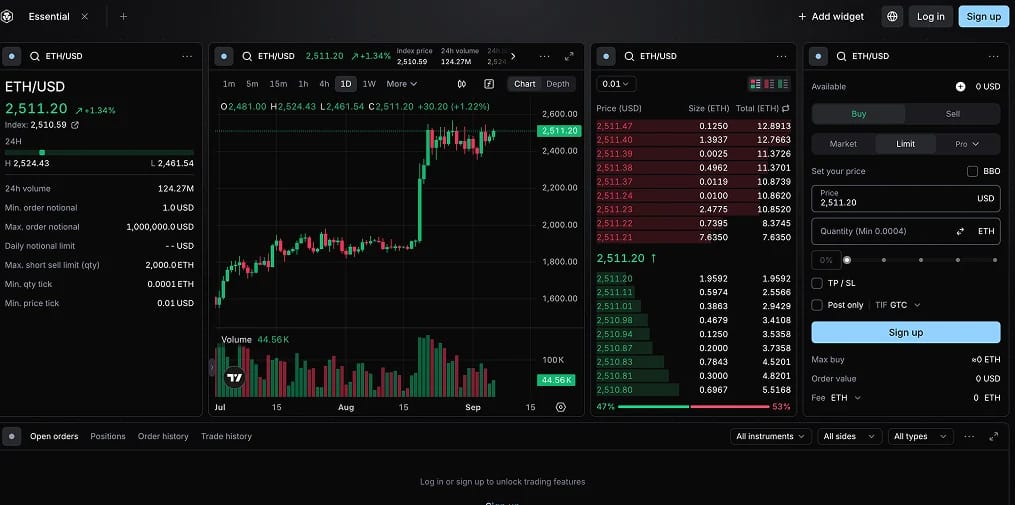
Perpetual futures are legal in the USA when they trade as futures on a CFTC-registered exchange and customer margin is held by a registered futures commission merchant. This structure is established under the Commodity Exchange Act. Each venue in our ranking either owns or uses the required regulatory layers.
- Designated contract market (DCM): The exchange lists the contract and files its rules with the CFTC. KalshiEX, Bitnomial Exchange, Coinbase Derivatives, and Crypto.com Derivatives North America are DCMs, which means their listed perps are treated as futures rather than swaps. Kalshi submitted BTCPERP through the voluntary Regulation 40.3 approval. Bitnomial and Coinbase used self-certification, a quicker route that carries less regulatory endorsement.
- Derivatives clearing organization (DCO): The clearinghouse guarantees each trade and collects margin. Kalshi Klear and Bitnomial Clearinghouse hold this registration internally, as does CDNA’s clearing arm. Coinbase Derivatives uses Nodal Clear.
- Futures commission merchant (FCM): The broker onboards customers and must keep their money segregated from its own funds. This separation helps protect balances if the platform fails. Kalshi Prime, Kraken Derivatives US, and Coinbase Financial Markets are registered FCMs and NFA members.
- Foreign futures under Regulation 30.1: In May, CFTC staff confirmed that qualifying perpetuals listed on an affiliated foreign board of trade can be offered to US customers through a registered FCM. Coinbase relies on this position for its Deribit access.
- Federal jurisdiction: Futures fall under federal jurisdiction, so state money transmitter laws and BitLicense requirements governing spot trading do not control these contracts. Kraken’s New York restriction comes from its spot business rather than a state prohibition on perps. Our New York exchange guide explains which platforms residents can use.
- Open litigation: CME Group sued the CFTC on June 18. It argues that perpetuals are swaps under Dodd-Frank and wants the court to overturn the Kalshi approval and policy statement. The CFTC moved to dismiss the case on September 2. If the agency loses, the products would need to be restructured, with existing positions wound down under exchange rules rather than frozen.
Chairman Michael Selig has described the Kalshi order as a beginning rather than an end. Every venue covered here plans to add more contracts.
Funding a US Perpetual Futures Account
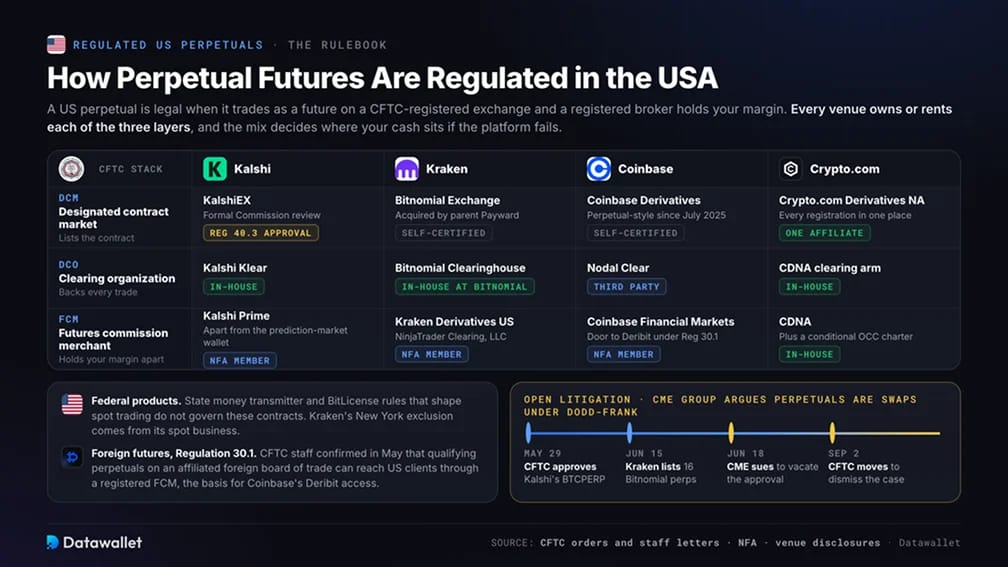
Funding a regulated US perpetual futures account generally involves sending dollars to a segregated account held by a futures broker. USD is therefore the usual collateral, and the balance remains separate from spot holdings. The mechanics differed across the accounts we tested.
ACH deposits often become tradable before the bank transfer settles. Withdrawals remain blocked until settlement, typically for three to five business days, so a locked withdrawal may coincide with a liquidation. Wires can arrive the same day but commonly incur a bank fee of $20 to $30. Debit card charges reach 2% or more. We funded our accounts from Chase and Ally checking without either transfer being flagged.
Customers holding Bitcoin or USDC must sell it for dollars before using the funds as margin, and the sale constitutes a taxable disposal. The only exception is Coinbase’s Deribit channel, which accepts crypto or stablecoin margin under the CFTC’s no-action conditions.
Kalshi pays approximately 3.25% APY on idle margin when the average balance exceeds $250. On a $10,000 account, that equals about $27 per month, whereas Kraken and Coinbase pay nothing. If a $5,000 position incurs funding of 0.01% every eight hours, the monthly cost is roughly $45. Kalshi’s interest would cover more than half of that carry during a quiet month.
How to Choose a Regulated Perpetual Exchange in the USA
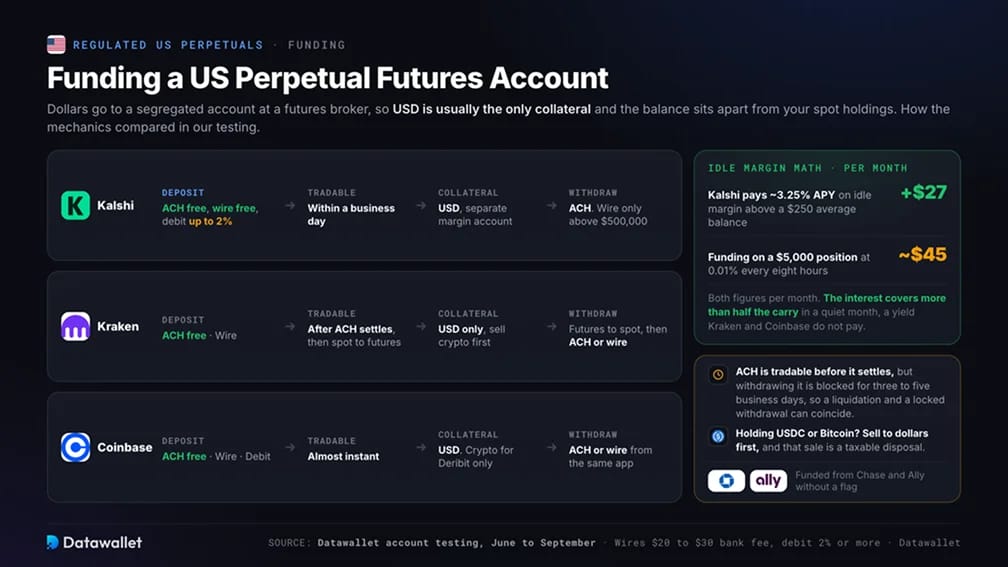
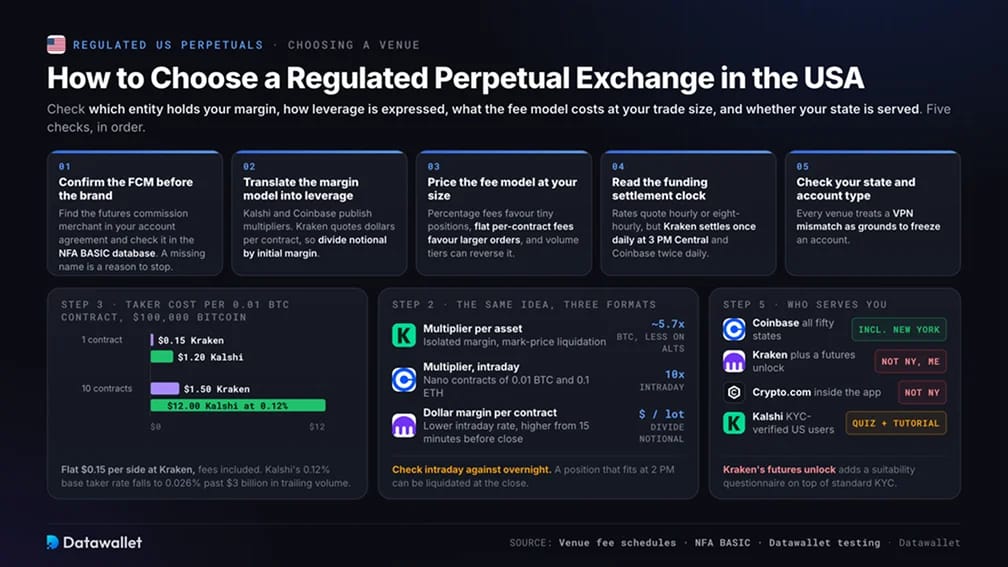
When comparing regulated perpetual exchanges in the USA, identify the entity holding your margin first. Then calculate the effective leverage and fees at your intended trade size. State availability also matters.
- Confirm the FCM before the brand: Locate the futures commission merchant named in the account agreement, then verify its registration and disciplinary record through the National Futures Association’s BASIC database. Kalshi Prime, Kraken Derivatives US, and Coinbase Financial Markets are all listed. Stop if the disclosures do not identify an FCM.
- Translate the margin model into a leverage number: Kalshi and Coinbase publish Bitcoin leverage multipliers of about 5.7x and 10x. Kraken instead gives a dollar margin requirement for each contract. Divide the contract’s notional value by the initial margin to make a direct comparison. Review both intraday and overnight requirements because a position that fits at 2 PM may face liquidation at the close.
- Price the fee model at your size: Percentage fees on notional value favor very small positions, while flat contract fees become more competitive on larger orders. With Bitcoin at $100,000, a single 0.01 BTC contract costs 15 cents on Kraken and about $1.20 in Kalshi taker fees. The difference narrows at ten contracts and may reverse after volume discounts. Our maker and taker fee guide explains how the two fee types work.
- Read the funding settlement schedule: The three main venues calculate funding hourly or in eight-hour periods, but the cash does not settle on the same schedule. Kraken posts one daily adjustment at 3 PM Central, while Coinbase settles twice per day. Check current rates on our funding rates tracker before keeping a position open overnight.
- Check your state and your account type: Coinbase operates in all fifty states. Kraken excludes New York and Maine, while Crypto.com excludes New York. Kalshi offers perps to KYC-verified US customers who complete a margin questionnaire and mandatory tutorial. A VPN mismatch can give any of these venues grounds to freeze an account.
Regulated US Perps vs Offshore Exchanges
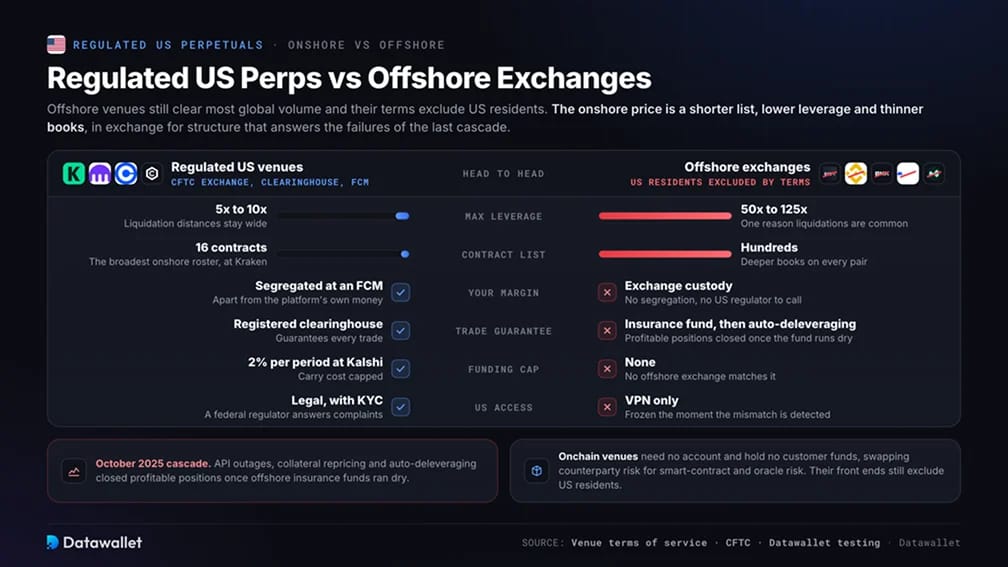
Offshore exchanges continue to handle most global perpetual volume, but their terms prohibit US residents from trading. Bybit, Binance, OKX, and MEXC exclude American customers, while Hyperliquid blocks US IP addresses. Using a VPN to access these platforms leaves traders without segregated funds or recourse to a US regulator. The exchange may also freeze the account as soon as it detects the location mismatch.
The offshore market offers considerably more depth. Leverage ranges from 50x to 125x, compared with roughly 5x to 10x onshore, and hundreds of contracts trade against only sixteen in the US market. The October 2025 cascade exposed the consequences of weaker protections under stress. API failures and collateral repricing contributed to liquidations, while auto-deleveraging closed profitable positions after insurance funds were exhausted.
Regulated US venues address those risks through their structure. An FCM segregates customer margin, and a registered clearinghouse guarantees each trade. Wider liquidation distances result from lower leverage limits, while Kalshi’s 2% funding cap restricts carry costs in a way that offshore exchanges do not. Traders accept fewer markets and thinner books in return while the sector develops. For leveraged Bitcoin or Ether positions in the low five figures, the onshore products are now sufficient.
Onchain venues do not require an account or take custody of customer funds. This removes counterparty risk but introduces smart-contract and oracle risks. Their front ends continue to exclude US residents.
How the IRS Taxes US Perpetual Futures
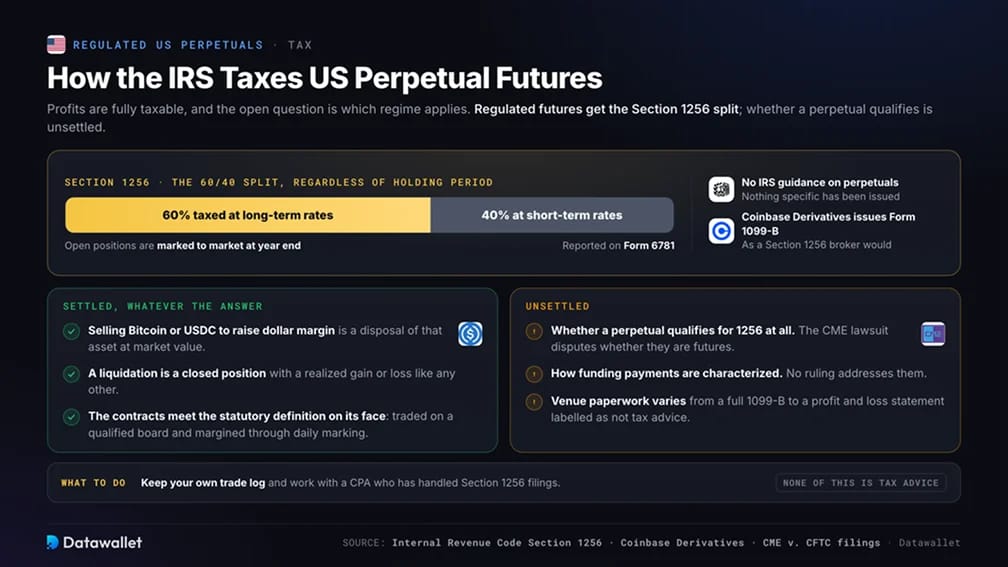
Profits from regulated US perpetuals are taxable, but the applicable regime remains uncertain. Section 1256 of the Internal Revenue Code applies a 60/40 split to regulated futures contracts. Under this treatment, 60% of gains are taxed at long-term rates and 40% at short-term rates, regardless of how long the position was held. Open contracts are marked to market at year end and reported on Form 6781.
It is not settled whether perpetuals qualify. They trade on qualified boards or exchanges and use daily margin marking, which appears to satisfy the statutory definition. Coinbase Derivatives issues Form 1099-B for perpetual-style trades, as a Section 1256 broker would. However, the IRS has not issued perpetual-specific guidance. The CME lawsuit also challenges whether the products are futures at all, and no ruling has determined how funding payments should be classified.
Regardless of the eventual classification, selling Bitcoin or USDC to obtain dollar margin is a disposal at market value. Liquidation closes a position and realizes its gain or loss. Maintain your own trading records and consult a CPA experienced with Section 1256 filings. Depending on the venue, you may receive a complete 1099-B or only a profit and loss statement marked as not tax advice. None of this is tax advice.
Which Platforms Are Next?
Only a few venues are currently live because approvals take place separately for each asset and firm. Several other platforms could enter the market before the end of the year.
- Gemini: Gemini Titan obtained DCM designation in December 2025, and its affiliate Gemini Olympus received clearinghouse registration in April. The company has said this regulatory stack will support crypto futures and perpetuals, although it had not launched a perp contract when we published.
- Polymarket: Polymarket US holds CFTC exchange and clearing registrations. However, the Polymarket Perps product that launched on September 3 with leverage of up to 20x operates through the offshore polymarket.com. It blocks US orders and directs American users to polymarket.us, where no perpetual is listed.
- Robinhood: In April, the broker told Reuters it was exploring perpetuals for US customers after offering them to EU clients through Bitstamp. No domestic product has launched.
- Bitnomial’s own retail platform: Botanical was developed as a retail interface for Bitnomial’s perpetuals before Payward acquired the company. Its future as a separate brand is unclear now that Kraken Pro offers the same contracts.
- CME Group: The largest futures exchange in the US could pursue perpetuals through the same Regulation 40.3 process it is challenging in court. The CFTC raised this point in its motion to dismiss.
We will add these platforms once their contracts are live and we have funded and traded them.
Final Thoughts
Kalshi ranks first because it offers the only perpetual contract available to Americans that received direct review and approval from a federal regulator. The product combines that approval with isolated positions and capped funding. Liquidations use a mark price, and idle cash earns interest. Its leverage is modest and the taker fee is expensive, but those drawbacks carry less weight for traders choosing the venue for its protections.
Kraken is better suited to active traders. It lists sixteen contracts and charges per-contract fees that beat percentage pricing on smaller positions. Perps, spot, margin, and CME futures all share one interface. Coinbase is the strongest choice for New York residents and could provide access to Deribit’s liquidity through a US broker once the retail channel opens. Crypto.com has the required licenses and a convenient app, but it needs fuller public specifications to compete directly.
Whichever platform you choose, start with a $500 test. Fund the account through ACH, open one contract, and keep it active through a funding settlement. Then close the position and withdraw to the same bank account. The fee preview and funding entry reveal the actual cost, while the withdrawal shows how quickly your money can leave. Those details are more useful than an approval order alone. For unleveraged trading, see our guide to the best crypto exchanges in the USA.
Our Methodology
We verified accounts at each venue using US documents and Social Security numbers. Our testing covered each platform’s futures or margin application, followed by ACH and wire deposits from Chase and Ally checking accounts. We placed market and limit orders on Bitcoin and Ether perpetuals, held them across several funding windows, and withdrew the resulting dollar balances. Scores were based on six criteria.
- Trust Score: Our proprietary score out of 5 weighs the CFTC registration structure supporting each product. It also considers the contract’s approval path, segregation of customer funds, corporate disclosure, and enforcement history.
- Regulatory Standing: We checked the DCM, DCO, and FCM entities disclosed by each venue against CFTC and NFA records. Open litigation affecting the framework was also tracked.
- USD Funding: Testing covered ACH and wire deposits, time to tradable balance, deposit and withdrawal charges, and accepted collateral.
- Margin and Leverage: We compared published leverage caps with per-contract margin requirements. Intraday and overnight rules were assessed alongside liquidation fees and mark-price methodology.
- Fees and Funding Cost: We calculated the total round-trip cost for one BTC contract and ten contracts on each platform, including funding through a complete settlement cycle.
- Product Depth and Execution: Our review counted active contracts and measured spreads and slippage on Bitcoin and Ether. We also tested one smaller market at each venue and examined maintenance schedules and outage disclosures.
We excluded platforms whose perpetuals were not open to US retail traders during testing. Offshore venues that prohibit American customers and onchain protocols that geoblock US users were also left out. Testing took place from June through early September. Regulatory status was checked again after the CFTC’s September 2 filing in the CME case.