

What is Nockchain?
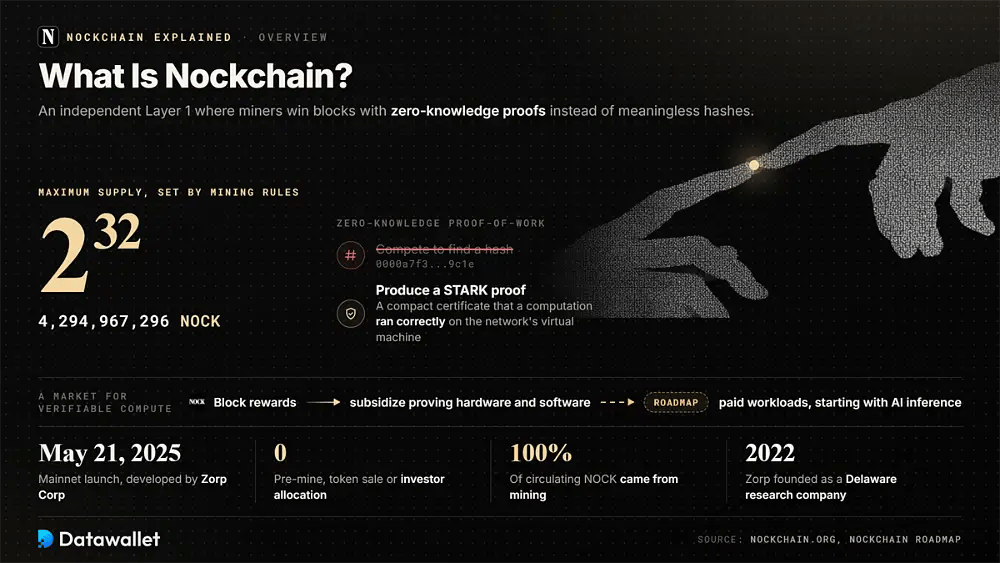
Nockchain is an independent Layer 1 blockchain secured through Zero-Knowledge Proof-of-Work (ZKPoW). Instead of competing to find meaningless hashes, miners produce STARK proofs: compact cryptographic certificates showing that a computation executed correctly on the network's virtual machine.
The project describes this system as a market for verifiable computation. Block rewards subsidize proving capacity, meaning the specialized hardware and software used to produce zero-knowledge proofs. Over time, the technical roadmap aims to redirect that capacity toward paid workloads, beginning with artificial intelligence inference provided by GPU operators.
Zorp Corp, a Delaware research company founded in 2022, developed the protocol and launched mainnet on May 21, 2025. There was no pre-mine, token sale or investor allocation. Every NOCK in circulation therefore came from mining. Maximum supply is 2^32 coins, equal to 4,294,967,296 NOCK.
That design puts Nockchain closer to Bitcoin than most AI crypto coins, which usually rely on team-issued token distributions. With supply determined entirely by mining rules, Nockchain's early difficulty settings, emission curve and upgrade history carry more weight than they would on a conventional venture-backed network.
How Does Nockchain Work?
Nockchain retains Bitcoin's broad structure: a proof-of-work blockchain built around unspent outputs. It replaces the mining function, virtual machine and execution model, however. Four components explain how the network works today.
1. Mining with Zero-Knowledge Proofs
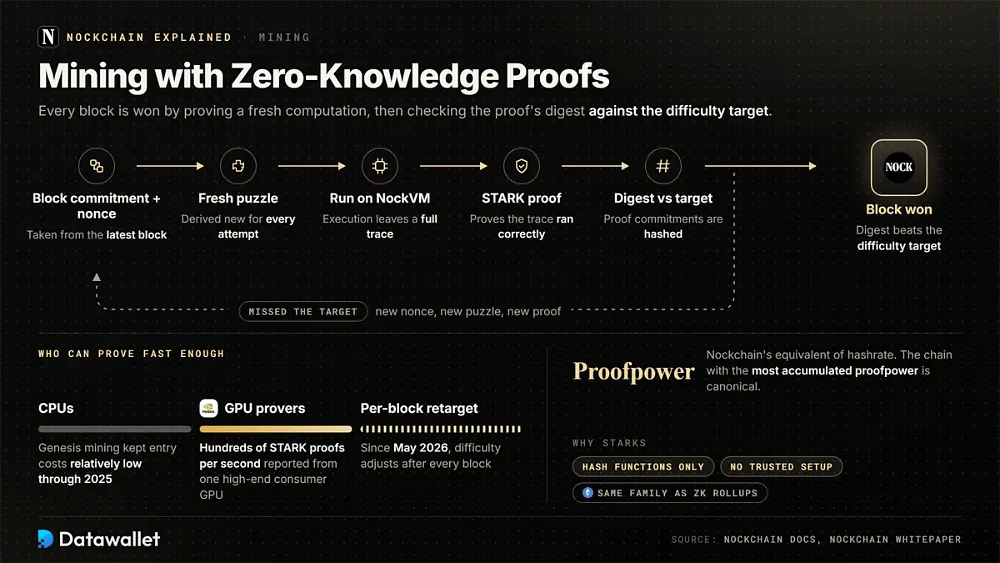
Winning a Nockchain block requires generating a zero-knowledge proof. Miners derive a fresh puzzle from the latest block commitment and a nonce, execute that puzzle on NockVM, and produce a STARK proof of the resulting execution trace. Selected proof commitments are then hashed into a digest and checked against the current difficulty target.
STARKs are the same proof family used by ZK rollups on Ethereum. They depend only on hash functions and require no trusted setup. Nockchain treats the chain with the greatest accumulated proofpower, its equivalent of hashrate, as canonical, following the same broad principle as Bitcoin's heaviest-chain rule.
At genesis, mining ran on CPUs, which kept entry costs relatively low through 2025. Competition later shifted operators toward custom GPU provers. Community software has reported hundreds of STARK proofs per second from a single high-end consumer GPU. Since May 2026, difficulty has adjusted after every block.
2. The Nock ISA and NockVM
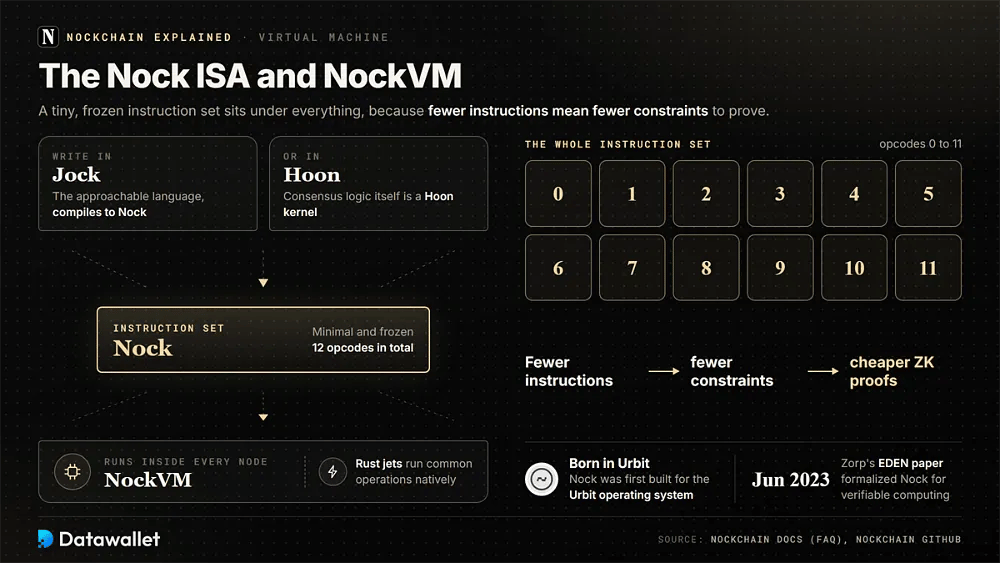
Nock is a minimal instruction set containing twelve opcodes and was originally developed for the Urbit operating system. Its small, frozen specification is unusually well suited to zero-knowledge proving because fewer instructions produce fewer constraints. Zorp's EDEN paper formalized Nock as a target for verifiable computing in June 2023.
NockVM runs the instruction set within each node, while Rust "jets" accelerate frequently used operations natively. According to the Nockchain repository, consensus logic itself is implemented as a Hoon kernel on the virtual machine. Developers who do not want to work directly in Hoon can use Jock, a more approachable language that compiles to Nock.
3. Notes, Intents and Offchain Execution
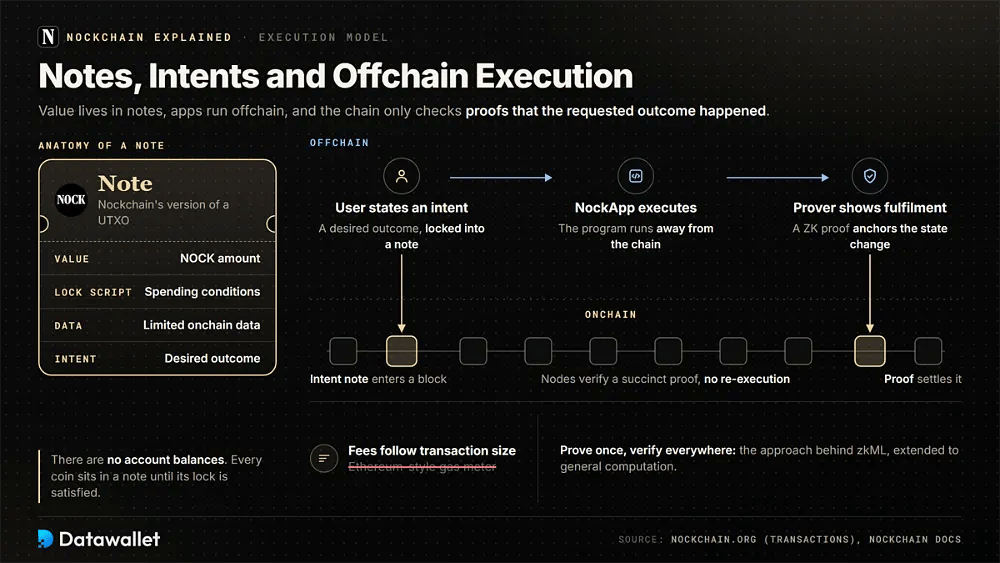
Rather than maintaining account balances, Nockchain records value through notes, its version of unspent transaction outputs (UTXOs). Each note carries spending conditions through lock scripts. Fees depend on transaction size instead of an Ethereum-style gas meter, and the transaction model allows limited amounts of data to be stored onchain.
Application execution happens offchain through NockApps. These programs anchor state transitions to Nockchain using zero-knowledge proofs. Users express desired outcomes as intents locked into notes, while provers show that those outcomes were fulfilled. The model resembles the prove-once, verify-everywhere approach behind zkML, extended to general computation.
4. Protocol Upgrades from Dumbnet to Logos
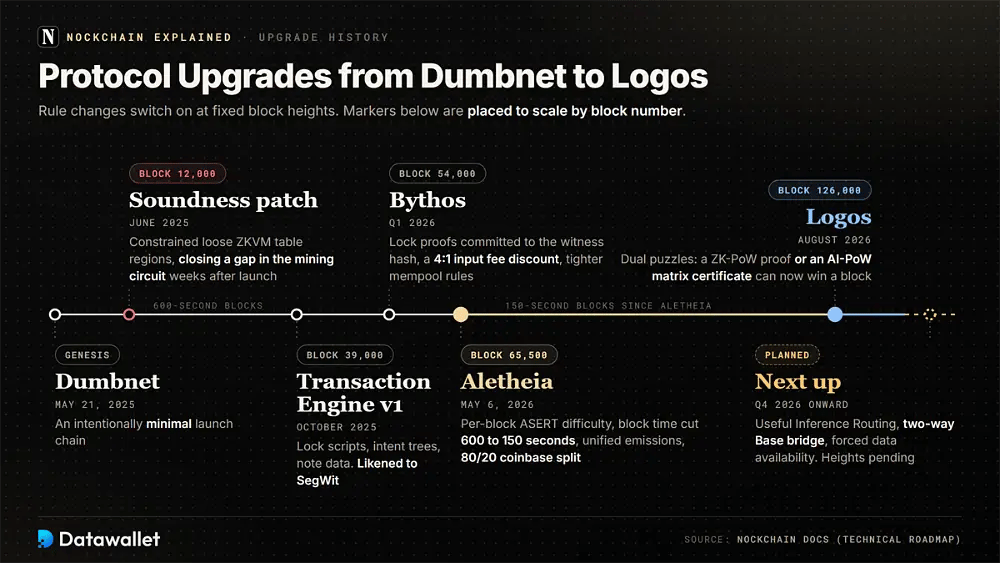
Nockchain began as an intentionally minimal "dumbnet." Since then, the protocol has moved through several height-activated upgrades, with each version documented in the developer documentation.
The major rule changes so far:
- Block 12,000 (June 2025): A consensus patch constrained previously unconstrained ZKVM table regions, closing a soundness gap in the original proof-of-work circuit shortly after launch.
- Transaction Engine v1 (block 39,000, October 2025): Added lock-script programmability, intent trees with Merkle proofs and onchain note data. Observers compare it to Bitcoin's SegWit restructuring.
- Bythos (block 54,000, Q1 2026): Committed lock Merkle proofs to the witness hash, rebalanced fees with a 4:1 input discount and tightened mempool admission rules.
- Aletheia (block 65,500, May 6, 2026): Switched difficulty to per-block ASERT, cut block time from 600 to 150 seconds, unified emissions and split the coinbase 80/20.
- Logos (block 126,000, August 2026): Activated a dual-puzzle system, letting either a ZK-PoW proof or an AI-PoW matrix-multiplication certificate win a block.
- Planned (Q4 2026 onward): A Useful Inference Routing Protocol, two-way Base bridge withdrawals and forced data availability sit on the published roadmap, pending activation heights.
How to Mine Nockchain
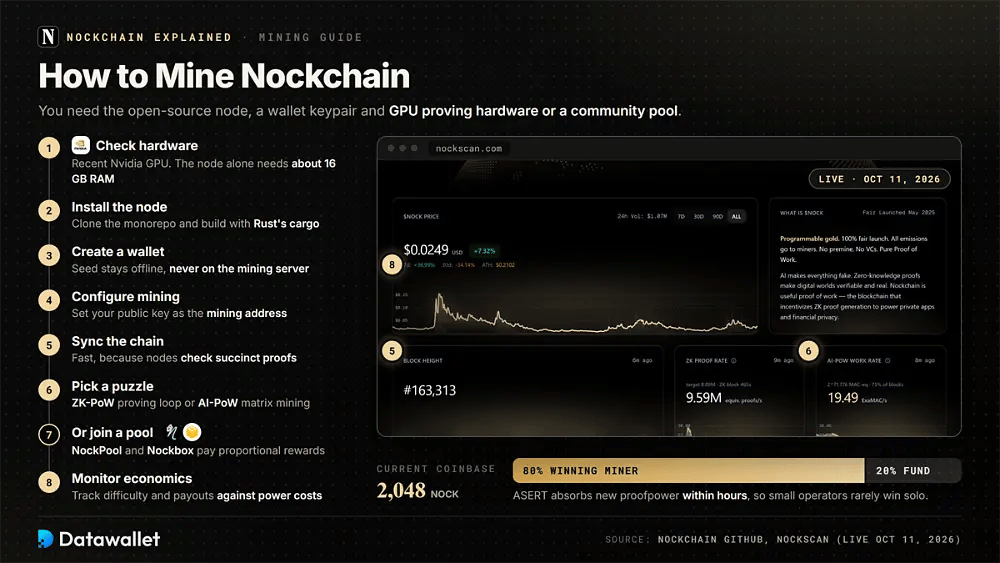
Mining NOCK requires the open-source node from the zorp-corp/nockchain repository, a wallet keypair, and either solo proving hardware or access to a community pool. Although genesis mining relied on CPUs, modern configurations are generally GPU-based.
From installation to your first reward:
- Check hardware: Solo ZK proving now favors recent Nvidia GPUs running community CUDA provers. A node alone needs roughly 16 GB of RAM after the demand-paging upgrade.
- Install the node: Clone the monorepo, build with Rust's cargo toolchain and follow the setup instructions. The software is experimental, so expect breaking changes between releases.
- Create a wallet: Generate a keypair with the bundled wallet, record the seed material offline and never expose the private key on a mining server.
- Configure mining: Set your public key as the mining address in the node's environment configuration so block rewards pay out to an address you control.
- Sync the chain: Start the node and let it verify history. Verification is fast because nodes check succinct proofs rather than re-executing every computation.
- Pick a puzzle: Since the Logos upgrade, operators choose between the standard ZK-PoW proving loop and AI-PoW matrix-multiplication mining aimed at GPU inference fleets.
- Or join a pool: Pools such as NockPool and Nockbox aggregate proofpower and pay proportional rewards, smoothing income for operators without warehouse-scale hardware.
- Monitor economics: Track difficulty and payouts against electricity or rental costs on an explorer like Nockscan. Per-block issuance steps down on a fixed schedule.
Small operators now have little chance of winning solo rewards regularly. ASERT adjusts difficulty after every block, absorbing additional proofpower within hours. The current 2,048 NOCK coinbase is divided between the winning miner, which receives 80%, and the protocol fund, which takes the remaining 20%.
NOCK Tokenomics & Supply
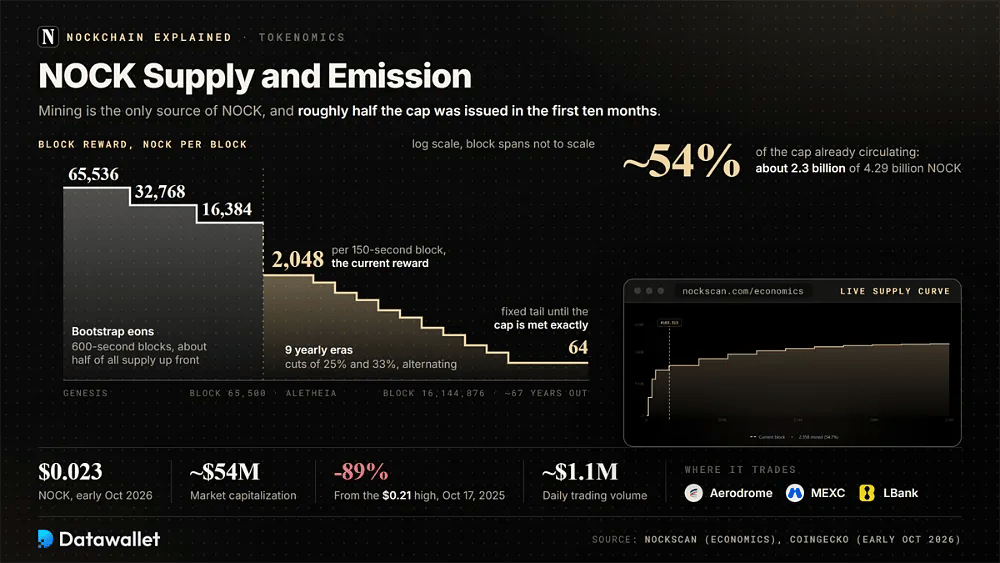
Mining is the sole source of NOCK. Genesis included no pre-mine, foundation treasury or private sale. Distribution has therefore been determined by the emission curve, early difficulty conditions and one major hard fork.
Supply and Emission
Nockchain adopts Bitcoin's hard-cap principle without copying its four-year halving schedule. Its first reward system used shrinking periods called "eons." The Aletheia fork later replaced that model with a unified curve documented on Nockscan's economics page.
NOCK supply and market figures in early October 2026:
- Maximum supply: 2^32 NOCK, exactly 4,294,967,296 coins. The final unit is scheduled to be mined at block 16,144,876, roughly 67 years from now.
- Circulating supply: About 2.3 billion NOCK according to CoinGecko, approximately 54% of the cap, reflecting the steep bootstrap issuance of the chain's first ten months.
- Bootstrap eons: Three launch periods paid 65,536, then 32,768, then 16,384 NOCK per 600-second block through block 65,500, front-loading roughly half of all supply.
- Current reward: The Aletheia schedule opened with 2,048 NOCK per 150-second block, followed by nine yearly eras cutting rewards 25% and 33% alternately.
- Tail emission: A fixed 64 NOCK per block continues after the eras until the cap is met exactly, giving miners a long, thin subsidy runway.
- Coinbase split: Since May 2026, each block pays 80% to the miner and 20% to a consensus-known protocol fund, a split documented in the official docs.
- Market value: NOCK traded near $0.023 in early October 2026, a market capitalization around $54 million, 89% below its October 17, 2025 all-time high of $0.21.
- Trading venues: Liquidity sits on Aerodrome on Base through wrapped NOCK, plus centralized listings on MEXC and LBank, with daily volume near $1.1 million.
The launch period warrants particular attention. Blocks initially targeted ten minutes and used Bitcoin-style fortnightly retargeting. Because proving was still CPU-bound, operators that optimized the open-source miner early captured disproportionately large rewards. Zorp also mined corporately, with contracts directing part of its mining capture to staff and seed investors.
Utility
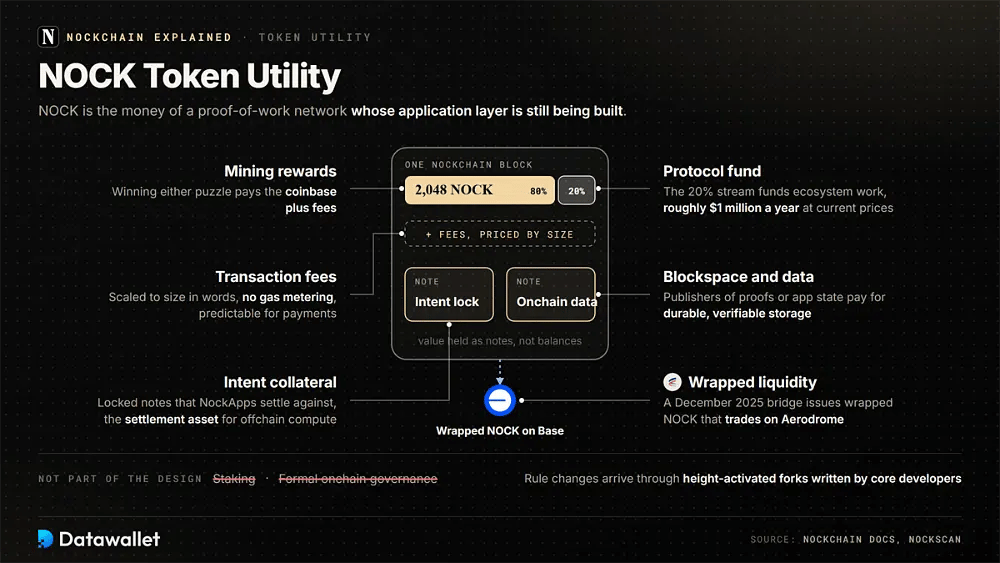
NOCK currently has a narrow role: it functions as the money of a proof-of-work network whose application layer is still being developed.
Current uses for NOCK:
- Mining rewards: Winning either puzzle pays the block's coinbase plus its fees, making NOCK the direct compensation for proofpower committed to the network.
- Transaction fees: Transfers pay fees scaled to transaction size in words, a deliberate rejection of gas metering that keeps costs predictable for simple payments.
- Blockspace and data: Notes can carry limited onchain data, so publishers of proofs or application state pay NOCK for durable, verifiable storage.
- Intent collateral: Locked notes express intents that NockApps settle against, positioning NOCK as the settlement asset for offchain verifiable computation.
- Wrapped liquidity: A December 2025 bridge issues wrapped NOCK on Base, where it trades on Aerodrome and reaches users of mainstream wallets.
- Protocol fund: The 20% coinbase stream accrues to ecosystem development under consensus rules, an onchain budget worth roughly $1 million yearly at current prices.
Nockchain has neither staking nor formal onchain governance. Height-activated forks written by core developers introduce rule changes. This makes the monetary schedule straightforward to read, but it also leaves substantial practical influence with Zorp and its collaborators.
The AI Compute Network: Is the Work Useful?
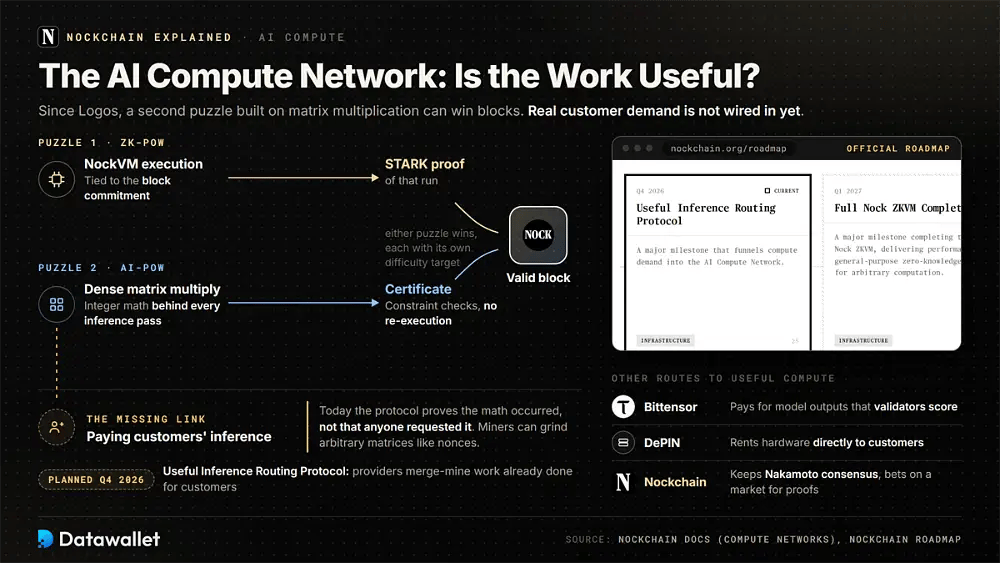
Nockchain's central proposition is that mining energy should pay for real computation. That idea became testable at block 126,000 in August 2026, when the Logos upgrade introduced AI-PoW. The second puzzle uses integer matrix multiplication, the arithmetic behind every neural-network inference pass.
Under this dual-puzzle system, separate competitions can produce valid blocks against independent difficulty targets. ZK blocks require STARK proofs showing NockVM execution tied to the block commitment. AI blocks instead need certificates showing that a large dense matrix multiplication was performed correctly, with constraint checks providing verification rather than full re-execution.
The Compute Networks framework lays out the longer-term model. Inference providers would merge-mine by reusing matrix work already performed for paying customers as mining attempts with negligible marginal cost. Block rewards would then subsidize AI compute while network security is purchased through computation someone wanted anyway.
That sequence is not complete yet. Today's protocol proves that matrix multiplications occurred; it does not establish that a customer requested them. AI-PoW miners can therefore process arbitrary matrices in much the same way conventional hash miners cycle through nonces. The Useful Inference Routing Protocol planned for Q4 2026 is intended to connect genuine demand with the mining puzzle.
Other networks pursue useful computation differently. Bittensor pays for model outputs that validators score, while most DePIN projects rent hardware directly to customers. Nockchain preserves Nakamoto consensus instead, betting that a sufficiently developed market will emerge for commoditized proofs of computation.
The Nockchain Ecosystem
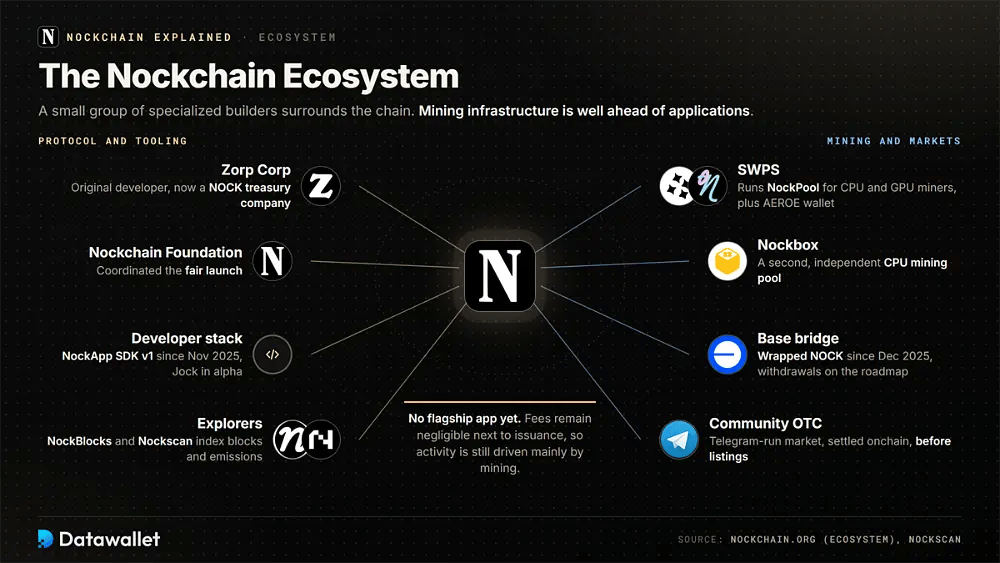
A relatively small group of specialized businesses and tools has emerged around Nockchain since launch. The project's ecosystem page lists the participants. Mining infrastructure is substantially further developed than the application layer.
Who builds what around NOCK:
- Zorp Corp: The original developer, now a self-described NOCK treasury company that mines corporately, ships protocol upgrades and plans revenue products including a native decentralized exchange.
- Nockchain Foundation: The entity credited with coordinating the fair launch, keeping protocol stewardship formally separated from Zorp's for-profit treasury operations.
- Southwest Pool Supply (SWPS): An infrastructure builder operating NockPool for CPU and GPU miners, alongside the AEROE wallet project for everyday NOCK users.
- Nockbox: An ecosystem company running its own CPU mining pool, giving smaller operators a second independent venue for pooled proofpower.
- Explorers: NockBlocks by LambdaCollective and Nockscan index blocks, addresses and emissions, filling the data gap left by mainstream analytics platforms.
- Developer stack: The NockApp SDK v1 shipped November 2025, the Jock language sits in alpha, and the first onchain NockApp was documented that same month.
- Base bridge: A December 2025 bridge mints wrapped NOCK on Coinbase's Base network, with withdrawals back to the Layer 1 on the roadmap.
- Community OTC: Before exchange listings, NOCK changed hands through a Telegram-coordinated over-the-counter market settled onchain, an unusual bootstrapping phase for price discovery.
No flagship application currently produces meaningful settlement demand, and fees remain negligible compared with issuance. The near-term question is whether NockApps and the proposed AI compute market can turn activity driven mainly by mining into organic network usage.
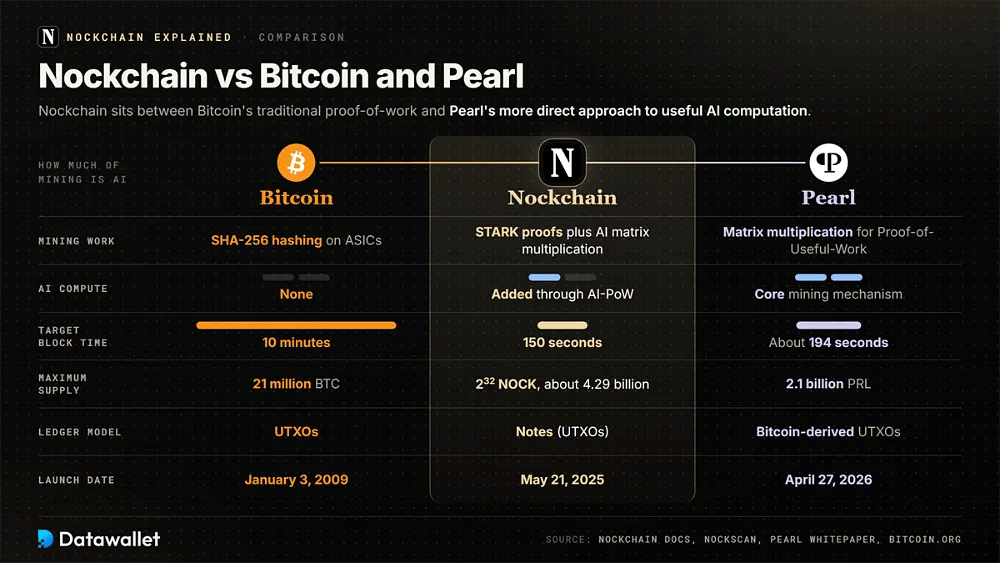
Nockchain vs Bitcoin and Pearl
Nockchain sits between Bitcoin's traditional proof-of-work model and Pearl's more direct approach to useful AI computation.
Bitcoin uses specialized ASICs whose main purpose is SHA-256 hashing, while its halving schedule reduces miner rewards roughly every four years. Nockchain keeps a capped-supply model but uses yearly reward reductions and mining hardware that can also perform broader computational work.
Pearl goes further by making matrix multiplication the core mining task. Nockchain still centers on ZK-Proof-of-Work, with AI-PoW added as a second route to block production. That gives Pearl a more direct AI-compute design, while Nockchain combines useful-work ambitions with a broader zero-knowledge execution model.
Bitcoin remains far more mature than either project. Nockchain changed its emission curve, block cadence and coinbase allocation within its first year, while Pearl only launched mainnet in April 2026. Both therefore carry substantially more protocol and execution risk than Bitcoin.
What Separates Nockchain From Conventional Proof-of-Work?
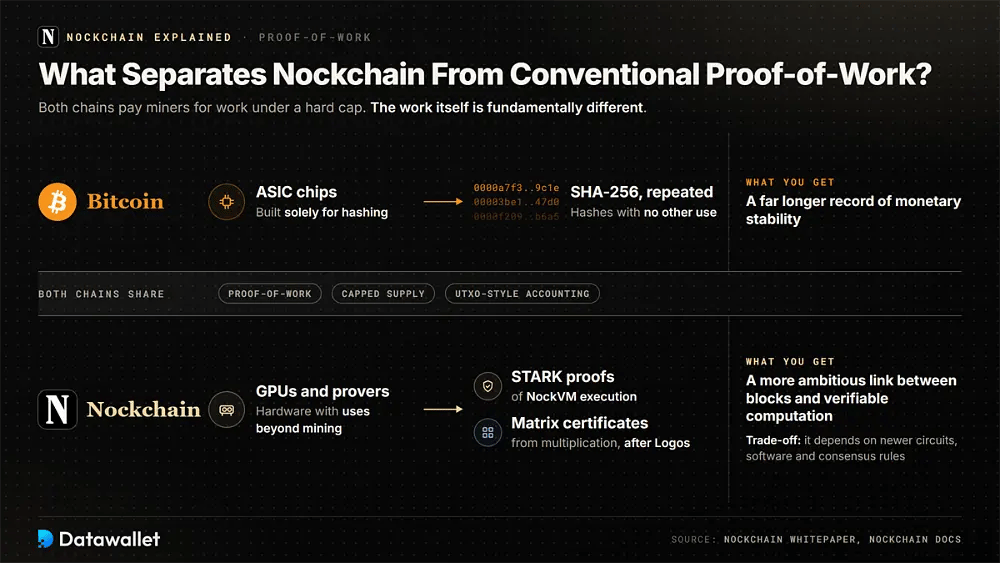
Bitcoin and Nockchain both use proof-of-work, capped supply and UTXO-style accounting, but the work performed by miners is fundamentally different. Bitcoin ASICs repeatedly calculate SHA-256 hashes. Nockchain instead asks miners to produce STARK proofs of NockVM execution or, after Logos, certificates derived from matrix multiplication.
That distinction is central to Nockchain's investment case and its technical risk. Proving hardware may have productive uses beyond mining, yet the system depends on newer circuits, software and consensus rules. Bitcoin offers a far longer record of monetary stability; Nockchain offers a more ambitious attempt to connect block production with verifiable computation.
Is Nockchain Safe?
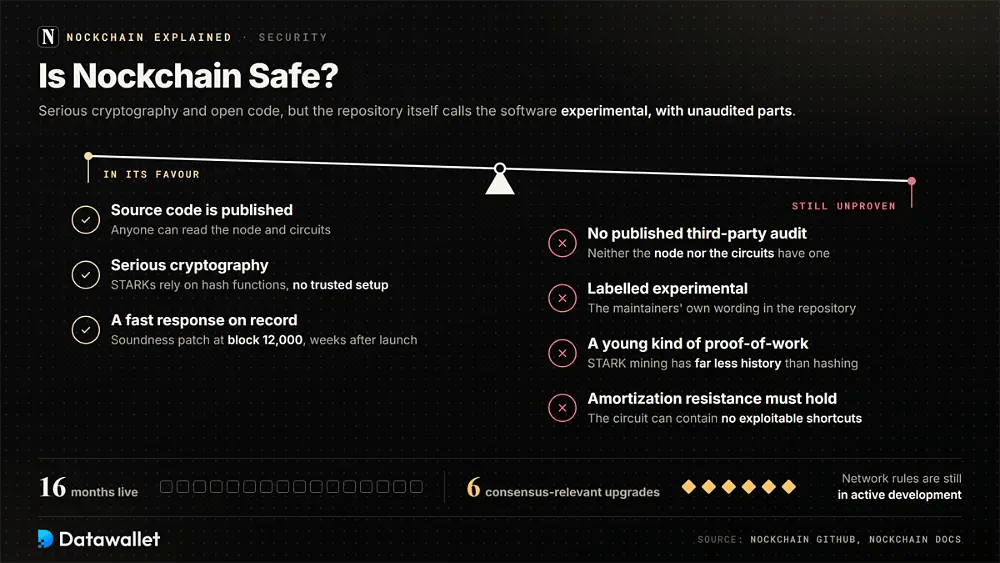
Nockchain uses serious cryptography and publishes its source code, but the repository itself describes the project as experimental software with unaudited components. The soundness patch activated at block 12,000 only weeks after launch demonstrated that the team could respond quickly, while also exposing how immature the original circuit still was.
STARK-based proof-of-work has far less history than hash-based mining. Its security depends partly on ensuring the proving circuit contains no exploitable shortcuts, a property Nockchain calls amortization resistance. No third-party audit of the node or circuits has been published. Six consensus-relevant upgrades in sixteen months also show that network rules remain in active development.
Risks
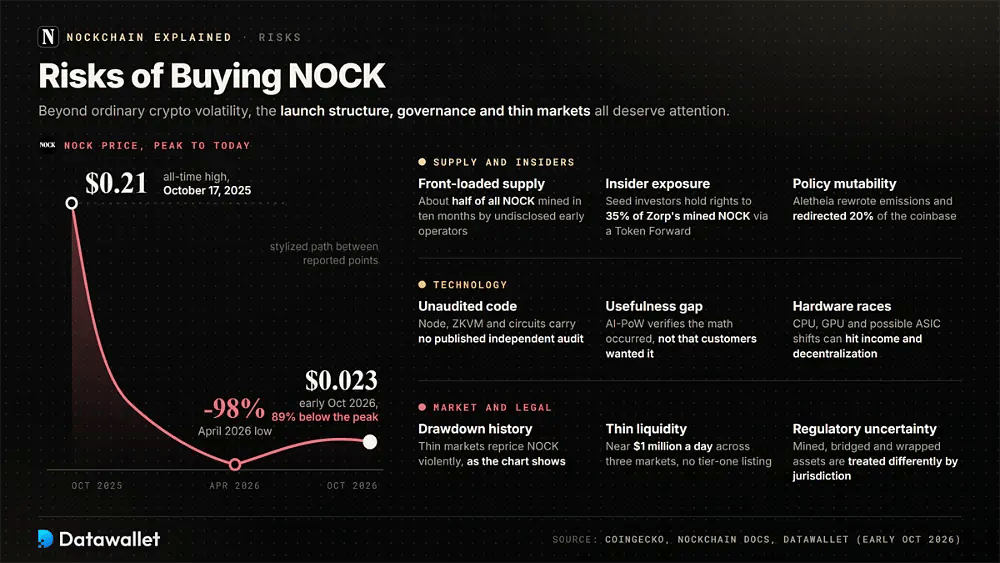
Nockchain carries risks beyond the volatility associated with crypto assets generally. Its launch structure, governance model and market conditions all deserve attention before buying NOCK.
The main risks to weigh before buying NOCK:
- Front-loaded supply: Roughly half of all NOCK was mined in the first ten months, concentrated among early operators whose holdings and selling plans are undisclosed.
- Policy mutability: The Aletheia hard fork rewrote the emission schedule and redirected 20% of the coinbase, proving the monetary rules can change when developers decide.
- Unaudited code: The node, ZKVM and proving circuits carry no published independent audit, and the maintainers themselves label the software experimental and unstable.
- Usefulness gap: AI-PoW currently verifies that matrix math occurred, not that customers wanted it, so the useful-work narrative awaits the inference routing protocol.
- Drawdown history: NOCK fell about 98% from its October 2025 peak to its April 2026 low, demonstrating how violently thin markets reprice this asset.
- Thin liquidity: Daily volume near $1 million across Aerodrome, MEXC and LBank means modest orders move price, and no tier-one exchange lists NOCK.
- Insider exposure: Zorp's seed investors hold rights to 35% of its mined NOCK via a Token Forward, creating structured future sell pressure outside the fair-launch optics.
- Hardware races: Proving advantages shift quickly between CPU, GPU and potential ASIC designs, so mining income and decentralization can both deteriorate without warning.
- Regulatory uncertainty: Treatment of mined, bridged and wrapped assets varies by jurisdiction and could restrict access or liquidity, as with other proof-of-work coins.
Nockchain Founders and Team
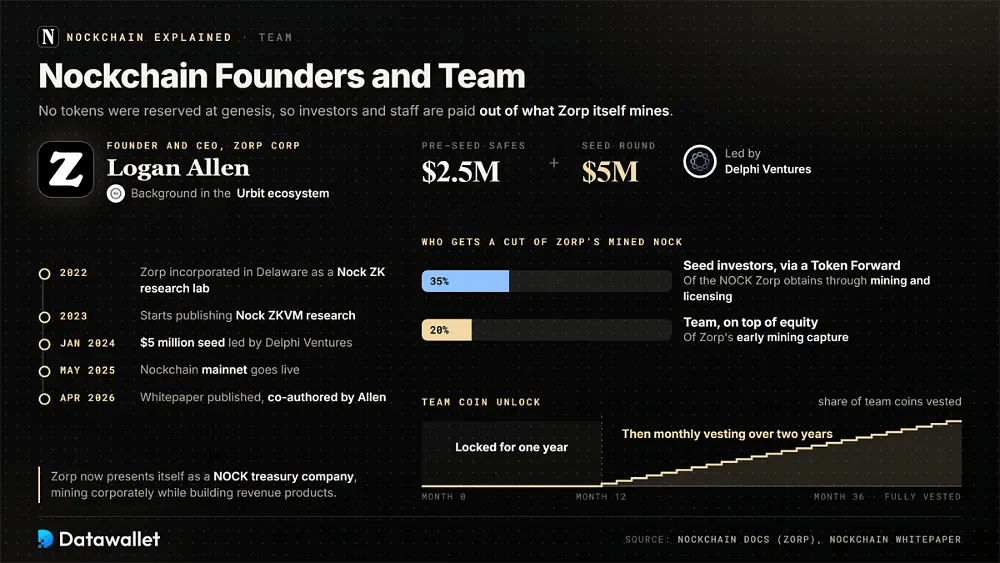
Founder and CEO Logan Allen runs Zorp Corp, which was incorporated in Delaware in 2022 as a research lab focused on Nock zero-knowledge proofs. His background includes the Urbit ecosystem, where the Nock instruction set originated. Allen also co-authored the project's April 2026 whitepaper.
Zorp raised $2.5 million through pre-seed SAFEs, followed by a $5 million seed round led by Delphi Ventures in January 2024. Since the blockchain did not reserve tokens for investors, seed backers instead received a Token Forward granting rights to 35% of the NOCK Zorp obtains through mining and licensing.
Team compensation consists of equity plus 20% of Zorp's early mining capture. Those coins are locked for one year before vesting monthly over the following two years. Zorp now presents itself as a NOCK treasury company, accumulating coins through corporate mining while developing revenue products, and has published Nock ZKVM research since 2023.
Final Thoughts
Nockchain is the most complete attempt yet to make proof-of-work pay for computation that matters. It completed a fair launch, introduced six consensus upgrades in sixteen months, activated the first dual ZK and AI mining regime, and drew a modest ecosystem of mining pools, explorers and infrastructure providers.
Its main unresolved questions are economic rather than cryptographic. Half the supply belongs to early miners, the monetary policy has already been altered through a hard fork, and the useful-work thesis still depends on an inference routing protocol that has not launched. Fee revenue remains negligible relative to daily issuance.
Three catalysts are worth watching: the Useful Inference Routing Protocol, flagship NockApps that create settlement demand, and exchange listings beyond MEXC and LBank. Until those emerge, NOCK remains a thinly traded bet on an unproven proof economy. Any position should be small enough that a total loss is tolerable.