



.svg)
What is Pendle Finance?
Pendle Finance is a decentralized protocol that creates an onchain market for yield. It lets users deposit yield-bearing assets, then splits them into two separate tokens so future yield can be bought, sold, and traded independently of the underlying principal, much like fixed-income instruments in traditional finance.
The core mechanism is yield tokenization. Every deposit produces a Principal Token, redeemable one-for-one at maturity, and a Yield Token, which streams the asset's variable yield until it expires. This lets conservative users lock in a guaranteed fixed rate while traders speculate on where yields are heading, all within a permissionless environment.
Launched in June 2021 by co-founders TN Lee and Vu Nguyen, Pendle found its stride during the liquid staking and restaking waves, integrating assets like Lido's stETH and later Ethena's USDe. Its total value locked climbed from roughly $230 million in early 2023 to a peak near $8.9 billion by August 2025, riding the demand for structured yield.
By 2026 Pendle has become critical DeFi infrastructure, controlling between 50% and 60% of the yield-trading sector with almost no direct competitor still standing. Former rivals such as Element Finance and Yield Protocol either rebranded or shut down, leaving Pendle as what several analysts describe as a near-monopoly in onchain fixed income.
How Does Pendle Finance Work?
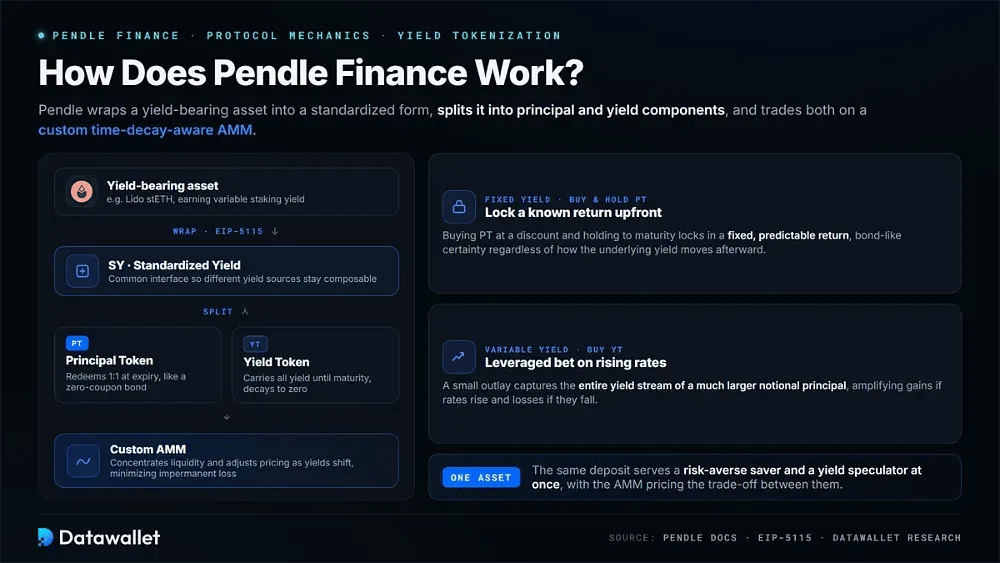
Pendle wraps a yield-bearing asset into a standardized form, splits it into principal and yield components, and trades both on a custom AMM. Understanding the moving parts clarifies how fixed and variable yield strategies actually function on assets like Lido's stETH:
- Standardized Yield: Pendle first wraps deposits into an SY token using the EIP-5115 standard, creating a common interface that lets wildly different yield sources plug into the same system and remain composable across DeFi.
- Principal Token: The PT represents the deposit's principal and trades at a discount before maturity, redeemable one-for-one at expiry, functioning much like a zero-coupon bond with a fixed, predictable return.
- Yield Token: The YT carries all future yield until maturity, letting holders gain leveraged exposure to rising rates or hedge yield risk, with its value decaying to zero as expiration approaches.
- Custom AMM: Pendle's time-decay-aware market maker concentrates liquidity and adjusts pricing curves as yields shift, minimizing impermanent loss for liquidity providers compared with a standard constant-product design.
- Fixed yield strategy: Buying and holding PT to maturity locks in a known return upfront, appealing to users who want bond-like predictability regardless of how the underlying yield moves afterward.
- Variable yield strategy: Buying YT is a leveraged bet that yields will rise, since a small outlay captures the entire yield stream of a much larger notional principal amount.
Understanding PT and YT with an Example
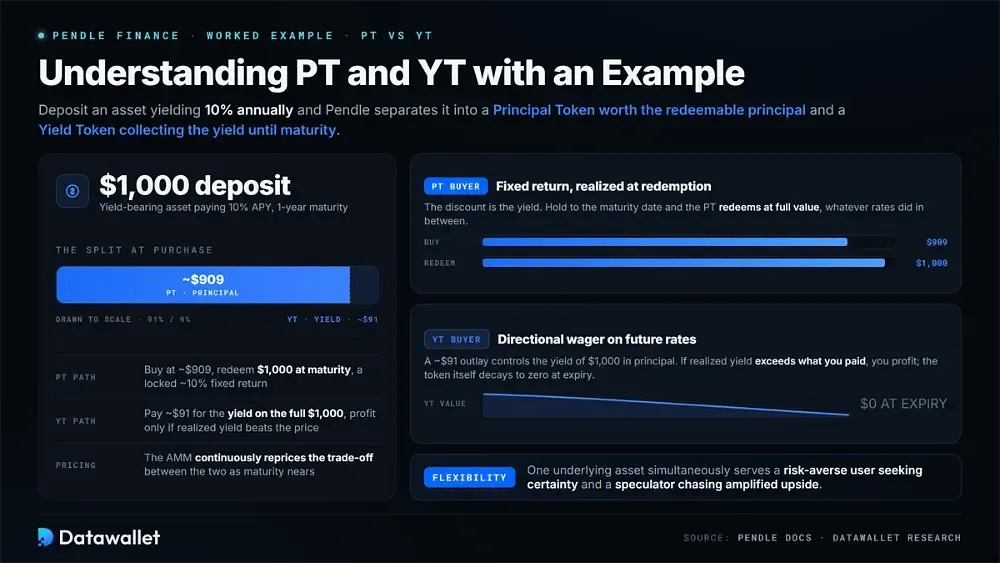
A simple example makes the split concrete. Suppose you deposit an asset yielding 10% annually; Pendle separates it into a Principal Token (PT) worth the redeemable principal and a Yield Token (YT) that collects the yield until maturity.
If you buy the PT at a discount, you lock in a fixed return realized when it redeems at full value on the maturity date. If you buy the YT instead, you profit only if the realized yield exceeds what you paid, making it a directional wager on future rates.
This separation is what unlocks Pendle's flexibility. The same underlying asset can simultaneously serve a risk-averse user seeking certainty and a speculator chasing amplified upside, with the AMM continuously pricing the trade-off between them as maturity nears.
Pendle Products and Strategies
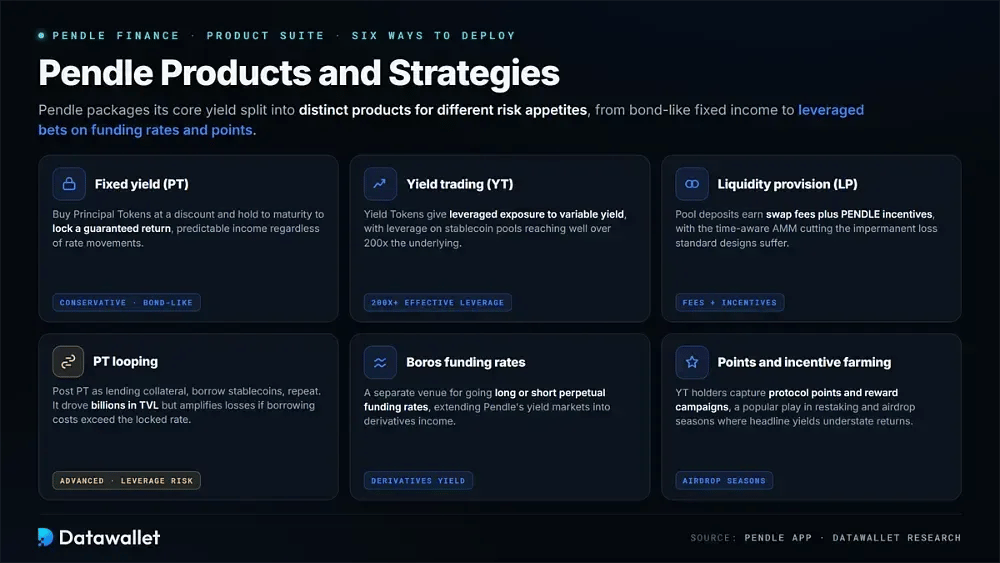
Pendle packages its core yield split into several distinct products, each serving a different risk appetite. Understanding what each one does clarifies how traders actually deploy capital on the platform:
- Fixed yield (PT): Buying Principal Tokens at a discount and holding to maturity locks a guaranteed return, the conservative, bond-like product that appeals to users wanting predictable income regardless of rate movements.
- Yield trading (YT): Purchasing Yield Tokens gives leveraged exposure to variable yield, letting bullish traders amplify returns if rates rise, with leverage on stablecoin pools reaching well over 200x the underlying.
- Liquidity provision (LP): Depositing into a pool earns swap fees plus PENDLE incentives, with the time-aware AMM concentrating liquidity near maturity to reduce the impermanent loss that standard designs suffer.
- PT looping: Advanced users post PT as collateral in lending markets, borrow stablecoins, and repeat to multiply fixed-yield exposure, a strategy that drove billions in TVL but amplifies losses if borrowing costs exceed the locked rate.
- Boros funding rates: The separate Boros venue lets traders take long or short positions on perpetual funding rates, extending Pendle's yield markets beyond spot assets into derivatives income.
- Points and incentive farming: YT holders capture protocol points and reward campaigns from underlying assets, a popular play during liquid restaking and airdrop seasons where headline yields understate total returns.
How Pendle Makes Money
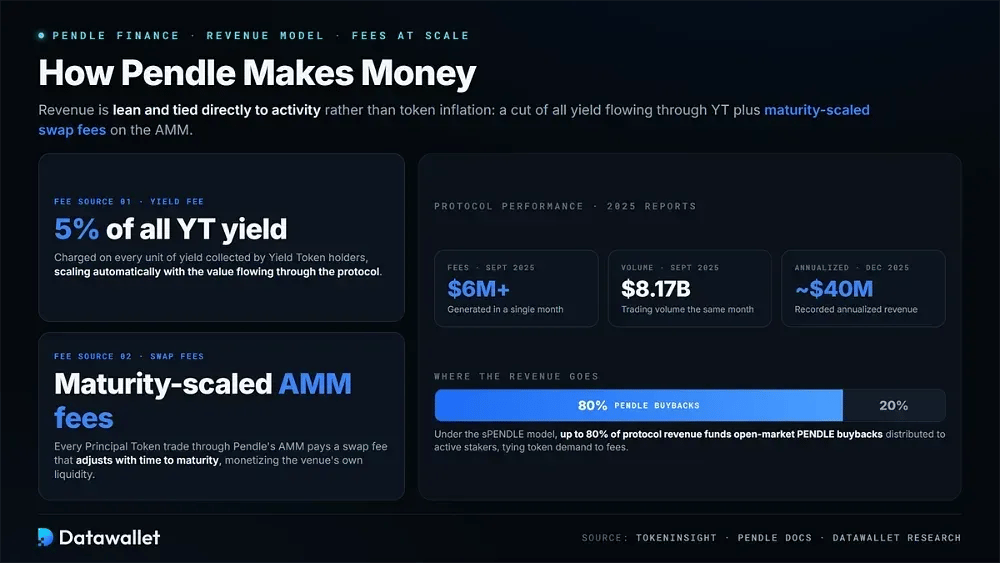
Pendle's revenue model is lean and directly tied to activity rather than token inflation. It charges a 5% fee on all yield collected by Yield Tokens, plus maturity-scaled swap fees on Principal Token trades executed through its AMM.
These fees add up at scale. In September 2025 the protocol generated over $6 million in fees on roughly $8.17 billion in trading volume, and by the December 2025 report it recorded around $40 million in annualized revenue, of which 80% now funds PENDLE buybacks under the sPENDLE model.
Pendle Yields and APYs in 2026
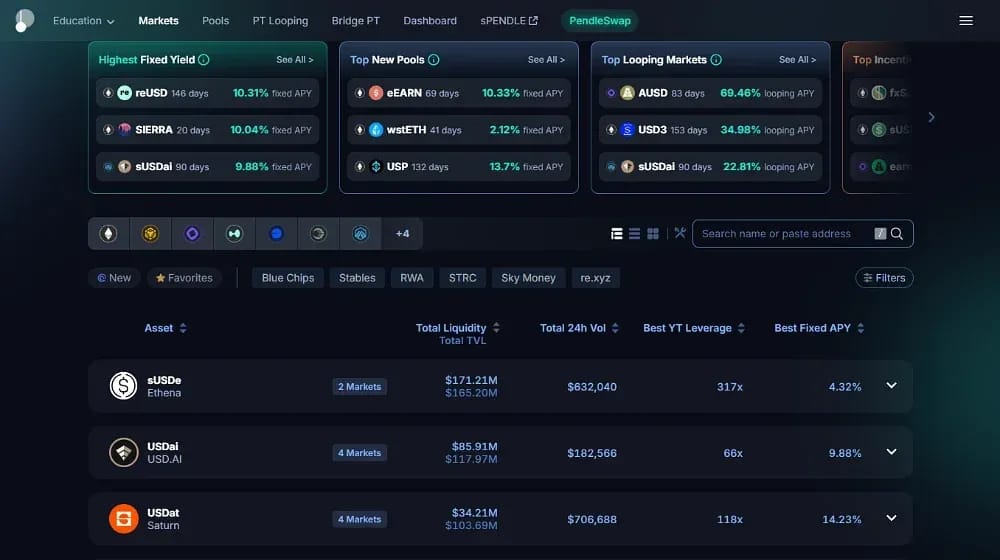
Pendle's main appeal is the yield itself, and rates vary widely by asset, maturity, and market conditions. The figures below reflect representative fixed APYs on major pools during mid-2026, though live rates shift constantly:
Two forces explain the spread. Stablecoin pools linked to newer or higher-risk protocols pay materially more than blue-chip staking assets like stETH, and the implied fixed APY on a PT typically runs one to three points below the underlying's spot rate, reflecting the premium buyers pay for certainty over floating stablecoin rates.
Yields are also path-dependent and can compress fast. Ethena's sUSDe rate, for instance, swung from above 12% to under 5% within months as perpetual funding cooled, which is precisely the volatility that makes Pendle's rate-locking useful for anyone wanting to fix a return before it fades.
For yield chasers, the YT side offers leveraged upside instead. Because a YT costs only a fraction of the underlying, a modest outlay controls the yield stream of a much larger notional, delivering outsized gains if realized yield beats the market's implied rate, or a total loss of the YT premium if it does not.
How to Use Pendle Finance
Getting started on Pendle is straightforward once you understand which strategy fits your goals. The workflow below covers connecting, choosing a market, and executing a fixed or variable yield position:
- Connect a wallet: Visit the Pendle app and connect a self-custodial wallet such as MetaMask, then select the network you want to trade on, whether Ethereum, Arbitrum, or another supported chain.
- Browse markets: Explore available pools, each showing the underlying asset, its maturity date, the fixed APY on PT, and the implied yield on YT, so you can compare opportunities before committing.
- Choose a strategy: Decide whether you want fixed yield by buying PT, leveraged yield exposure by buying YT, or liquidity provision to earn swap fees and incentives from a given pool.
- Buy PT for fixed yield: Purchase Principal Tokens at a discount to lock in a guaranteed return, redeemable one-for-one for the underlying asset when the pool reaches maturity.
- Buy YT for variable yield: Acquire Yield Tokens to gain amplified exposure to rising yields, remembering the token amortizes to zero at expiry, so timing and rate direction matter.
- Provide liquidity: Deposit into a Pendle pool to earn a share of trading fees plus PENDLE incentives, with the AMM designed to limit impermanent loss relative to a standard exchange.
- Manage at maturity: Redeem matured PT for the underlying, claim accrued yield from YT before expiry, or roll positions into a new maturity to maintain continuous exposure.
What is Boros and Funding Rate Trading?
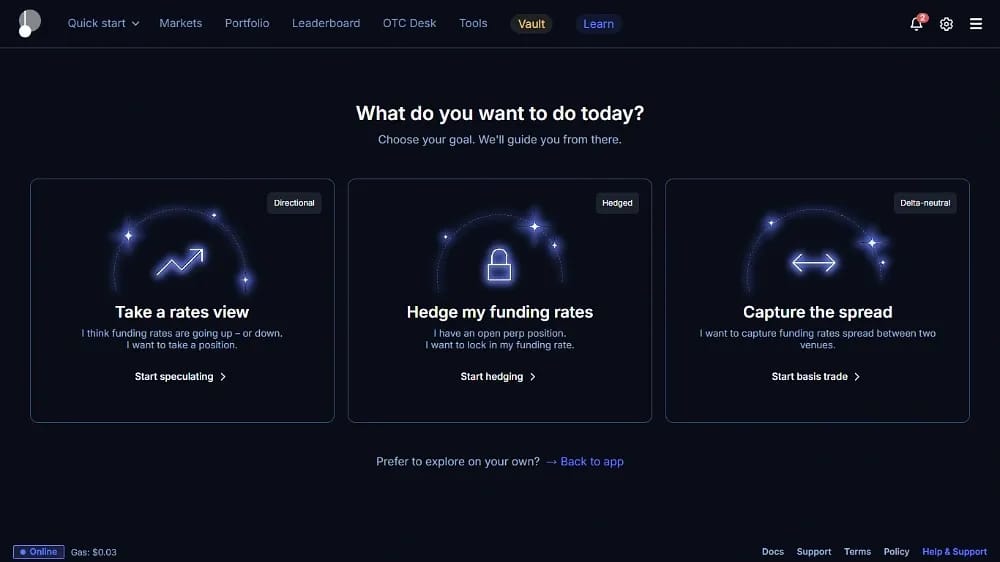
Pendle's biggest expansion is Boros, a platform that extends yield trading beyond onchain assets into the funding rates of perpetual futures. Launched in early 2025, it opened an entirely new market that was previously inaccessible through decentralized finance.
Boros works by tokenizing funding rates into Yield Units. Each YU represents the funding rate stream of one unit of an underlying asset, such as one BTC on Hyperliquid, letting traders take long or short positions on rates without holding the asset or betting on its price direction.
The addressable market is enormous. Perpetual funding rates see over $150 billion in daily volume, and Boros lets traders hedge funding costs, lock in fixed rates for cash-and-carry strategies, or arbitrage rate spreads between exchanges. Early testing reportedly recorded around $5.5 billion in notional volume and $730,000 in revenue.
Strategically, Boros matters because it diversifies Pendle's income away from pure TVL dependence. Where the core protocol's fees rise and fall with deposited assets, Boros generates trading-driven revenue that can hold up through TVL cycles, which is central to the team's 2026 growth thesis of becoming a full onchain rates venue.
$PENDLE Token and sPENDLE Tokenomics
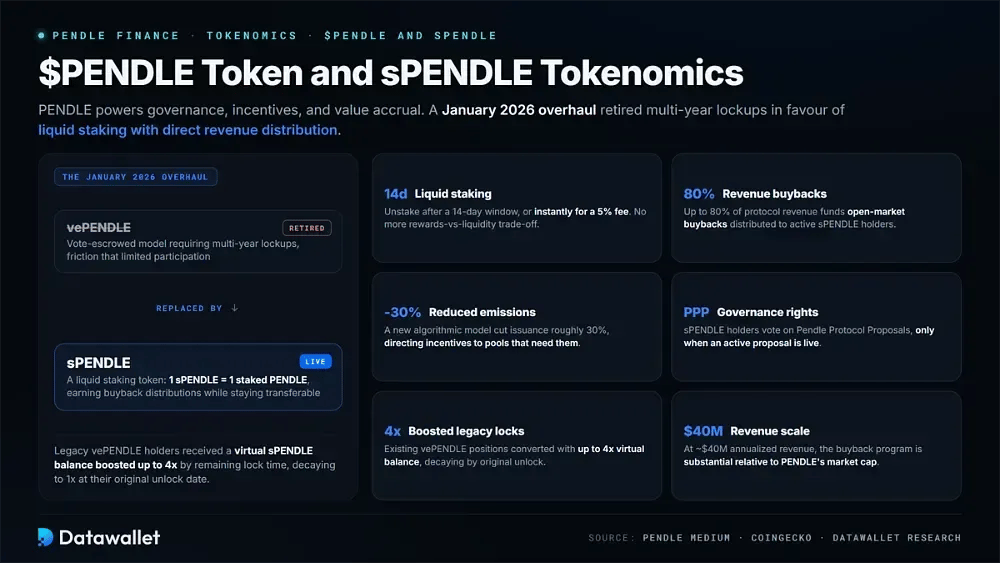
The PENDLE token powers the protocol's governance, incentives, and value accrual. It is an ERC-20 application utility token used to reward liquidity providers, direct emissions, and, since a major 2026 overhaul, distribute protocol revenue directly to stakers through buybacks.
The mechanics and rationale of the new system break down as follows:
- Liquid staking: sPENDLE represents one staked PENDLE and can be unstaked after a 14-day window, or instantly for a 5% fee, eliminating the previous trade-off between earning rewards and retaining liquidity.
- Revenue buybacks: Up to 80% of protocol revenue funds open-market PENDLE buybacks, which are distributed to active sPENDLE holders, tying token demand directly to the fees the protocol generates.
- Reduced emissions: A new algorithmic emissions model cut overall token issuance by roughly 30%, directing incentives to pools that genuinely need them rather than through manual gauge voting.
- Governance rights: sPENDLE holders vote on Pendle Protocol Proposals, retaining decentralized control over key decisions while only needing to vote when an active proposal is live.
- Boosted legacy locks: Existing vePENDLE holders received a virtual sPENDLE balance boosted up to 4x based on remaining lock time, decaying to 1x by their original unlock date.
- Revenue scale: With roughly $40 million in annualized protocol revenue, the 80% buyback allocation translates to a substantial repurchase program relative to PENDLE's market capitalization.
The defining change arrived in January 2026, when Pendle retired its vote-escrowed vePENDLE model in favour of sPENDLE, a liquid staking token. The move addressed the friction of multi-year lockups that had limited participation.
PENDLE Token Allocation Breakdown
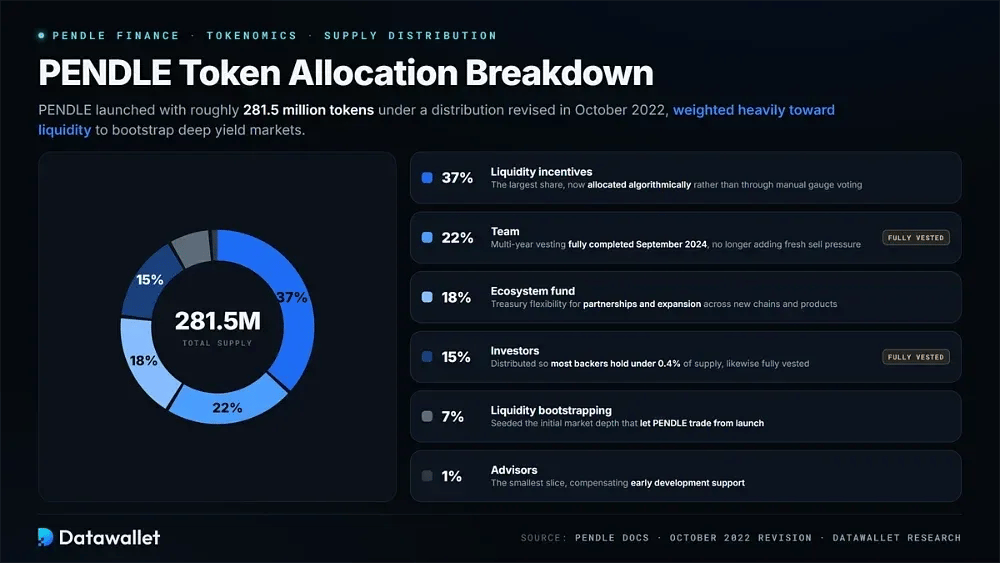
PENDLE launched with a total supply of roughly 281.5 million tokens under a distribution revised in October 2022, weighted heavily toward liquidity to bootstrap deep yield markets. The allocation breaks down as follows:
- Liquidity incentives: 37% directs the largest share to liquidity providers, reflecting the team's priority of building deep, liquid yield markets, now allocated algorithmically rather than through manual gauge voting.
- Team: 22% is reserved for the founding team under a multi-year vesting schedule, which reached full vesting in September 2024 and no longer adds fresh sell pressure.
- Ecosystem fund: 18% supports partnerships, integrations, and ecosystem growth initiatives, giving the protocol treasury flexibility to fund expansion across new chains and products.
- Investors: 15% went to backers, deliberately distributed so most individual investors hold under 0.4% of supply, and this allocation has likewise fully vested.
- Liquidity bootstrapping: 7% seeded the initial liquidity that let PENDLE trade from launch, establishing the early market depth needed for a functional token.
- Advisors: 1% compensates advisors who supported the protocol's early development, the smallest slice of the overall distribution.
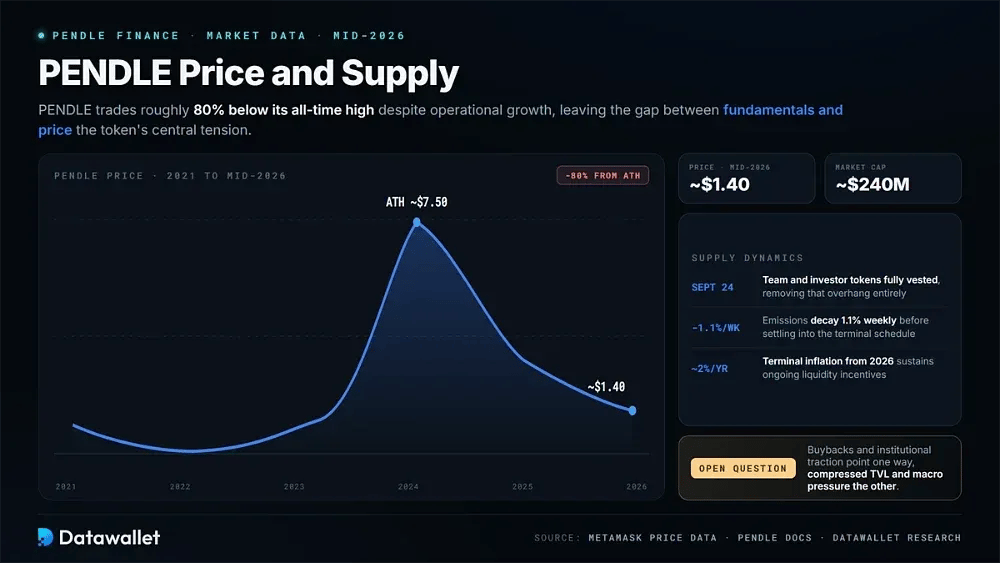
PENDLE Price and Supply
PENDLE has struggled against its history. After peaking near $7.50, the token traded around $1.40 by mid-2026 with a market capitalization near $240 million, sitting roughly 80% below its all-time high despite the protocol's operational growth.
Supply dynamics have stabilized meaningfully. Team and investor tokens fully vested back in September 2024, removing that overhang, and emissions decay 1.1% weekly before settling into a roughly 2% annual terminal inflation rate from 2026 to sustain ongoing liquidity incentives.
The central tension for the token is the gap between fundamentals and price. Buybacks, reduced emissions, and institutional traction point one way, while a compressed TVL and broader macro pressure on yield demand point the other, leaving PENDLE's re-rating an open question.
Citadels and the Institutional Push
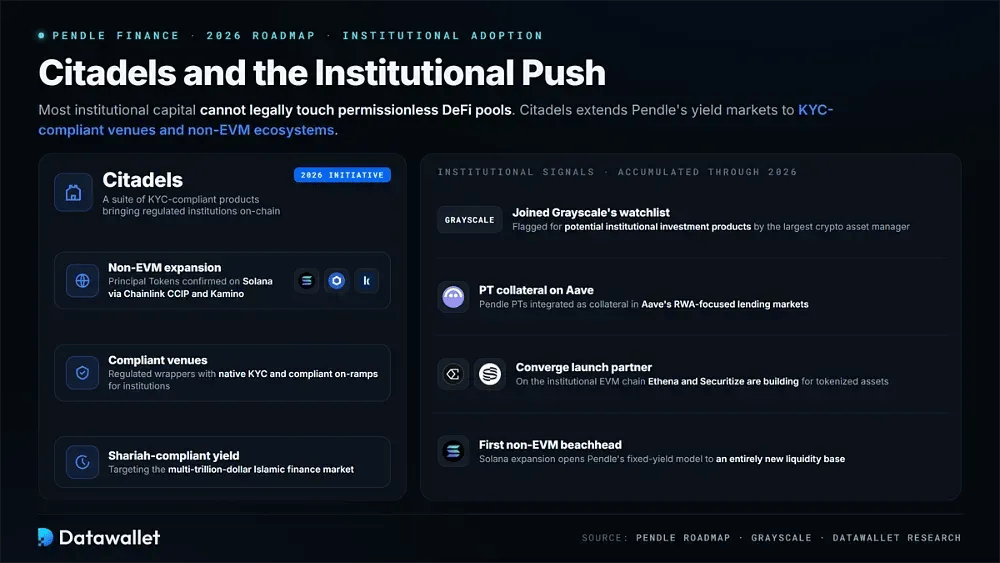
Pendle's most ambitious 2026 initiative is Citadels, a suite of KYC-compliant products designed to bring regulated institutions and traditional finance onchain. It addresses the reality that most institutional capital cannot legally touch permissionless DeFi pools.
Citadels extends Pendle's principal and yield markets to non-EVM ecosystems and compliant venues, including a confirmed expansion of Principal Tokens to Solana via Chainlink CCIP and Kamino. It also targets Shariah-compliant yield products, opening access to the multi-trillion-dollar Islamic finance market.
The institutional signals have accumulated through 2026. Pendle joined Grayscale's watchlist, its PT tokens were integrated as collateral in Aave's RWA-focused markets, and it became a launch partner on Converge, the institutional EVM chain that Ethena and Securitize are building with native KYC and compliant on-ramps for tokenized assets.
Is Pendle Finance Safe?
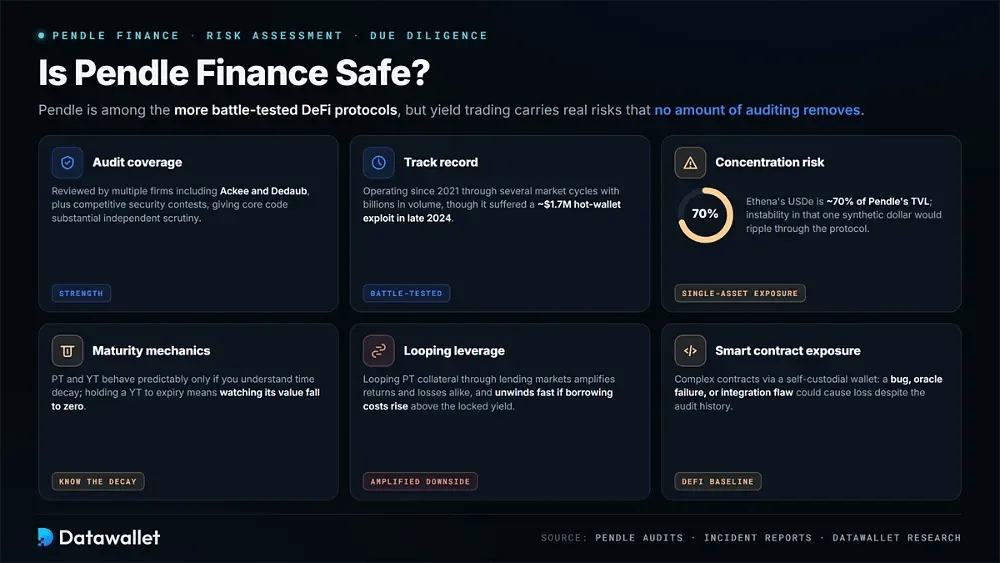
Pendle is among the more battle-tested DeFi protocols, but yield trading carries real risks that no amount of auditing removes. The following factors are worth weighing before committing capital:
- Audit coverage: Pendle's smart contracts have been reviewed by multiple firms including Ackee and Dedaub, alongside competitive audits through security contests, giving its core code substantial independent scrutiny.
- Track record: Operating since 2021 with billions in cumulative volume, Pendle has weathered several market cycles, though it did suffer a roughly $1.7 million hot-wallet exploit in late 2024.
- Concentration risk: Ethena's USDe accounts for around 70% of Pendle's total value locked, so any instability in that single synthetic dollar would ripple heavily through the protocol.
- Maturity mechanics: PT and YT values behave predictably only if users understand time decay, and holding a YT to expiry means watching its value fall to zero as yield runs out.
- Looping leverage: Popular strategies that loop PT collateral through lending markets amplify returns but also amplify losses, and they unwind fast if borrowing costs rise above the locked yield.
- Smart contract exposure: As with any DeFi platform, users interact with complex contracts through a self-custodial wallet, where a bug, oracle failure, or integration flaw could result in loss despite the extensive audit history.
Pendle vs Other Yield Protocols
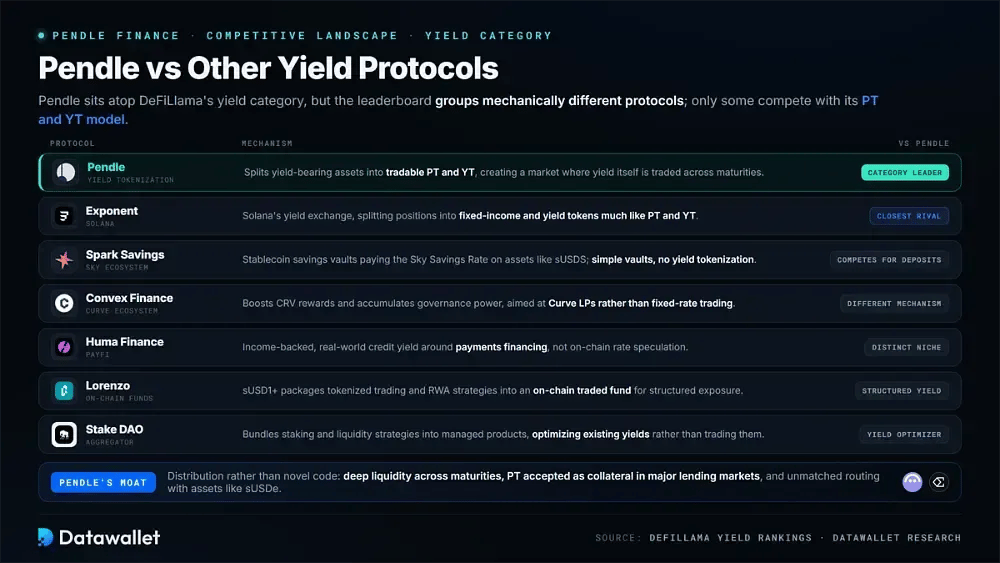
Pendle sits atop DeFiLlama's yield category, but the leaderboard groups mechanically different protocols, and only some directly compete with its PT and YT model.
Here is how the main yield venues stack up:
- Spark Savings: A Sky ecosystem product offering stablecoin savings vaults that pay the Sky Savings Rate on assets like sUSDS, Spark competes for yield-seeking deposits but uses simple savings vaults rather than tokenizing future yield.
- Convex Finance: Built around the Curve ecosystem, Convex boosts CRV rewards for liquidity providers and accumulates governance power, a completely different mechanism aimed at Curve LPs rather than fixed-rate yield trading.
- Exponent: The closest genuine rival to Pendle's model, Exponent is Solana's yield exchange, splitting positions into fixed-income and yield tokens much like PT and YT, effectively serving as the Solana-native counterpart to Pendle.
- Huma Finance: A PayFi protocol offering income-backed, real-world credit yield, Huma addresses a distinct niche around payments financing rather than the onchain rate speculation that defines Pendle's core markets.
- Lorenzo: Its sUSD1+ product packages tokenized trading and real-world-asset strategies into an onchain traded fund, targeting structured yield exposure instead of the tradable principal and yield split Pendle pioneered.
- Stake DAO: A long-running yield aggregator that bundles staking and liquidity strategies into managed products, Stake DAO optimizes existing yields rather than creating a market where yield itself is traded.
Pendle's moat: The protocol's advantage is distribution rather than novel code, spanning deep liquidity across maturities, PT acceptance as collateral in major lending markets, and unmatched routing and integration with assets like sUSDe.
Final Thoughts
Pendle has quietly become one of DeFi's most important primitives, building the infrastructure for onchain fixed income that barely existed a few years ago. By turning future yield into something tradable, it gave the market a way to price interest rates that traditional finance has relied on for decades.
The current chapter is about proving the next leg of growth. Boros is diversifying revenue beyond TVL, Citadels is courting institutions, and the sPENDLE overhaul has realigned tokenomics around buybacks, yet the token still trades far below its peak and TVL leans heavily on a single stablecoin.
For users, Pendle offers a genuinely useful toolkit for managing yield, whether locking in fixed returns or speculating on rates, provided the mechanics are well understood. As onchain fixed income matures and more protocols like Ethena integrate its tokens, Pendle's role as the rate-market layer of the ecosystem looks increasingly entrenched.