

Login to Track Your Live Crypto Portfolio
Sign Up and Track Your Live Crypto Portfolio for Free
Forgot your password?
Google Cuts Quantum Errors 40-Fold Raising Bitcoin Risk

This article has been reviewed and verified for accuracy by our editorial team. All claims, data points and platform details are cross-referenced against primary sources.
Some links on this page are affiliate links. Datawallet may earn a commission when you sign up through them, at no extra cost to you. This never influences our editorial ratings, rankings or recommendations.
Some links on this page are affiliate links. Datawallet may earn a commission when you sign up through them, at no extra cost to you. Ratings and rankings reflect our own testing and assessment criteria.

GM. Google said its Willow quantum chip cut errors about 40-fold when preparing magic states, chipping away at a hardware bottleneck behind any future attack on Satoshi-era bitcoin.
Elsewhere, Balaji Srinivasan's Network School bought Farcaster, a federal judge refused to scrap Gemini's $5 million CFTC settlement, and Russia confirmed peer-to-peer crypto trading ends July 1, 2027.
Pull up a chair, the full story waits just below. 👇
Google's Willow Cuts Quantum Errors 40-Fold Raising Bitcoin Risk
Google said its Willow chip cut errors about 40-fold when preparing magic states, the quantum fuel consumed by calculations that could one day crack bitcoin wallets. The result, published in Science, targets the hardware an attacker must devote to preparation rather than the raw size of the machine.
The method, called cultivation, starts with a rough state, checks it for errors and discards flawed attempts, reaching about 99.99% fidelity. Only about 8% of attempts survived inspection, roughly eight in every 100 tries, and scaling the process while keeping states usable through longer calculations remains unsolved.
The oldest coins are most exposed because their public keys have sat onchain since mining, giving a Shor's algorithm attacker ample time, while lost keys block any move to quantum-resistant addresses. On October 7, 100.02 Satoshi-era BTC moved after 16 years, following 553.59 BTC from dormant wallets in August.
Google estimated in March that a machine with fewer than 500,000 physical qubits could break the wallet cryptography behind Bitcoin and Ethereum, needing roughly 500,000 reliable magic states per second for a nine-minute attack. The new result tests that engineering path rather than cutting attack costs another 40 times.
Network School Buys Farcaster, Second Sale This Year
Balaji Srinivasan's Network School acquired Farcaster from Neynar, which had taken over the decentralized social network from Merkle Manufactory in January, on undisclosed terms. Neynar co-founders Rish and Manan will move on, while other staff join Network School to keep developing the app and protocol.
Rebranded the Network State Protocol, Farcaster now asks users to sign a social smart contract banning so-called digital felonies such as hate speech, scams and passing off AI content, with opt-ins receiving an access NFT. Those who decline get read-only access, and several users report bans over months-old posts.
Judge Refuses to Scrap Gemini's $5 Million CFTC Settlement
US District Judge Alvin Hellerstein denied a joint motion from Gemini and the Commodity Futures Trading Commission to vacate the $5 million settlement the Winklevoss-led exchange signed in January 2025. Neither the agency's shifting enforcement priorities nor alleged misconduct in its enforcement unit justified reopening a signed judgment.
The ruling keeps a permanent injunction barring Gemini from false or misleading statements to the CFTC, and the already-paid $5 million stays with the government. The charges date to 2022 and a proposed bitcoin futures product, while Gemini recently won CFTC approval to broaden prediction markets and perpetual futures.
Russia Bans Peer-to-Peer Crypto Trading From July 1, 2027
The Bank of Russia confirmed in updated guidance that direct crypto trades between individuals stay legal only until July 1, 2027, under Federal Law No. 282-FZ, which took effect September 1. After that date, residents may trade only through licensed brokers or registered exchange organizations.
Individuals also cannot move crypto from digital accounts to non-custodial wallets, and the rules end card deals swapping rubles for USDT, the main route since Binance exited Russia in 2023. Non-qualified investors face a 300,000 ruble yearly cap, about $3,600, with only bitcoin, ether and USDT allowed.
Data of the Day
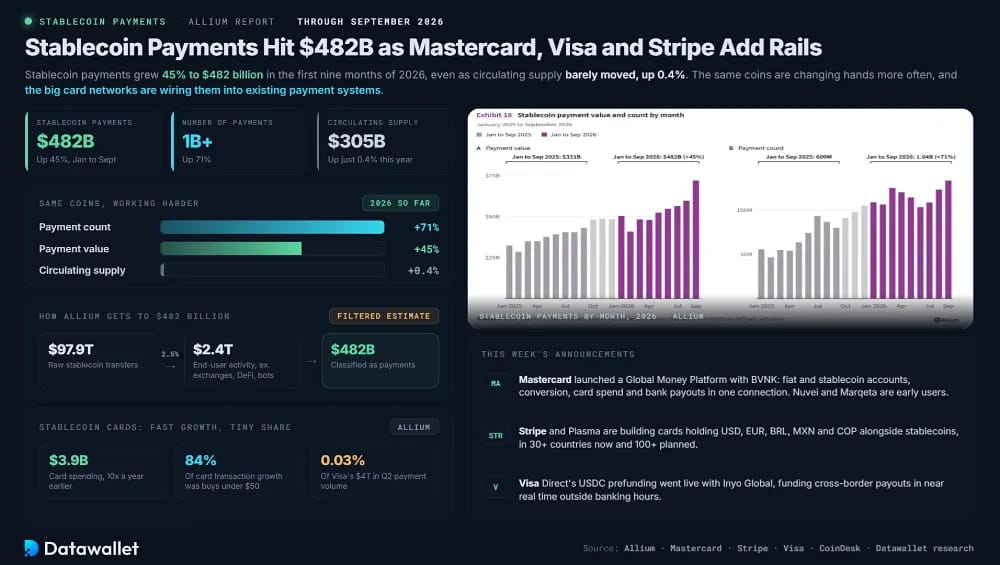
Stablecoin payments grew 45% to $482 billion in the first nine months of 2026, Allium found, while circulating supply barely moved, up 0.4% to about $305 billion. Payment counts jumped 71% to over 1 billion, and stablecoin-linked card spending hit $3.9 billion, ten times a year earlier.
Only $2.4 trillion of $97.9 trillion in raw transfers counted as end-user activity, and card spend equalled just 0.03% of Visa's second-quarter volume. Mastercard, Stripe and Visa each tied stablecoins to existing rails, with Visa Direct now letting payout firms prefund cross-border transfers in USDC.
More Breaking News
- Turkey confirmed Richard Heart's arrest, saying police seized $7.15 million in cash and six cold wallets across 15 Istanbul addresses, while his Hex token fell about 14%.
- Bitcoin ETFs shed $228.6 million over the week after the prior week's $681.1 million drain, leaving the spot bitcoin funds about $615 million down for October.
- TD Cowen lifted Strive's price target 27% to $56 after the firm grew holdings to 35,595 BTC, edging past MARA as the fourth-largest public bitcoin treasury.
- Circle said it paid $819 million to USDC partners and transaction costs in the first half, from $1.4 billion in revenue, keeping roughly 7 cents profit per dollar.
- Latvia could let residents pay taxes in crypto as early as next year, after parliament passed a law taxing withdrawals above deposits with a one-time 10% declaration option.
- OpenAI said a research model spent another wallet's Sepolia testnet ETH without authorization after scanning 362 addresses derived from common developer recovery phrases to finish a coding task.
- GTA 6's trailer flashed Dacity Coin, sending a copycat Solana meme coin 2,900% higher from a $104,000 market cap to $3.18 million within an hour.
- Helius CEO Mert Mumtaz joined NEAR's Foundation Council as NEAR Intents reports $33 billion in all-time volume, weeks after a $3.8 million exploit hit the protocol.
- Deutsche Bank is weeks from launching crypto custody in Germany, starting with bitcoin and ether before expanding the platform into Asian financial centers next year, per Reuters.
For the latest updates on digital asset markets, follow us on X @Datawalletcom.
Get tomorrow’s issue in your inbox