


Login to Track Your Live Crypto Portfolio
Sign Up and Track Your Live Crypto Portfolio for Free
Forgot your password?
Justin Sun Seeks Sanctions Over World Liberty's Hidden UAE Ties

This article has been reviewed and verified for accuracy by our editorial team. All claims, data points and platform details are cross-referenced against primary sources.
Some links on this page are affiliate links. Datawallet may earn a commission when you sign up through them, at no extra cost to you. This never influences our editorial ratings, rankings or recommendations.
Some links on this page are affiliate links. Datawallet may earn a commission when you sign up through them, at no extra cost to you. Ratings and rankings reflect our own testing and assessment criteria.
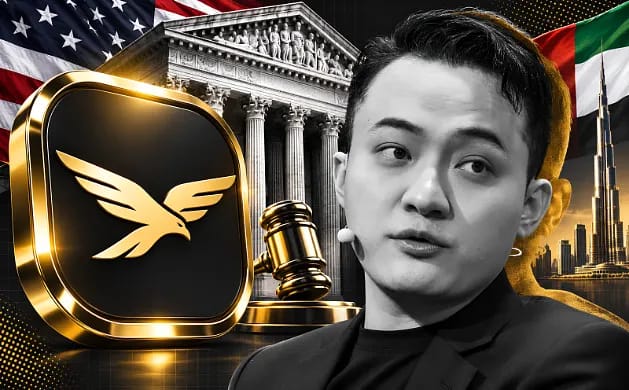
GM. Justin Sun filed for sanctions against World Liberty Financial, alleging the Trump-linked firm hid its UAE citizenship to escape federal court in their $45 million dispute.
Elsewhere, the CFTC approved single-stock perpetual futures for US exchanges, Binance completed a fresh proof of reserves after its record hack, and Aztec shipped a major privacy upgrade.
Settle in, the full rundown starts right below. 👇
Justin Sun Seeks Sanctions Over World Liberty's Hidden UAE Ties
Tron founder Justin Sun filed a motion seeking sanctions against World Liberty Financial, alleging the Trump-linked DeFi protocol concealed its United Arab Emirates citizenship until months into their legal fight. Sun, who says he invested $45 million in WLFI tokens, sued in April alleging fraud and unlawfully frozen holdings.
World Liberty's first court disclosure listed a single entity in its ownership chain and Florida as its sole citizenship. A later filing named 22 members and claimed citizenship in Florida, Delaware, Puerto Rico and the UAE, which Sun calls a ploy to challenge federal jurisdiction.
Federal diversity jurisdiction requires opposing parties to be citizens of different places, and a company inherits its owners' citizenship, so UAE ties could knock the case out of federal court. Sun said World Liberty was proudly American when selling tokens and discovered its UAE roots only when needing an exit.
Justin Sun plans to refile in California state court once the sanctions motion is resolved, while World Liberty countersued in May, calling his claims a meritless PR stunt. The WLFI token trades near $0.051, down from a $0.33 peak, for a fully diluted valuation of about $5.1 billion.
CFTC Approves First US Single-Stock Perpetual Futures
CFTC Chair Michael Selig approved perpetual futures tied to individual stocks for US exchanges for the first time, with oversight shared between the CFTC and the SEC. Perps carry no expiry date and let traders bet on price moves without owning the underlying asset directly.
Perps surged in popularity after US and Israeli strikes on Iran hit over a weekend, when oil futures were closed but 24/7 venues like Hyperliquid kept trading. The agency earlier cleared bitcoin perps for Kalshi and Coinbase, while President Trump said in August he wanted Hyperliquid brought onshore.
Binance Replenishes 95% of Hacked Assets, Publishes Reserves Proof
Binance completed a zero-knowledge proof of reserves snapshot, letting holders of BTC, ETH, USDT, BNB, SOL, USDC, XRP, USD1, RLUSD and ZEC verify their balances are backed 1:1. The exchange said it replenished about 95% of hacked assets with its own funds, still acquiring the remaining less-liquid tokens.
Co-CEO Yi He said each full zero-knowledge proof takes 40 to 50 hours to generate, with another snapshot planned as withdrawals return network by network. Binance's 24-hour net outflows eased to about $3.29 billion from a $7 billion peak, per DeFiLlama, which tracks roughly $127.78 billion in its wallets.
Aztec Tierra Cuts Ethereum Deposit Times to 12 Seconds
Privacy-focused Ethereum Layer 2 Aztec rolled out its Tierra upgrade, designated Alpha V6, fixing a critical vulnerability found in V5 and adding an AI-powered security testing harness plus formal verification of core cryptography. The network runs more than 3,000 validators with no privileged viewing keys or centralized sequencer.
Private transactions now generate client-side proofs in about one second, twice as fast, while messages from Ethereum drop from two minutes to as little as 12 seconds. The launch brings private apps including the revived zk.money payments app, AI inference platform Galactica and perpetuals venue Nemi.
Data of the Day
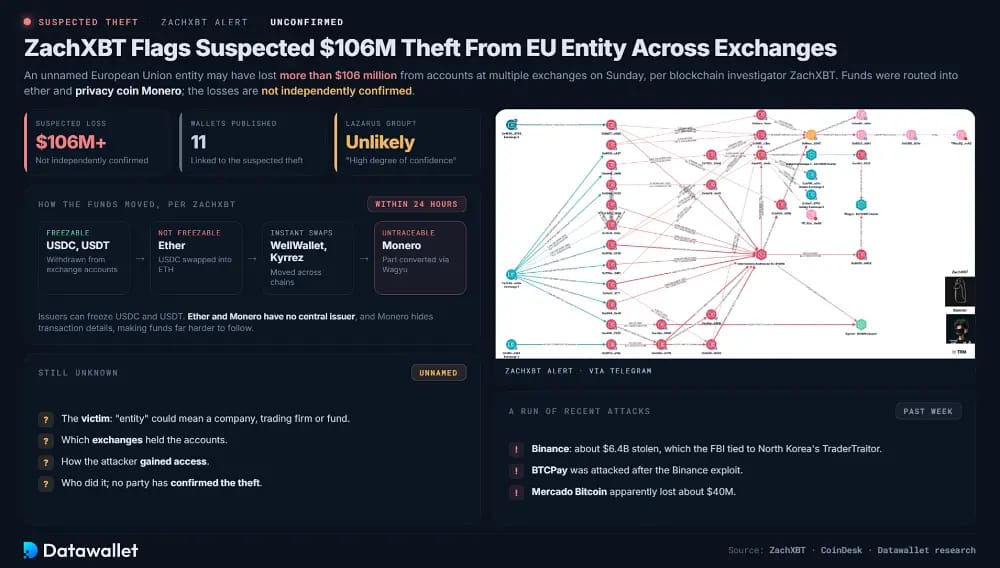
An unidentified EU entity may have lost more than $106 million from accounts at multiple crypto exchanges, according to blockchain investigator ZachXBT, though the losses remain unconfirmed. The attacker withdrew USDC and USDT, swapped into ether through instant-exchange services WellWallet and Kyrrez, and converted some into Monero via Wagyu.
ZachXBT published 11 linked wallet addresses and said he was highly confident North Korea's Lazarus Group was not responsible, citing multiple laundering indicators. The suspected theft follows the record Binance hack plus attacks on BTCPay and Brazil's Mercado Bitcoin, which apparently lost about $40 million.
More Breaking News
- Amazon, Tesla and SpaceX joined objectors to OKXICE's tokenized stock venue, lifting the tally to 56 as 49 of its 62 initially picked companies opted out.
- Binance blamed a fake job interview and an internal AI tool for the breach of its wallet-signing systems, saying it has frozen or intercepted $2.85 billion.
- Liquid Network restored full bitcoin backing for LBTC two months after a $320 million exploit, as Blockstream CEO Adam Back urged developers to treat AI-suggested fixes with suspicion.
- OpenUSD's issuer set a management fee of 0.1 basis point on payment volume, capped at $0.01 per payment, and offered partners equity based on their stablecoin holdings.
- NEAR governance approved cutting token issuance from 2.5% to 1.6% over 24 months, avoiding roughly 11.8 million NEAR in the first two years as staking yield falls.
- Moscow Exchange will open crypto trading on December 1 with bitcoin, ether and USDT, capping non-qualified investors at 300,000 rubles, about $3,700, a year per broker.
- Kim Jong-un's sister rejected FBI claims that North Korea's TraderTraitor group was behind the record $6 billion Binance hack, calling the attribution a grave political provocation.
- Leaks hint at Claude Fable 5.5 and GPT-6.2 Astra, as users report Opus 5.5 rerouting and a Mythos 5.5 label surfaced in Anthropic's site code.
For the latest updates on digital asset markets, follow us on X @Datawalletcom.
Get tomorrow’s issue in your inbox