

Login to Track Your Live Crypto Portfolio
Sign Up and Track Your Live Crypto Portfolio for Free
Forgot your password?
KPMG Signs Off on Tether's First Financial Audit

This article has been reviewed and verified for accuracy by our editorial team. All claims, data points and platform details are cross-referenced against primary sources.
Some links on this page are affiliate links. Datawallet may earn a commission when you sign up through them, at no extra cost to you. This never influences our editorial ratings, rankings or recommendations.
Some links on this page are affiliate links. Datawallet may earn a commission when you sign up through them, at no extra cost to you. Ratings and rankings reflect our own testing and assessment criteria.

GM. Tether said KPMG issued an unqualified opinion on its 2025 financial statements, calling it the largest inaugural financial audit in history after years of scrutiny over reserves.
Elsewhere, SafePal disclosed a breach exposing nearly 40,000 customers, a hacker began selling French tax records tied to 678,000 taxpayers, and Harvard left its Bitcoin ETF stake untouched.
Read the full issue below. 👇
KPMG Signs Off on Tether's First Financial Audit
Tether said KPMG issued an unqualified opinion on the 2025 financial statements of Tether International, the entity behind the world's largest stablecoin. The company billed the review as the largest inaugural financial audit in history.
KPMG examined assets, liabilities, income, cash flows, internal systems, records, counterparties, and supporting documentation. Auditors physically counted and inspected every individual gold bar the firm holds, verifying each rather than relying on reports from custodians or counterparties.
An unqualified opinion means auditors found no major problems with how the statements were presented. It stops short of endorsing the business or guaranteeing USDT can meet its obligations, a distinction that matters given the company's history.
Reserves and disclosures have drawn sustained scrutiny for years. Tether settled with New York in 2021 over an $18.5 million fine, then paid $41 million to the CFTC over claims the token was fully dollar-backed, with CEO Paolo Ardoino framing the audit as vindication.
SafePal Breach Exposes Data of Nearly 40,000 Customers
SafePal said an authorization flaw in its order-tracking system allowed unauthorized access to personal data belonging to roughly 39,798 customers. Exposed details span names, emails, shipping addresses, phone numbers, and purchase records for orders placed since March 2025.
Seed phrases, private keys, and wallet credentials were untouched, the company said, though it warned attackers may impersonate staff offering firmware updates or replacements. The disclosure follows breaches at shipping partners used by rival hardware wallet makers Trezor and Ledger.
France Tax Data Leak Could Fuel Attacks on Holders
A hacker is selling tax records allegedly stolen from France's DGFiP covering 678,437 people and businesses, offered for several thousand euros. The sample includes names, home addresses, phone numbers, income figures, withholding rates, and family details.
Among those exposed are 26,805 people with reference income above $116,000 and eight above $11.6 million, handing criminals a targeting list. The leak lands as France records the most wrench attacks worldwide, with 33 of 52 global incidents this year.
Harvard Leaves Bitcoin ETF Stake Untouched After Cuts
Harvard's endowment reported an unchanged position of 3,044,612 IBIT shares worth $101.4 million, pausing two consecutive quarters of selling. The $15.6 million drop in value tracked price declines rather than any disposal.
The university now holds more in gold products at $171.2 million than in Bitcoin funds. Abu Dhabi's Mubadala and Investment Council also held their combined 22.9 million shares steady, while Morgan Stanley trimmed and JPMorgan added.
Data of the Day
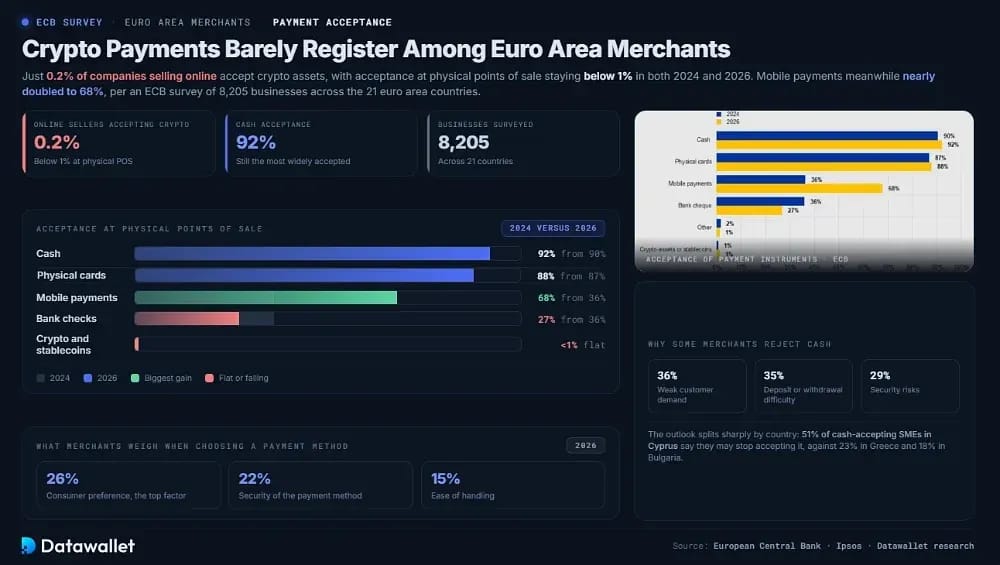
Just 0.2% of euro area companies selling online accept crypto assets, according to a European Central Bank survey of 8,205 businesses across 21 countries. Acceptance at physical points of sale stayed below 1% in both 2024 and 2026.
Mobile payments meanwhile leapt to 68% acceptance from 36% two years earlier, while cash edged up to 92%. Merchants ranked consumer preference as the top criterion at 26%, suggesting demand rather than infrastructure limits paying with crypto.
More Breaking News
- Binance will block transactions with 16 platforms under EU Russia sanctions, including HTX, whose owner Justin Sun said settlement talks with regulators are already underway.
- The EU's crypto cleanup triggered a scam wave, with fraudsters impersonating regulators as up to 10 million users relocate funds toward MiCA-licensed platforms.
- Trump-linked World Liberty won a conditional bank charter to issue its USD1 stablecoin, with the OCC requiring $20 million in capital and compliance with the GENIUS Act.
- Hackers exploited a macOS Screen Sharing flaw to install Monero miners, taking full control of internet-facing Macs in a vulnerability US officials rated a critical 9.8 out of 10.
- SharpLink will stake $200 million of ether through Lido, roughly 12% of its holdings, receiving wstETH that keeps earning yield while remaining usable as collateral.
- Bank Leumi tapped Galaxy to offer crypto trading from early 2027, making Israel's largest bank the first there to put Bitcoin, ether, and solana inside its investment app.
- JPMorgan cut banking ties with the prediction market last October yet still wants an underwriting role should Polymarket eventually pursue a public listing.
- Strategy and Metaplanet face index exclusion under an MSCI proposal targeting non-operating companies, a screen that would delete both Bitcoin treasuries from its global benchmark.
For the latest updates on digital asset markets, follow us on X @Datawalletcom.
Get tomorrow’s issue in your inbox