



Compare Top Platforms to Buy Pokémon Cards With Crypto
1. Collector Crypt
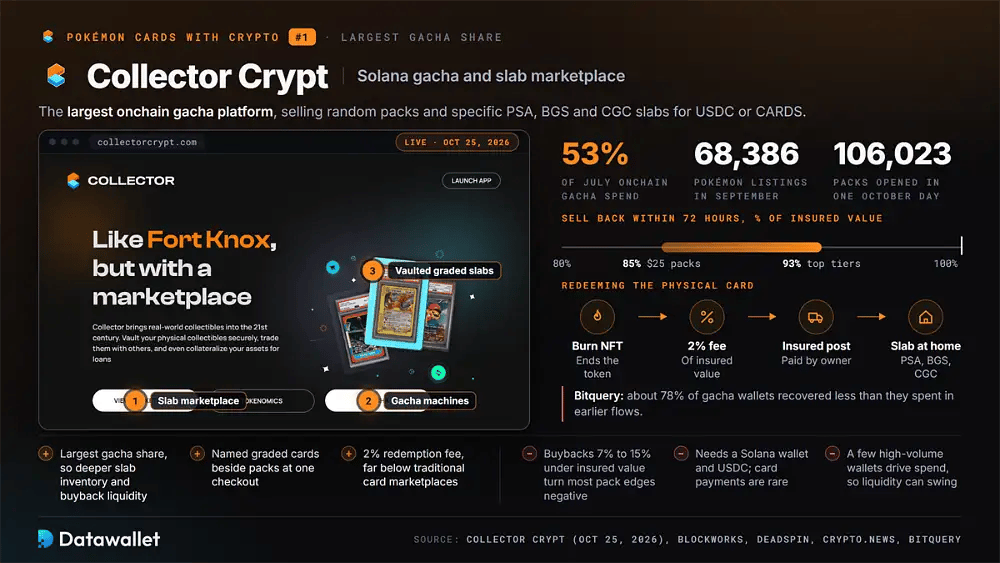
Collector Crypt processed more onchain gacha spend than any competitor in July 2026, taking 53% of the monthly total in Blockworks' count. Its Solana marketplace also sells individual PSA, BGS and CGC slabs, with Deadspin counting 68,386 Pokémon listings in September. Checkout settles in USDC or the platform's CARDS token.
Gacha machines range from $25 starter packs to $5,000 tiers, with odds displayed per machine and draws resolved by onchain randomness. Any pull can be sold back within 72 hours for 85% to 93% of its insured value, and costlier packs carry the higher rates. Our Collector Crypt explainer covers the CARDS token and buyback program.
To receive a card, the owner burns its NFT, pays a 2% vault withdrawal fee on insured value, and covers insured shipping. Demand remains heavy: Crypto.news reported 106,023 pack openings on a single day in October. A Bitquery investigation of earlier flows found roughly 78% of gacha wallets recovered less than they spent.
Pros
- Holds the largest share of onchain gacha spend, so slab inventory and buyback liquidity run deeper than on smaller rivals.
- Sells specific graded cards alongside gacha packs, giving buyers a non-random option at the same checkout.
- Charges a 2% redemption fee, well below the double-digit selling costs on traditional card marketplaces.
Cons
- Buyback quotes sit 7% to 15% below insured value, which turns most advertised pack edges negative in cash terms.
- Requires a Solana wallet and USDC, since card payments make up only a small share of activity.
- Spending is concentrated among a small group of high-volume wallets, which can make liquidity swing sharply.
2. Courtyard
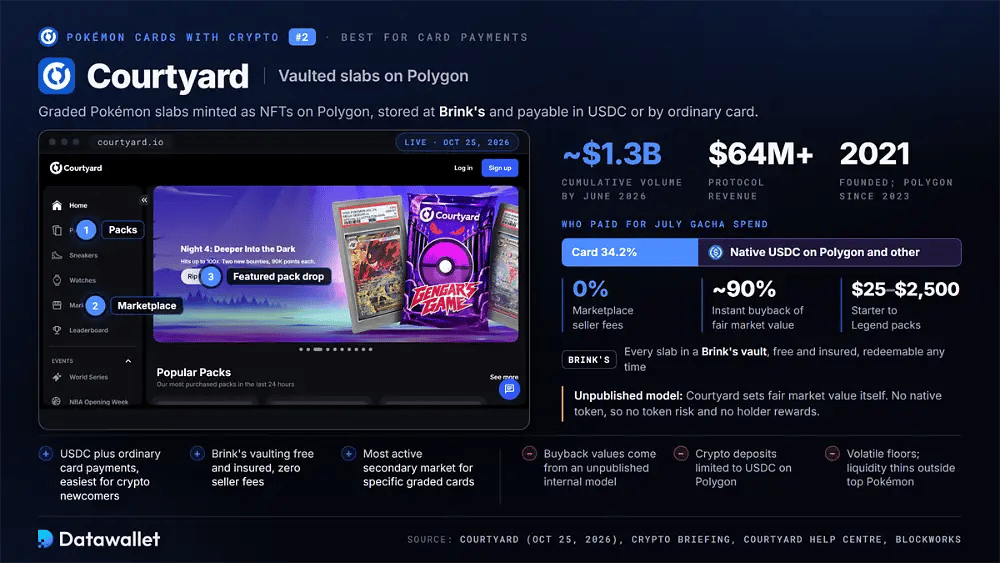
Founded in 2021, Courtyard mints graded Pokémon slabs as NFTs on Polygon after moving from Ethereum in 2023. Every card sits in a Brink's vault, and the owner can redeem it whenever they choose. Crypto Briefing reported cumulative volume near $1.3 billion and protocol revenue above $64 million by June 2026.
Crypto buyers fund a wallet with native USDC on Polygon, as described in the Courtyard help centre. Card, Apple Pay and Google Pay checkout also works, and Blockworks found cards covered 34.2% of July gacha spend. Packs run from $25 Starter to $2,500 Legend tiers, and marketplace sellers pay no fees.
The instant buyback pays about 90% of fair market value, though Courtyard sets that value through its own unpublished model. Redemption burns the NFT and adds a small per-card handling charge plus postage. Courtyard has no native token, which removes token-price risk from the platform but also removes any holder rewards.
Pros
- Accepts USDC alongside ordinary card payments, the easiest mix for collectors new to crypto.
- Stores every slab with Brink's, with free insured vaulting and zero seller fees on the marketplace.
- Runs the most active secondary market for specific graded cards among the platforms reviewed.
Cons
- Fair market values for buybacks come from an internal model that Courtyard does not publish.
- Crypto deposits are limited to USDC on Polygon, so other tokens need a swap or bridge first.
- Card floor prices have proven volatile, and liquidity thins quickly outside sought-after Pokémon.
3. Phygitals
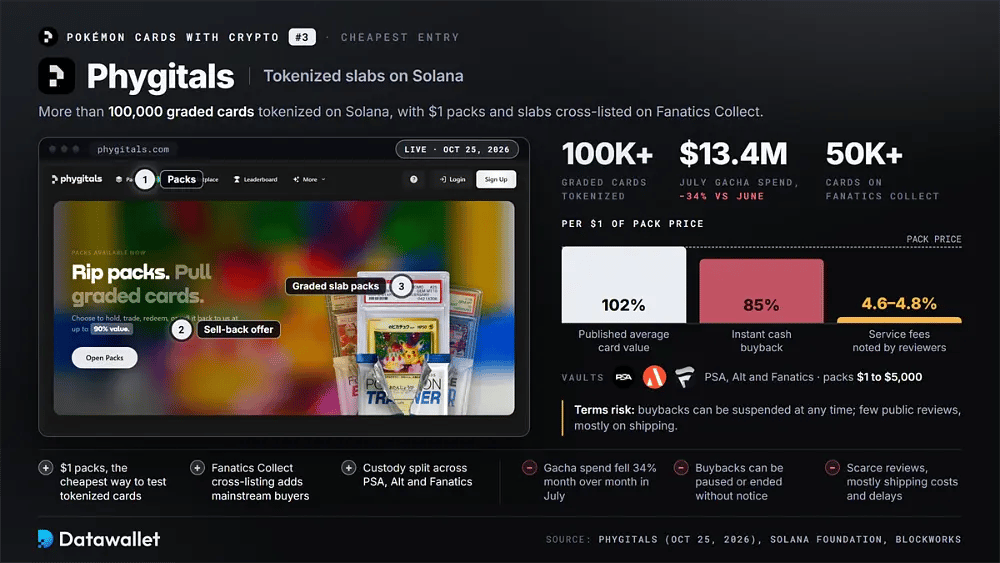
Phygitals began as a Solana Pokémon marketplace and now tokenizes more than 100,000 graded cards, according to the Solana Foundation. Slabs are stored with PSA, Alt and Fanatics. On 25 April 2026, it opened a Fanatics Collect storefront with over 50,000 cross-listed cards, reaching collectors who pay in dollars.
Pack prices span $1 to $5,000, the widest range in this comparison, and odds appear before each purchase. Phygitals publishes an average return of roughly 102% of pack price in card value. Its instant buyback pays 85% of market value in cash, while reviewers have noted service fees of about 4.6% to 4.8%.
Activity is smaller than at the two leaders. Blockworks put July gacha spend at $13.4 million, down 34% from June. Its terms allow the buyback to be suspended at any time, and the handful of public Trustpilot reviews concern shipping costs and delays.
Pros
- Offers $1 packs, the cheapest entry point for collectors testing tokenized cards with small USDC amounts.
- Cross-lists vaulted cards on Fanatics Collect, adding a large mainstream buyer pool for resale.
- Splits custody across PSA, Alt and Fanatics vaults rather than a single storage provider.
Cons
- Gacha spend fell 34% month over month in July, signalling thinner activity than larger rivals.
- The terms allow buybacks to be paused or discontinued without notice.
- Public user reviews are scarce and mostly concern shipping costs and delivery delays.
4. Jupiter Gacha
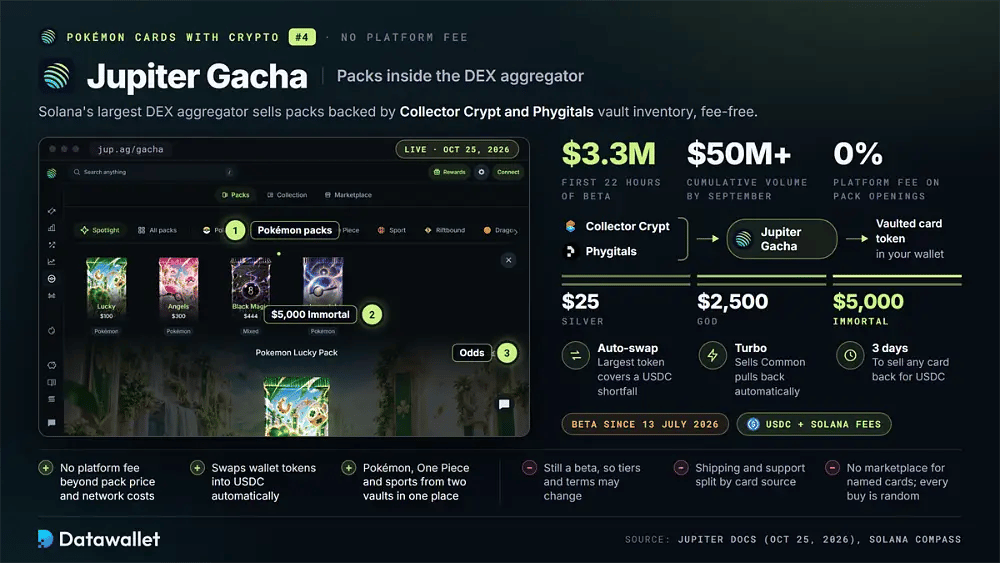
Jupiter, Solana's largest DEX aggregator, launched Jupiter Gacha in beta on 13 July 2026. Packs draw on Collector Crypt and Phygitals inventory, so every pull is a token backed by a vaulted card. The product handled $3.3 million in its first 22 hours, and Solana Compass reported cumulative volume above $50 million by September.
Jupiter's documentation states that opening packs carries no platform fee: buyers pay the USDC price plus Solana network fees. When a wallet lacks USDC, the app offers to swap the shortfall from its largest token balance. Pokémon tiers run from the $25 Silver pack to the $2,500 God and $5,000 Immortal packs.
A Turbo toggle sells Common pulls back automatically, and any card can be sold back for USDC within three days. Shipping depends on the supplier: Collector Crypt ships its cards from Jupiter, while Phygitals cards ship through Phygitals' own site. Our DEX aggregator guide explains Jupiter's swap routing.
Pros
- Charges no platform fee on pack openings beyond the pack price and Solana network costs.
- Swaps other wallet tokens into USDC automatically, removing a separate exchange step before buying.
- Combines two vault providers' inventory, including Pokémon, One Piece and sports packs, in one interface.
Cons
- Still labelled a beta product, so features, tiers and terms may change.
- Shipping and support are split between Collector Crypt and Phygitals depending on the card's source.
- Lacks a marketplace for buying specific named cards, so every purchase is randomized.
5. Beezie
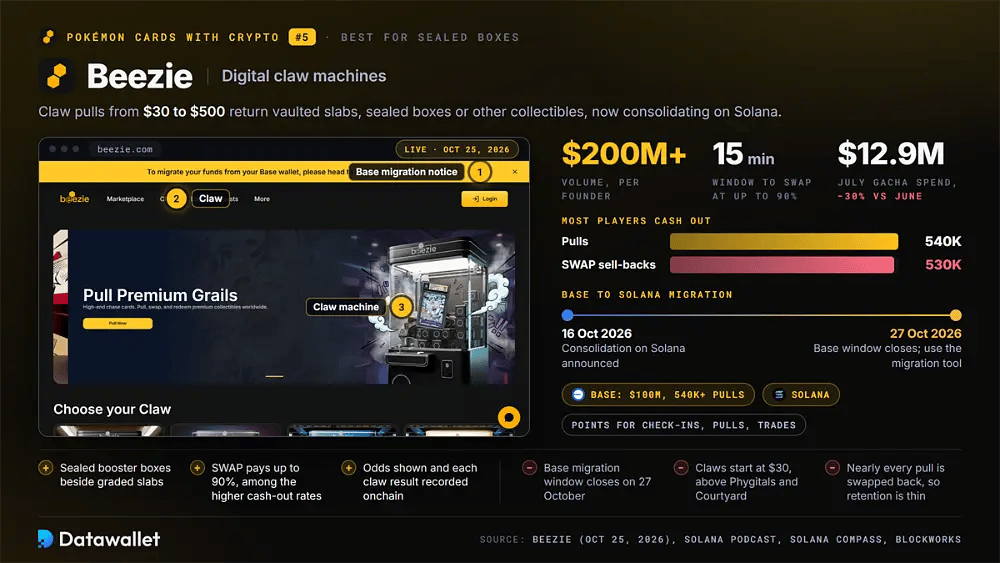
Beezie replaces packs with digital claw machines, where each pull costs $30 to $500 and returns a vaulted graded card, sealed box or other collectible. It reported more than 540,000 pulls and $100 million of Base volume before adding Solana. Founder Andrea Miele told a Solana podcast that volume had passed $200 million.
The SWAP feature trades any pull for up to 90% of fair market value within 15 minutes. Usage data suggests most players cash out: Beezie disclosed 530,000 swaps against 540,000 pulls. A peer-to-peer marketplace handles listings for specific items, and a points program rewards daily check-ins, pulls and trades with discount codes, free pulls and cards.
The platform is mid-migration. On 16 October 2026, Beezie said it would consolidate on Solana, and Solana Compass reported that the Base window closes on 27 October. Holders on Base must move their collectibles using the migration tool. July gacha spend reached $12.9 million, down 30% from June.
Pros
- Sells sealed booster boxes alongside graded slabs, which most gacha platforms do not offer.
- Pays up to 90% on swaps, among the higher instant cash-out rates in this group.
- Shows odds and records each claw result onchain for later verification.
Cons
- The Base-to-Solana migration closes on 27 October, so Base holders must act quickly.
- Its claw machines start at $30, above the entry prices at Phygitals and Courtyard.
- Swap data shows nearly every pull is sold back, pointing to thin collector retention.
6. rip.fun
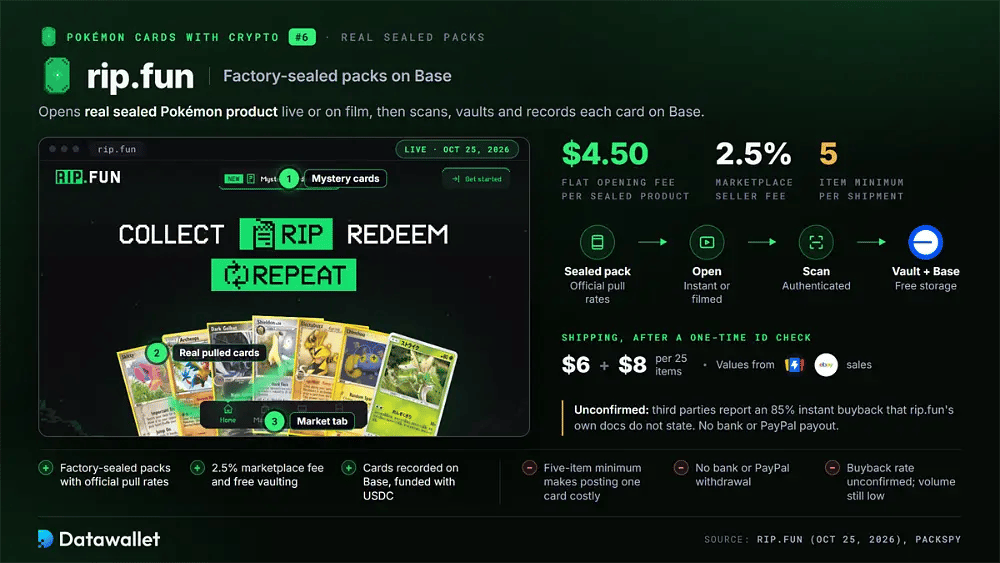
rip.fun stocks real sealed Pokémon product instead of pre-graded slabs: booster packs, Elite Trainer Boxes and booster boxes. Buyers pick an instant reveal or a filmed opening of their exact pack. Each card is scanned, authenticated, vaulted at no charge, and recorded on Base, Coinbase's Ethereum layer 2.
Balances are held as USDC on Base, and sealed products carry a flat $4.50 opening fee. Marketplace sales cost 2.5%, the lowest seller fee here after Courtyard. Because the packs are factory-sealed, pull odds follow Pokémon's printed rates rather than a machine table. Card values come from completed sales on TCGplayer and eBay.
Shipping costs $6 plus $8 per 25 items, with a five-item minimum and a one-time identity check, according to PackSpy's review. There is no direct bank or PayPal payout. Third parties report an 85% instant buyback that rip.fun's own documentation does not confirm. Public review history remains thin for this newer platform.
Pros
- Opens factory-sealed packs with official pull rates, the closest online match to buying booster packs.
- Charges a 2.5% marketplace fee and offers free vaulting for as long as cards are held.
- Records every card on Base, a low-fee network funded directly with USDC.
Cons
- Requires at least five items per shipment, raising the cost of posting a single card.
- Has no direct bank or PayPal withdrawal, so value stays in USDC and cards.
- The buyback rate is not confirmed in official documentation, and volume remains low.
7. Bitrefill
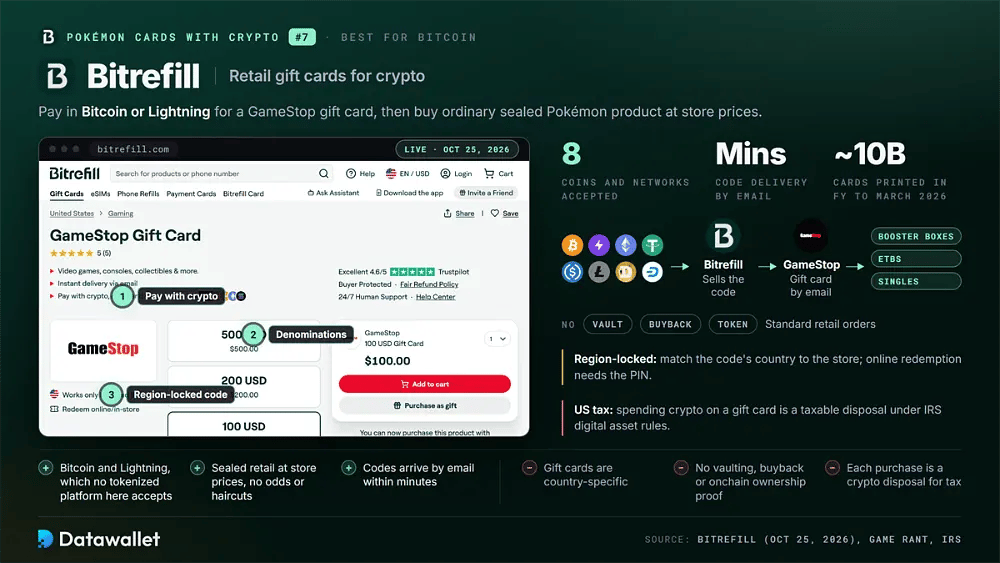
Bitrefill suits collectors who want ordinary retail Pokémon products rather than tokenized cards. GameStop does not take crypto, but Bitrefill sells regional GameStop gift cards payable in Bitcoin, Lightning, Ether, USDT, USDC, Litecoin, Dogecoin and Dash. Codes arrive by email, and the balance can buy booster boxes, Elite Trainer Boxes and singles.
Purchases made this way are standard retail orders. There is no vault, buyback or token, and sealed product ships from the retailer. Codes are region-locked, and online redemption needs the card's PIN. Bitrefill also lists other retailer gift cards, so collectors should match the code's country with the store they plan to use.
Retail stock remains tight around new releases. The Pokémon Company printed about 10 billion cards in the fiscal year ending March 2026, and Game Rant reported that production still lagged demand. In the United States, spending crypto on a gift card counts as a taxable disposal under IRS digital asset rules.
Pros
- Works with Bitcoin and Lightning, which none of the tokenized platforms in this list accept.
- Buys sealed retail products at store prices without gacha odds or buyback discounts.
- Delivers gift card codes by email within minutes of payment confirmation.
Cons
- Gift cards are country-specific, so availability depends on the retailer's region.
- Offers no vaulting, buyback or onchain proof of ownership.
- Turns each purchase into a crypto disposal that may need reporting for tax purposes.
How to Choose a Platform to Buy Pokémon Cards With Crypto
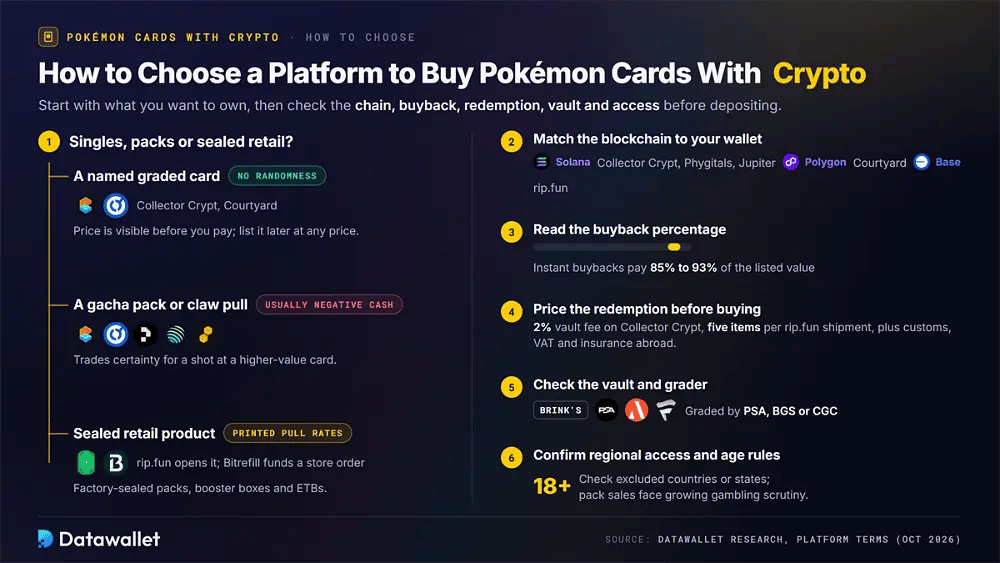
The right platform depends on whether you want a named card, a random pull, or sealed retail product. Payment tokens, buyback terms and shipping rules differ more than pack art suggests. We check six points before depositing.
- Decide between singles and packs: Buying a specific graded card on Collector Crypt or Courtyard removes randomness entirely. Gacha packs and claw pulls trade that certainty for a chance at a higher-value card, usually with a negative cash return once buybacks are counted.
- Match the blockchain to your wallet: Collector Crypt, Phygitals and Jupiter Gacha run on Solana, Courtyard on Polygon, and rip.fun on Base. Holding USDC on the correct network avoids bridging fees; our Solana wallet comparison covers suitable options.
- Read the buyback percentage: Advertised expected values use market or insured prices, but instant buybacks pay 85% to 93%. That gap decides what a pull is really worth if you sell immediately.
- Price the redemption before buying: Collector Crypt adds a 2% vault fee, while rip.fun requires five items per shipment. Customs, VAT and insurance apply to international deliveries, so low-value cards can cost more to ship than they are worth.
- Check the vault and grader: Look for named custodians such as Brink's, PSA, Alt or Fanatics, plus PSA, BGS or CGC grading. A token is only as reliable as the company storing the physical card.
- Confirm regional access and age rules: Gacha and pack platforms require users to be 18 or older, and pack sales face growing gambling scrutiny. Review the terms for excluded countries or states before funding an account.
Gacha Packs vs Buying Singles: What a Pull Really Costs
Pack platforms advertise expected values above the ticket price, yet most buyers finish behind. The difference comes from how card value is measured, how buybacks are priced, and which fees appear only after the reveal.
How Instant Buybacks Change the Expected Value
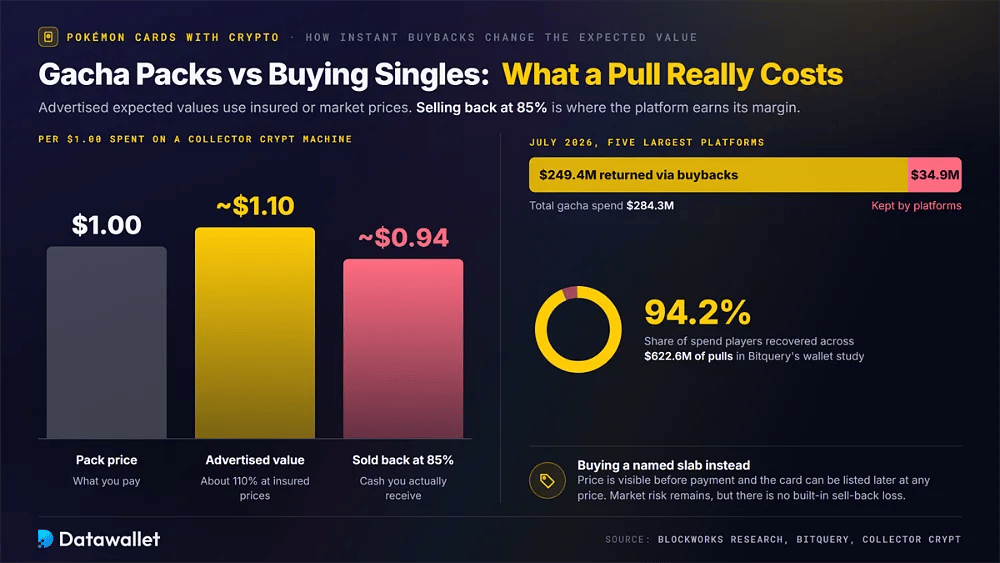
Gacha operators price each pull against an insured or fair market value, often drawn from eBay, ALT or TCGplayer sales. Collector Crypt's machines have historically advertised returns near 110% on that basis. Selling back at 85% converts the same pull to about 94 cents per dollar, which is where the platform earns its margin.
Realized flows confirm the gap. In July 2026, the five largest platforms took in $284.3 million of gacha spend and returned $249.4 million through buybacks, keeping $34.9 million, according to a Blockworks Research report. Bitquery's wallet study found players recovered 94.2% of what they spent across $622.6 million of pulls.
Buying a named slab avoids that discount. The purchase price is visible before payment, and the card can be listed later at any price. Singles still carry market risk, since graded Pokémon prices move with demand, but buyers avoid the mechanical loss built into an immediate sell-back. Collectors chasing one card usually spend less this way.
Hidden Costs to Budget For
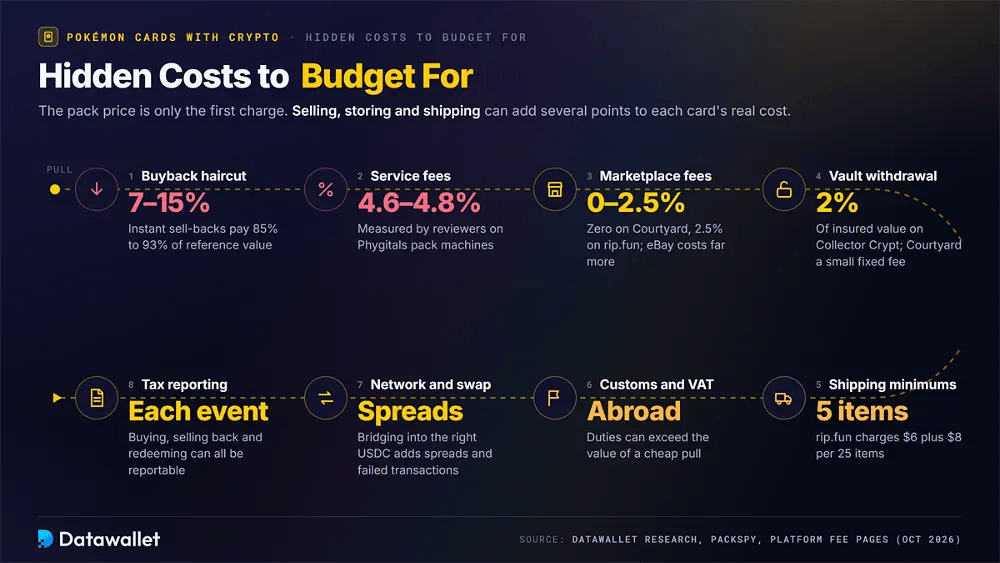
The pack price is only the first charge on most platforms. Fees for selling, storing and shipping can add several percentage points to each card's real cost. Plan for these charges before opening packs.
- Buyback haircut: Instant sell-backs pay 85% to 93% of reference value, so every card sold immediately loses 7% to 15% versus its listed market price.
- Service fees: Some machines add pack service charges; reviewers measured roughly 4.6% to 4.8% on Phygitals, separate from the advertised odds shown for each pack tier.
- Marketplace fees: Seller fees range from zero on Courtyard to 2.5% on rip.fun, while traditional marketplaces such as eBay charge far higher combined selling costs.
- Vault withdrawal: Collector Crypt charges 2% of insured value to release a card, while Courtyard adds a smaller fixed handling charge per card before postage.
- Shipping minimums: rip.fun requires five items per order at $6 plus $8 per 25 items, which makes posting a single cheap card relatively expensive.
- Customs and VAT: International collectors pay local duties and import taxes on redeemed cards, which can exceed the card's value for low-priced pulls shipped from US vaults.
- Network and swap costs: Solana, Polygon and Base fees are small, but swapping or bridging into the correct USDC version adds spreads and occasional failed transactions.
- Tax reporting: Spending crypto on packs, selling cards back, and redeeming NFTs can each create reportable events, depending on your country's rules for digital assets.
Tokenized Pokémon Card Market Trends in 2026
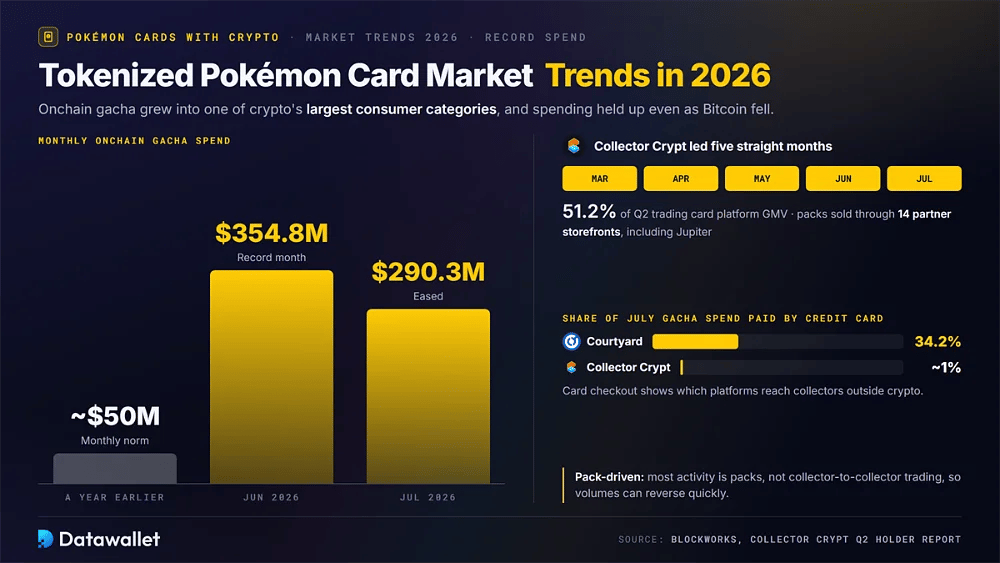
Tokenized Pokémon cards grew from a niche NFT experiment into one of crypto's largest consumer categories during 2026. Spending held up even as Bitcoin fell, while mainstream brands moved toward the sector.
These developments shaped it:
- Record monthly spend: Onchain gacha reached $354.8 million in June 2026 before easing to $290.3 million in July, per Blockworks. A year earlier, monthly spending sat near $50 million.
- Collector Crypt consolidation: The Solana platform led gacha spend for five straight months through July and held 51.2% of trading card platform GMV in Q2, according to its Q2 holder report.
- Distribution through partners: Collector Crypt sells packs through 14 partner storefronts, including Jupiter, while Phygitals cross-lists slabs on Fanatics Collect, bringing tokenized cards to buyers without crypto wallets.
- Exchanges moving in: Coinbase teased vaulted Pokémon pack openings on 28 September, as reported by The Defiant. Pricing, odds, custody partners and launch timing were still undisclosed in late October.
- Chain consolidation on Solana: Beezie is closing its Base operations on 27 October, joining Collector Crypt, Phygitals and Jupiter Gacha on Solana. Courtyard on Polygon and rip.fun on Base remain the main exceptions.
- Card payments split the market: Credit cards funded 34.2% of Courtyard's July gacha spend but roughly 1% at Collector Crypt, showing which platforms reach collectors outside crypto.
- Record physical supply: The Pokémon Company printed about 10 billion cards in the year to March 2026, lifting lifetime production past 85 billion during the franchise's 30th anniversary year.
- Gambling scrutiny: Legal scholar Leon Xiao described some digital pack products as unlicensed gambling in comments reported by TheGamer. No US court has ruled on tokenized card gacha specifically.
Most activity remains pack-driven rather than collector-to-collector trading, so volumes can reverse quickly when speculative capital moves elsewhere. Our tokenization statistics and RWA projects guide place trading cards within the wider real-world asset market.
How to Buy Pokémon Cards With Crypto
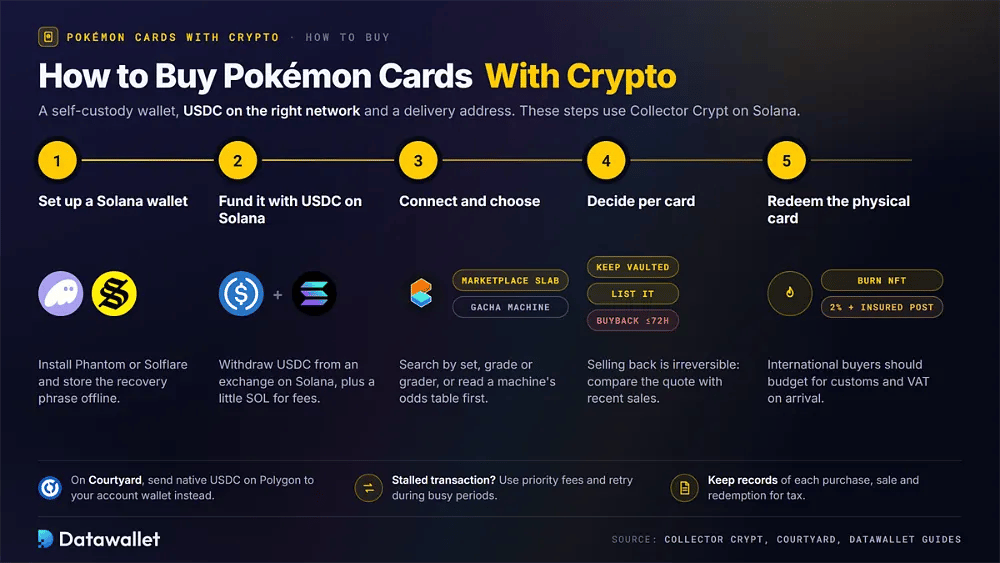
You need a self-custody wallet, USDC on the platform's network, and a delivery address if you plan to redeem. These steps use Collector Crypt on Solana; the process is similar on other platforms.
- Set up a Solana wallet: Install Phantom or Solflare and store the recovery phrase offline. Our Phantom wallet review explains setup and security settings.
- Fund it with USDC on Solana: Buy USDC on an exchange and withdraw it on the Solana network, adding a small amount of SOL for fees. Funds on another chain can move over using our Solana bridging guide.
- Connect and choose a purchase type: Link the wallet to Collector Crypt. Search the marketplace by set, grade or grader for a specific slab, or open a gacha machine after reading its odds table.
- Decide what to do with each card: Keep it vaulted, list it on the marketplace, or accept the buyback within 72 hours. Selling back is irreversible, so compare the quote with recent sales first.
- Redeem the physical card: Burn the NFT, enter your shipping address, and pay the 2% vault fee plus insured shipping. International buyers should budget for customs and VAT on arrival.
If a transaction stalls during busy periods, our guide to fixing failed Solana transactions covers priority fees and retries. On Courtyard, send native USDC on Polygon to your account wallet instead. Keep records of each purchase, sale and redemption for tax purposes.
Risks of Buying Pokémon Cards With Crypto
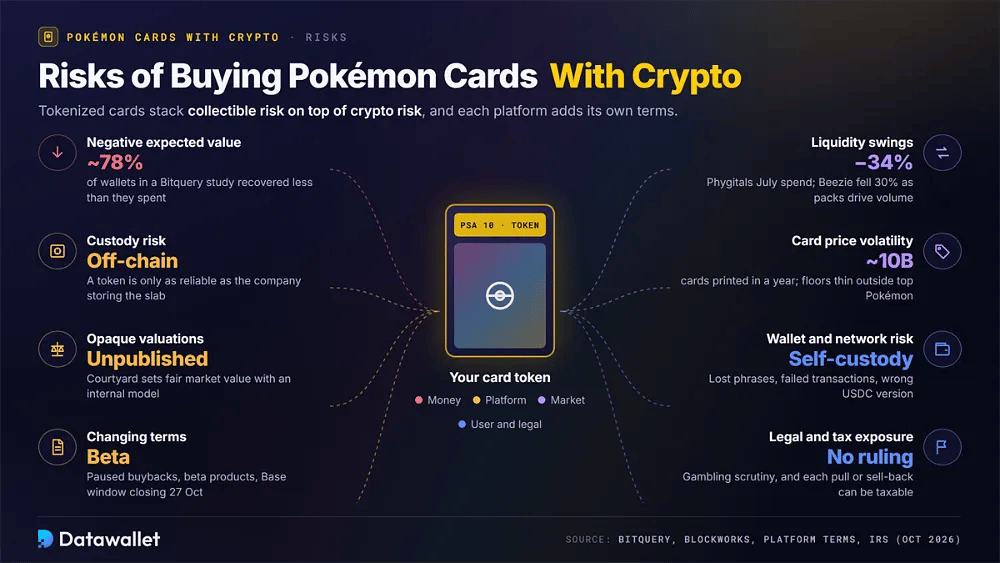
Tokenized cards combine collectible risk with crypto risk, and each platform adds its own terms on top of card prices.
Weigh these before the first deposit:
- Negative expected value: Instant buybacks pay 85% to 93% of reference value, and a Bitquery study of earlier gacha flows found roughly 78% of wallets recovered less than they spent.
- Custody risk: A card token is only as reliable as the company storing the physical slab, so a platform failure or vault dispute could delay or block redemption.
- Opaque valuations: Expected values and buyback quotes depend on reference prices, and Courtyard sets fair market value through an internal model it does not publish.
- Changing terms: Phygitals can pause buybacks without notice, Jupiter Gacha is still in beta, and Beezie's Base window closes on 27 October.
- Liquidity swings: Spending is concentrated among a small group of high-volume wallets and remains pack-driven, as shown by July declines of 34% at Phygitals and 30% at Beezie.
- Card price volatility: Graded Pokémon prices move with demand, floors thin quickly outside sought-after cards, and record print runs of about 10 billion cards a year add supply.
- Wallet and network risk: Lost recovery phrases, failed transactions and bridging into the wrong USDC version can cost money or access to card tokens.
- Legal and tax exposure: Pack sales face growing gambling scrutiny with no US court ruling on tokenized gacha, and each purchase, sell-back or redemption can be a taxable event.
Treat gacha pulls as entertainment spending rather than an investment, and keep each deposit to an amount you can afford to lose.
Final Thoughts
Collector Crypt ranks first for its leading gacha share, deep slab inventory and 85% to 93% buybacks on Solana. Courtyard is the better fit for buyers who want card payments alongside USDC and Brink's custody. Phygitals offers the cheapest entry, while Jupiter Gacha removes platform fees for existing Solana users.
For sealed product, rip.fun opens factory packs with official pull rates, and Bitrefill gift cards cover ordinary retail purchases with Bitcoin. Beezie suits claw-machine fans, though Base holders must migrate before 27 October. Coinbase's pack feature may change the field once launched, but it remains unranked until its terms are public.
Treat randomized packs as entertainment spending rather than investing, because buyback discounts make most pulls lose value immediately. Start with a small USDC deposit, test one redemption, and compare shipping costs before buying more. For the wider tokenized asset market, see our stablecoin statistics and best crypto wallets guides.
Our Methodology
We assessed platforms that accepted crypto for real, physical Pokémon cards on 24 October 2026, using six criteria.
- Trust Score: Ratings out of 5 reflect custody partners, grading standards, operating history, public disclosures and the consistency of buyback and redemption terms.
- Crypto payments: We confirmed accepted tokens and networks through each platform's documentation, including USDC on Solana, Polygon and Base, and Bitrefill's checkout options.
- Total cost: We compared pack prices, buyback rates, marketplace fees, vault withdrawal charges and shipping minimums as published or reported in October 2026.
- Physical backing: Each platform had to vault real graded or sealed cards that owners can redeem. Coinbase was excluded because its product had not launched, and pure Pokémon-themed tokens were not considered.
- Activity and liquidity: Gacha spend, market share and volume figures came from Blockworks Research, company reports and onchain analytics from Bitquery and Dune.
- Regulatory and user risk: We reviewed age requirements, regional restrictions, chain migrations, and legal commentary on whether paid random packs count as gambling.
Sources included platform help centres and documentation, Blockworks, the Solana Foundation and The Pokémon Company's published production figures. We did not complete test purchases or deliveries on every platform. Our editorial methodology explains the full process.