







No quantum computer can break Ethereum's signatures today, yet the network's developers already treat that machine's arrival as a scheduling problem.
In March 2026, Google researchers estimated that fewer than 500,000 physical qubits, the basic units of a quantum computer, could crack the elliptic curve maths protecting crypto accounts. Earlier estimates were roughly 20 times higher.
By then the Ethereum Foundation already had a dedicated post-quantum team and a public roadmap, and in September 2026 it added a self-imposed deadline. Researchers who want to move faster have challenged that deadline twice since.
Core developers are now debating how much of the next upgrade to give up for it. The outcome matters to anyone holding ETH, because the fixes arrive through Ethereum Improvement Proposals (EIPs) that are still in draft.
What Is the Ethereum Quantum Roadmap?
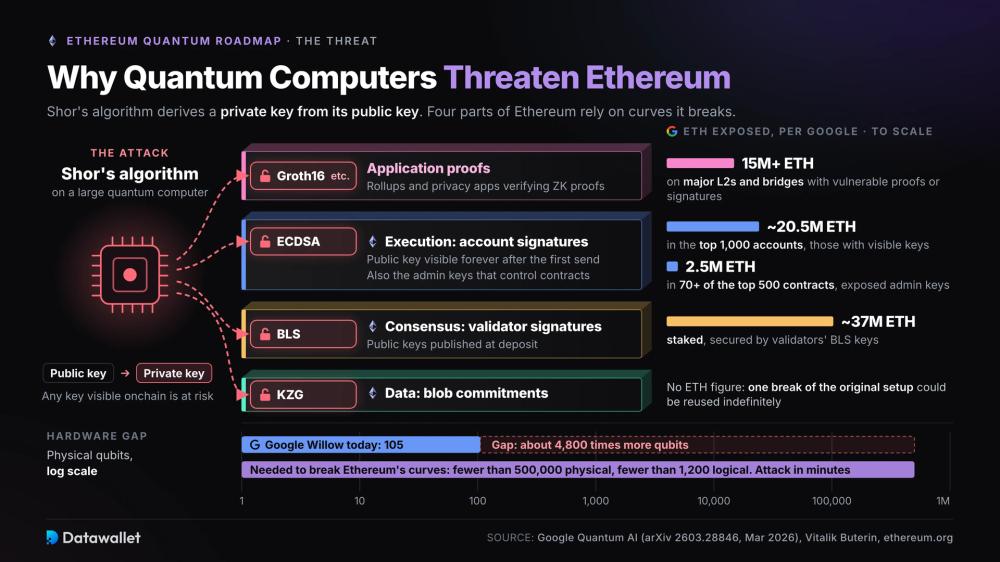
The Ethereum quantum roadmap is the Ethereum Foundation's plan to make the base network safe against quantum computers on all three of its layers. Execution covers accounts and transactions. Consensus covers the validators that confirm blocks, and the data layer is the storage used by rollups, the cheaper networks built on Ethereum. In its September 2026 protocol priorities, the Foundation's Protocol team committed to quantum resistance across all three by December 2029.
Delivery is spread over several hard forks, the scheduled network upgrades that every node must adopt. Progress is tracked on a public planning document called the strawmap. Four Foundation researchers maintain it, Vitalik Buterin and Justin Drake among them, and they describe it as a coordination tool whose dates deserve scepticism.
The Foundation created a post-quantum team in January 2026 under cryptographic engineer Thomas Coratger. A month later, Buterin published a four-part plan covering validator signatures, data availability, user accounts and zero-knowledge proofs, which confirm a computation was done correctly without repeating it. The official ethereum.org quantum resistance page still uses that structure.
Quantum computers only weaken hash functions, the one-way fingerprints used across crypto. Elliptic curves they break outright. Ethereum is therefore rebuilding its signatures and proofs on hashes, and the strawmap states the aim as "centuries-long cryptographic security, via hash-based schemes."
Why Quantum Computers Threaten Ethereum
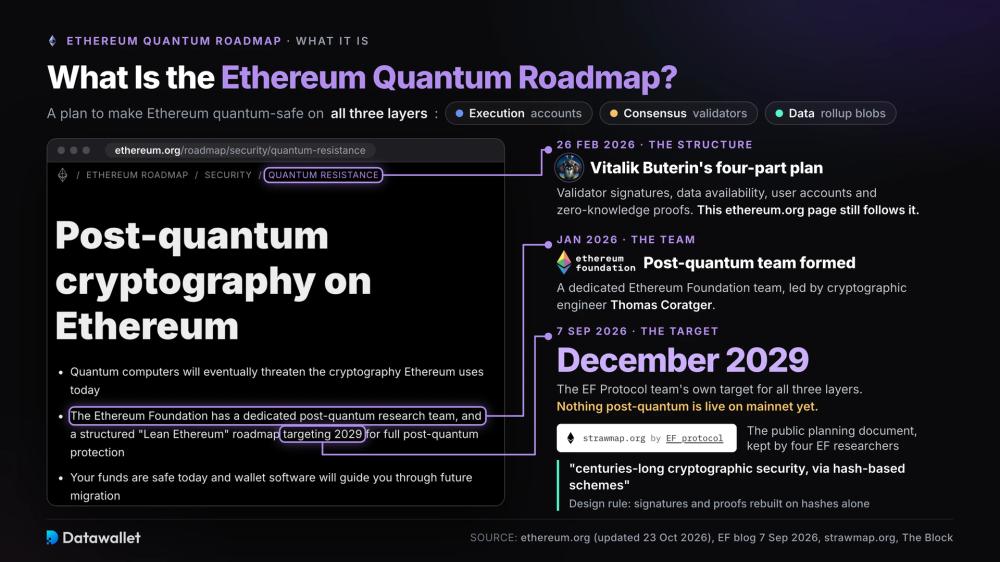
Ethereum's security depends on elliptic curve cryptography. This type of maths lets anyone check a signature against a public key while the matching private key stays impossible to compute. Shor's algorithm, run on a large enough quantum computer, reverses that protection and derives the private key from the public one.
Google Quantum AI's March 2026 paper, co-authored by Justin Drake and Stanford cryptographer Dan Boneh, put the requirement at fewer than 1,200 logical (error-corrected) qubits, built from fewer than half a million physical qubits. A superconducting machine of that size would run the attack in minutes. Current hardware is far smaller. Google's own Willow chip has 105 physical qubits.
The Four Vulnerable Components
Ethereum uses breakable cryptography in four places.
- Account signatures (ECDSA): Every standard wallet signs transactions with the Elliptic Curve Digital Signature Algorithm. Once an account sends its first transaction, its public key is visible onchain permanently.
- Validator signatures (BLS): Validators, the computers that stake ETH to confirm blocks, cast their votes with BLS signatures. Their public keys are published from the moment they deposit.
- Data availability (KZG): Rollups post their transaction data to Ethereum in blobs, introduced by EIP-4844. Blobs are checked with KZG commitments, a compact proof scheme built on elliptic curves.
- Application proofs: Many rollups and privacy apps verify zero-knowledge proofs, such as Groth16, that depend on the same curves.
How Much ETH Is Exposed?
Google's paper mapped five exposures on Ethereum, which CoinDesk broke down. Among the 1,000 largest Ethereum accounts, those with visible public keys hold about 20.5 million ETH. A machine cracking one key every nine minutes could work through them in under nine days.
Contracts are the second exposure. At least 70 of the 500 largest are controlled by exposed administrator keys and hold about 2.5 million ETH. Separately, roughly $200 billion in stablecoins and tokenised assets sits in contracts with the same weakness.
At least 15 million ETH sits on major layer 2 networks and bridges that rely on quantum-vulnerable signatures or proofs of their own. About 37 million staked ETH is secured by BLS keys, and a single provider, Lido, accounts for around a fifth of it. The blob system carries a different risk. One successful attack on its original setup would produce an exploit that could be reused indefinitely.
The paper finds Ethereum has a broader quantum attack surface than Bitcoin, because exposed account keys are joined by vulnerable contracts, staking and data availability. Migration should be faster on Ethereum, the paper adds, since the Ethereum Foundation gives it stronger central coordination than Bitcoin has. On its post-quantum hub, the Foundation estimates that long-abandoned vulnerable accounts hold about 0.1% of ETH, against roughly 5% of supply for Bitcoin.
Ethereum Quantum Roadmap Timeline
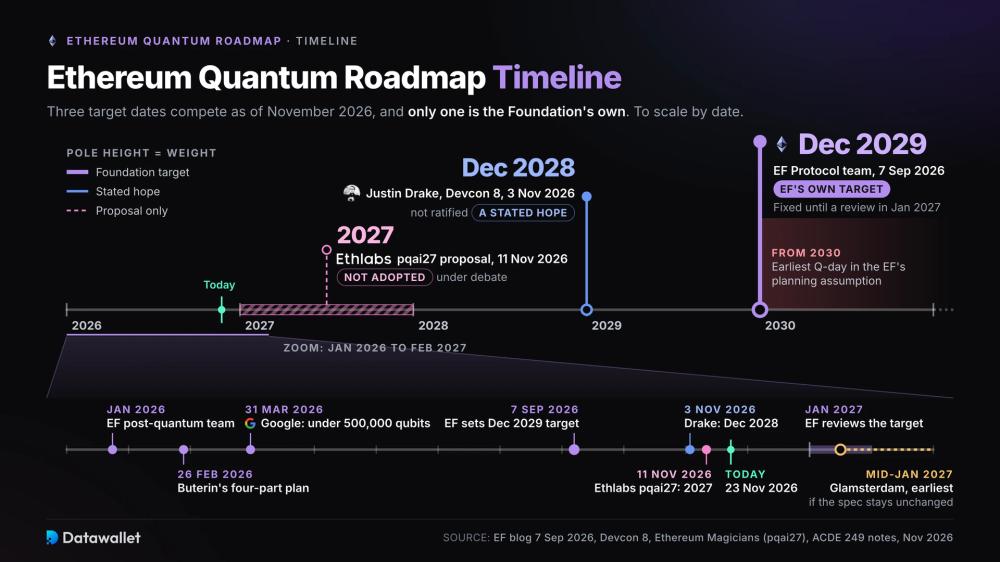
Three target dates are in circulation as of November 2026, and only one is the Foundation's published target.
Target | Source | Date Stated | Status |
|---|---|---|---|
December 2029 | Ethereum Foundation Protocol team, protocol priorities post | 7 September 2026 | The Foundation's own target, due for review in January 2027 |
December 2028 | Justin Drake at Devcon 8; the strawmap moved the milestone to a fork dated 2028 to 2029 the day before | 3 November 2026 | A stated hope that has not been ratified |
2027 | Ethlabs pqai27 proposal | 11 November 2026 | Under debate by core developers and not adopted |
The December 2029 date rests on a planning assumption that Q-day, the day a quantum computer can break live cryptography, could arrive as early as 2030. The Protocol team calls that assumption "deliberately aggressive". It treats the deadline as fixed until at least January 2027, when it will review quantum progress with outside experts. Google, Cloudflare and Microsoft have set 2029 migration targets for their own systems, and the Foundation's date matches them.
Drake put a firm date on it at Devcon 8 in Mumbai, where he said he hoped to complete the transition by December 2028. Cointelegraph reported that the goal would take three more network upgrades within 24 months. The strawmap had been edited the day before. Its public changelog shows the full post-quantum milestone moving forward twice in four weeks, to a fork dated 2028 to 2029.
The most aggressive plan is pqai27, published on 11 November by Ethlabs, which The Block describes as a nonprofit founded by former Ethereum Foundation researchers. Its first stage, "pqai-ready", means validators are quantum-safe and every user has a way to move to a quantum-safe account. A second stage, "pqai-scaled", restores full network capacity. To free up resources, Ethlabs withdrew its own proposal for faster block times.
Fork-by-Fork Schedule
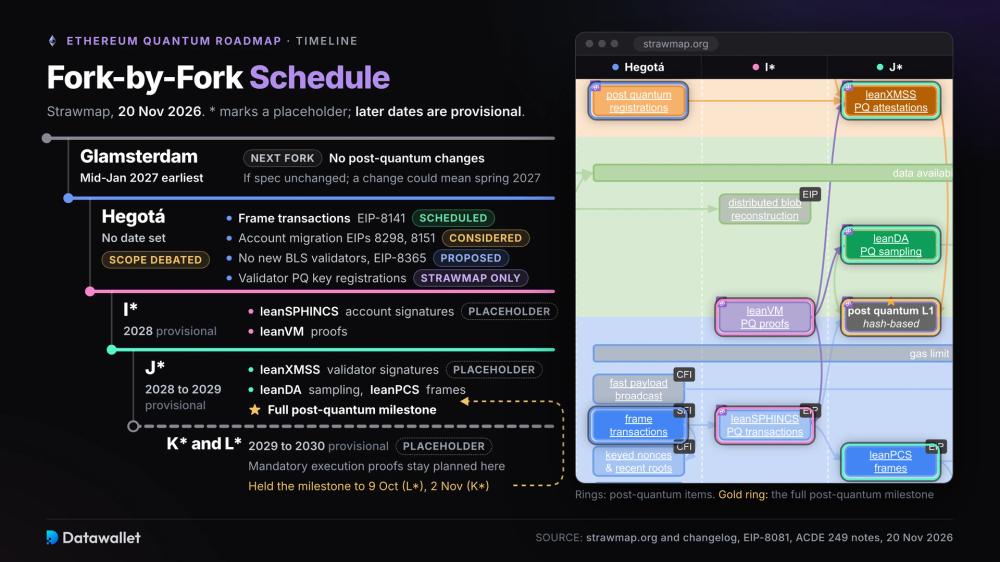
The schedule below reflects the strawmap as of 20 November 2026. Fork names ending in an asterisk are placeholders, and every date after Glamsterdam is provisional.
Fork | Expected | Post-Quantum Content | Status |
|---|---|---|---|
Glamsterdam | Mainnet no earlier than mid-January 2027 if the specification stays unchanged; a specification change could push it to April or May 2027 | None. Block-building changes, block access lists and gas repricing | Live on Sepolia testnet; Hoodi test pencilled in for the week of 14 December 2026, pending a go or no-go decision on 26 November |
Hegotá | No date set | Frame transactions (EIP-8141, scheduled); account migration EIPs 8298 and 8151 (under consideration); a block on new BLS withdrawal credentials (EIP-8365, proposed); validator post-quantum key registrations (strawmap only) | Scope under debate |
I* | 2028 | leanSPHINCS account signatures, leanVM proofs | Placeholder |
J* | 2028 to 2029 | leanXMSS validator signatures, leanDA blob sampling, leanPCS frames, the full post-quantum milestone | Placeholder |
K* and L* | 2029 to 2030 | L* held the full post-quantum milestone until 9 October 2026 and K* until 2 November 2026, when it moved to J*. Mandatory execution proofs remain planned here | Placeholder |
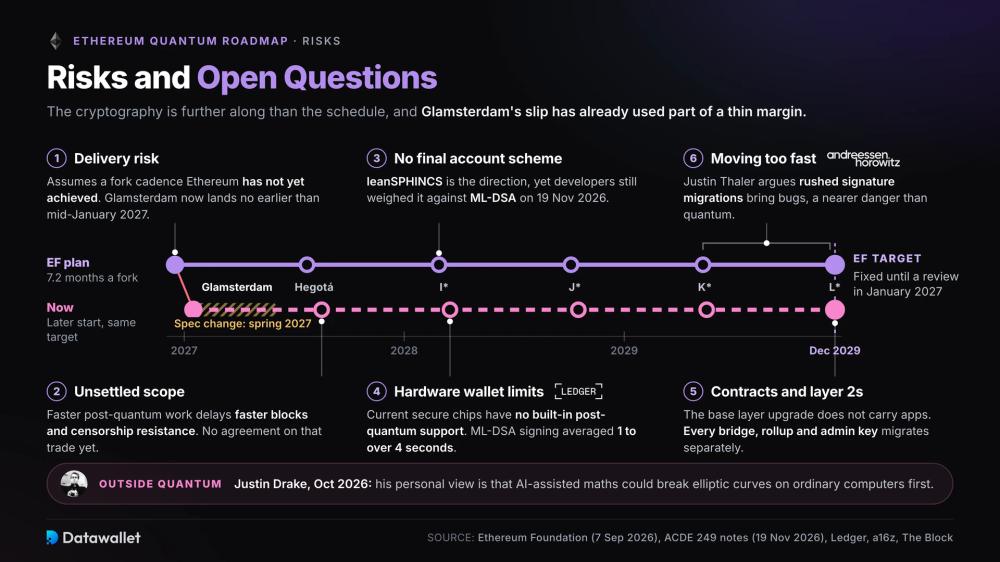
Everything in this schedule depends on Glamsterdam shipping first, and Glamsterdam is late. Its changes to gas prices, the fees charged for computation, would break some existing smart contracts, so developers postponed its final test network run. Notes from the 19 November core developer call give mid-January 2027 as the earliest mainnet date if the specification stays unchanged.
A specification change could push activation to April or May 2027, according to Cointelegraph. The Foundation's own calculation assumed a December 2026 launch, followed by one fork every 7.2 months to finish by December 2029.
That delay has turned Hegotá into the deciding fork. On the same call, developers reviewed five options for its scope. They ranged from the full planned feature set to a minimal fork carrying only post-quantum changes. No decision was reached. The teams that build Ethereum's node software were asked to submit short written positions by the end of the following week, 27 November.
How Ethereum Plans to Fix Each Layer
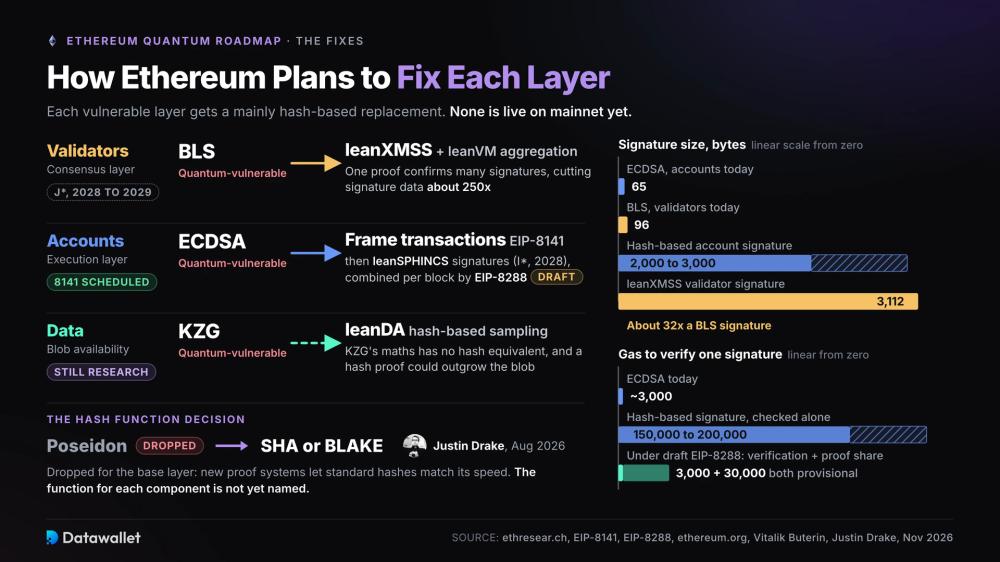
Each vulnerable component gets its own replacement, and all are built on hash functions. Most carry the "lean" prefix from lean Ethereum, the redesign vision Justin Drake published on the Foundation's blog in July 2025.
Validators: leanXMSS and leanVM
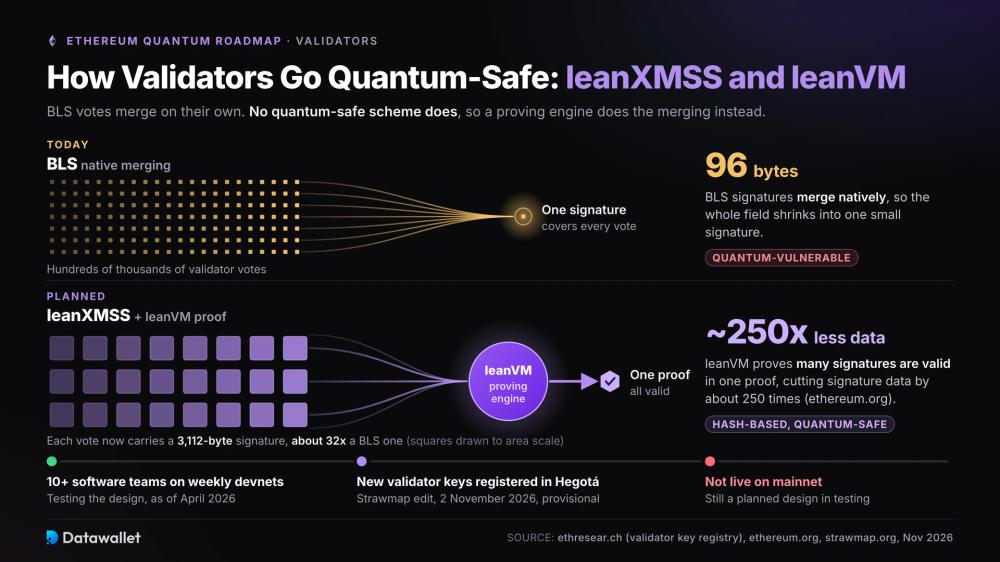
BLS signatures can be merged, so hundreds of thousands of validator votes shrink into one small signature. No quantum-safe scheme does this on its own. The planned replacement is leanXMSS. Its signatures run to 3,112 bytes against 96 bytes for BLS, according to the Foundation team's validator key registry design.
A small proving engine called leanVM handles the size problem by producing one proof that many signatures are valid. That compresses signature data by about 250 times, ethereum.org says. As of April 2026, more than 10 software teams were testing the design on weekly developer networks. Validators would register their new keys in Hegotá under the 2 November strawmap edit.
Accounts: Frame Transactions and leanSPHINCS
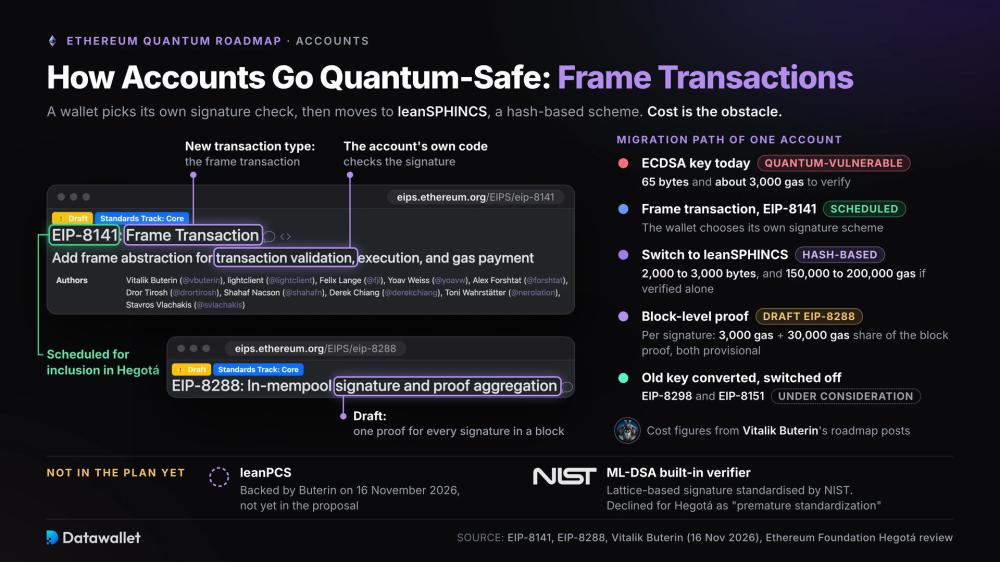
The fix for user accounts starts with EIP-8141, which introduces a new transaction format called a frame transaction. An account's own code decides how a signature is checked, so a wallet can switch to a quantum-safe signature without waiting for a network-wide change. The proposal is already scheduled for inclusion in Hegotá. Two companion proposals under consideration, EIP-8298 and EIP-8151, let an existing account convert and permanently switch off its old key.
Cost is the obstacle. Buterin's roadmap posts, including one from 16 November, put an ECDSA signature at 65 bytes and about 3,000 gas to verify. A hash-based signature runs to 2,000 or 3,000 bytes and 150,000 to 200,000 gas. EIP-8288 addresses this by having nodes combine every signature in a block into one proof before the block is built.
Under that design, the draft sets the verification charge for each leanSPHINCS signature at 3,000 gas, plus a per-signature share of the block proof's cost, currently 30,000 gas. leanSPHINCS is the planned hash-based scheme for accounts, and both figures are provisional.
The same November post backed a variant called leanPCS that would also let applications verify large proofs cheaply. It is not yet written into the proposal. Developers have also declined to add a built-in verifier for ML-DSA, the lattice-based signature standardised by NIST, to Hegotá. The Foundation's Hegotá review labelled the idea "premature standardization."
Data Availability: Replacing KZG
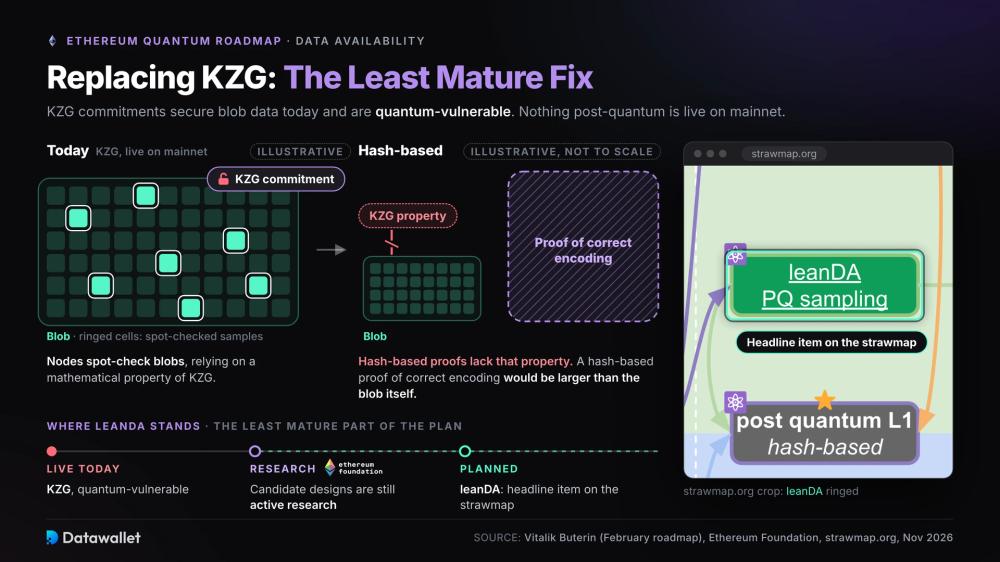
Blob verification is the least mature part of the plan. According to Buterin's February roadmap, the current method of spot-checking blobs depends on a mathematical property of KZG that hash-based proofs lack. A hash-based proof that a blob was encoded correctly would also be larger than the blob itself.
A hash-based replacement called leanDA is now a headline item on the strawmap. The Foundation still describes the candidate designs for data availability as active research.
The Hash Function Decision
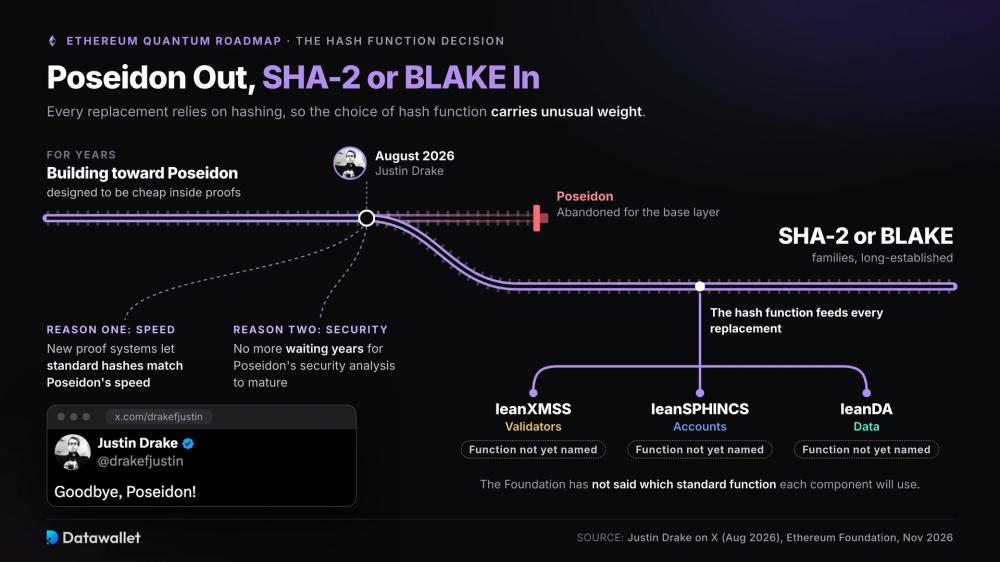
Every replacement relies on hashing, so the choice of hash function carries unusual weight. For years the Foundation built toward Poseidon, a function designed to be cheap inside proofs. In August 2026, Drake said the Foundation was abandoning Poseidon for the base layer in favour of the long-established SHA-2 or BLAKE families.
His reasoning was that new proof systems let standard hash functions match Poseidon's speed, and that the Foundation no longer has to wait years for Poseidon's security analysis to mature. The Foundation has not said which standard function each component will use.
Ethereum's Emergency Plan for an Early Q-Day
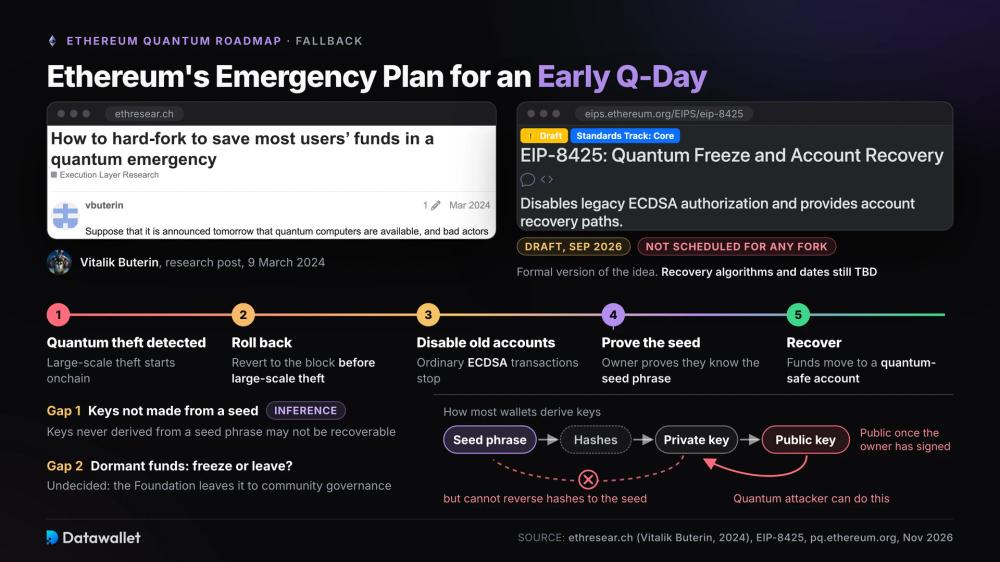
Ethereum has a fallback if a quantum attack arrives before the migration finishes, which Buterin outlined in a 2024 research post. The network would roll back to the block before large-scale theft began. Ordinary account transactions would be disabled. Owners would then reclaim their accounts by proving they know the seed phrase, the list of recovery words, behind them.
This works because most wallets derive private keys from a seed phrase through a chain of hashes. A quantum attacker can compute the private key from a public key, yet cannot reverse the hashes to find the seed. Knowledge of the seed therefore separates the real owner from the thief.
A September 2026 draft, EIP-8425, turns the idea into a formal proposal. From a set freeze time, ECDSA-signed transactions would become invalid. Owners would recover accounts either through a commitment registered in advance or through a proof of seed ownership. The recovery algorithms and the dates are still undefined, and the draft has not been scheduled for any fork.
The scheme only helps keys that were derived by hashing a seed. On unmigrated dormant funds, the Foundation takes no position on whether they should be frozen or left alone. It describes that choice as a matter for community governance.
Risks and Open Questions
The cryptography is further along than the schedule, and the main uncertainties are practical.
- Delivery risk: The Foundation's deadline assumes a fork cadence Ethereum has not yet achieved. Glamsterdam has slipped into 2027, as reported by CoinDesk, and by the Foundation's own fork arithmetic that uses up part of the margin.
- Unsettled scope: Speeding up post-quantum work means delaying other features, including faster blocks and stronger censorship resistance. Core developers have not agreed on that trade.
- No final account scheme: Hash-based leanSPHINCS is the current direction. Developers were still weighing it against ML-DSA on 19 November, partly because standardised schemes have better hardware support.
- Hardware wallet limits: Ledger's security team found that current secure chips have no built-in support for post-quantum algorithms. Signing with ML-DSA averaged between one and more than four seconds in its tests, and sometimes exceeded ten.
- Contracts and layer 2s: Upgrading the base network does not upgrade the applications on it. Every bridge, rollup and administrator key has to be migrated separately by its own team.
- Moving too fast: Justin Thaler of a16z argues that rushed signature migrations introduce bugs that are a nearer danger than quantum computers.
In October 2026, Drake urged the industry to prepare for the possibility that AI-assisted mathematics breaks elliptic curves on ordinary computers first, a scenario he described to The Block as his personal view. The same worry is one reason pqai27 refers to "post-AI" security. The proposal also uses the term for hardening client software against bugs found by AI.
How Ethereum Compares with Other Blockchains
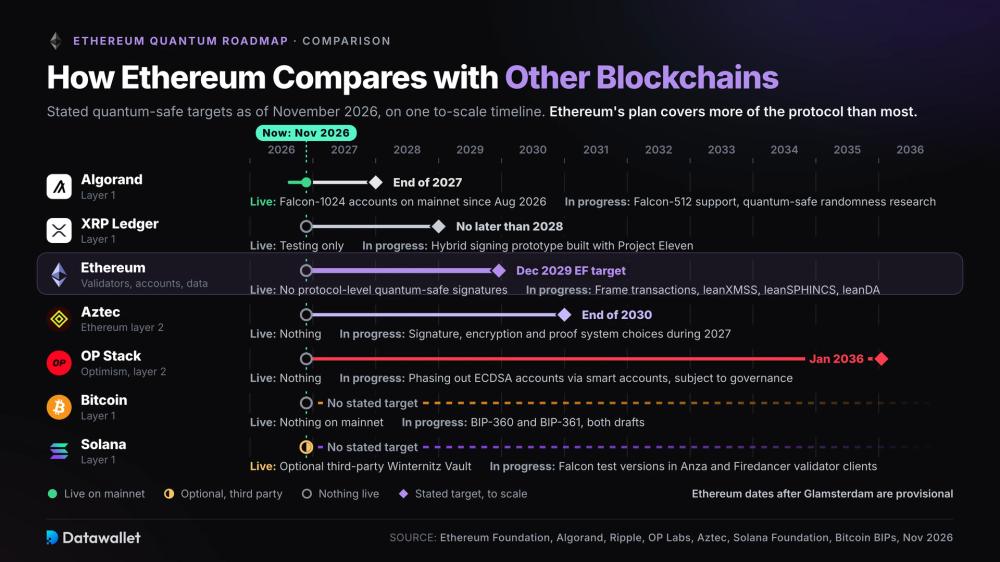
As of November 2026, several other networks already run quantum-safe features in production.
Network | Live Today | In Progress | Stated Target |
|---|---|---|---|
Ethereum | No protocol-level quantum-safe signatures | Frame transactions, leanXMSS, leanSPHINCS, leanDA | December 2029 (the Foundation's own target) |
Bitcoin | Nothing on mainnet | BIP-360 and BIP-361, both drafts | None |
Solana | Winternitz Vault, an opt-in third-party vault for individual users | Falcon test versions in the Anza and Firedancer validator clients | None |
Algorand | Falcon-1024 accounts on mainnet since August 2026 | Falcon-512 support, quantum-safe randomness research | End of 2027 |
XRP Ledger | Testing only | Hybrid signing prototype built with Project Eleven | No later than 2028 |
OP Stack (Optimism) | Nothing | Phasing out ECDSA accounts through smart accounts, subject to governance | January 2036 |
Aztec | Nothing | Signature, encryption and proof system choices during 2027 | End of 2030 |
Bitcoin's main proposal, BIP-360, is still a draft with no activation date, and it reduces exposure without adding quantum-safe signatures. Its companion, BIP-361, is a draft too. Algorand is ahead on live features, having had quantum-safe accounts on its main network since August 2026.
The XRP Ledger's plan targets a full transition no later than 2028. On Solana, the two validator clients have test versions of Falcon and no activation date. Ethereum's task is larger than any of these, because it must replace validator voting and blob verification as well as account signatures.
Layer 2 networks cannot finish without the base layer. Optimism's developer OP Labs has asked Ethereum to commit to a timeline for moving off BLS and KZG, and Aztec's roadmap states that its own migration depends on Ethereum's. The difference between ZK rollups and optimistic rollups matters here too, since rollups using hash-based proofs have less to replace.
What ETH Holders, Stakers and Developers Should Do
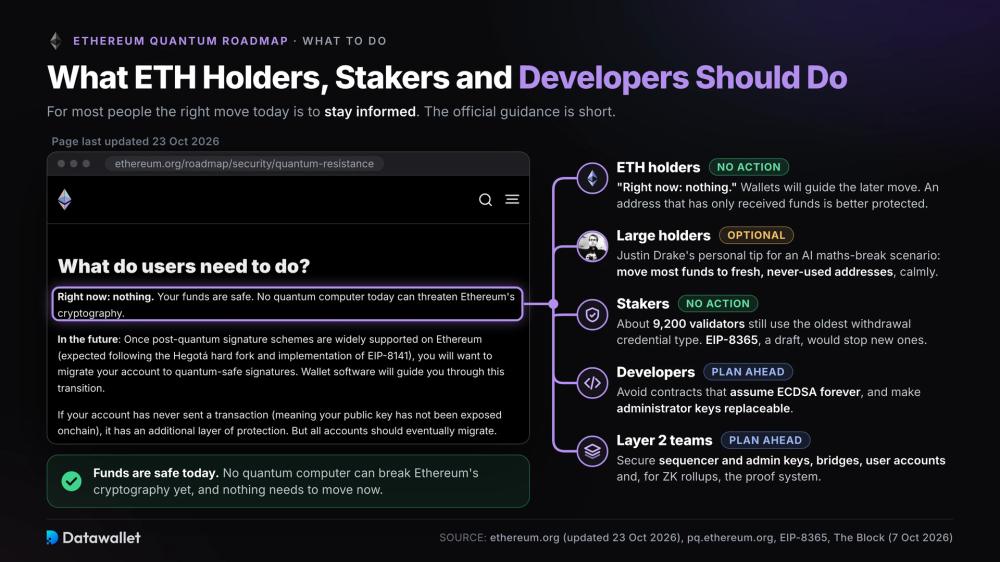
For most people the correct action today is to stay informed.
- ETH holders: The Foundation's guidance is "Right now: nothing." Funds are safe, and wallet software is expected to guide the eventual move to quantum-safe signatures. An address that has only received funds is better protected, because its public key has never been published.
- Large holders: Drake's personal advice to large and sophisticated holders is to move most funds to fresh addresses that have never signed a transaction, without rushing. He gave it for his AI scenario, so it sits apart from quantum guidance. If you are choosing storage now, our guide to the best Ethereum wallets compares the main options.
- Stakers: No action is required. Around 9,200 validators still use the oldest type of withdrawal credential, and EIP-8365 would stop new ones being created. Our Ethereum staking statistics page tracks the latest validator and provider data.
- Developers: Avoid contracts that assume ECDSA forever, and make administrator keys replaceable. Google's finding on exposed administrator keys shows how much value a single such key can control.
- Layer 2 teams: The Foundation's post-quantum team lists the points layer 2s must secure. They are the sequencer keys that order transactions and admin keys, bridges and cross-chain messaging, user accounts and, for ZK rollups, the proof system.
Bottom Line
Ethereum has one of the most detailed quantum migration plans of any major blockchain, and none of it has shipped. The design work points to hash-based cryptography for validators, accounts and data. The calendar remains contested between the Foundation's December 2029 target, a December 2028 ambition and a 2027 proposal.
Core developers must choose Hegotá's scope in the coming weeks, and the Foundation will revisit its deadline with outside experts in January 2027. Those decisions will show which timeline is realistic. Until quantum-safe accounts exist, ETH holders can keep funds where they are and follow both outcomes.


