







What Is Elysium?
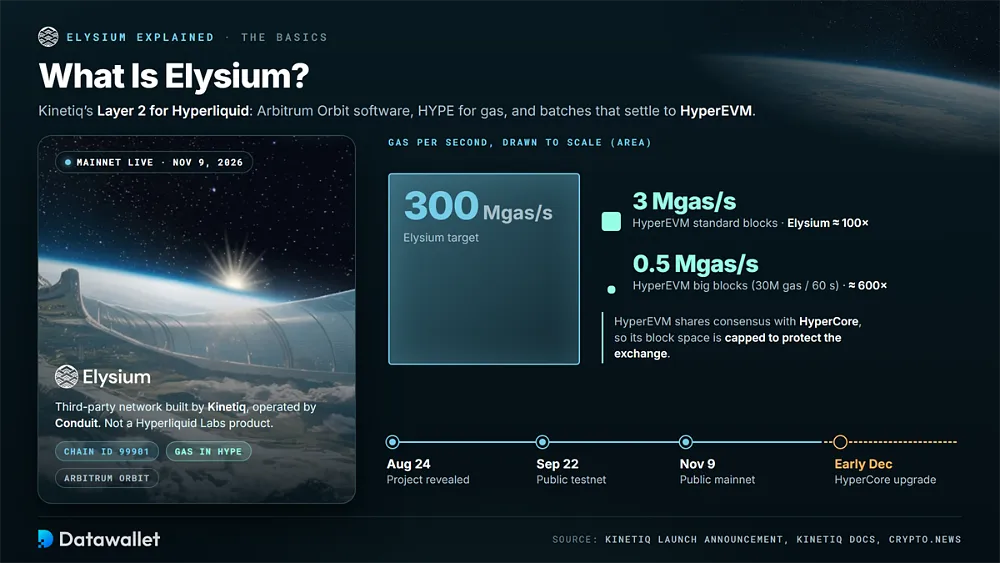
Elysium is a general-purpose Layer 2 network for the Hyperliquid ecosystem, developed by the liquid staking protocol Kinetiq. It is built on the Arbitrum Orbit stack, yet it does not settle to Ethereum. Its parent chain is HyperEVM, the smart contract layer of Hyperliquid, and every fee is paid in HYPE.
The chain exists because HyperEVM is deliberately small. HyperEVM shares consensus with HyperCore, the order book engine where nearly all Hyperliquid trading happens, so its block space is capped to protect the exchange. Standard blocks carry 3 million gas each second, which leaves little room for busy spot markets, launchpads or market-making contracts.
Elysium moves that activity to a separate execution layer. According to the launch announcement, it targets 300 million gas per second, about 100 times HyperEVM's standard blocks and 600 times its slower big blocks. Kinetiq revealed the project on August 24, 2026, opened a public testnet on September 22 and launched mainnet on November 9.
Hyperliquid Labs did not build Elysium. Kinetiq develops the chain and the infrastructure firm Conduit operates it. It is a third-party network that describes itself as the first Layer 2 dedicated to Hyperliquid. Its closest peers are the rollups in our guide to the best Layer 2 networks, although those settle to Ethereum.
How Does Elysium Work?
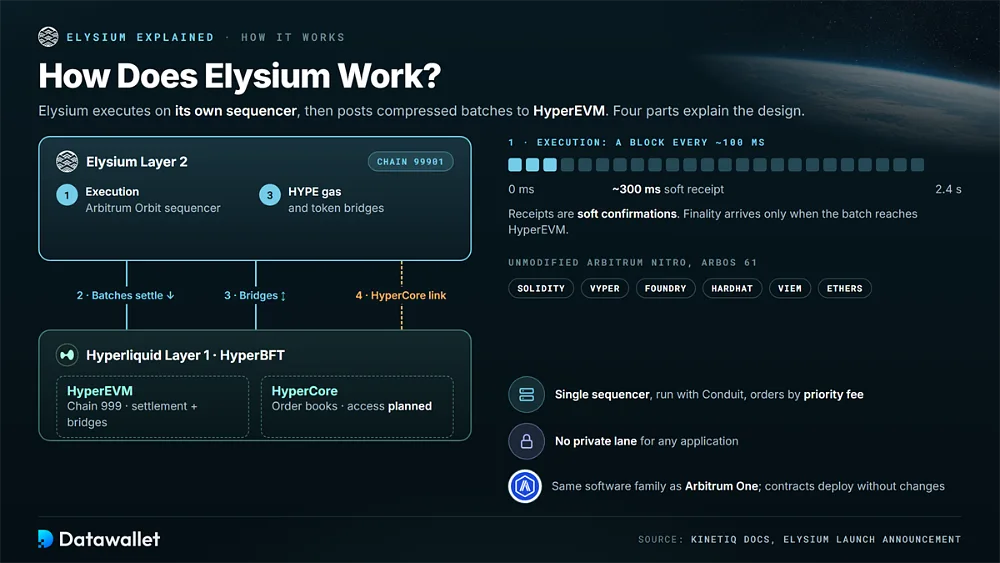
Elysium executes transactions on its own sequencer, then posts compressed batches to HyperEVM for settlement. Four parts explain the design: the execution stack, the settlement and data model, the token bridges, and the planned link to HyperCore.
1. Arbitrum Orbit Execution
Elysium runs Arbitrum Nitro with an unmodified ArbOS 61, the same software family behind Arbitrum One. Solidity and Vyper contracts deploy without changes, and tools such as Foundry, Hardhat, viem and ethers work as they do on other EVM chains. The mainnet chain ID is 99901.
A single sequencer, run with Conduit, orders transactions by priority fee and gives no application a private lane. Blocks are produced roughly every 100 milliseconds, and the Kinetiq documentation puts the perceived receipt time near 300 milliseconds. Those receipts are soft confirmations. Finality arrives only when the batch reaches HyperEVM.
2. Settlement, Data and Finality
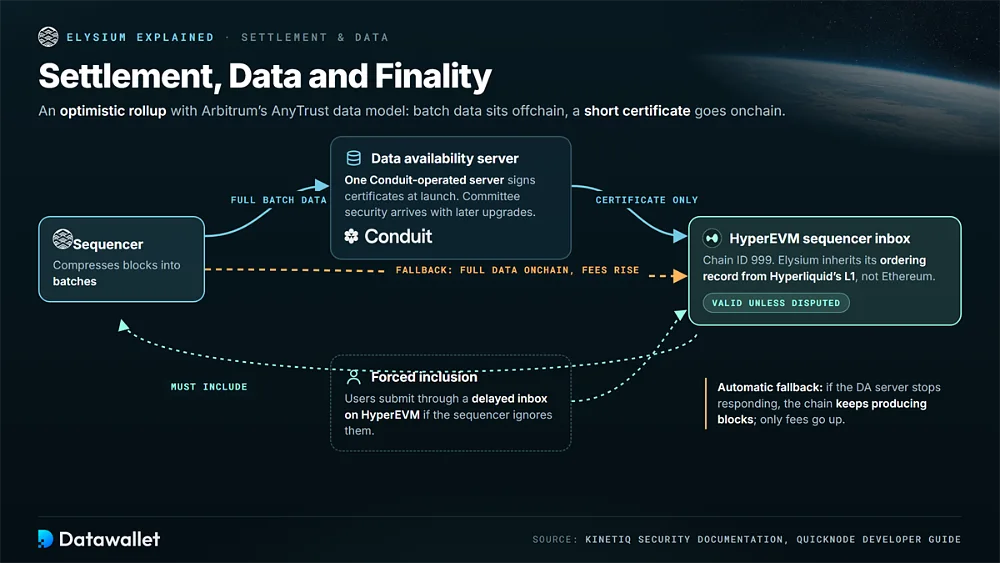
Elysium is an optimistic rollup, which means HyperEVM accepts its batches as valid unless a validator proves otherwise during a dispute window. Its data model follows Arbitrum's AnyTrust design, where transaction data is held offchain.
The settlement pipeline has seven parts that every user should understand:
- Settlement Layer: Batches post to a sequencer inbox contract on HyperEVM, chain ID 999, so Elysium inherits its ordering record from the Hyperliquid Layer 1 rather than from Ethereum.
- Data Availability: Full transaction data sits on a data availability server, and only a short certificate goes onchain. Our explainer on data availability covers the trade-off in detail.
- Single Server: At launch one Conduit-operated server signs those certificates. Kinetiq states that the AnyTrust label describes the mechanism only, and committee security arrives with later upgrades.
- Automatic Fallback: If the server stops responding, the sequencer posts complete transaction data to HyperEVM instead. Fees rise during that period, but the chain keeps producing blocks.
- Batch Finality: Testnet batches landed about every 15 minutes, per a QuickNode developer guide. A transaction is final in under a minute or up to 15, depending on timing.
- Withdrawal Delay: Moving assets back to HyperEVM through the canonical bridge takes about 5.5 days, the length of the challenge period set out in Kinetiq's security documentation.
- Forced Inclusion: Users can submit transactions through a delayed inbox on HyperEVM if the sequencer ignores them, which limits censorship even while one operator controls ordering.
3. HYPE Gas and Token Bridges
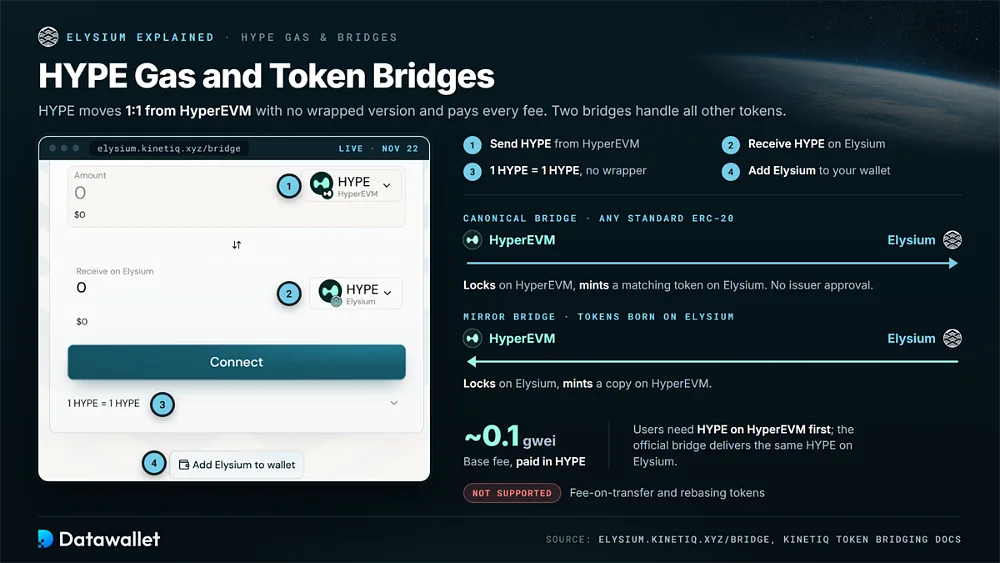
HYPE is the native gas token and moves between HyperEVM and Elysium at a one-to-one rate with no wrapped version. Users need HYPE on HyperEVM first, which our guide to adding HyperEVM to MetaMask explains. The official bridge then delivers the same HYPE on Elysium, where it pays every transaction fee.
Two bridge designs handle other tokens. The canonical bridge locks any standard HyperEVM ERC-20 and mints a matching token on Elysium, with no issuer approval required. The mirror bridge works in reverse for tokens born on Elysium, locking them there and minting a copy on HyperEVM. Fee-on-transfer and rebasing tokens are not supported.
Those routes create a listing path that Kinetiq calls graduation. A token can launch on an Elysium AMM, mirror to HyperEVM, link to a HyperCore spot order book through a deposit wallet and later gain a perpetual market under HIP-3. Bridging needs no approval, while HyperCore spot deployment is run once by the issuer.
4. HyperCore Read and Write Access
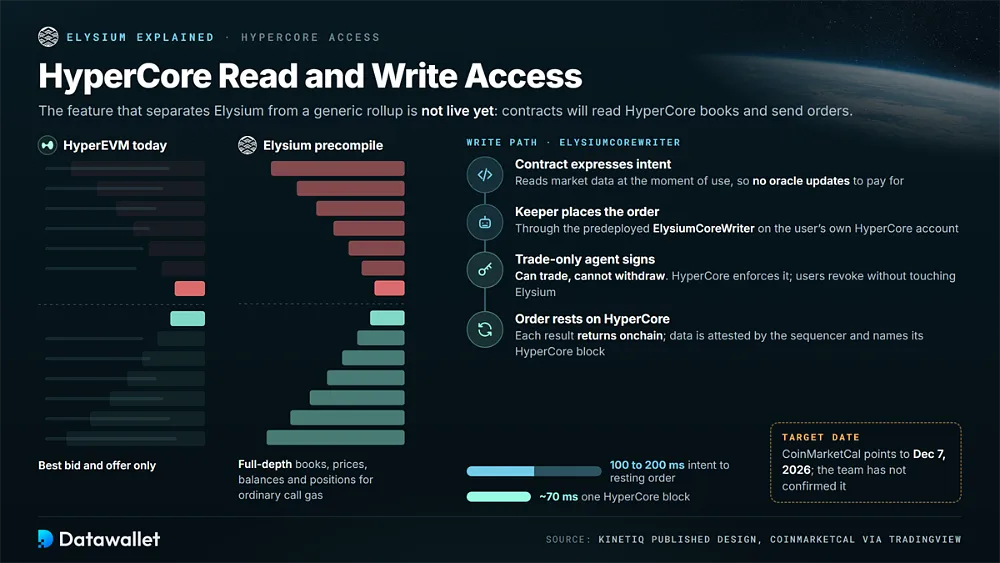
The feature that separates Elysium from a generic rollup is not live yet. A network upgrade planned for about four weeks after mainnet will let contracts read HyperCore markets and send orders to them.
The upgrade adds the following components, according to Kinetiq's published design:
- Data Precompile: A built-in contract returns full-depth HyperCore order books, prices, balances and positions for ordinary call gas. HyperEVM contracts today see only the best bid and offer.
- No Oracles: Because market data is read at the moment of use, applications avoid paying for continuous oracle updates, a significant running cost for lending and derivatives protocols.
- Core Writer: A predeployed contract called ElysiumCoreWriter lets a keeper place orders on a user's own HyperCore account, and the result of each order returns onchain.
- Trade-Only Agents: Orders are signed by agents that can trade but cannot withdraw. HyperCore enforces that limit, and users can revoke an agent without touching Elysium.
- Order Latency: Kinetiq targets roughly 100 to 200 milliseconds from a contract's intent to a resting order, close to one HyperCore block of about 70 milliseconds.
- Data Trust: The sequencer attests to the market data rather than proving it. Each response names its HyperCore block, so stale or altered data can be checked afterwards.
- Target Date: Kinetiq has published no fixed day. A CoinMarketCal event listing points to December 7, 2026, a date the team itself has not confirmed in its documentation.
Who Built Elysium?
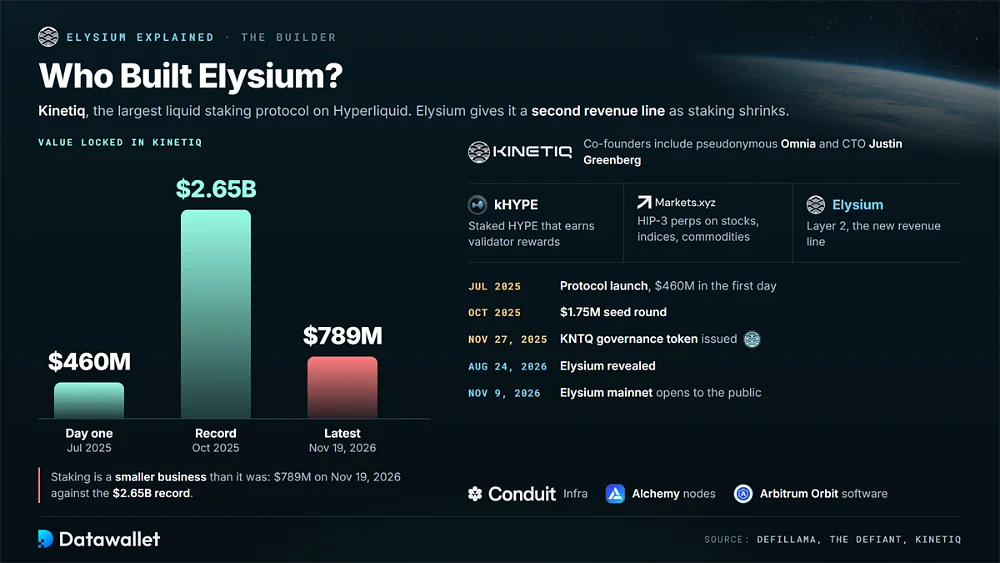
Kinetiq is the largest liquid staking protocol on Hyperliquid. Users deposit HYPE and receive kHYPE, a token that earns validator rewards while staying usable in DeFi, as described in our guide to liquid staking derivatives. The protocol launched in July 2025 and attracted $460 million within its first day.
Kinetiq has three co-founders, among them the pseudonymous Omnia and chief technology officer Justin Greenberg. Kinetiq raised a $1.75 million seed round in October 2025 and issued its KNTQ governance token on November 27, 2025. Its other main product is Markets.xyz, a venue for perpetual futures on stocks, indices and commodities built under HIP-3.
Staking is a smaller business than it was. DefiLlama showed $789 million locked in Kinetiq on November 19, 2026, against a record $2.65 billion in October 2025. Elysium gives the team a second revenue line, with Conduit running infrastructure, Alchemy supplying node services and Arbitrum's Orbit stack providing the software.
Elysium Ecosystem and Launch Apps
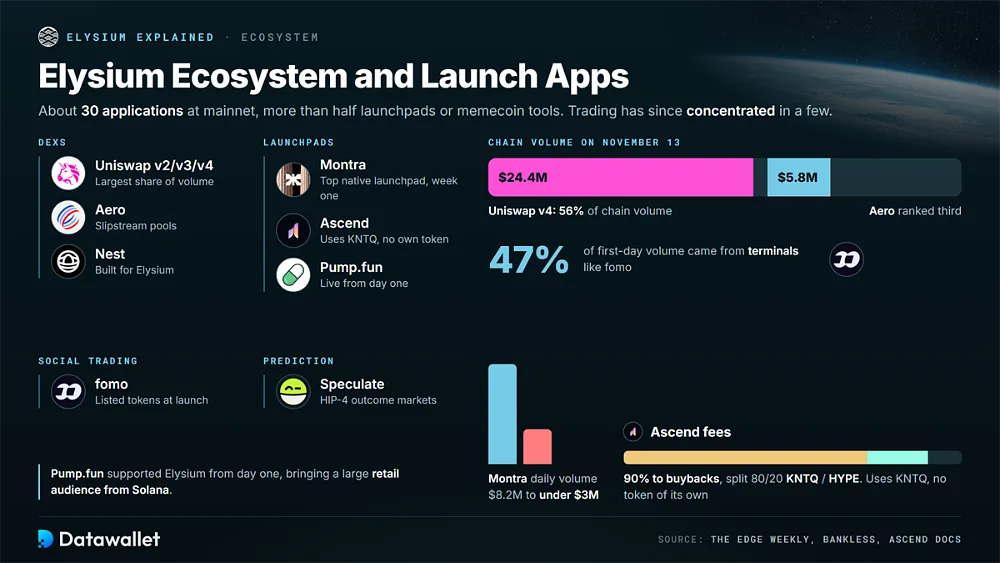
About 30 applications were listed when mainnet opened, and more than half were launchpads or memecoin tools. Trading has since concentrated in a few venues, with Uniswap handling the largest share of volume.
These are the most significant applications running on Elysium today:
- Uniswap: Versions 2, 3 and 4 of the Uniswap protocol are deployed. Version 4 processed about $24.4 million on November 13, or 56% of chain volume.
- Aero: The Aero exchange offers Slipstream concentrated liquidity pools and ranked third by volume on November 13 with roughly $5.8 million traded, according to The Edge Weekly.
- Nest: A decentralised exchange built for Elysium and live from the first mainnet block, named in Bankless coverage among the launch-day DeFi venues alongside Uniswap and Aero.
- Pump.fun: The memecoin platform supported Elysium trading from day one, bringing a large retail audience from Solana. Our Pump.fun guide explains how its token launches work.
- fomo: The social trading app listed Elysium tokens at launch. Terminals of this kind produced 47% of first-day volume. Our fomo explainer covers the app itself.
- Montra: The most active native launchpad in week one, with its MONTRA token the chain's largest by day three. Daily volume fell from $8.2 million to under $3 million.
- Ascend: A launchpad that uses KNTQ instead of issuing its own token. Its documentation directs 90% of protocol fees to buybacks, split 80/20 between KNTQ and HYPE.
- Speculate: A prediction market application that connects to Hyperliquid's outcome markets, the feature introduced by HIP-4. It was among the first applications to commit to Elysium mainnet.
Elysium Adoption Statistics
Launch demand was heavy. Co-founder Omnia said the chain processed nearly 10 million transactions within hours, with blocks landing every 50 to 90 milliseconds, Bankless reported. Conduit briefly rate-limited traffic in the first five minutes. Decentralised exchange volume reached $59.9 million on day one and peaked at $122 million on November 10.
Activity then fell quickly. By day nine, daily volume stood at $17.2 million, down 86% from the peak, and active wallets had dropped from 58,654 to 5,628, according to one independent analysis. First-week volume of $372 million still exceeded the $313.5 million that Robinhood Chain recorded in its first seven days.
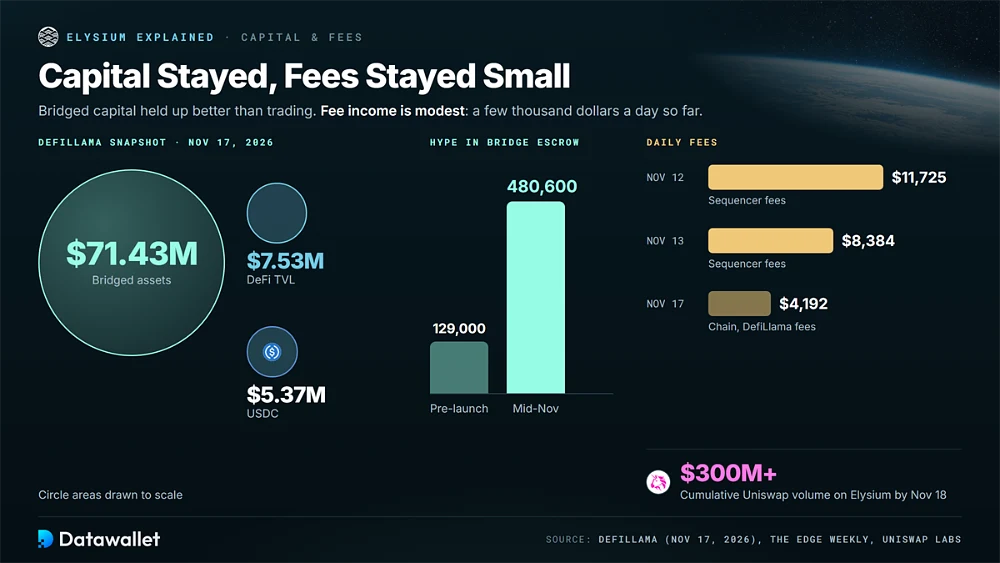
Capital stayed more stable than trading. The latest DefiLlama snapshot we could verify, dated November 17, 2026, showed $7.53 million in DeFi total value locked, $5.37 million in USDC and $71.43 million in bridged assets. Bridge escrow held about 480,600 HYPE in mid-November, up from roughly 129,000 before public launch.
Fee income is modest so far. Sequencer fees were $11,725 on November 12 and $8,384 on November 13, The Edge Weekly reported, and DefiLlama recorded $4,192 in chain fees on November 17. Uniswap Labs said cumulative volume on its Elysium deployment passed $300 million by November 18.
Elysium Roadmap
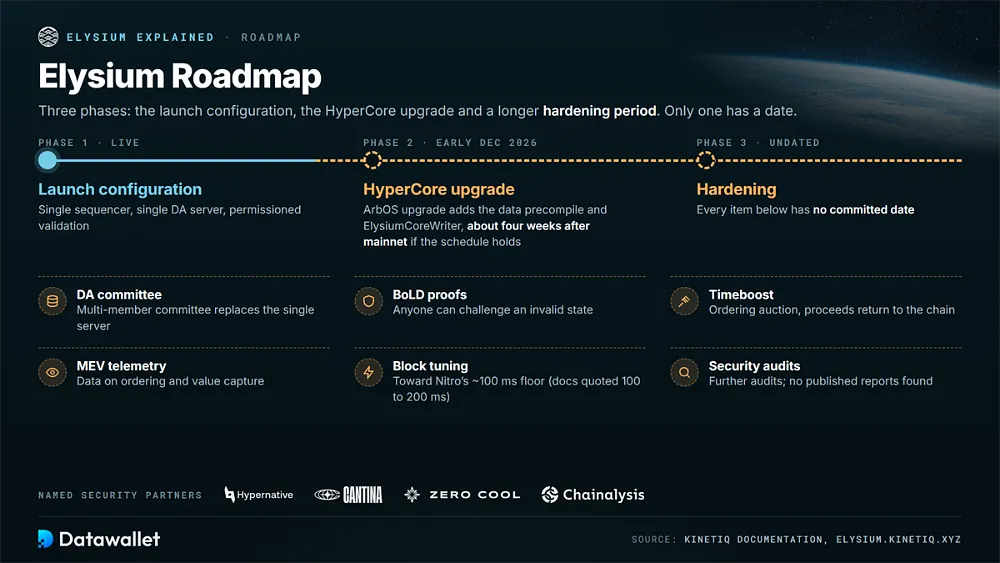
Kinetiq's documentation splits development into three phases: the launch configuration, the HyperCore upgrade and a longer hardening period. Only the HyperCore upgrade has an approximate date, and every other item is undated.
The following upgrades are planned after mainnet, in rough order:
- HyperCore Upgrade: An ArbOS network upgrade adds the data precompile and ElysiumCoreWriter about four weeks after mainnet, which places activation in early December 2026 if the schedule holds.
- DA Committee: The single data availability server is due to be replaced by a multi-member committee, so that no one operator can withhold the data behind a batch.
- BoLD Proofs: Validation is permissioned today. Kinetiq plans to adopt Arbitrum's BoLD protocol, which would let anyone challenge an invalid state and defend withdrawals without needing permission.
- Timeboost: Arbitrum's transaction ordering auction is listed for a later release. It sells a brief timing advantage to the highest bidder and returns the proceeds to the chain.
- MEV Telemetry: Monitoring of maximal extractable value is planned, which should give traders and builders data on how transactions are ordered and where value is being captured.
- Block Tuning: The team intends to tune block production toward the Nitro software's floor of roughly 100 milliseconds, after documentation quoted a range of 100 to 200 milliseconds.
- Security Audits: Further audits are scheduled for the hardening phase. The Elysium site names Hypernative, Cantina, Zero Cool and Chainalysis as security partners, though we found no published audit reports.
Elysium Fees and KNTQ Tokenomics
Elysium has no native token, no presale and no chain-wide points programme. Users pay gas in HYPE, and the base fee sits near 0.1 gwei. Any site offering an Elysium token claim should be treated as a scam. Rewards, where they exist, come from individual applications that set their own terms.
Value flows to KNTQ, Kinetiq's governance token, instead. Half of sequencer revenue buys KNTQ on the open market and sends it to Hyperliquid's Assistance Fund, which removes it from supply. A quarter goes to builders whose applications create demand for block space, and the final quarter funds protocol operations.
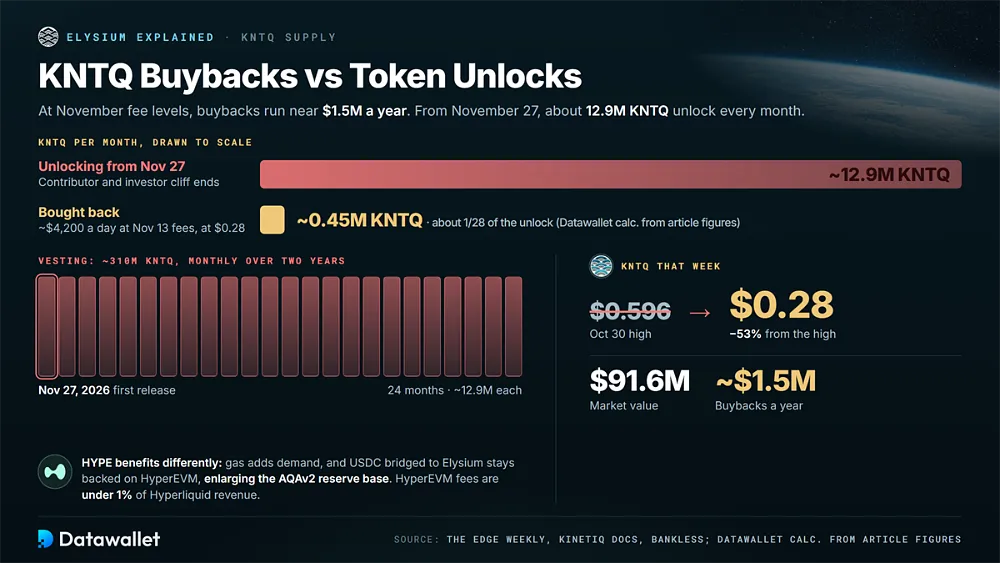
The sums are small against the token's supply schedule. At the November 13 fee level, buybacks run near $4,200 a day, or about $1.5 million a year. KNTQ traded at $0.28 that week with a market value of $91.6 million, 53% below its October 30 high of $0.596.
A larger supply event arrives on November 27, 2026, when the one-year cliff for contributors and investors ends. Roughly 310 million KNTQ then vest monthly over two years, about 12.9 million tokens each month. Our token unlock calendar tracks schedules of this kind across the market.
HYPE benefits in a different way. Gas spending adds demand, and new USDC bridged to Elysium remains backed on HyperEVM, which enlarges the reserve base that funds HYPE buybacks under Hyperliquid's AQAv2 programme. Bankless notes HyperEVM fees are under 1% of Hyperliquid's revenue, so little is lost if activity migrates.
Elysium vs HyperEVM vs HyperCore
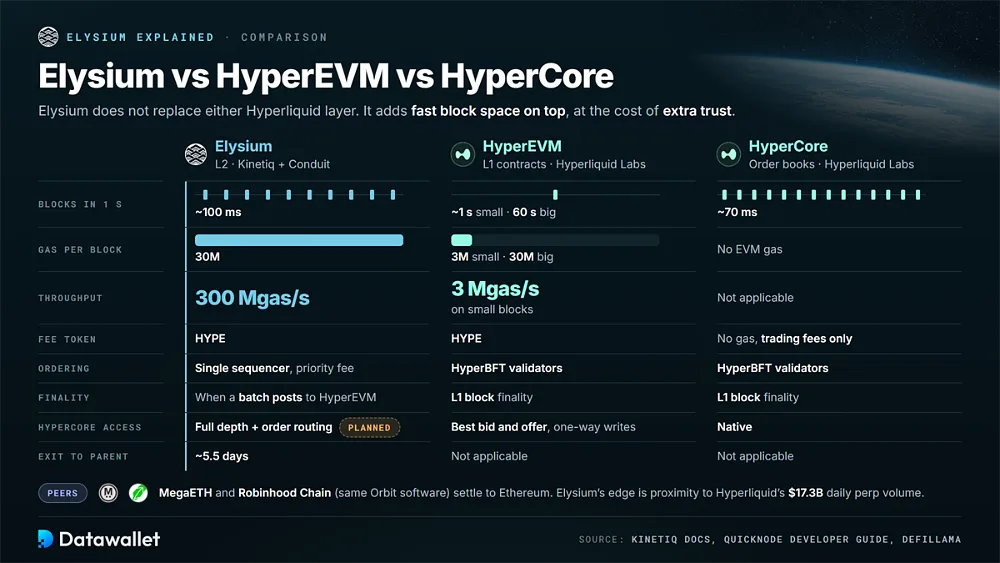
Elysium does not replace either existing Hyperliquid layer. HyperCore remains the order book engine for perpetuals and spot, HyperEVM remains the base layer for smart contracts, and Elysium adds fast block space on top. The table compares the three using Kinetiq's published figures and the QuickNode developer guide.
Feature |
 Elysium |
 HyperEVM |
HyperCore |
|---|---|---|---|
Role |
Layer 2 for high-throughput apps |
Smart contract layer of the Layer 1 |
Native order book engine |
Developer |
Kinetiq, operated with Conduit |
Hyperliquid Labs |
Hyperliquid Labs |
Block time |
About 100 ms |
About 1 s (small), 60 s (big) |
About 70 ms |
Gas per block |
30 million |
3 million (small), 30 million (big) |
No EVM gas |
Throughput target |
300 Mgas/s |
3 Mgas/s on small blocks |
Not applicable |
Fee token |
HYPE |
HYPE |
No gas, trading fees only |
Ordering |
Single sequencer, priority fee |
HyperBFT validators |
HyperBFT validators |
Finality |
When a batch posts to HyperEVM |
Layer 1 block finality |
Layer 1 block finality |
HyperCore access |
Full depth and order routing, planned |
Best bid and offer, one-way writes |
Native |
Exit to parent |
About 5.5 days |
Not applicable |
Not applicable |
The practical difference is trust. HyperEVM and HyperCore are secured by Hyperliquid's validator set through HyperBFT consensus. Elysium adds a sequencer, a data server and a 5.5-day exit window on top of that base. In return, contracts get around 100 times more gas each second than HyperEVM's standard blocks provide.
Compared with other new chains, Elysium is narrowly focused on trading. MegaETH pursues similar speeds while settling to Ethereum, and Robinhood Chain uses the same Arbitrum Orbit software for tokenised stocks. Elysium's distinguishing asset is proximity to Hyperliquid, where daily perpetual volume recently reached $17.3 billion, per DefiLlama.
Is Elysium Safe?
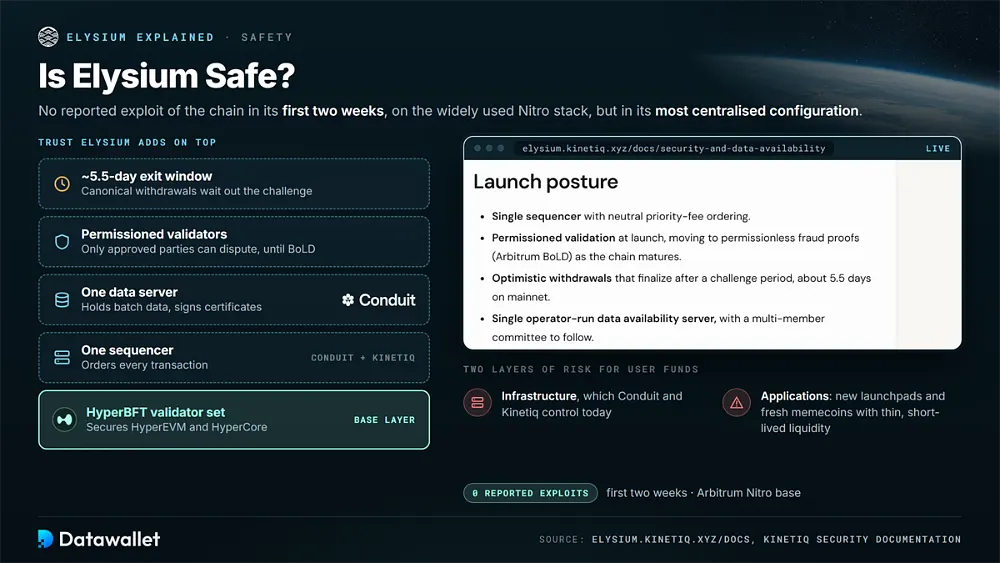
We found no reported exploit of the chain itself in its first two weeks, and its software base is the widely used Arbitrum Nitro stack. It is still a new network in its most centralised configuration.
User funds face two layers of risk: the chain's infrastructure, which Conduit and Kinetiq control today, and the applications on it, many of which are new launchpads and freshly issued memecoins with thin and short-lived liquidity.
Risks
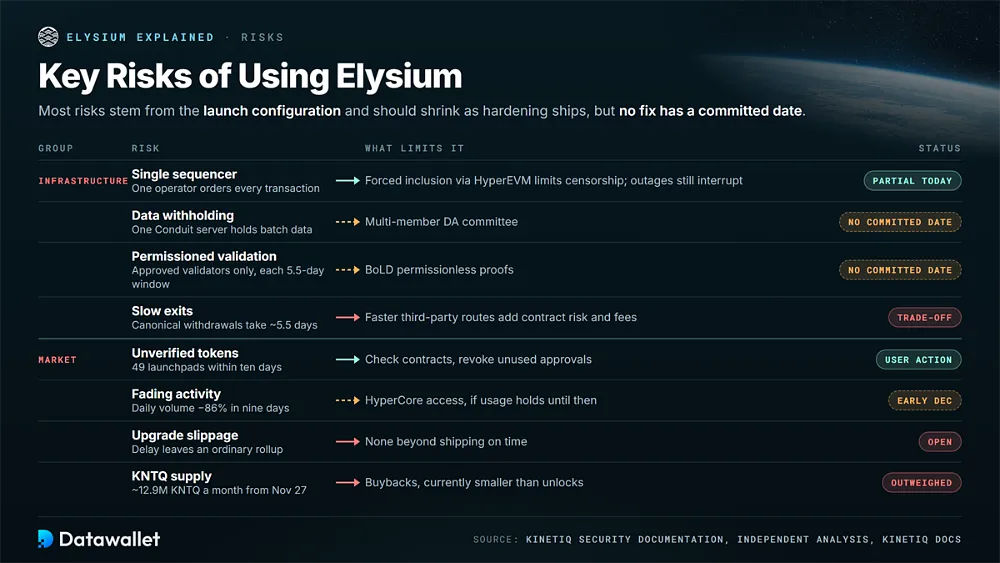
Anyone bridging HYPE to Elysium should weigh the following risks. Most stem from the launch configuration and should shrink as the hardening roadmap ships, although none of those upgrades has a committed date.
The main risks at the time of writing are:
- Single Sequencer: One operator orders every transaction. Forced inclusion through HyperEVM limits censorship, but a sequencer outage would still interrupt normal activity until service is restored.
- Data Withholding: One Conduit server holds batch data. If it and the onchain fallback both failed, users could not reconstruct balances, a weakness the planned committee should remove.
- Permissioned Validation: Only approved validators can dispute an invalid state until BoLD arrives. Users therefore rely on those parties staying honest and online throughout each 5.5-day challenge window.
- Slow Exits: Canonical withdrawals take about 5.5 days. Faster third-party routes exist, but they add contract risk and fees, as our crypto bridges guide explains in detail.
- Unverified Tokens: Trackers counted 49 launchpads within ten days. Most new tokens have little liquidity, so holders should check contracts and revoke unused token approvals on a regular basis.
- Fading Activity: Daily volume fell 86% within nine days of launch. If usage keeps shrinking before HyperCore access arrives, liquidity for Elysium-native tokens could thin even further.
- Upgrade Slippage: The HyperCore integration is the reason many builders came. Any delay beyond early December would leave Elysium operating as an ordinary rollup for longer than planned.
- KNTQ Supply: Monthly unlocks of about 12.9 million KNTQ begin on November 27 and currently outweigh buybacks, which matters for anyone holding the token as an Elysium proxy.
Final Thoughts
Elysium gives Hyperliquid something it lacked: abundant, fast block space that pays its fees in HYPE. The launch proved demand exists, with nearly 10 million transactions in hours and more first-week volume than Robinhood Chain managed. It also showed how quickly memecoin-driven activity fades once the novelty passes.
The next test is the HyperCore upgrade expected in early December. Full order book reads and contract-driven order routing are features that general-purpose rollups cannot offer, and they underpin the proprietary AMM and market-making use cases Kinetiq describes. Until they ship, Elysium competes mostly on speed.
Users should bridge only what they can leave for 5.5 days, verify chain ID 99901 and treat new tokens with caution. Longer term, three markers will show progress: a multi-member data committee, permissionless fraud proofs and sequencer revenue large enough to matter against KNTQ's unlock schedule.


