



MetaMask vs Phantom: Overview
MetaMask is the self-custodial wallet built by Consensys and the default gateway to Ethereum. It reaches beyond the EVM world with native Solana and Bitcoin accounts, an in-app perps terminal, the mUSD stablecoin, and a seasonal rewards program feeding into a confirmed token launch. Over 30 million people use it monthly.
Phantom began as the leading Solana wallet and has grown into a self-custodial money app serving more than 20 million users. It supports eight networks, issues its own dollar-pegged stablecoin, ships a Visa debit card, and embeds perpetuals and prediction markets in its interface.
We compared the essentials side by side in the table below.
MetaMask vs Phantom: Supported Networks
MetaMask covers the broadest territory. Alongside Ethereum, it connects to every major EVM chain, including Arbitrum, Base, Polygon, BNB Chain, Optimism, Avalanche, and Linea, while its unified accounts extend natively to Solana and Bitcoin. Community-built Snaps push support further into non-EVM ecosystems such as Sei and Cosmos chains.
Phantom takes a curated approach. Its official network list covers Solana, Ethereum, Base, Polygon, Sui, Monad, Bitcoin with Native SegWit and Taproot addresses, and HyperEVM. It deliberately skips Arbitrum, Optimism, BNB Chain, Avalanche, and Linea, so heavy Layer 2 users will hit gaps MetaMask does not have.
MetaMask vs Phantom: Features
Both wallets have moved beyond simple key storage and now compete as full financial apps, layering in payments, yield, derivatives, and event trading on top of basic asset management.
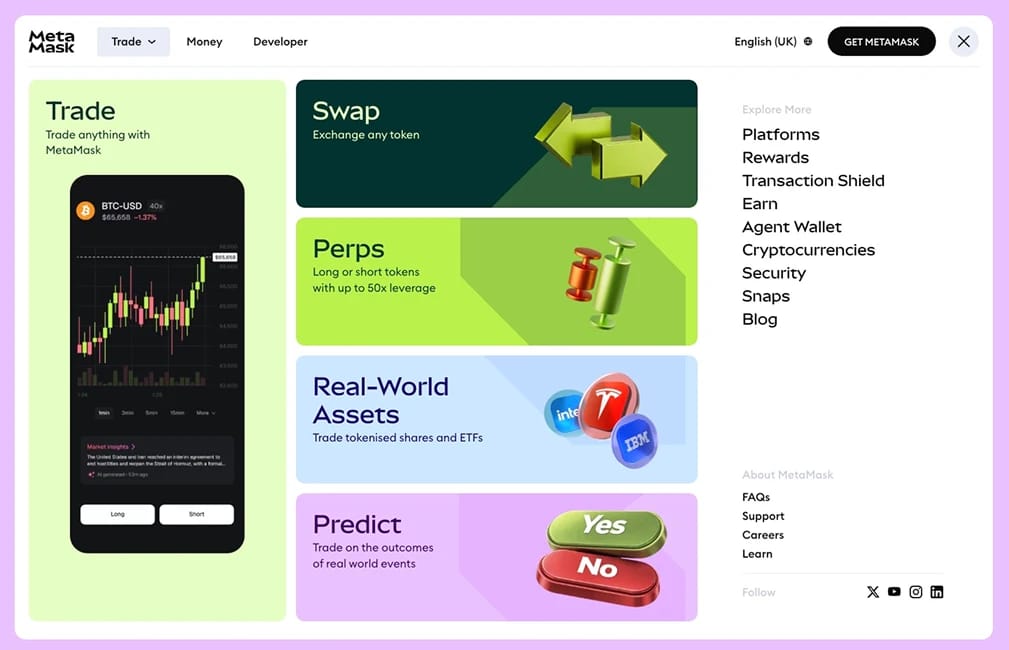
MetaMask Features
MetaMask has rebuilt itself around trading, payments, and a points economy that Consensys has confirmed will lead to a MASK token.
Explore the standout tools inside MetaMask:
- Money Account: Convert USDC, USDT, or DAI into mUSD at a one-to-one rate and earn up to 4% APY through Morpho-powered DeFi vaults.
- MetaMask Card: Spend crypto at Mastercard merchants and earn up to 3% cashback in mUSD on qualifying purchases.
- MetaMask Rewards: Collect seasonal points for swaps, perps, predictions, and card spending, with the first season paying out over $30 million in LINEA tokens.
- Perps Terminal: Trade leveraged futures on crypto and tokenized US equities in the wallet, funded in one click from any EVM network.
- MetaMask Predict: Take positions on Polymarket event markets spanning sport, politics, and macro data from the mobile app.
- Smart Accounts: Upgrade to EIP-7702 accounts for transaction batching and gasless swaps on supported networks.
- Transaction Shield: Subscribe to receive up to $10,000 per month in transaction protection plus priority support, a first among self-custodial wallets.
- Agent Wallet: Give AI agents controlled on-chain access, an early move in a category most rivals have not touched.
Phantom Features
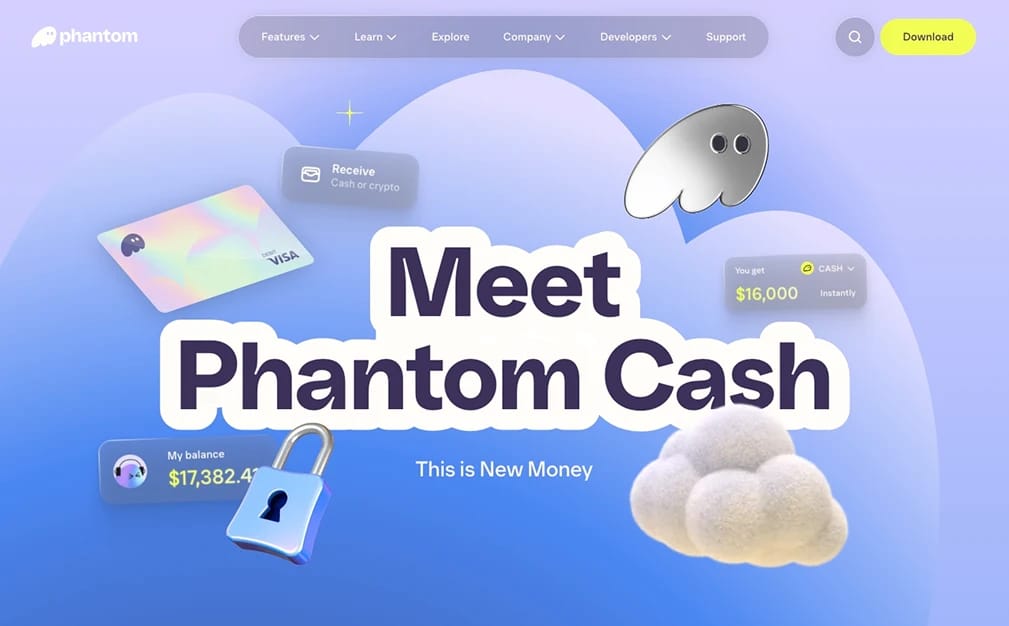
Phantom focuses on a single app that handles saving, trading, and spending, with its own stablecoin at the center of the design.
The features below define the current Phantom experience:
- Phantom Cash: Hold a dollar balance in CASH, a stablecoin issued through Bridge and Stripe, funded instantly from a bank account or card.
- Phantom Card: Spend the CASH balance anywhere Visa is accepted via Apple Pay, Google Pay, or a physical card.
- Cross-Chain Swaps: Trade across all eight supported networks through an internal aggregator that hides the bridging steps.
- Perps: Open leveraged positions on 100+ Hyperliquid markets with stop-loss, take-profit, and PNL tracking built in.
- Prediction Markets: Trade tokenized event positions with automatic payouts and a live chat attached to every market.
- Tokenized Stocks: Gain on-chain exposure to major US equities alongside regular crypto holdings.
- Native Staking: Delegate SOL to validators in a few taps and track rewards on the same dashboard.
- AI Agent Tools: Connect agents to swaps, portfolio tools, and perps through the Phantom MCP server, each agent receiving its own wallet.
MetaMask vs Phantom: Stablecoins and Payments
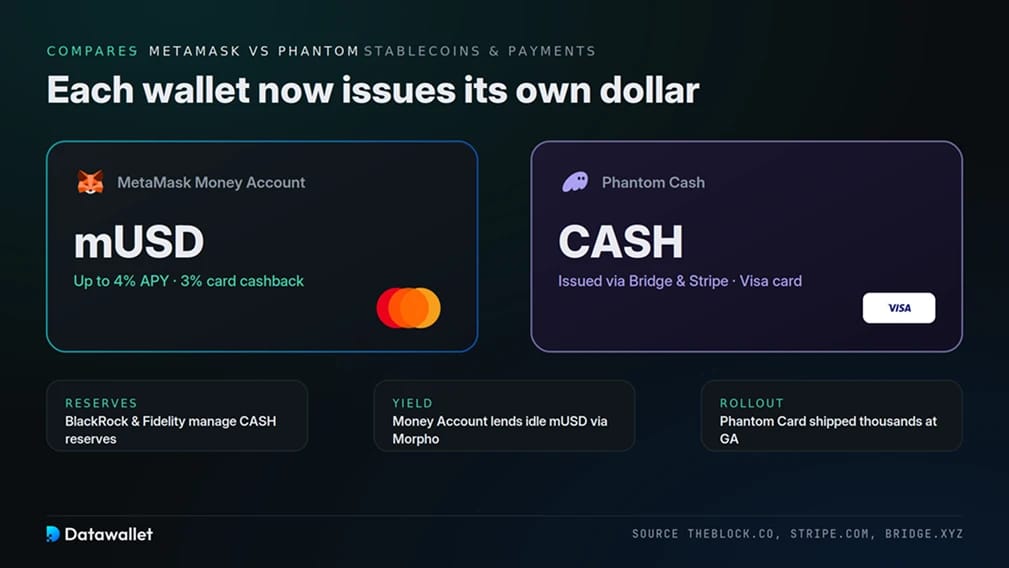
The clearest sign that these wallets now compete with fintech apps is that each issues its own dollar token. MetaMask launched mUSD on Ethereum and Linea, then wrapped it in a Money Account that moves idle balances into DeFi lending vaults for up to 4% APY. The same balance settles MetaMask Card purchases and earns cashback, so a single asset covers saving, spending, and rewards.
Phantom went further down the payment path. CASH was the first stablecoin built on Bridge's Open Issuance platform, with reserves managed by institutions including BlackRock and Fidelity, and it underpins the native onramp, peer transfers, and the Phantom Card. After a limited release, the card reached general availability, with thousands of Visa cards shipped within weeks.
We tested both payment stacks, and Phantom's onramp is faster because Stripe's Link checkout reuses saved payment details instead of pushing users through a third-party widget.
MetaMask vs Phantom: Perps and Prediction Markets
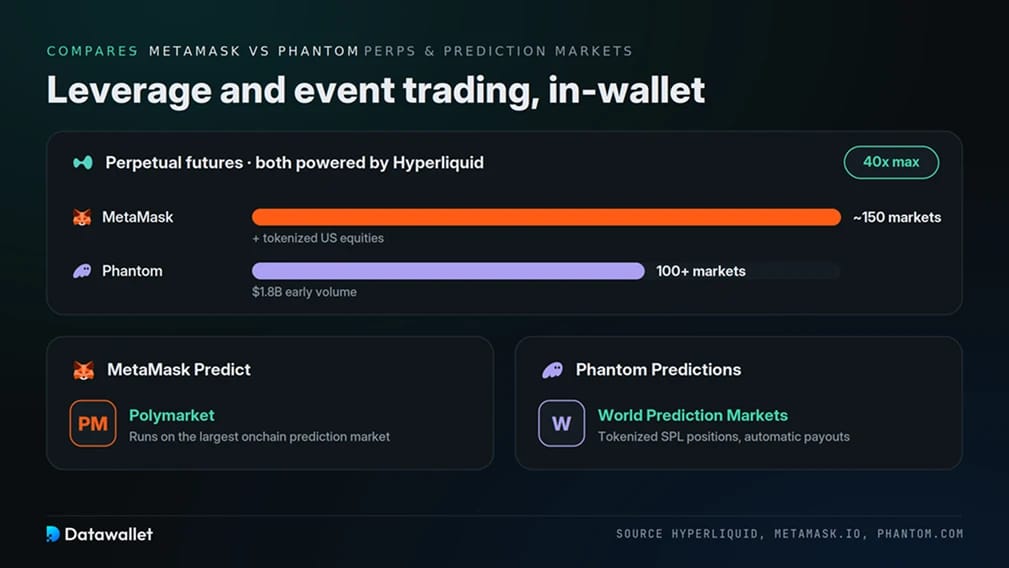
Perpetual futures run through Hyperliquid in each wallet, so execution quality is nearly identical, and the differences lie in market coverage and pricing. MetaMask Perps spans roughly 150 crypto markets plus tokenized US equities at up to 50x leverage, with fee discounts unlocked through Rewards levels. Phantom Perps offers 100+ markets at the same maximum leverage and cleared $1.8 billion in volume within weeks of launching.
On event trading, the two took opposite sides of an industry split. MetaMask Predict runs on Polymarket, giving mobile users access to the largest on-chain prediction market. Phantom started with Kalshi before switching to World Prediction Markets as its issuer in June 2026, a change that made positions tradable SPL tokens and removed manual settlement, since winnings now redeem automatically when a market resolves.
MetaMask vs Phantom: Security
Neither wallet has suffered a core software breach, and both pair local key encryption with transaction simulation that flags dangerous approvals before signing.
MetaMask Security
MetaMask remains the most battle-tested wallet codebase in crypto, though its scale also makes its users the favorite target for phishing campaigns.
These are the main defenses protecting MetaMask accounts:
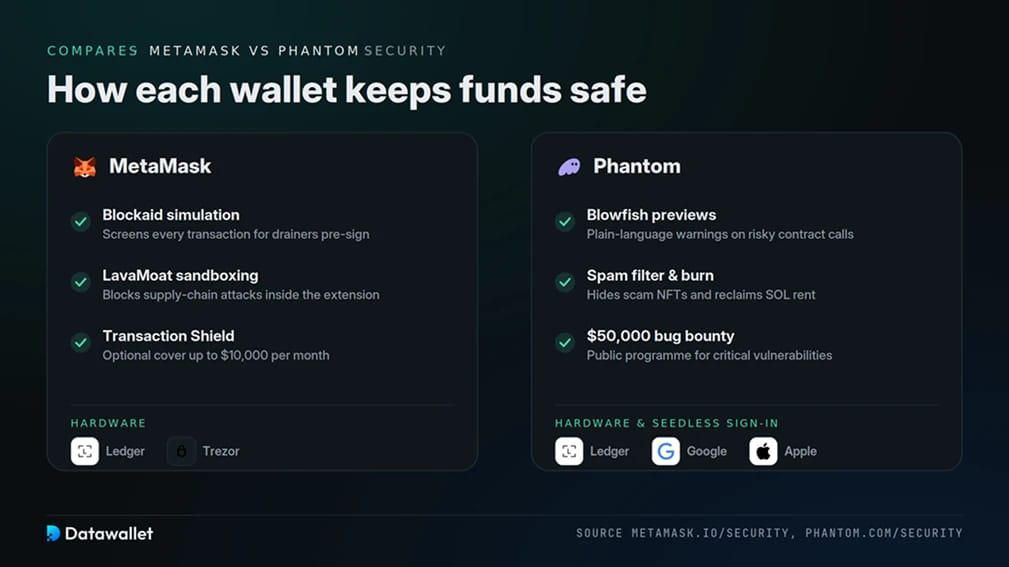
- Blockaid Simulation: Every transaction is simulated and screened for drainer contracts and malicious approvals before you sign.
- LavaMoat Sandboxing: Dependency isolation prevents supply chain attacks from reaching private keys within the extension.
- Phishing Detection: Known malicious domains are blocked before a connection request loads.
- Social Login Backup: Recovery phrases can be sharded and encrypted behind an Apple or Google account for safer recovery.
- Hardware Support: Ledger, Trezor, Keystone, Lattice, and NGRAVE devices keep signing keys offline.
- Transaction Shield: The optional subscription provides up to $10,000 per month in protection for covered incidents.
Phantom Security
Phantom builds its protection around the scams that dominate consumer chains, particularly malicious tokens and fake collectibles on Solana.
Phantom's key safeguards include the following:
- Blowfish Simulation: In-house previews translate contract calls into plain warnings about likely fund loss.
- Spam Filtering: Fraudulent NFTs and tokens are hidden automatically, and a burn tool clears them while reclaiming SOL rent.
- Seedless Onboarding: New wallets can be created using Google or Apple sign-ins, eliminating seed phrase mistakes that trap beginners.
- Bug Bounty: Researchers earn up to $50,000 for reporting critical vulnerabilities through the public program.
- Hardware Support: Ledger and Keystone devices add offline signing for high-value accounts.
- Impersonation Policy: Phantom never contacts users first for support, cutting off the fake-support scams common on social platforms.
MetaMask vs Phantom: Fees
MetaMask builds a 0.875% fee into every in-wallet swap and bridge quote, layered on top of network gas and the underlying liquidity source's costs. Perps pricing improves with Rewards levels, and a flat $1 fee applies to perps account withdrawals.
Phantom charges 0.85% on select swap pairs, with cross-chain trades adding a bridge provider fee of around 0.3%. Gasless swaps on Solana mobile carry a flat 1.5% all-in rate for users without SOL. Stablecoin purchases through Phantom Cash are free of platform fees.
The headline swap rates are close enough that neither wallet wins on cost alone. Active traders save more by checking quotes against a DEX aggregator before large trades.
Is MetaMask Better Than Phantom?
MetaMask is the stronger pick for anyone active across Ethereum and its Layer 2 networks. Its EVM coverage has no real rival, Snaps extend it into niche ecosystems, and Rewards seasons paired with a confirmed MASK token give users a reason to keep their volume inside the app.
Phantom is the better wallet for most other people. It delivers a cleaner interface, faster performance on consumer chains, and a payments layer that MetaMask has only partially matched. For Solana traders, NFT collectors, and anyone wanting one app for saving, spending, and speculating, Phantom is the more complete product.
Final Thoughts
The wallet category has become a super app race, and MetaMask and Phantom are running it from opposite starting points. MetaMask is turning unmatched network reach into a trading and rewards ecosystem, while Phantom is turning a beloved consumer app into a full money platform.
Our verdict favors Phantom for everyday users because it removes friction at every step, from a Stripe-powered onramp to automatic prediction market payouts. MetaMask keeps the crown for EVM power users and airdrop hunters positioning for the MASK launch.
Whichever you choose, both are self-custodial, so your funds stay in your hands. For deeper platform details, read our full MetaMask review and Phantom wallet review before committing.