
What Is Midnight Network?
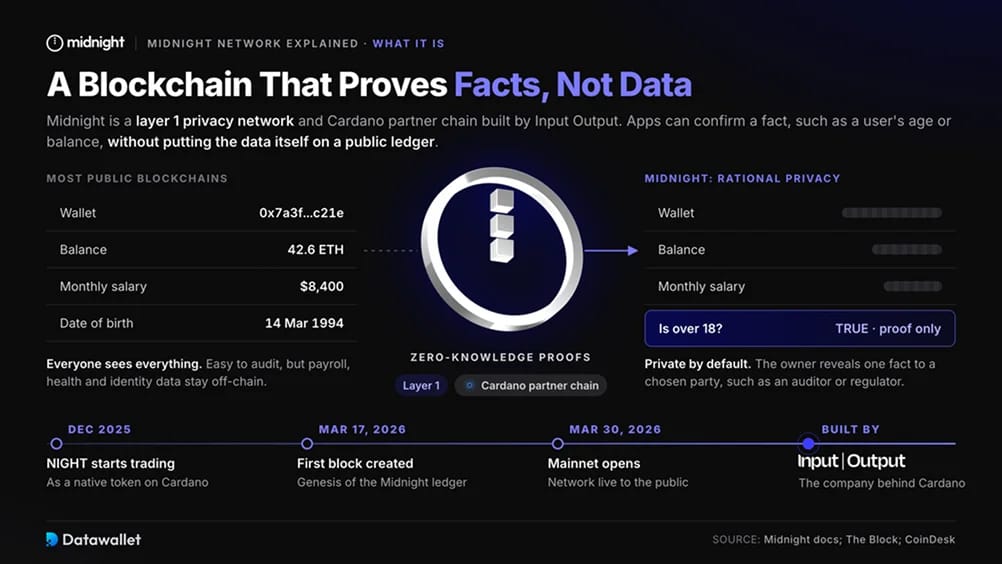
Midnight Network is a blockchain that lets apps use private data without publishing it. It runs its own ledger, consensus and smart contracts as a layer 1 network and a partner chain to Cardano. Cardano's stake pool operators (SPOs), who produce Cardano blocks, will be able to secure Midnight and earn its token.
Most public blockchains show every balance, address and transaction to anyone. That makes auditing easy, but it keeps payroll, health, identity and commercial data off blockchains because companies cannot publish it. Midnight calls its answer "rational privacy." Data stays private by default, and its owner can reveal a specific fact to a chosen party, such as an auditor or a regulator.
This approach separates Midnight from older privacy coins. Charles Hoskinson told CoinDesk that Midnight will not try to win over Monero and Zcash users and instead targets "billions of people that don't know they need privacy." Readers comparing designs can see how Zcash works or review the best privacy coins.
Midnight created its first block on March 17, 2026, and opened to the public on March 30. The NIGHT token had already traded on Cardano since December 2025.
How Does Midnight Network Work?
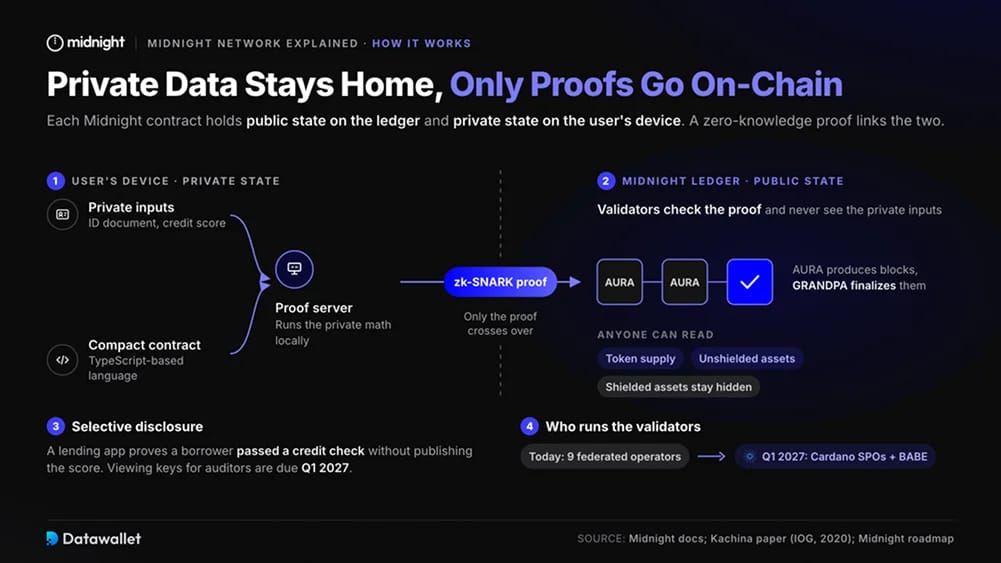
For users, Midnight keeps private data on their own device and puts only proofs on the blockchain. Zero-knowledge proofs show that a statement is true without revealing the data behind it. A small group of validators orders transactions today, and Cardano SPOs will join that work later.
1. One Contract Holds Public and Private Data
Public data in a Midnight contract, such as a token supply, lives on the ledger for anyone to read. Private data, such as an identity document, stays on the user's device. This model comes from Kachina, a private smart contract framework that Input Output researchers published in 2020. One transaction can move shielded (hidden) and unshielded (visible) assets together.
2. Proofs Are Created on the User's Device
When a user calls a contract, a proof server on the user's computer runs the private calculation. It then produces a zk-SNARK, a short cryptographic proof that the calculation followed the contract rules. Validators check the proof and never see the private inputs. Developers write contracts in Compact, a TypeScript-based language that turns normal code into these proofs, so developers do not need to design cryptography by hand.
3. Selective Disclosure Controls Who Sees What
A lending app can prove that a borrower passed a credit check without publishing the credit score. A bank can show one customer record to a regulator without exposing other customers. Some disclosure tools are still in development, and the official roadmap lists viewing keys for auditors and regulators for the first quarter of 2027.
4. Federated Validators Now, Cardano SPOs Later
Midnight nodes use AURA to produce blocks and GRANDPA to finalize them, two methods from the Substrate blockchain framework, according to the node documentation. Today a fixed group of approved companies, called federated node operators, runs every validator. The roadmap opens block production to Cardano SPOs in the first quarter of 2027, alongside NIGHT staking and a staged move to the BABE consensus protocol.
$NIGHT Tokenomics & Supply
Holding NIGHT gives you DUST, and DUST pays your fees, so a normal transaction never requires selling the token. Midnight's documentation calls this a dual-component model. NIGHT is the transferable token that people trade, and it will carry staking and governance rights. DUST is consumed as fees and cannot be traded.
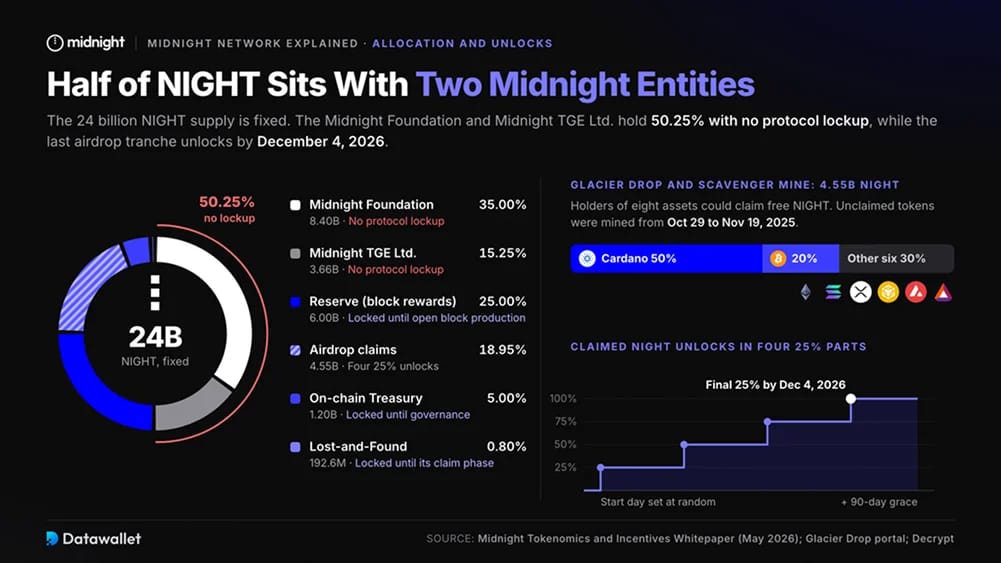
NIGHT has a fixed supply of 24 billion. The full amount was minted on Cardano and copied to Midnight in its first block. A cross-chain mechanism stops the combined supply on both chains from going above 24 billion. About 16.6 billion NIGHT, or 69.2% of supply, counted as circulating on CoinGecko on November 9, 2026.
Allocation and Unlocks
The Glacier Drop let holders of ADA, BTC, ETH, SOL, XRP, BNB, AVAX and BAT claim free NIGHT. Half of the pool went to Cardano holders and 20% to Bitcoin, Decrypt reported. In the second phase, Scavenger Mine, participants earned unclaimed tokens through computing work from October 29 to November 19, 2025. The two phases distributed about 4.55 billion NIGHT, one of the largest crypto airdrops by participation.
These figures come from the May 2026 tokenomics and incentives whitepaper. In our review of that document, the Midnight Foundation and Midnight TGE Ltd., the token generation event (TGE) entity that ran the distribution, hold 50.25% of supply. Neither allocation has a protocol lockup, so both can move their tokens at any time.
Claimed airdrop tokens unlock in four parts of 25% each. The first unlock day for each claim was set at random to spread selling over time. The final part unlocks by December 4, 2026, according to the Glacier Drop portal. After a 90-day grace period, holders who have not redeemed must use the Cardano smart contracts directly.
DUST Generation and Block Rewards
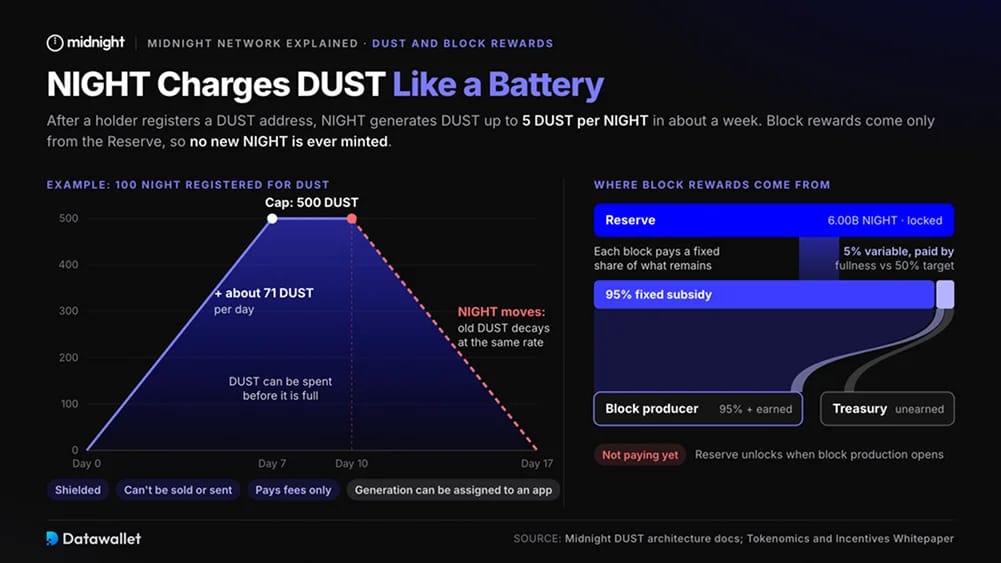
After a NIGHT holder registers a DUST address, the network generates DUST from that NIGHT. The DUST architecture documentation sets a cap of 5 DUST per NIGHT and a fill time of about one week. For example, 100 NIGHT produces about 71 DUST per day until the balance reaches 500 DUST.
DUST is shielded, cannot be transferred or sold, and can only pay fees. If the NIGHT behind it moves, the old DUST decays to zero at the same rate it grew. NIGHT holders can assign DUST generation to another address, so a developer can pay fees for its users. Each fee combines a minimum charge, a congestion rate that adjusts every block and the transaction's size.
Block rewards come only from the Reserve, so the protocol never mints new NIGHT. Each block pays a fixed share of the remaining Reserve. At launch, 95% of that payment is a fixed subsidy, and the rest depends on how full the block is against a 50% target. Unearned parts go to the Treasury. The Reserve stays locked until block production opens up, so it pays no rewards yet.
How to Get NIGHT and Generate DUST
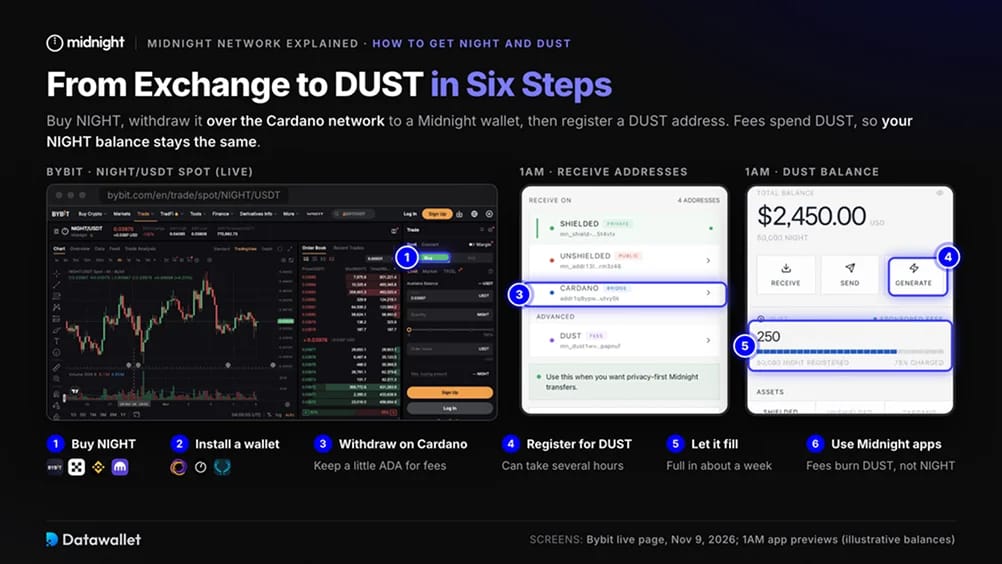
NIGHT trades on major exchanges as a Cardano native asset, and Binance Research also lists a BEP-20 version on BNB Chain. DUST registration works with NIGHT held on Cardano or on Midnight. Check the withdrawal network before moving tokens.
- Buy NIGHT on an exchange: NIGHT/USDT spot markets are available on Bybit, OKX and Binance. European buyers can also use the NIGHT/EUR pair on Kraken.
- Install a Midnight wallet: Lace, 1AM and Gero support NIGHT registration and DUST tracking. Write the recovery phrase on paper and keep it offline.
- Withdraw over the Cardano network: Send NIGHT from the exchange to the wallet's Cardano address. Keep a little ADA in the wallet to pay the Cardano registration fee.
- Register for DUST: Open the wallet's DUST option and sign the registration transaction. DUST can take several hours to appear after registration.
- Let the balance fill: DUST grows at a steady rate and reaches its cap after about a week. You can spend it before it is full.
- Use Midnight applications: Connect the wallet to a Midnight dApp (decentralized application). Each transaction consumes a small amount of DUST, and your NIGHT balance stays the same.
Midnight Network Statistics and Trends
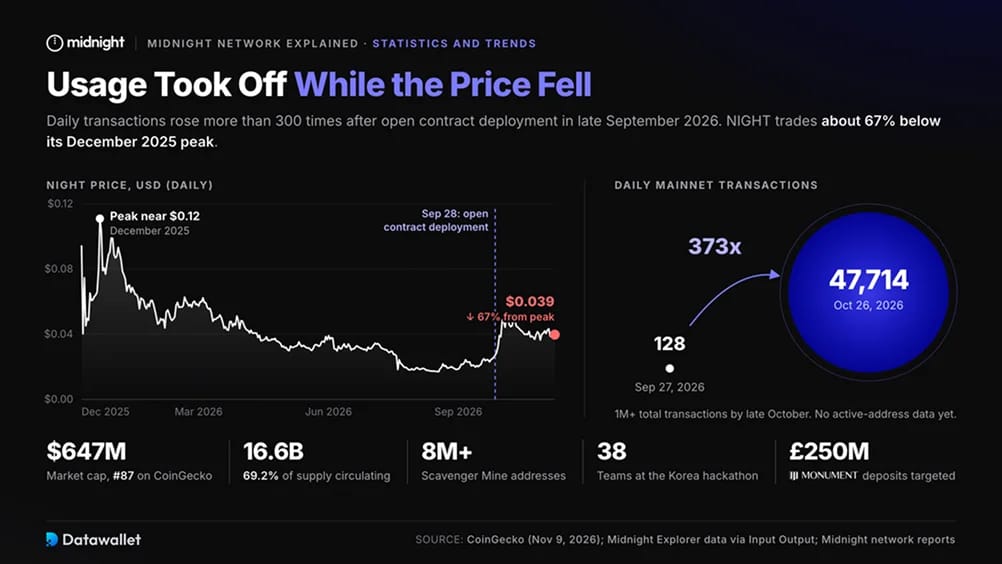
Midnight's usage grew fast in late 2026 while its token price fell. Market figures are from November 9, 2026, unless stated otherwise.
- Price and market value: NIGHT traded near $0.039 with a market capitalization of about $647 million, ranked 87th on CoinGecko.
- Distance from peak: The token peaked near $0.12 in December 2025, shortly after listing, and now trades about 67% below that high.
- Circulating supply: About 16.6 billion NIGHT, or 69.2% of the 24 billion total, counts as circulating.
- Airdrop reach: More than 8 million addresses took part in Scavenger Mine alone, according to the November 2025 network report.
- Transactions: Mainnet passed 1 million total transactions in late October 2026. Daily transactions rose from 128 on September 27 to 47,714 on October 26, according to Midnight Explorer data shared by Input Output.
- Builders: 38 teams submitted working apps to the Midnight Korea Hackathon, which Midnight co-hosted with CertiK and the Seoul Fintech Lab.
- Institutional pipeline: Monument Bank, which manages about £7 billion in deposits, targets £250 million of tokenized retail deposits in its first phase.
The rise in transactions began after the September upgrade that removed the review step for new contracts. Neither Midnight nor its analytics partners have published active-address counts, so it is unclear how much of this activity comes from real users.
Midnight Network Roadmap and Recent Upgrades
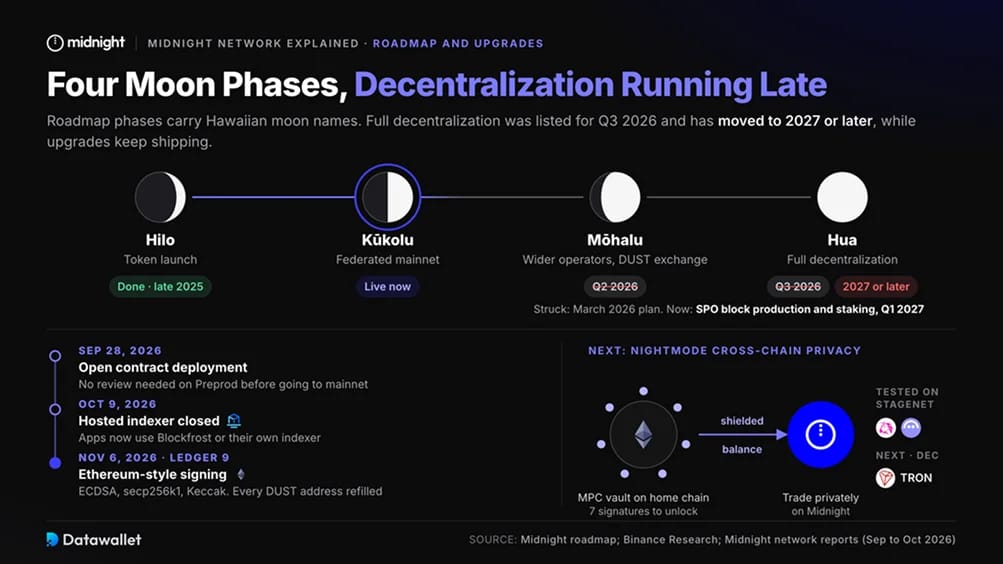
Midnight's move to open block production is running behind its original plan. Its roadmap phases carry Hawaiian moon names, from Hilo (the token launch in late 2025) to Kūkolu (the current federated mainnet).
In March 2026, Binance Research listed Mōhalu (wider operator participation and a DUST capacity exchange) for the second quarter of 2026 and Hua (full decentralization) for the third quarter. The current roadmap places NIGHT staking and SPO block production in the first quarter of 2027. Several upgrades shipped in the meantime.
- Open contract deployment (September 28, 2026): Developers can deploy contracts to mainnet without a security review on Preprod, the public test network, according to the September network report.
- Hosted indexer shutdown (October 9, 2026): Midnight closed its hosted indexer and RPC endpoints, the services that apps use to read chain data. Apps now use Blockfrost or run their own indexer.
- Ledger 9 (November 6, 2026): The ledger 9 release added calls between contracts and contract events for public data. It also added ECDSA signature checks, native secp256k1 support and Keccak hashing, the same signing and hashing methods that Ethereum uses.
- Compatibility and DUST reset: Ledger 8 transactions do not work on ledger 9, so every wallet and app had to update. The upgrade also refilled every registered DUST address to its full cap, and NIGHT balances did not change.
Cross-chain privacy is the newest focus, and it would let users trade assets from other chains privately without moving them. Under Nightmode, assets sit in a multi-party computation (MPC) vault on their home chain, and access to the vault depends on seven signatures. Midnight credits the user a shielded balance to trade.
Sig Network gives each Midnight contract its own Ethereum account and has tested deposits, Uniswap swaps and Aave lending. These tests run only on Midnight's stagenet test network, and TRON is the next target for December 2026, according to the October network report.
Midnight vs Zcash vs Monero vs Canton
Midnight competes with two groups of networks. Zcash and Monero protect payments, while Canton Network gives regulated institutions private smart contracts.
The main difference is programmability. Zcash and Monero hide who paid whom, as our Zcash vs Monero comparison explains. Midnight adds private logic, so an app can enforce rules on hidden data. Other projects test different methods, such as encrypted computation on Zama and shielded transfers through Umbra on Solana.
Regulation may widen this gap. From July 10, 2027, the EU's Anti-Money Laundering Regulation bars crypto-asset service providers from keeping accounts that use anonymity-enhancing coins. NIGHT is issued as an unshielded token, which may help exchanges keep listing it. EU supervisors have not yet said how they will treat shielded assets on Midnight.
Midnight Ecosystem and Key Partners
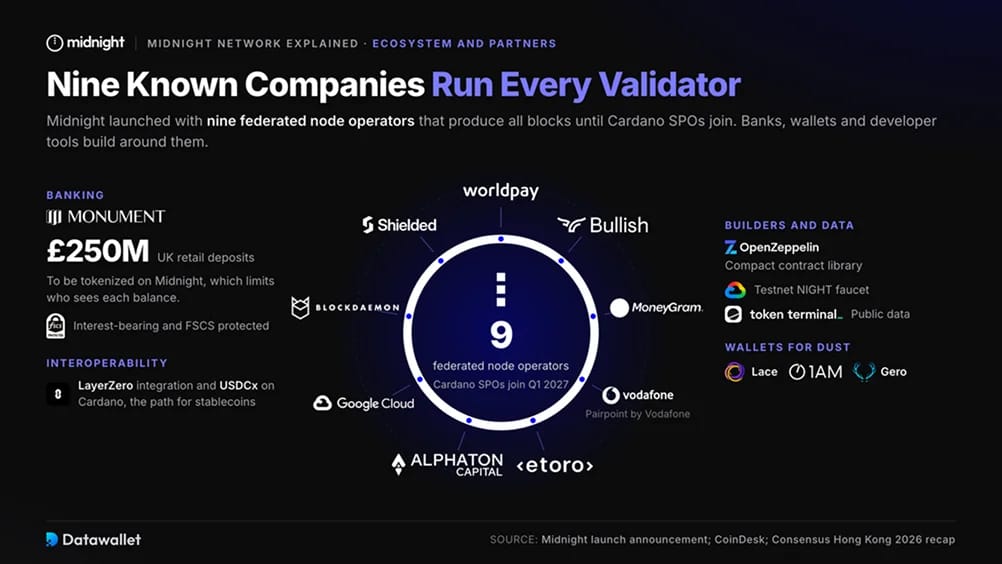
Midnight's first validators are well-known companies, so users and institutions know who runs the network today. The launch announcement named nine federated node operators, which are Worldpay, Bullish, MoneyGram, Pairpoint by Vodafone, eToro, AlphaTON Capital, Google Cloud, Blockdaemon and Shielded Technologies. They run the validator nodes until Cardano SPOs can join.
Monument Bank is the largest announced banking use case so far. The UK-regulated bank plans to tokenize up to £250 million of retail deposits on Midnight, and CoinDesk reported that the deposits will stay interest-bearing and protected by the UK's Financial Services Compensation Scheme. Midnight's privacy layer limits who can see each customer's balance. The deal adds to a wider shift in tokenization and real-world asset projects.
OpenZeppelin is building a Compact contract library, and Google Cloud offers a testnet NIGHT faucet through its Web3 portal. Dune and Token Terminal track public chain data, while shielded transactions stay private. Lace, 1AM and Gero are the main wallets for DUST registration.
At Consensus Hong Kong 2026, Charles Hoskinson announced a LayerZero integration and USDCx on Cardano as groundwork for moving stablecoins between Cardano and Midnight. LayerZero is a messaging protocol that connects many blockchains.
Who Founded Midnight Network?
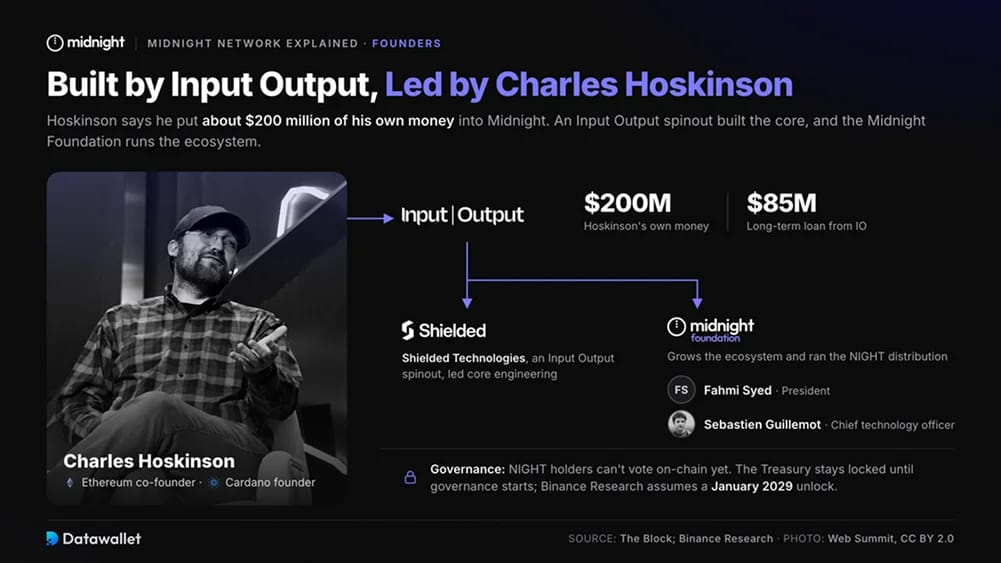
Charles Hoskinson, an Ethereum co-founder and Cardano's founder, leads the project through Input Output. He said he put about $200 million of his own money into Midnight's development, according to The Block. Binance Research also lists an $85 million long-term loan from Input Output as part of the project's funding.
Shielded Technologies, an Input Output spinout, led core engineering. The Midnight Foundation, led by President Fahmi Syed, grows the ecosystem and ran the NIGHT distribution. Sebastien Guillemot serves as the Foundation's chief technology officer.
Governance
NIGHT holders cannot vote on-chain yet. The Treasury stays locked until decentralized governance starts, and Binance Research assumed an unlock in January 2029 for its supply chart. Until then, the Midnight Foundation and the core engineering teams coordinate protocol upgrades.
Is Midnight Network Safe?
Midnight's cryptography rests on peer-reviewed research, but the network is less than a year old and still centrally coordinated. The Kachina paper behind its design appeared at the IEEE Computer Security Foundations Symposium in 2021, and its validators are known companies with legal accountability.
For users, the larger risk sits in the apps they use. Since September 28, any developer can deploy a contract to mainnet without review. The Midnight Explorer listed in the official documentation is a community project, and that page states it has not been audited. Start small and check for an app audit before depositing funds.
Risks
- Federated block production: Nine approved companies produce all blocks. A coordinated outage or a legal order affecting several of them could stop or censor the chain until SPOs join in 2027.
- Concentrated, unlocked supply: The Midnight Foundation and Midnight TGE Ltd. hold 50.25% of NIGHT without a protocol lockup. Large sales from either wallet could move the price.
- Final airdrop unlock: The last 25% of claimed tokens unlocks through December 4, 2026, which adds supply that holders can sell.
- Roadmap delays: Full decentralization was listed for the third quarter of 2026 and has moved to 2027 or later.
- Unreviewed contracts: Open deployment means bugs or malicious apps can reach mainnet. Midnight's public bug bounty is still a roadmap item for the fourth quarter of 2026.
- Breaking upgrades: Ledger 9 did not support ledger 8 transactions, and the hosted indexer closed in October. Apps that do not update on time can stop working.
- Cross-chain signer trust: Nightmode vaults depend on an MPC signer group. A production set of independent signers is not live yet.
- Regulatory uncertainty: EU rules on anonymity-enhancing coins apply from July 2027. Exchanges may restrict shielded assets if supervisors classify them broadly.
- Price volatility: NIGHT trades about 67% below its December 2025 peak and can move sharply in either direction.
Final Thoughts
Midnight is one of the few live networks that make privacy a normal feature of public smart contracts. On mainnet today, contracts keep private data on the user's device, and validators check proofs without seeing that data. The NIGHT and DUST split also lets apps cover fees for their users.
Decentralization is the weak point in late 2026. Nine companies produce every block, the Treasury cannot be used, and NIGHT holders cannot stake or vote yet. Two Midnight entities also control about half of the supply without a lockup.
The first quarter of 2027 will show whether the plan holds. SPO block production, NIGHT staking and viewing keys for regulators are all due then. After that, usage from builders and banks such as Monument will matter more than airdrop trading.