








Datawallet Newsletter · Issue #889
France Rejects Declaring Self-Custody Wallets Over €100K

This article has been reviewed and verified for accuracy by our editorial team. All claims, data points and platform details are cross-referenced against primary sources.
- Data accuracy verified
- Sources cross-referenced
- Platform details confirmed
Some links on this page are affiliate links. Datawallet may earn a commission when you sign up through them, at no extra cost to you. This never influences our editorial ratings, rankings or recommendations.
Read our full disclosureGM. France's Senate rejected a plan forcing holders to declare self-custodied crypto above €100,000, as critics warned a register could fuel the country's wave of crypto kidnappings.
Elsewhere, Spain gave its anti-laundering unit power to freeze crypto accounts without a judge, New York floated a 10% prediction market tax, and UniCredit launched a capital-protected bitcoin product.
Grab a coffee, the full rundown waits right below. 👇
01
French Senate Rejects Declaring Self-Custody Wallets Over €100,000
France's Senate rejected a proposal to make holders declare self-custodied crypto worth more than €100,000 ($110,000) to tax authorities during its 2027 budget debate. Two identical amendments, from the Communist-led CRCE-K group and senators led by Anne-Sophie Romagny, fell after the government and finance committee opposed them.
French taxpayers already declare crypto accounts held on platforms, but not coins kept in their own self-custody wallets. Senator Alexandre Basquin argued that tighter platform oversight pushes large holders toward self-custody, warning that the shop window is illuminated while the back room remains in the dark.
Public accounts minister David Amiel said the EU's DAC8 directive already forces providers to report transactions, and that a simple declaration would not help track laundering. Senators also rejected taxing crypto-to-stablecoin swaps and extending France's exit tax to holdings above €800,000, after the lower house's budget collapsed.
Critics warned a register of large holders could become a target in France, which recorded more than 70 crypto-linked kidnappings in the first eight months of 2026. A tax authority breach in August exposed records on over 678,000 people and businesses, deepening fears for French crypto investors.
🇫🇷 NEW: The French Senate rejected a 2027 finance bill amendment that would have required taxpayers to declare self-hosted crypto wallets worth €100,000 or more. https://t.co/4wrnLzUkKE
— Cointelegraph (@Cointelegraph) November 25, 2026
02
Spain Lets Sepblac Freeze Crypto Accounts for Five Days
Spain gave its financial intelligence unit power to freeze crypto accounts for up to five business days without prior judicial approval or a foreign request. Sepblac can act on suspected money laundering or terrorist financing under a consumer-credit decree published in the state gazette, effective January 25, 2027.
The unit can freeze an entire account for five business days or hold a pending transaction for up to 10, after which a prosecutor needs a judge's approval. The change, which requires parliamentary validation, closes a gap ahead of Spain's FATF evaluation for Spanish crypto exchanges and their users.
JUST IN: Spain grants its financial intelligence unit the power to freeze crypto accounts for up to five days without a foreign request, taking effect January 25, 2027. https://t.co/0Ycrv2w08a
— CoinDesk (@CoinDesk) November 26, 2026
03
New York Bill Proposes 10% Tax on Prediction Markets
New York State Senator Jeremy Cooney proposed a 10% surcharge on net trading fee revenue that prediction market operators earn from transactions in the state. Proceeds from the Futures Act would flow into a new fund supporting universal pre-kindergarten for children ages 2 to 4.
The bill would also require age verification, deposit limits and self-exclusion tools, while barring elected officials from trading on such platforms. It arrives as Attorney General Letitia James pursues Kalshi and Polymarket for unlicensed gambling, and as Utah moves to drop its criminal charges against Kalshi.
NEW YORK PROPOSES 10% TAX ON PREDICTION MARKETS — POLITICO New York State Senator Jeremy Cooney has proposed a 10% tax on prediction market operators' net trading fee revenue to help fund universal pre-K. Multiple city council member have come out in support of the bill which would regulate regulate prediction markets, ban elected officials and policy advisers from trading, and introduce consumer safeguards. Cooney wants regulation and taxation rather than an outright ban.
— *Walter Bloomberg (@DeItaone) November 24, 2026
04
UniCredit Launches Capital-Protected Bitcoin Product From €1,000
UniCredit launched a six-year certificate in Italy giving retail clients bitcoin exposure through BlackRock's iShares Bitcoin ETP, with 100% principal protection at maturity. The euro-denominated product requires a minimum of €1,000, caps the total gross gain at 65% and is open for subscription until December 18.
Its first bitcoin certificate last year was restricted to professional investors, with a $25,000 minimum and an 85% performance cap. The retail version lands as bitcoin trades near $58,700, roughly 53% below its record, while spot bitcoin ETFs shed nearly $5 billion so far in November.
JUST IN: 🇮🇹 Italy's 2nd largest bank UniCredit launches a Bitcoin-linked investment product, offering clients 100% capital protection at maturity. The bank says this is the first investment solution of its kind in the country! 🚀 https://t.co/umEe7ZLwlt
— Bitcoin Magazine (@BitcoinMagazine) November 24, 2026
05
Data of the Day
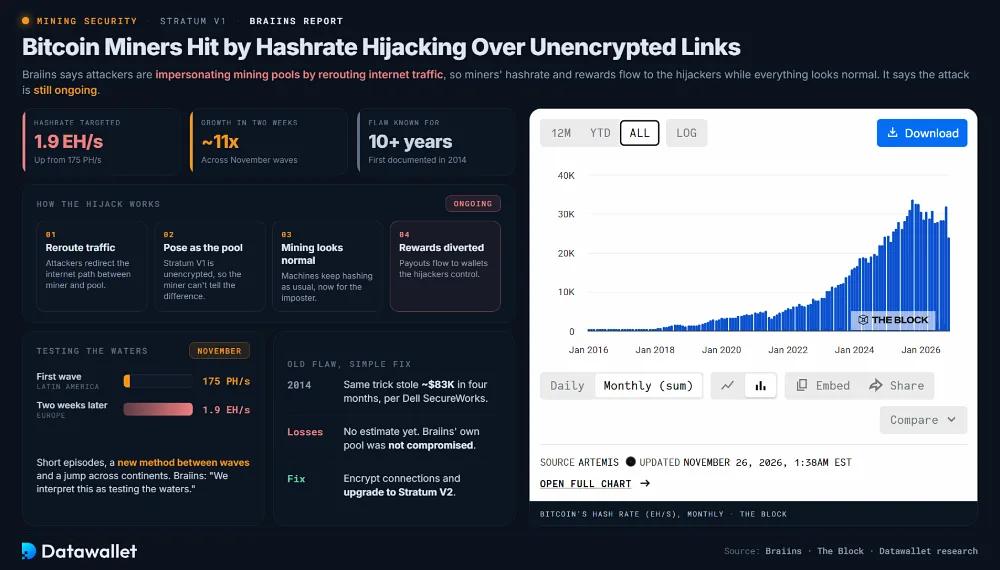
Mining pool Braiins uncovered an ongoing attack that hijacks bitcoin miners' hashrate by impersonating pools through rerouted internet traffic, exploiting unencrypted Stratum V1 connections used by many miners. Rewards that should reach miners instead flow to attacker-controlled wallets, while the hijacked machines appear to keep mining as usual.
The waves grew from 175 PH/s to 1.9 EH/s in two weeks, spreading from Latin America to Europe as the attacker switched methods. Braiins urged miners to adopt encrypted Stratum V2, noting the flaw dates to a 2014 incident that stole about $83,000 in bitcoin mining rewards.
06
More Breaking News
- Utah moved to drop criminal charges against Kalshi without prejudice after the platform paused operations there, warning the 14 counts will return if Kalshi resumes serving Utah residents.
- Switzerland approved 57 jurisdictions for crypto data exchange under the OECD's reporting framework from 2028, including every EU member state, the UK and several G20 economies.
- Zcash developers urged users to migrate about 400,000 ZEC, nearly 2% of supply worth $302 million, out of the Sapling pool, warning AI-driven math could break its cryptography.
- Aave Labs opened its savings app to the public after early access drew $63 million in balances, offering a variable 6% base rate on up to $100,000.
- Sky proposed an emergency governance vote to transfer 25 million USDS for debt repayment, as just $3,270 remains withdrawable from the stUSDS pool's $158.48 million in assets.
- X won a UK default judgment against two men accused of running Bitcoin-focused bot accounts that gamed its creator payouts, claiming at least £207,384, about $271,000, in revenue.
- Justin Sun Prize awarded its first honor to four researchers for a Lean formalization of the Poincaré Conjecture proof, with MathDB awards reaching $1 million per problem.
- Ukraine's parliament passed a law legalizing its crypto market from July 2027, taxing profits at 18% plus a 5% military levy and giving the central bank stablecoin oversight.
- Franklin Templeton's EZPZ fund will add Hyperliquid's HYPE token from December 1 alongside bitcoin, ether and XRP, after the token climbed more than 120% this year.
- CertiK trained Interpol investigators from 20 countries in Hanoi to trace stolen crypto and secure exchange freezes, as Web3 security losses hit about $2.6 billion through September.
For the latest updates on digital asset markets, follow us on X @Datawalletcom.


