


Login to Track Your Live Crypto Portfolio
Sign Up and Track Your Live Crypto Portfolio for Free
Forgot your password?
Hyperliquid and Circle Press Brussels in MiCA Review

This article has been reviewed and verified for accuracy by our editorial team. All claims, data points and platform details are cross-referenced against primary sources.
Some links on this page are affiliate links. Datawallet may earn a commission when you sign up through them, at no extra cost to you. This never influences our editorial ratings, rankings or recommendations.
Some links on this page are affiliate links. Datawallet may earn a commission when you sign up through them, at no extra cost to you. Ratings and rankings reflect our own testing and assessment criteria.

GM. The Hyperliquid Policy Center urged Brussels to treat perpetual futures as derivatives under existing rules, while Circle pressed to scrap the bank deposit floor binding stablecoin reserves.
Elsewhere, Paradigm-backed Blast will wind down after costs outran revenue, Drift opened recovery claims paying barely a cent per dollar, and the Ethereum Foundation shipped anonymous AI payments.
Read the full issue below. 👇
Hyperliquid and Circle Press Brussels in MiCA Review
The Hyperliquid Policy Center urged the European Commission to regulate perpetual futures under MiFID II rather than fold them into MiCA, arguing instrument classification should follow economic features rather than the ledger recording them.
Clarity in application rather than new legislation is what would help, CEO Jake Chervinsky wrote, pushing back on lumping perps with contracts for difference. The group cited HIP-3 markets, where regulated firms set leverage limits through onchain allowlists.
Circle used the same review to target the reserve rules, noting only three of the top 25 stablecoins globally hold MiCA authorization. The bank deposit floor requiring 30% in commercial deposits increases exposure to banking sector credit risk, the issuer argued.
That stance has European Central Bank backing, with the ESCB also proposing maturity-based liquidity requirements instead. Circle knows the hazard firsthand, since USDC briefly broke its peg in 2023 with $3.3 billion stranded at Silicon Valley Bank.
Paradigm-Backed Blast to Wind Down Ethereum Layer 2
Blast will shut its network down because operating costs exceed revenue with no credible path to sustainability. Total value locked sits above $32 million, collapsed from more than $2 billion before its February 2024 mainnet launch.
Users have until October 26 to withdraw through the normal interface before needing bridge contracts directly. The Layer 2 will first unwind its Lido positions over roughly a week, and BLAST fell 17% to a $23 million capitalization.
Drift Opens Recovery Claims Paying One Cent Per Dollar
Velocity, formerly Drift, opened claims for April exploit victims, issuing one DFX token per USDT lost. Each currently redeems for just over 0.01 USDT, roughly a cent returned for every dollar taken.
Holders can redeem now, sell on secondary markets, or wait as burns concentrate later deposits among fewer tokens. Mandiant attributed the $295.4 million theft to North Korean group UNC6862, and Tether's pledged $127.5 million has yet to appear.
Ethereum Foundation Ships Anonymous Payments for AI
The Ethereum Foundation launched zkAPI on mainnet, letting users pay for AI models without revealing identity. Every API call carries an identity linking years of prompts into one profile, the Foundation wrote, built alongside the Open Anonymity Project.
Users deposit ETH or USDC into a vault recording balances as private notes, then generate zero-knowledge proofs unlocking temporary API keys. The design implements work Vitalik Buterin published in February, though the repository still describes the protocol as experimental.
Data of the Day
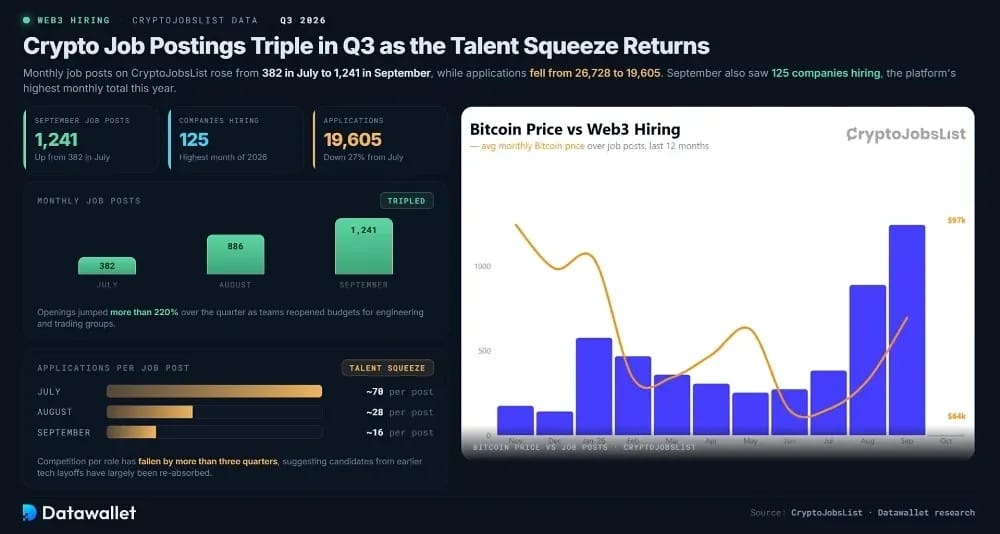
Crypto job postings tripled across the third quarter, climbing from 382 in July to 1,241 in September, according to CryptoJobsList. Unique hiring teams hit 125 in September, the highest monthly total recorded this year.
Applications moved the other way, falling from 26,728 to 19,605 across the same stretch. That squeeze suggests candidates displaced by earlier layoffs have been reabsorbed, with protocol developers, compliance leads, and quant traders likely to outstrip supply through year end.
More Breaking News
- Trump expected to name Jay Clayton as AI czar, with the former SEC chair retaining his intelligence role as Anthropic pushes for slower development.
- The ECB outlined three models for onchain central bank money, spanning direct reserve issuance, an interoperability layer, and settlement tokens backed by reserves held at the bank.
- El Salvador received $138 million after the IMF granted waivers on missed criteria, with no further bitcoin accumulation envisaged beyond documented private donations.
- Community bankers sued the OCC over trust charters they call a side door into banking, naming Protego as GENIUS Act rules near completion.
- Russia paid wages in digital rubles for the first time, extending budget rails that moved 16 million units during 2025 trials across Russian payrolls.
- Robinhood's crypto chief flagged volume caps in the SEC exemption, saying stock token activity is already high enough to hit some of those limits.
- Cathie Wood says follow the agents, as machines spending autonomously could route payments through protocols like x402 rather than traditional rails.
- Near Intents recovered $3.8 million in full after telling the attacker it had identified them, with an onchain message conceding NEAR exploiters were in the wrong.
- BlackRock packaged portfolios into single tokens with Ondo, moving tokenization beyond individual assets toward strategies worth $9.8 trillion in model portfolios.
For the latest updates on digital asset markets, follow us on X @Datawalletcom.
Get tomorrow’s issue in your inbox