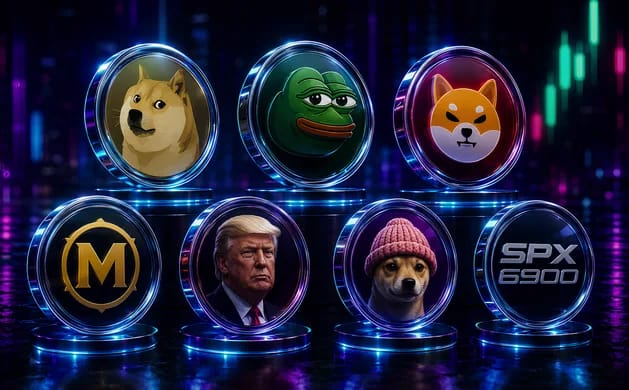

Compare Top Meme Coins
1. Dogecoin ($DOGE)
On top of the list, Dogecoin remains the benchmark meme coin because it has survived since 2013, when Billy Markus and Jackson Palmer launched it as a Litecoin fork. Its own proof-of-work blockchain, unlimited supply, and roughly $14 billion market cap give DOGE unmatched staying power.
Unlike most meme tokens, DOGE is not an ERC-20 or Solana asset; it is a standalone payments network with miners, nodes, wallets, and exchange support. That makes it useful for readers comparing meme speculation with older peer-to-peer crypto rails, especially through our guide to best crypto wallets.
In our view, Dogecoin is the safest “meme blue chip,” but also the hardest to re-rate dramatically. Its brand is enormous, Elon Musk still shapes sentiment, and liquidity is strong; however, the token lacks a modern roadmap, scarcity story, or the explosive novelty smaller meme coins can offer.
Pros
- Oldest meme coin with resilient exchange support and deep global liquidity.
- Standalone proof-of-work chain gives DOGE a clearer technical identity than tokens.
- Massive brand recognition helps it recover attention during meme cycles.
Cons
- Unlimited supply weakens scarcity narratives compared with fixed-cap meme tokens.
- Price action often depends on celebrity comments and social momentum.
- Mature market cap may limit upside versus newer meme coin launches.
2. Pepe ($PEPE)
Next in the ranking, Pepe is the Ethereum meme coin built around the Pepe the Frog internet icon, launching in 2023 without a presale or formal team. With a market cap near $1.2 billion, PEPE remains one of the most liquid non-dog meme coins.
Its appeal is simplicity: fixed supply, ERC-20 infrastructure, no transaction tax, and no serious claim to utility. That makes it easy to trade through Ethereum wallets and DEXs, while our best decentralized exchanges guide is a relevant internal resource for users moving beyond centralized listings.
We like PEPE for cultural purity, not fundamentals. The lack of roadmap is part of the joke, but it also means holders are betting on attention, whales, listings, and meme cycles. Among large-cap meme coins, it arguably has the cleanest “the meme is the product” positioning.
Pros
- Strong Ethereum liquidity across major centralized and decentralized venues for traders.
- Fixed supply and zero-tax structure are easy for traders to understand.
- Recognizable meme IP gives PEPE broad internet-native awareness across communities.
Cons
- Anonymous origins reduce accountability and long-term delivery visibility for serious holders.
- No formal utility means attention is the main value driver.
- Ethereum gas costs can be painful during periods of network congestion.
3. Shiba Inu ($SHIB)
Another major contender is Shiba Inu, the 2020 Ethereum-based token created by the anonymous Ryoshi and later expanded by the ShibArmy. SHIB’s market cap is around $3 billion, placing it above most meme competitors while giving it a larger ecosystem than pure joke coins overall.
SHIB now sits alongside Shibarium, ShibaSwap, BONE, LEASH, TREAT, NFTs, and DAO-related experiments, including identity and metaverse hooks, making it more infrastructure-heavy than Dogecoin or PEPE. For readers evaluating Ethereum-adjacent networks, our EVM chains explainer can support broader context around compatible ecosystems and application-layer design.
Our opinion is mixed: Shiba Inu deserves credit for turning a meme into a multi-token brand, but complexity cuts both ways. The ecosystem creates more narratives for holders, yet it also makes SHIB harder to explain than one-message tokens built only around culture, liquidity, and humor.
Pros
- Larger ecosystem gives SHIB more narratives than most meme coins.
- Strong community identity remains a powerful distribution advantage across crypto social channels.
- Shibarium and ShibaSwap add utility beyond simple passive token holding.
Cons
- Very large supply makes unit-price upside psychologically confusing for newer traders.
- Multi-token ecosystem can dilute focus across SHIB, BONE, LEASH, and TREAT.
- Delivery expectations are higher because the project promises more utility.

4. MemeCore ($M)
For a newer infrastructure angle, MemeCore is not just a meme token; it is an EVM-compatible Layer 1 blockchain built around “Meme 2.0.” Founded in 2024 and led by Jun Ahn, Cherry Hsu, and Rudy Rong, M trades near a multibillion-dollar market cap now.
The project’s pitch is that meme coins can become cultural economies if creators, validators, traders, and communities receive on-chain rewards. Its Proof of Meme framework, MRC-20 tokens, Meme Vaults, and social-mining language make it more technical than the average meme coin, with useful overlap for best DeFi projects readers.
We are cautiously interested because MemeCore adds infrastructure to a category usually driven by jokes alone. Still, its challenge is proving that meme communities want a dedicated chain, not just faster speculation on Solana, Base, Ethereum, or whatever launchpad is hot during the next cycle.
Pros
- Purpose-built Layer 1 offers more infrastructure depth than typical memes.
- EVM compatibility may help developers port tools and smart contracts.
- Proof of Meme creates a distinctive narrative around community contribution.
Cons
- Newer chain still needs durable applications, liquidity, and user retention.
- Complex tokenomics may be harder for casual meme traders to understand.
- Competes with established meme venues like Solana, Base, and Ethereum.

5. Official Trump ($TRUMP)
For political meme exposure, Official Trump is the Solana-based token launched in January 2025 around Donald Trump’s brand. It trades near a $450 million market cap, with a maximum supply close to 1 billion tokens and holder perks tied to official Trump-branded experiences online and offline.
TRUMP is different from most meme coins because its promoter is a sitting U.S. political figure, not an anonymous internet team. That creates enormous media reach but also unusual controversy, unlock risk, ethics scrutiny, and sentiment shocks, making our crypto crashes history page a useful risk-context link.
We dislike the concentration and headline risk more than we dislike the meme itself. TRUMP can move fast when political attention spikes, yet investors should treat it as a narrative trade with unusually visible insiders, event-driven volatility, and public scrutiny that most meme coins never face.
Pros
- Mainstream political branding gives TRUMP unusual awareness outside core crypto circles.
- Solana deployment supports fast trading and broad meme-coin liquidity across venues.
- Holder perks and events create a clearer community-access narrative than most memes.
Cons
- Insider allocation and unlocks create serious concentration concerns for risk-aware traders.
- Political headlines can dominate price action without warning or technical confirmation.
- Ethical scrutiny may deter some exchanges, institutions, and conservative traders.
6. dogwifhat ($WIF)
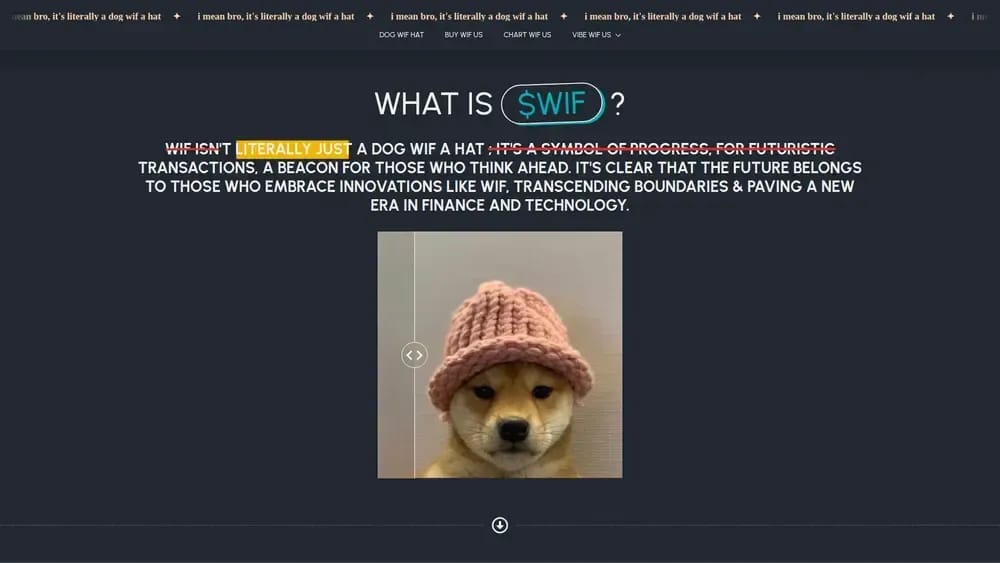
If Solana meme exposure is the priority, dogwifhat remains one of the simplest picks: a Shiba Inu wearing a knitted hat, launched anonymously in late 2023. WIF’s market cap sits around $170 million, far below its 2024 peak but still highly liquid across major venues.
The coin has no complex roadmap, no serious utility promise, and almost its entire supply already circulating, which makes the thesis unusually direct. Traders mostly care about Solana liquidity, listings, social reach, and chart momentum.
In our opinion, WIF is attractive precisely because it refuses to over-explain itself. The downside is that “dog wif hat” works brilliantly during risk-on meme markets and looks thin when sentiment disappears. It is more culture beta than technology bet, and that must be understood.
Pros
- Simple meme identity makes WIF instantly recognizable and highly shareable online.
- Solana liquidity supports fast, low-cost speculative trading during meme rotations.
- High circulating supply ratio reduces future emission uncertainty for existing holders.
Cons
- No utility roadmap leaves sentiment as the main demand source.
- Lower market cap can amplify drawdowns during weak meme cycles.
- Reliance on Solana meme flows exposes WIF to ecosystem rotation.
7. SPX6900 ($SPX)
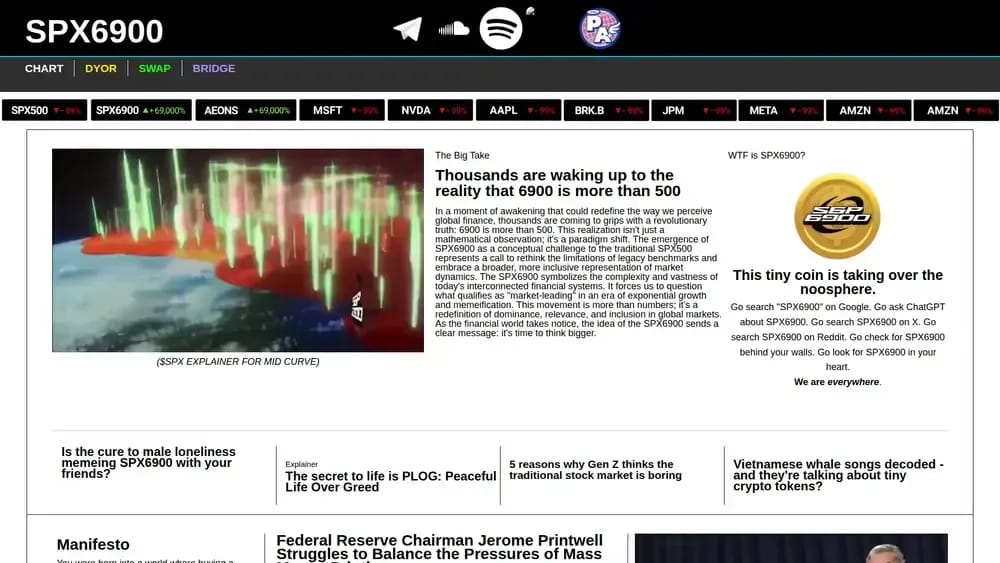
Finally, SPX6900 brings financial satire to the meme coin market with its “6900 is more than 500” parody of traditional indices. The token is associated with Ethereum, Solana, and Base access, while recent market data places SPX around the $400 million market-cap range across exchanges.
Unlike dog memes, SPX targets traders who enjoy anti-Wall Street humor, index memes, and the absurdity of financial numerology. Its multi-chain presence helps access different communities and trading venues, and readers exploring Base liquidity may find our bridge to Base guide useful before moving funds.
We like SPX as one of the more original meme brands because it is not another animal token. The risk is that satire needs constant community creativity to stay fresh. Without ongoing social energy, SPX can quickly become another ticker competing for attention in a crowded meme market.
Pros
- Distinct financial-satire theme separates SPX from crowded animal meme coins.
- Multi-chain access broadens reach across Ethereum, Solana, and Base communities.
- Fixed-size supply makes valuation easier to compare against similar meme peers.
Cons
- Anonymous origins make accountability limited, as with many meme coin projects.
- Brand relies heavily on community humor staying culturally relevant across cycles.
- Multi-chain liquidity can fragment attention across venues, bridges, and wallets.
What Are Meme Coins?
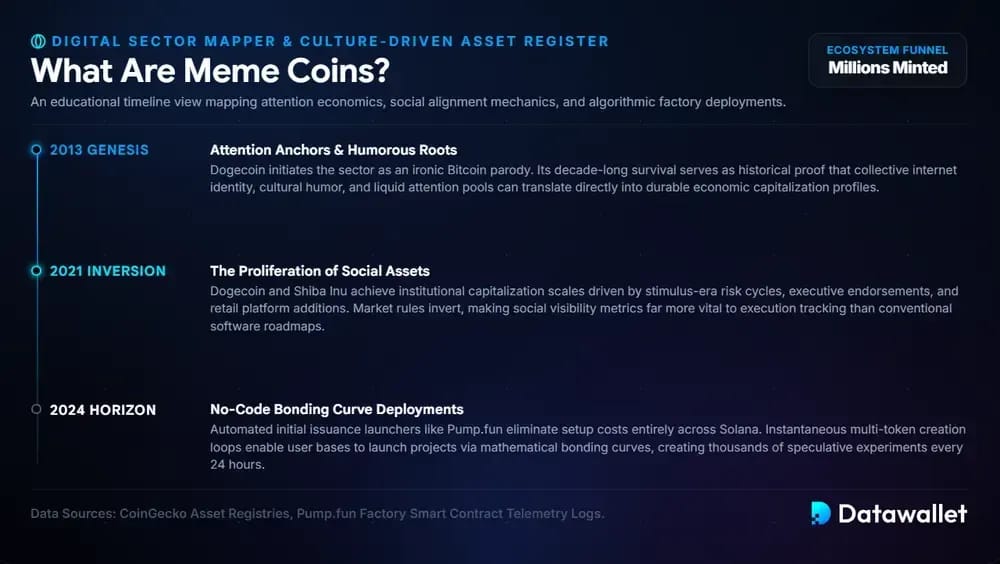
Meme coins are cryptocurrencies built around jokes, internet characters, political moments, animals, or viral communities rather than traditional business fundamentals. Dogecoin started the category in 2013 as a parody of Bitcoin seriousness, but its survival showed that humor, identity, and community can create durable market value.
The first major meme cycle arrived in 2021, when Dogecoin and Shiba Inu rode retail trading, Elon Musk posts, exchange listings, and stimulus-era risk appetite. By then, meme coins had become more than jokes: they were cultural assets where social reach often mattered more than revenue, code, or roadmap depth.
The 2024 cycle changed the market again because Pump.fun made no-code token launches instant on Solana. Instead of waiting for developers, users could create coins in minutes, trade them on bonding curves, and watch successful launches graduate toward larger decentralized markets.
Estimates vary because most meme coins die quickly, but public datasets already track tens of thousands of notable tokens, while Pump.fun alone has hosted millions. With over 11 million launches reported since 2024, the real universe likely sits in the millions, averaging thousands of new experiments daily.
How Are Memecoins Regulated?
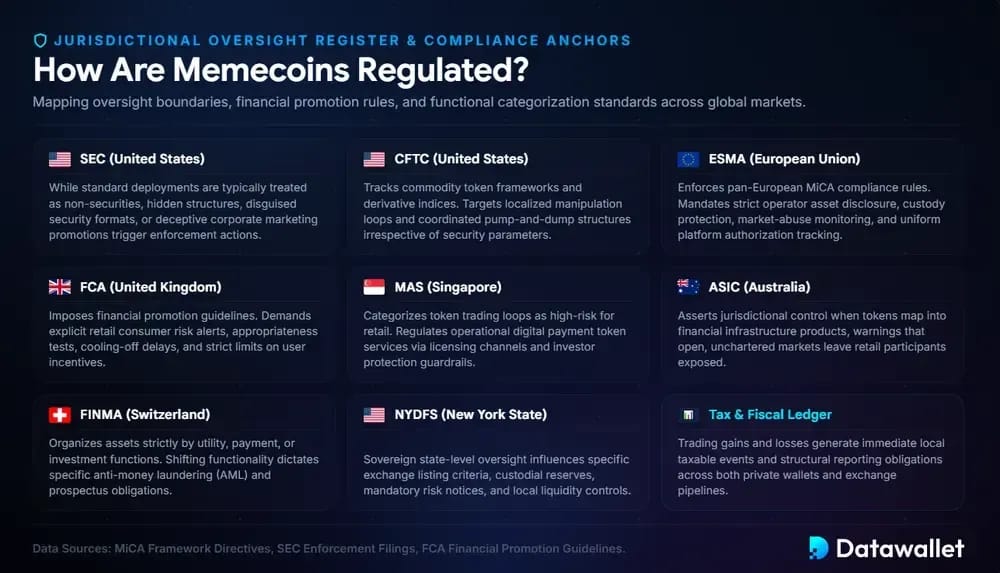
Memecoin regulation depends on jurisdiction, token design, promotions, exchange access, and whether authorities view the asset as a security, commodity, payment token, or collectible.
Key regulatory angles to understand before trading globally:
- SEC: U.S. staff said typical meme coins are not securities, but fraud, disguised securities, or misleading promotions can still trigger enforcement.
- CFTC: The agency focuses on commodity markets, derivatives, fraud, and manipulation, making pump-and-dump behavior relevant even when securities law does not apply.
- ESMA: Under MiCA, EU crypto service providers face authorization, disclosure, conduct, custody, and market-abuse rules that can affect meme coin access.
- FCA: UK firms promoting cryptoassets must follow financial-promotion rules, including risk warnings, cooling-off periods, appropriateness checks, and restrictions on incentives.
- MAS: Singapore treats crypto trading as high risk for retail users and regulates digital payment token services through licensing and consumer safeguards.
- ASIC: Australia regulates digital assets when they involve financial products or services, but warns unregulated crypto leaves consumers with limited protection.
- FINMA: Switzerland classifies tokens by function, so payment, utility, or asset-like features can change licensing, AML, and prospectus obligations.
- NYDFS: New York oversight can affect exchange listings, custody, consumer alerts, and risk controls for tokens available to state residents.
- Tax: Even unregulated meme trades can create taxable gains, losses, or reporting duties, depending on local rules and the exchange or wallet used.
How to Find Meme Coins Early
Finding meme coins early means combining launch feeds, on-chain filters, social momentum, and risk controls before liquidity spreads. The goal is not predicting every winner, but avoiding obvious rugs while spotting credible attention early.
Strategy 1: Track Launchpads and Fresh Pair Feeds
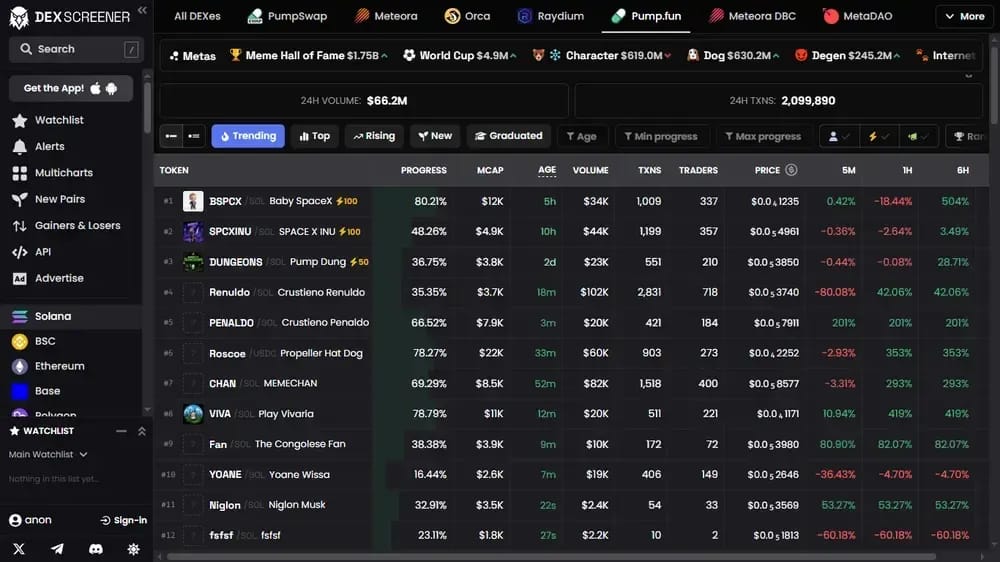
Start with launchpads and new-pair dashboards because they reveal tokens before centralized exchanges, influencers, and news sites notice them. Speed matters, but filtering matters more.
Use this workflow before touching a new chart:
- Launchpad: Watch Pump.fun for new Solana launches, sorting by market cap, replies, age, volume, and whether creators are actively communicating.
- Pairs: Open DEX Screener and filter new pairs by chain, liquidity, age, volume, transaction count, and price movement across five-minute intervals.
- Volume: Compare early volume with liquidity. A token moving hard on tiny liquidity can collapse instantly when one wallet exits.
- Graduation: Track whether Pump.fun tokens graduate to Raydium or another DEX, since graduation often signals broader liquidity and greater trader visibility.
- Fees: Review Solana network conditions, execution costs, and failed transactions, especially when volatile meme launches overload wallets or bots.
- Shortlist: Save only tokens with real liquidity, rising holders, active discussion, and no obvious contract, bundle, or insider red flags.
Strategy 2: Follow Smart Money and Wallet Clusters
The second approach is wallet intelligence: identify profitable meme traders, then monitor what they buy, sell, and hold. This is practical but never foolproof.
Use this workflow to separate signal from noise:
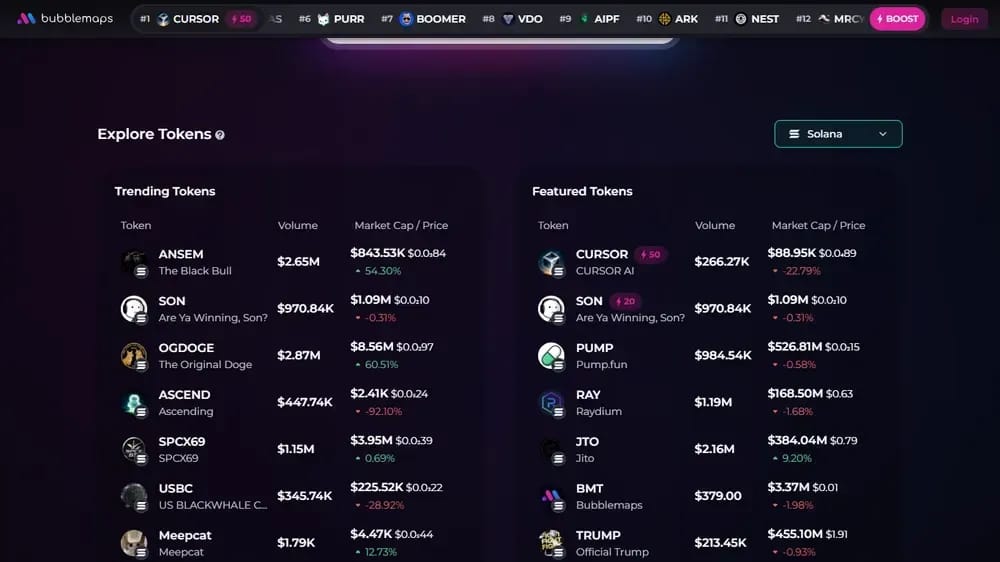
- Wallets: Use Solscan or Etherscan to inspect top holders, creator wallets, deployer behavior, and early buyer concentration.
- Trackers: Build a watchlist using Birdeye alerts or Datawallet’s track Solana wallets guide for recurring profitable addresses.
- Clusters: Check Bubblemaps for connected wallets, circular transfers, or large holder groups that could coordinate selling pressure.
- Bundles: Review bundle risk with Datawallet’s Solana bundles explainer before assuming broad ownership is genuinely decentralized.
- Timing: Focus on wallets buying before social attention, not influencers posting after a chart has already moved several hundred percent.
- Exits: Watch whether smart wallets scale out gradually, dump into green candles, or transfer supply to fresh wallets before promotion begins.
Strategy 3: Use Social Momentum Without Becoming Exit Liquidity
Meme coins move through attention, so social research matters. The trick is finding authentic traction before coordinated promotion turns late buyers into liquidity.
Use this workflow before trusting viral hype:
- X Search: Search X for the ticker, contract address, meme phrase, and creator name to confirm conversation started organically.
- Telegram: Compare chat growth, pinned messages, moderation quality, and bot activity, then review Datawallet’s Telegram crypto trading bots guide carefully.
- Discord: Join Discord servers only to observe tone, roadmap claims, founder access, and whether members discuss risk honestly.
- GMGN: Use GMGN to review trending Solana memes, holder behavior, sniper activity, wallet profits, and real-time trading flows.
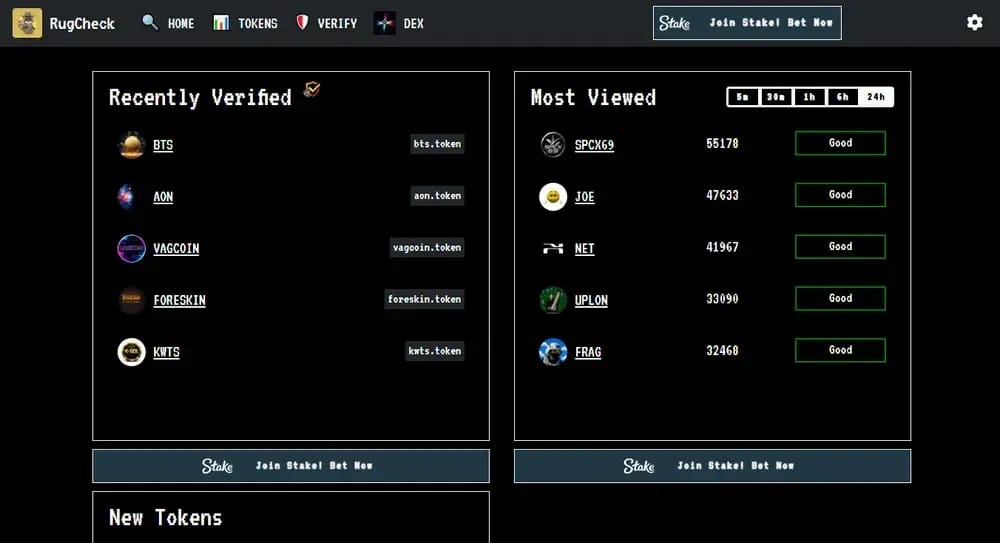
- RugCheck: Run the contract through RugCheck for authority, liquidity, mint, freeze, and ownership warnings before buying.
- Influencers: Treat paid calls, anonymous KOL groups, and sudden “community takeover” narratives as red flags unless on-chain data confirms accumulation.
- Sizing: Enter with small position sizes, predefine invalidation, and avoid averaging down if liquidity, holders, or social momentum deteriorate quickly.
Where Can You Buy Meme Coins From?
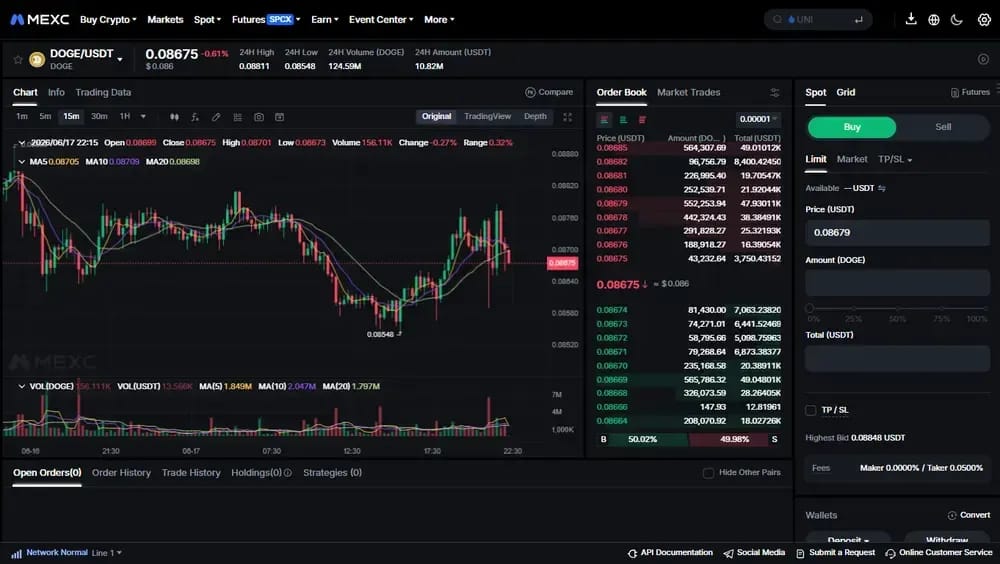
For centralized access, MEXC is a strong meme coin venue because it lists many small-cap tokens quickly while still offering account security and spot markets.
A practical MEXC buying flow from signup to storage:
- Account: Visit MEXC, create an account with email or phone, then secure it immediately with two-factor authentication.
- Verification: Complete identity checks where required, and make sure that you live in an available countriy before depositing funds from a restricted region.
- Funding: Add money through card, bank transfer, P2P, or crypto deposit, then convert into USDT because most meme pairs trade against stablecoins.
- Fees: Check spot costs before trading, especially if you trade frequently; Datawallet’s MEXC fees guide helps compare charges.
- Search: Use the exchange search bar or Memecoin Zone to find the ticker, then verify the full token name and pair carefully.
- Liquidity: Open the order book, spreads, recent trades, and 24-hour volume before buying, because thin meme markets can slip heavily.
- Order: Use limit orders for volatile pairs when possible, since market orders can execute far above the chart price during fast moves.
- Risk: Start small, avoid leverage, and set a maximum loss before entering, because meme coin candles can reverse within minutes.
- Storage: Keep active trades on exchange only as needed, then withdraw larger holdings to a wallet after confirming network and address details.
Risks of Memecoins
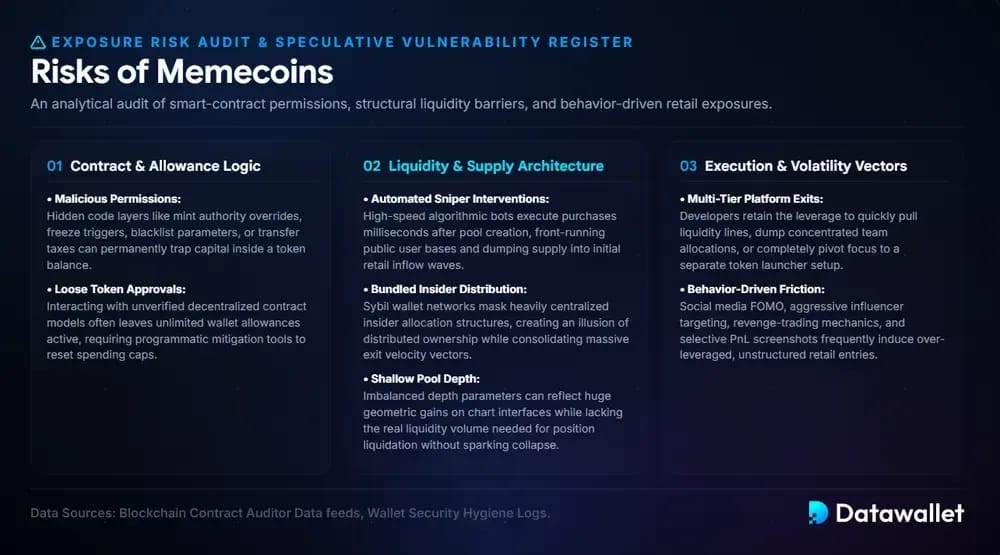
Meme coins can produce spectacular gains, but the same mechanics create extreme losses. Most projects lack revenue, utility, accountability, and durable liquidity.
Main meme coin risks to check before buying:
- Volatility: Meme coins can rise or collapse by double digits within minutes because liquidity is thin and sentiment changes extremely fast.
- Rugs: Developers or insiders can drain liquidity, dump concentrated supply, abandon socials, or migrate attention to a fresh token quickly.
- Snipers: Automated bots often buy immediately after launch, then sell into retail demand before ordinary traders understand the token structure.
- Bundles: Coordinated wallets can hide insider ownership, making supply look distributed while one group controls meaningful selling pressure.
- Liquidity: A chart can show huge percentage gains, yet still lack enough liquidity for investors to exit without crashing price.
- Contracts: Mint authority, freeze authority, transfer taxes, blacklists, or malicious permissions can trap buyers, so contract checks are essential.
- Approvals: Revoke unsafe token permissions after interacting with new DEXs or meme contracts using our MetaMask revoke guide.
- Listings: Exchange listings can validate demand, but rushed listings may also attract late buyers after insiders already captured upside.
- Psychology: FOMO, influencer pressure, revenge trading, and screenshots of early winners often push traders into oversized, poorly planned entries.
Do Meme Coins Have a Future?
Meme coins probably have a future, but not every cycle will reward them equally. CoinGecko data showed the sector peaked near $150 billion in late 2024 before shrinking sharply through 2025, which suggests attention rotated away from pure speculation toward stablecoins, ETFs, and stronger utility narratives.
Activity has also become more fragmented. Pump.fun proved that anyone can launch a coin, but saturation created fatigue, lower graduation rates, and more short-lived communities. CoinDesk noted Standard Chartered cautioning that Solana may need to diversify beyond meme coins if network activity weakens.
The balanced outlook is selective, not blindly bullish. Meme coins tied to strong culture, fairer launches, transparent holders, and real distribution can survive; celebrity coins and copycats may keep burning trust. Investor Ross Gerber argues repeated losses can scare ordinary buyers away from crypto entirely.
Final Thoughts
Meme coins are the most attention-driven assets in crypto. They reward timing, community awareness, liquidity analysis, and discipline, but punish traders who confuse jokes, celebrity promotion, or early screenshots with fundamentals.
For 2026, the best approach is selective exposure. Focus on liquid leaders, transparent launches, active communities, and strong risk controls, while treating microcap meme trades as speculation rather than investing.
The category will likely survive because internet culture never disappears. Still, only a small minority of meme coins will retain attention after the launch window, exchange hype, and influencer cycle fade.
Our Methodology
We evaluated leading meme coins by combining market data, on-chain behavior, exchange access, community strength, token design, and narrative durability across the 2026 crypto cycle.
These criteria shaped our final rankings and exclusions:
- Liquidity: We favored meme coins with deep exchange books, active DEX pools, narrow spreads, and enough daily volume for realistic entries and exits.
- Market Cap: Large caps scored for resilience and visibility, while smaller coins needed stronger growth catalysts, cleaner distribution, or a more original meme identity.
- Chain Fit: We reviewed whether each token benefits from its host blockchain, including Ethereum security, Solana speed, Base distribution, or a dedicated Layer 1.
- Launch Quality: Fair launches, transparent supply, limited insider control, and visible contract settings mattered more than flashy branding or short-term social media bursts.
- Community: We checked X activity, Telegram engagement, holder growth, meme output, and whether discussion looked organic rather than purely paid promotion.
- Exchange Access: Tokens listed on reputable centralized exchanges scored higher, especially when paired with strong spot liquidity and clear withdrawal support.
- Tokenomics: Supply caps, emissions, unlocks, wallet concentration, taxes, and circulating supply were reviewed because meme coins often fail through hidden sell pressure.
- Narrative: We prioritized memes with simple, repeatable stories that traders can instantly understand, because cultural clarity often drives liquidity in this category.
- Risk Profile: Regulatory exposure, celebrity dependency, smart-contract concerns, insider allocations, and historical drawdowns were weighed heavily before inclusion.
- Staying Power: Older projects needed evidence of renewed relevance, while newer tokens needed more than launch hype to justify ranking for 2026.