









What Is Bitcoin's Quantum Risk?
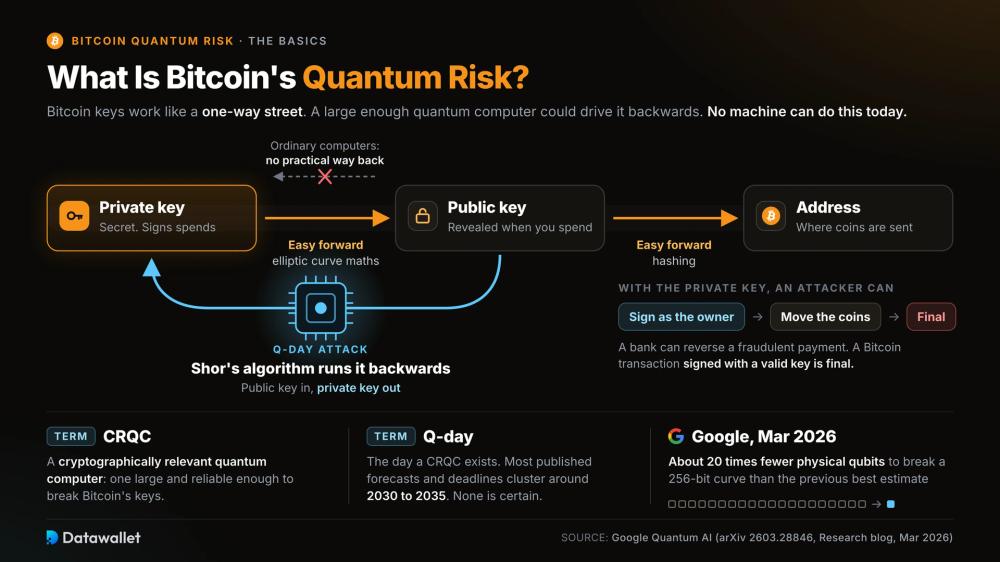
Bitcoin's quantum risk is the possibility that a quantum computer works out a private key from its public key and then signs transactions as if it were the owner. Every bitcoin is locked by a signature scheme built on elliptic curve cryptography. Ordinary computers cannot reverse that mathematics in any practical time.
Shor's algorithm, published in 1994, can. It needs a machine known as a cryptographically relevant quantum computer (CRQC), and the day one exists is called Q-day. Google Quantum AI reported in March 2026 that breaking the 256-bit elliptic curve cryptography Bitcoin relies on would take about 20 times fewer physical qubits than the previous best estimate.
A bank can reissue credentials and reverse a fraudulent payment. Bitcoin cannot, because a transaction signed with a valid key is final. Public keys recorded on the blockchain also stay there permanently, so an attacker needs no earlier data theft to prepare.
Which Parts of Bitcoin Are Exposed?
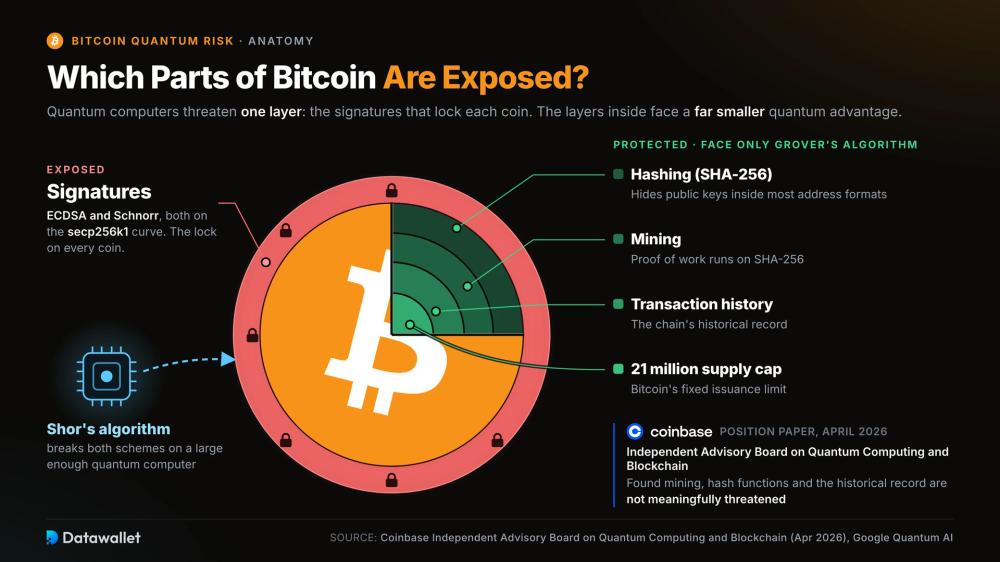
Quantum computers threaten Bitcoin's digital signatures and any coins whose public keys are visible. Mining, the transaction history and the 21 million supply cap face no meaningful threat.
Signatures and Hash Functions
Spending is authorised by ECDSA or Schnorr signatures, two schemes that share one elliptic curve, secp256k1. Shor's algorithm breaks both. Hash functions are a different case. SHA-256 secures mining and hides public keys inside most address formats, and the only quantum method against it is Grover's algorithm, a search technique that offers a far smaller advantage.
The Coinbase Independent Advisory Board on Quantum Computing and Blockchain, a panel of six cryptography and quantum computing researchers, found in its position paper of 21 April 2026 that Bitcoin mining, hash functions and the chain's historical record are not meaningfully threatened.
Long-Exposure and Short-Exposure Attacks
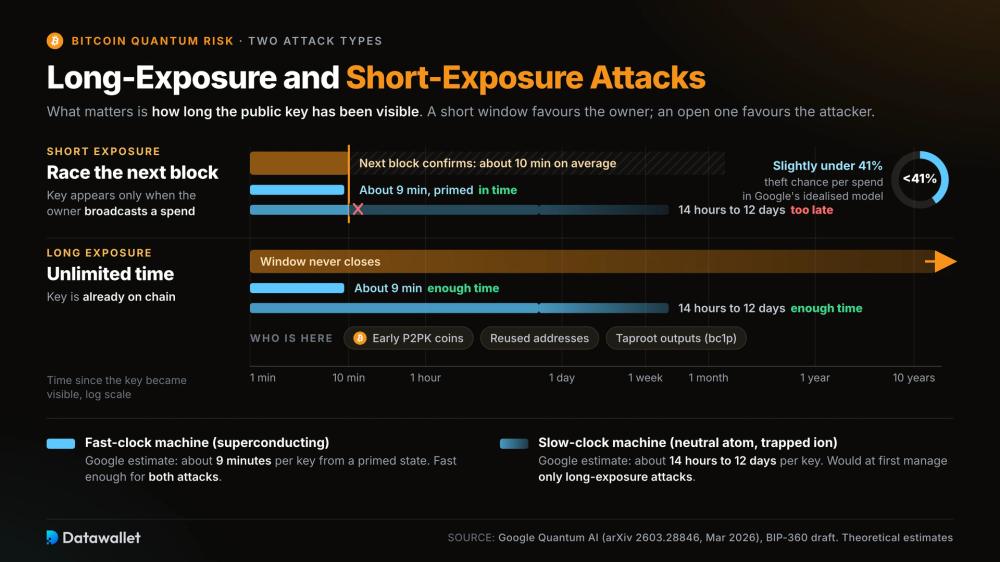
Developers classify quantum attacks by how long a public key stays visible, using terms from the BIP-360 draft.
- Long-exposure attack: The public key is already on the blockchain, which gives an attacker unlimited time to compute the private key. Early P2PK coins, reused addresses and Taproot addresses fall into this group.
- Short-exposure attack: The public key appears only when the owner broadcasts a transaction. An attacker has to compute the key and publish a competing transaction before the original confirms, a window of about ten minutes on average.
The Google Quantum AI whitepaper modelled the second case. A fast superconducting machine, it estimated, could derive a key in roughly nine minutes from a prepared state. Under idealised assumptions that gives a theft probability of slightly under 41% per transaction. Slower designs based on neutral atoms or trapped ions would at first manage only long-exposure attacks.
Exposure by Address Type
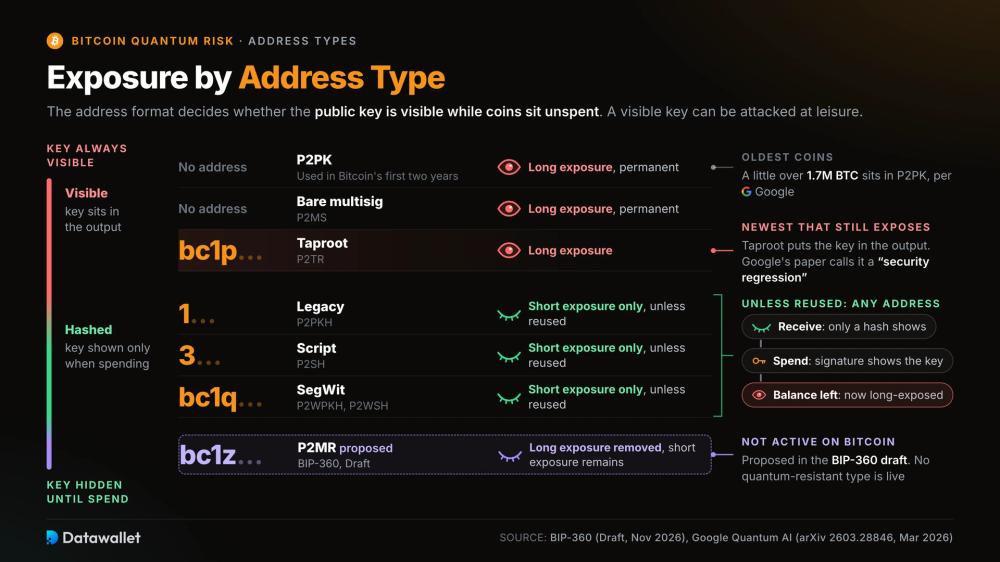
The address format decides whether a public key is visible while coins sit unspent.
Address type | Starts with | Public key visible while unspent | Quantum exposure |
|---|---|---|---|
P2PK (used in Bitcoin's first two years) | No address prefix | Yes | Long exposure, permanent |
Bare multisig (P2MS) | No address prefix | Yes | Long exposure, permanent |
Legacy (P2PKH) | 1 | No, until first spend | Short exposure only, unless reused |
Script (P2SH) | 3 | No, until first spend | Short exposure only, unless reused |
SegWit (P2WPKH, P2WSH) | bc1q | No, until first spend | Short exposure only, unless reused |
Taproot (P2TR) | bc1p | Yes | Long exposure |
P2MR (proposed in BIP-360) | bc1z | No | Long exposure removed, short exposure remains |
Taproot is the newest format and still exposes a key, which Google's paper describes as a security regression. Any other address becomes long-exposed too once it has been spent from and still holds a balance.
How Much Bitcoin Is Quantum-Vulnerable?
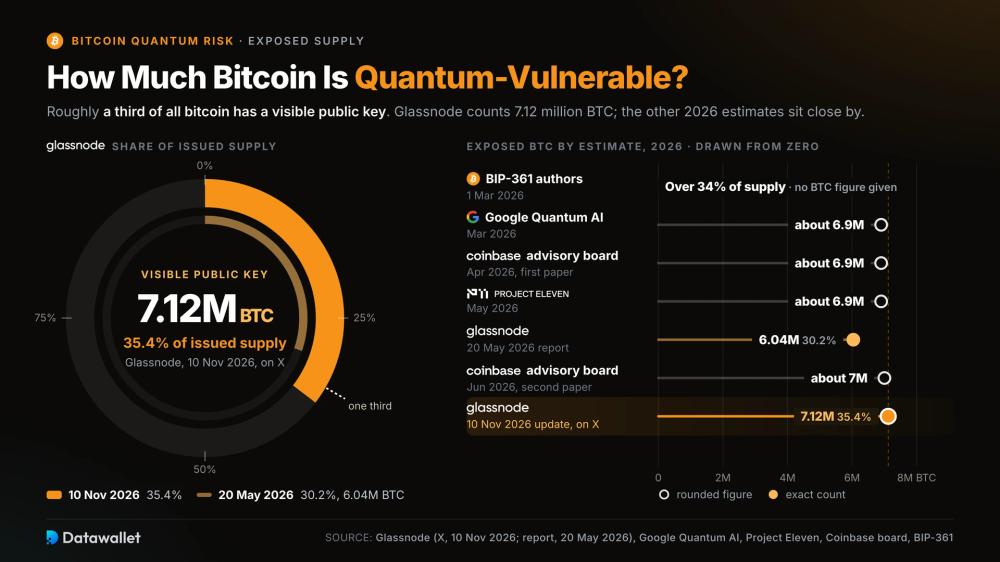
Roughly a third of all bitcoin has a visible public key, according to every major estimate published in 2026.
Source | Date | Exposed BTC | Share of supply |
|---|---|---|---|
BIP-361 authors | 1 March 2026 | Not stated | Over 34% |
Google Quantum AI | March 2026 | About 6.9 million | Not stated |
Coinbase advisory board (position paper) | 21 April 2026 | About 6.9 million | Not stated |
Project Eleven | May 2026 | About 6.9 million | Not stated |
Glassnode | 20 May 2026 | 6.04 million | 30.2% |
Coinbase advisory board (second paper) | June 2026 | About 7 million | Not stated |
Glassnode (update posted on X) | 10 November 2026 | 7.12 million | 35.4% |
Estimates differ because each source treats address formats and address reuse differently. Glassnode's methodology is the most detailed. Its 10 November update, posted on X, put the figure at 7.12 million BTC, up from 6.04 million in May. Our Bitcoin statistics page tracks the wider supply and ownership data behind these percentages.
Most Exposure Comes from Behaviour
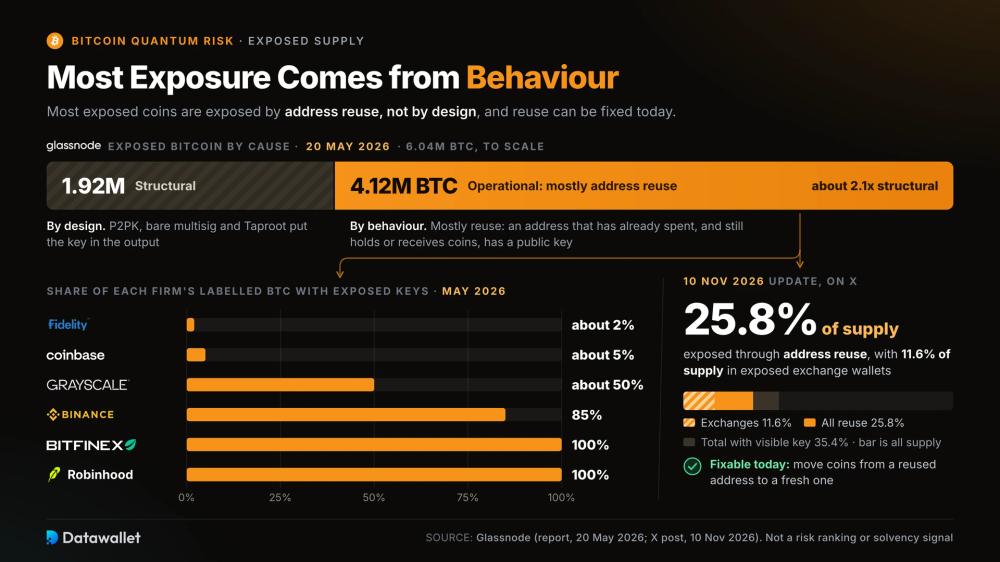
Structural exposure, in Glassnode's terms, covers formats that reveal the key by design, such as P2PK, bare multisig and Taproot. It totalled 1.92 million BTC in May. Operational exposure, which comes from address reuse, was more than twice as large at 4.12 million BTC.
Exchanges account for a large part of that reuse. Glassnode's November post attributed 25.8% of supply to address reuse, including 11.6% of supply held on exchanges. The May report showed wide variation between platforms, from about 5% of Coinbase's balance to 85% at Binance and 100% at Robinhood. Moving coins from a reused address to a fresh one removes this exposure today.
Dormant Coins Cannot Be Moved by Their Owners
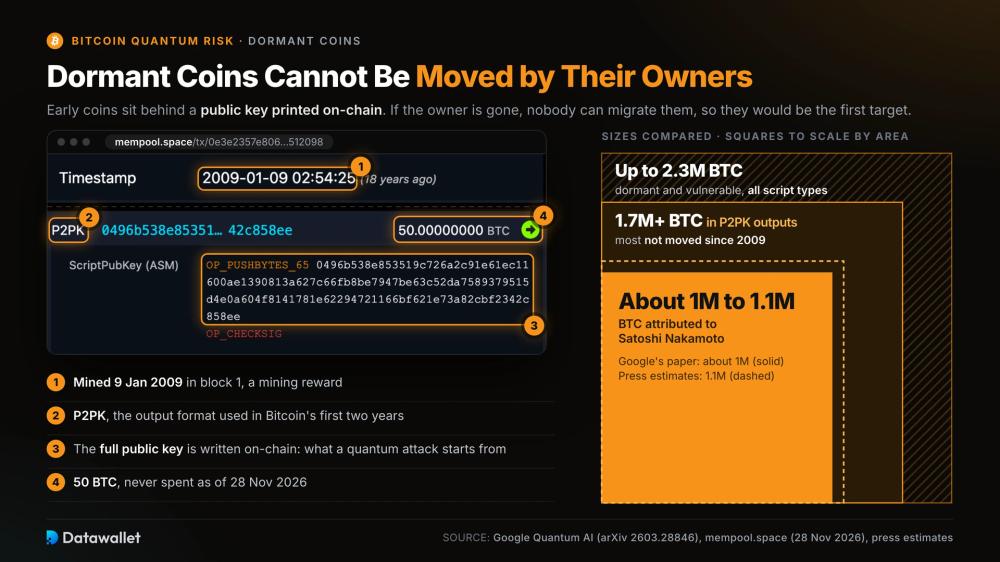
Google's paper counts a little over 1.7 million BTC in P2PK outputs, the format used in Bitcoin's first two years, and says most have not moved since 2009. Across all address formats, it estimates that dormant vulnerable coins may reach 2.3 million BTC.
Among them is the roughly 1.1 million BTC attributed to Bitcoin's creator, covered in our Satoshi Nakamoto net worth profile. If the keys are lost, no upgrade can move these coins to safety. They would be the first target of a long-exposure attack, and a sale of that size would affect every holder.
How Close Are Quantum Computers to Breaking Bitcoin?
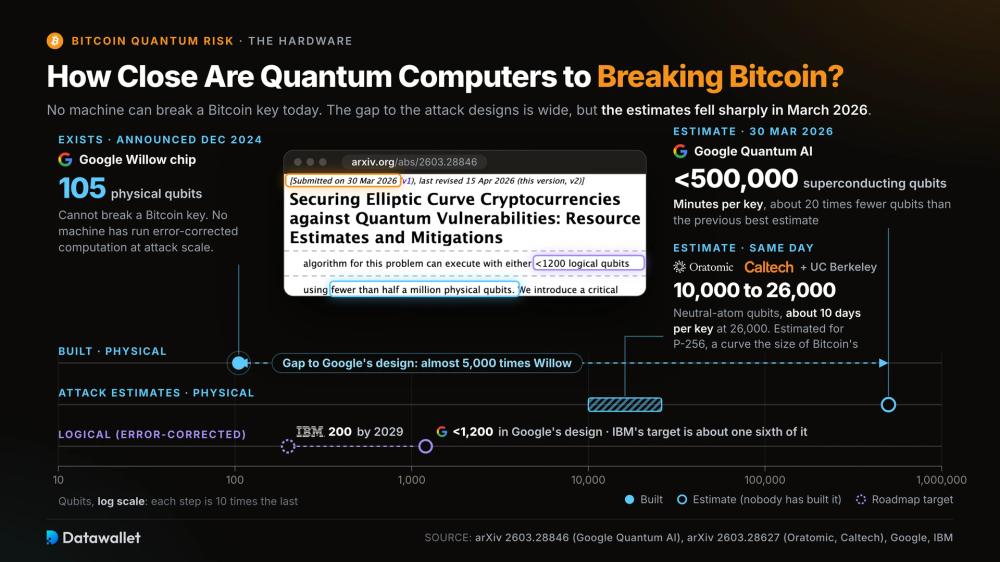
No quantum computer can break a Bitcoin key today. Google's Willow chip has 105 physical qubits, and Google's own attack design needs almost 5,000 times more. Neutral-atom designs need far fewer, 10,000 to 26,000 qubits, but no machine has run error-corrected computation at anything near that scale.
The current benchmarks come from two papers posted to arXiv on the same day, 30 March 2026.
Estimate | Hardware type | Physical qubits needed | Time to break one key |
|---|---|---|---|
Google Quantum AI with UC Berkeley, Stanford and Ethereum Foundation co-authors | Superconducting | Fewer than 500,000 | Minutes |
Oratomic, Caltech and UC Berkeley | Neutral atoms | About 10,000 to 26,000 | About 10 days at 26,000 qubits, longer with fewer |
Google's paper puts the requirement at fewer than 1,200 logical qubits, meaning error-corrected qubits that are each built from hundreds of physical ones.
The Oratomic and Caltech paper finds that neutral-atom machines could need far fewer qubits and far more time. Its estimate covers P-256, a 256-bit curve of the same size as Bitcoin's, and does not model secp256k1 itself. That profile suits attacks on dormant coins and rules out attacks on transactions in progress.
Both papers are resource estimates, and nobody has built either machine. IBM's published roadmap targets a system called Starling for 2029, designed to run 100 million operations on 200 logical qubits. That is about one sixth of the logical qubits in Google's attack design.
In October 2026, Google reported in the journal Science that Willow cut errors about 40-fold when preparing magic states, a resource the attack consumes in large numbers. CoinDesk's coverage noted that the March estimate already assumed this efficiency. The result therefore confirms part of the design without making an attack cheaper.
Forecasts and Official Deadlines
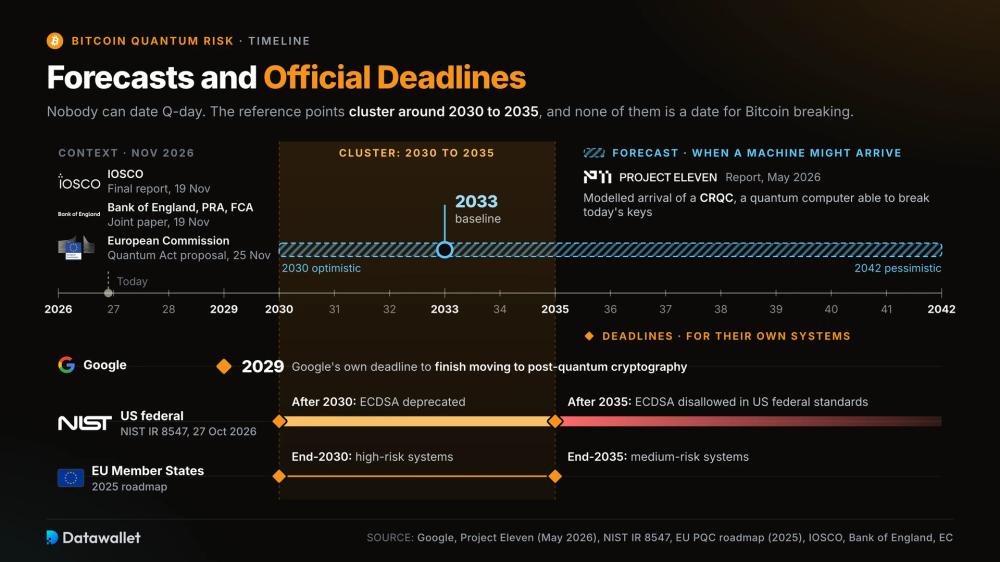
Nobody can date Q-day with confidence. The useful reference points are specialist forecasts and the deadlines governments set for their own systems.
Source | Date given | What it refers to |
|---|---|---|
Google | 2029 | Google's own deadline to finish moving to post-quantum cryptography |
Project Eleven | 2033 baseline, 2030 to 2042 range | Modelled arrival of a CRQC |
NIST (United States) | After 2030 and after 2035 | ECDSA deprecated, then disallowed, in federal standards |
2030 and 2035 | High-risk systems by end-2030, medium-risk by end-2035 |
Project Eleven, a post-quantum security firm, published the model behind its 2033 baseline in May 2026. NIST, the US standards body, finalised its transition report, IR 8547, on 27 October 2026. In Europe, the Commission proposed its Quantum Act on 25 November 2026, and the proposal includes preparation for post-quantum cryptography.
IOSCO, the global body of securities regulators, said in a final report on 19 November 2026 that migration may be particularly challenging for blockchains because upgrades need coordination across decentralised networks. On the same day the Bank of England, the PRA and the FCA published a joint paper on effective practices for managing quantum-related cyber risk.
What Bitcoin Is Doing About Quantum Risk
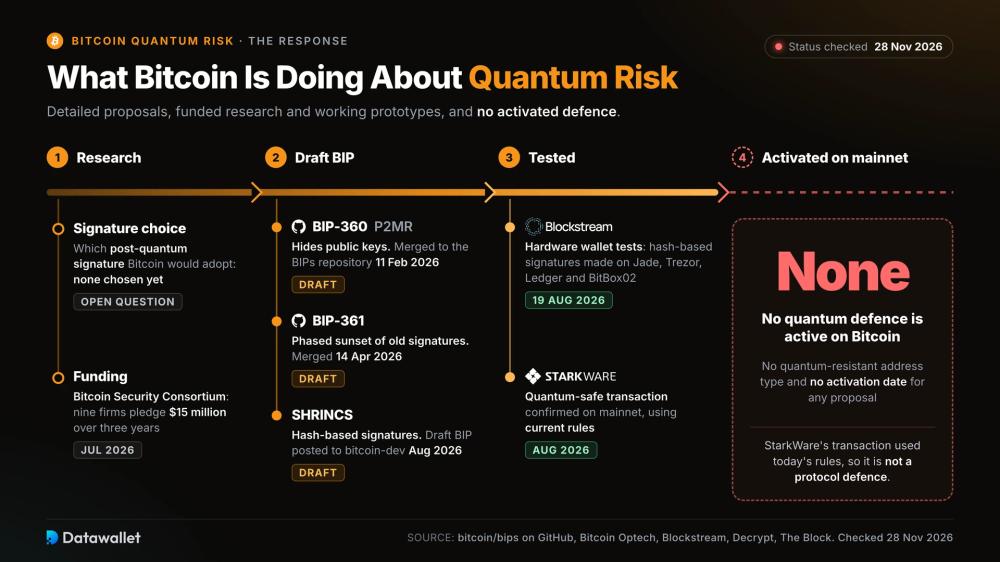
Bitcoin has detailed proposals, funded research and working prototypes. It has no activated defence. When we checked the official proposal repository on 28 November 2026, BIP-360 and BIP-361 both still carried Draft status, and no post-quantum signature scheme had been chosen.
BIP-360 Hides Public Keys
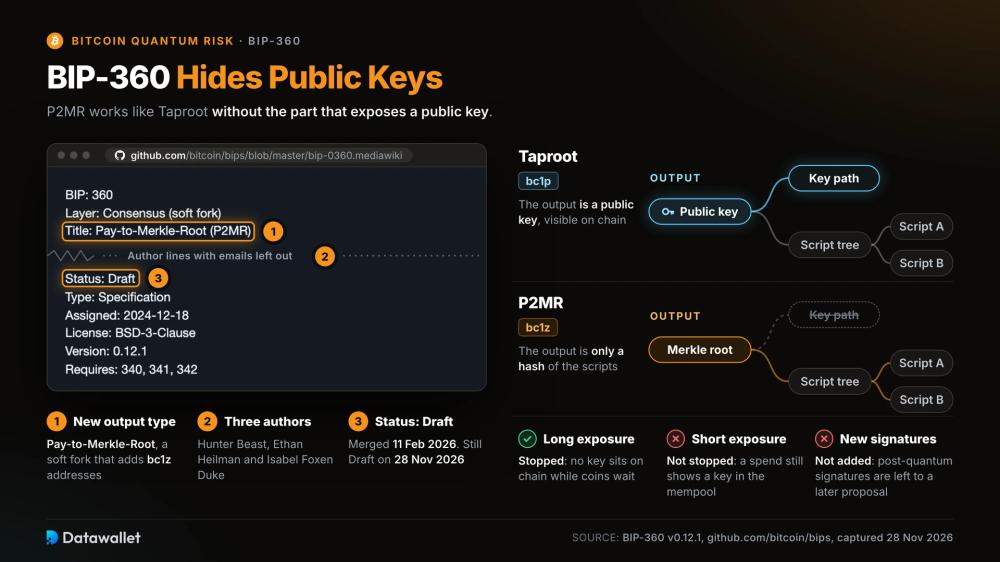
BIP-360, the furthest advanced proposal, adds a new address format called Pay-to-Merkle-Root (P2MR). It works like Taproot without the part that exposes a public key, so coins held in P2MR addresses would be protected from long-exposure attacks.
The draft itself states that P2MR does not protect against short-exposure attacks and does not add post-quantum signatures, which would arrive in a later proposal. Our BIP-360 explainer covers the design, the criticism and the alternatives.
Post-Quantum Signatures Are Large
A complete fix needs a signature scheme that quantum computers cannot break. Most Bitcoin research favours hash-based signatures because they rely only on the security of hash functions that Bitcoin already trusts.
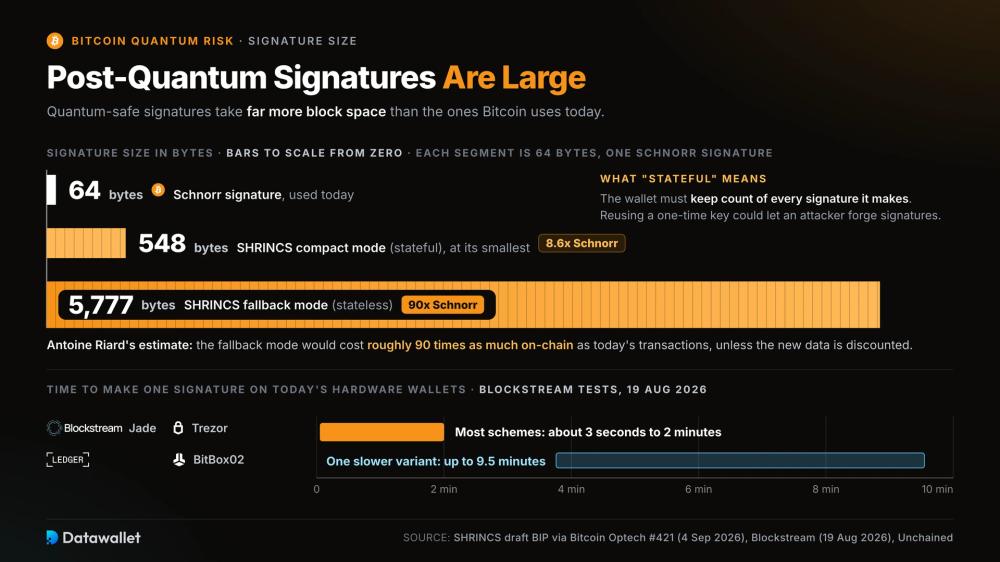
SHRINCS is the leading candidate. A working group that includes Blockstream Research posted its draft BIP in August 2026, specifying signatures of 548 bytes in the compact mode and 5,777 bytes in the fallback mode.
A current Schnorr signature is 64 bytes. Developer Antoine Riard estimated that the fallback mode would cost roughly 90 times as much on-chain as today's transactions unless the new data is discounted.
The compact mode is stateful, meaning the wallet must track every signature it has made. Reusing a one-time key could let an attacker forge signatures, Trezor's chief technology officer told Unchained in November 2026. Trezor is considering the larger, safer mode as its default.
Blockstream's tests, dated 19 August 2026, produced hash-based signatures on existing Jade, Trezor, Ledger and BitBox02 devices. Signing took about three seconds to two minutes for most schemes and up to nine and a half minutes for one slower variant.
Later that month, StarkWare confirmed a quantum-safe transaction on Bitcoin's main network using current rules. The method cannot protect keys that are already exposed and must be sent directly to miners. StarkWare still favours a soft fork, meaning a backward-compatible change to Bitcoin's rules.
Institutions Are Funding the Work
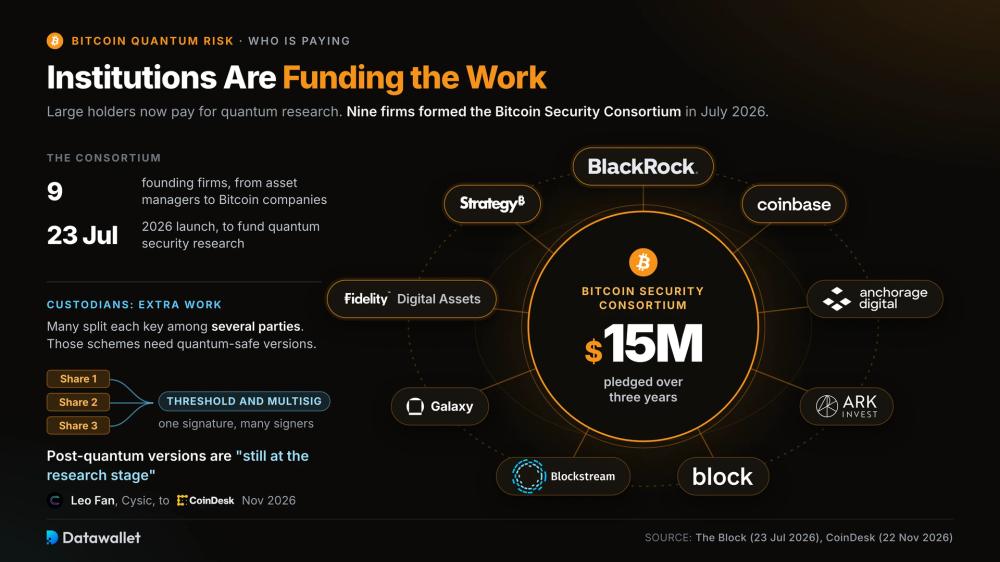
In July 2026, nine firms including BlackRock, Coinbase, Strategy and Fidelity Digital Assets formed the Bitcoin Security Consortium and pledged $15 million over three years. Several members appear in our Bitcoin treasury tracker.
Custodians face extra work beyond the protocol, since many secure coins with keys split among several parties. Post-quantum versions of those shared-key schemes are still at the research stage, Leo Fan, chief executive of Cysic, told CoinDesk in November 2026. Investors who hold bitcoin through funds listed on our Bitcoin ETF tracker depend on those custodians to migrate.
The Dormant Coin Problem: Freeze, Rescue or Leave Alone?
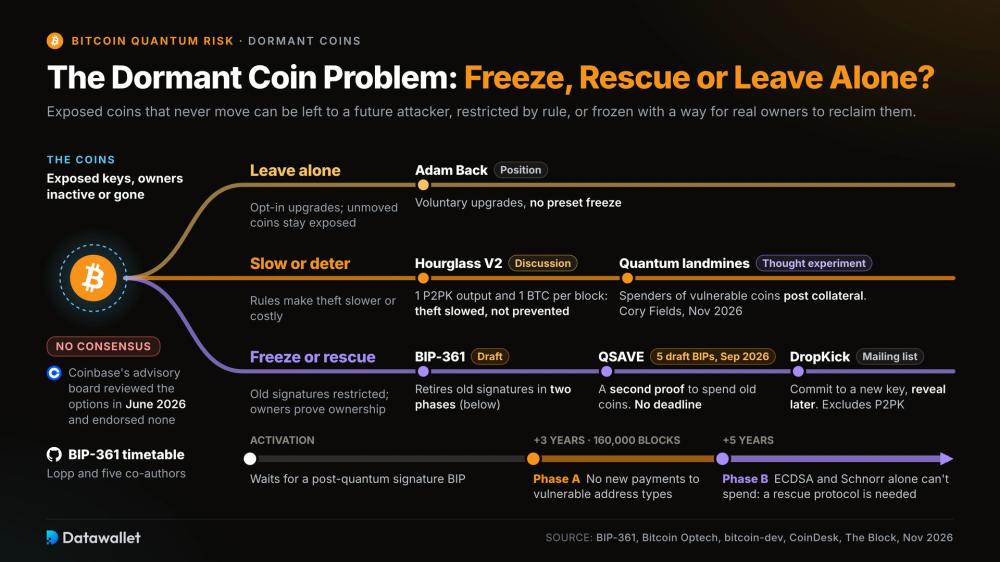
The most divisive question is what happens to exposed coins that never move. Bitcoin can let a future attacker take them, restrict them by rule, or build a way for real owners to reclaim them later.
Proposal | What it does | Effect on unmigrated coins | Status in November 2026 |
|---|---|---|---|
BIP-361 | Retires ECDSA and Schnorr signatures in phases | Cannot be spent with old signatures alone; owners need a quantum-safe rescue protocol | Draft |
Limits P2PK spending to one output and 1 BTC per block | Slows theft without preventing it | Draft, under discussion | |
QSAVE | Requires a second proof to spend old coins | Held by custodians for recovery, never destroyed | Five draft BIPs, posted September 2026 |
Quantum landmines | Makes anyone spending vulnerable coins post collateral | Owners can reclaim coins and seize a thief's collateral | Thought experiment |
Lets owners commit to a new key, then reveal it later | Rescue for late movers, excluding P2PK coins | Mailing list proposal |
BIP-361, written by Jameson Lopp and five co-authors, sets the firmest timetable. Phase A begins 160,000 blocks, about three years, after activation and blocks new payments to vulnerable address types.
Phase B follows two years later, five years after activation, and stops ECDSA and Schnorr signatures from spending coins on their own. Owners would need to pass a quantum-safe rescue protocol. None of this can start until a post-quantum signature scheme exists.
Opponents argue that freezing coins breaks the principle that only a private key controls bitcoin. Blockstream chief executive Adam Back supports voluntary upgrades with no preset freeze. Newer proposals try to sit between the two positions. QSAVE, which Bitcoin Optech summarised on 6 November, has no deadline. Cory Fields's landmines make theft a financial gamble for the attacker.
No option has broad agreement. Google's paper raises a further idea it calls digital salvage, in which recovering abandoned coins becomes a regulated activity similar to recovering a shipwreck. The Coinbase advisory board reviewed the main options in its second paper, in June 2026, and endorsed none of them.
What Bitcoin Holders Should Do Now
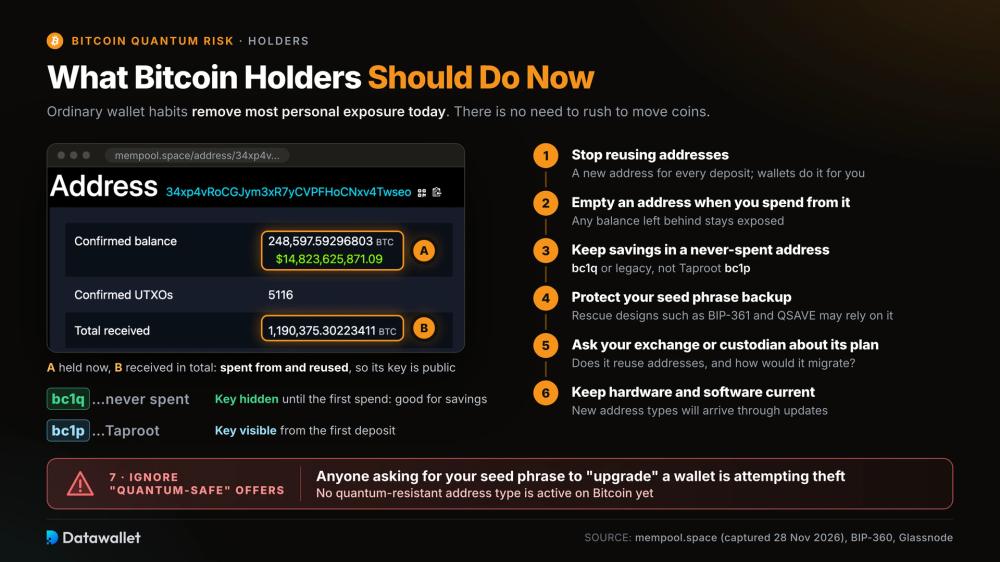
Holders can reduce their exposure today with ordinary wallet habits that need no new software.
- Stop reusing addresses: Use a new address each time you receive bitcoin. Modern wallets generate one automatically, and reuse is the largest single source of exposed supply.
- Empty an address when you spend from it: Spending reveals the public key. Any balance left behind in that address becomes long-exposed, so move the whole amount.
- Keep long-term savings in a never-spent address: A bc1q or legacy address that has only received funds keeps its public key hidden. Taproot addresses, which start with bc1p, show the key from the first deposit.
- Protect your seed phrase backup: Several rescue designs, including those discussed in BIP-361 and QSAVE, would let owners prove ownership with the seed phrase behind a wallet. P2PK coins and others without one have no such fallback.
- Ask your exchange or custodian about its plan: In Glassnode's data, exposure on exchanges ranges from about 5% to 100% of balances. A custodian should be able to say whether it reuses addresses and how it would migrate.
- Keep hardware and software current: New address types will arrive through wallet updates. Our Ledger and Trezor comparison and best crypto wallets guide explain how the main devices handle updates.
- Ignore offers to make your coins quantum-safe: No quantum-resistant address type is active on Bitcoin. Anyone who asks for your seed phrase to upgrade or migrate a wallet is attempting theft.
Moving coins only for quantum reasons is not urgent in 2026. A transfer made today faces no quantum attacker, and BIP-360 addresses do not exist on the main network yet. Migration makes sense once an upgrade activates and your wallet supports it.
Bottom Line
Bitcoin's quantum risk is real and measurable, though not yet practical. About a third of supply has a visible public key. The estimated hardware needed to exploit that fell sharply in 2026, and the machines that exist remain far too small.
The open questions are about coordination more than mathematics. Quantum-resistant signatures exist and run on current hardware wallets. Bitcoin has not agreed which scheme to adopt, when to activate it or what to do with coins that never move. Ethereum faces the same threat with a dated plan, which we cover in our Ethereum quantum roadmap guide.
Good address habits remove most personal exposure today. The remaining work belongs to developers, wallet makers and custodians over the next several years.


