
About Bitpanda
Bitpanda was founded by Eric Demuth, Christian Trummer and Paul Klanschek in Vienna in 2014 as a Bitcoin broker for European customers. The parent company, Bitpanda Group AG, is now registered in Zurich. In 2021, Valar Ventures, the fund co-founded by Peter Thiel, led a funding round that valued the business at $4.1 billion.
Heavy spending on growth shaped Bitpanda's 2025 results. Adjusted revenue rose 16% to 371 million euros, but adjusted EBITDA fell 75% to 13 million euros. Management attributed the decline to product and regulatory spending ahead of a planned listing. Consultancy EY estimates that Bitpanda handles close to 60% of Austria's domestic crypto trading.
The leadership changed twice in under a year. Demuth moved to the board as Executive Chairman in November 2025, when Lukas Enzersdorfer-Konrad became sole CEO. Bitpanda then announced in September 2026 that Enzersdorfer-Konrad will step down in the first quarter of 2027. Co-founder Trummer is serving as Co-CEO until a successor is chosen.

Bitpanda Features
The Bitpanda app centers on buying assets rather than using order books. All asset classes share one portfolio view, and you can use each for a savings plan, limit order, or card payment. For an exchange-style terminal, traders can switch to Bitpanda Fusion within the same account.
Trading Types
- Crypto brokerage: More than 650 coins and tokens are available at quoted prices that include Bitpanda's premium.
- Bitpanda Fusion: The advanced platform aggregates quotes from 12+ external venues across 2,000+ pairs, including CHF and GBP quote currencies.
- Real stocks, ETFs and ETCs: Since January 29, 2026, users have held actual shares in a securities account, paying a flat fee of 1 euro per trade.
- Margin trading: More than 120 crypto assets support positions with up to 10x leverage. Stocks, ETFs and ETCs allow up to 20x, as covered in the next section.
- Leveraged tokens: Products such as Bitcoin/EUR 2x Long and 1x Short amplify exposure and cannot be liquidated. Daily rebalancing, however, erodes their value over long holding periods.
- Crypto indices: The Bitpanda Crypto Index family, including BCI10 and BCI25, buys each constituent coin for the user and rebalances automatically.
- Precious metals: Gold, silver, platinum, and palladium are backed by physically stored, insured metal, with no storage fee.
Earn Options
Bitpanda Earn distinguishes products by the source of rewards. Proof-of-stake networks pay staking rewards, while Bitpanda pays stablecoin yields under a loan agreement.
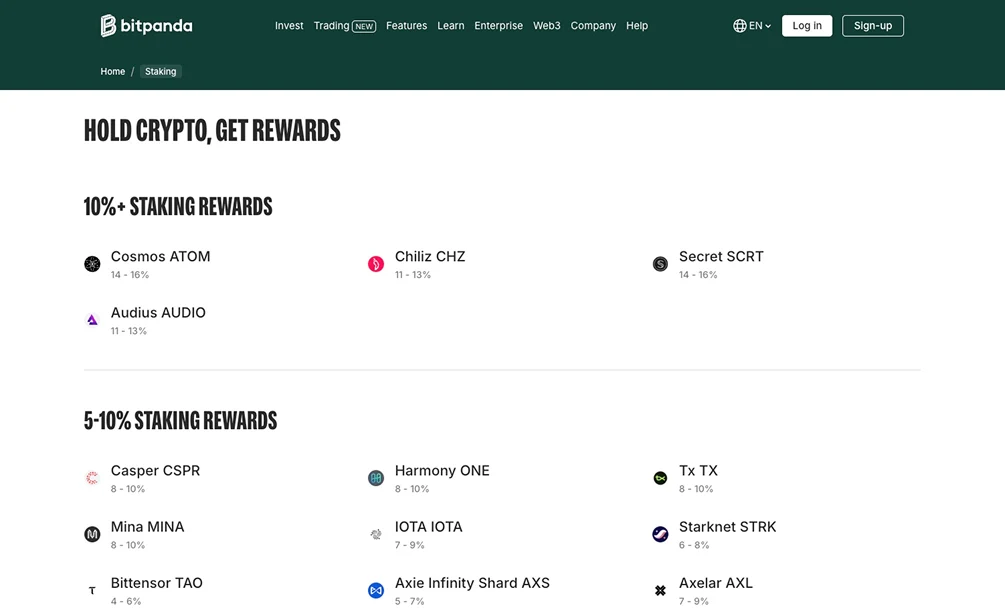
- Staking: Around 50 assets pay rewards every Tuesday. There is no lock-in except for ETH's network unbonding period. Advertised ranges are 2% to 4% for ETH and 14% to 16% for ATOM.
- Earn on Stablecoins: Lending USDC and EURCV to Bitpanda pays up to 7% APY, comprising a 3% fixed base and a discretionary bonus. Ownership passes to Bitpanda for the duration of the loan. The product sits outside MiCA, with redemptions taking 14 days.
- Cash Plus: Derivative contracts on BlackRock liquidity funds pay money market yields on uninvested euros, dollars and pounds. Current rates are 2.34% on EUR, 3.80% on USD and 3.86% on GBP. Balances remain available but are not bank deposits.
- Savings plans: Recurring purchases start at 1 euro and can run weekly, biweekly or monthly on any asset. Stock savings plans have no trade fee.
Additional Services
- AI-assisted investing: Since August, users have been able to connect Claude, ChatGPT, or any MCP-compatible assistant to their account with a permission-scoped API key. Assistants can read balances and prepare orders, but every trade requires the user's explicit confirmation.
- Vision Wallet: The Bitpanda Web3 unit's self-custody wallet provides on-chain access. Since 2026, it has also integrated Polymarket prediction markets in supported European countries.
- Bitpanda Card: A free Visa debit card that lets you spend any asset in the app, converting it to euros at checkout, with 1% cashback on crypto payments. The card section below sets out the limits and fees.
- Bitpanda Spotlight: A dedicated section introduces newly listed tokens with a research summary, and holders of staked VSN receive early access to selected listings before the wider platform.
- Bitpanda Club: Membership now depends on trading activity rather than token holdings and provides concierge support, early product access, member events, and an account lock that freezes funds on request. Gold members receive a dedicated success manager.
Bitpanda Real Stocks, ETFs and Margin Trading
Real securities replaced Bitpanda's derivative-based stock contracts on January 29, 2026, marking its largest product change. Shares are now held directly in a securities custody account. Users receive dividends and participate in corporate actions under issuer rules.
The earlier products offered only price exposure, and those legacy contracts are now in sell-only mode and cannot be bought. Real securities trade on a regulated exchange from Monday to Friday between 07:30 and 23:00, leaving weekends to crypto and metals.
- Range and pricing: More than 10,000 US and European stocks, ETFs, and ETCs are available for a fixed fee of 1 euro per order. There is no custody charge, and savings plans are free.
- Tax handling: Bitpanda handles tax deductions under local rules for residents of Austria and Germany, removing most of the paperwork offshore brokers leave to the user.
- Availability: Real securities are offered only in the EU. UK customers can access crypto and crypto indices, but not stocks, ETFs or metals.
Margin trading on these securities went live on July 8. By borrowing against their holdings, users can open positions with up to 20x leverage on more than 875 stocks, ETFs and ETCs. That is far above the 5x cap ESMA applies to retail stock CFDs.
The fee structure differs from a CFD broker's, with no buy fee, a 1 euro sell fee, a daily financing charge that starts at 0.18% and falls with size, plus a 1% liquidation fee. Acquired shares and any crypto or e-money in the account are pledged to Bitpanda GmbH as collateral. A 5% adverse move at 20x removes the entire margin, and overnight gaps can force liquidation before a user reacts.
Bitpanda's securities also differ from the tokenized shares sold by offshore exchanges. The tokens covered in our tokenized stock exchange comparison track share prices; Bitpanda users own the shares.
.webp)
What Is Vision (VSN)?
Vision (VSN) replaced the Bitpanda Ecosystem Token (BEST) and Pantos (PAN) on July 16, 2025. Conversion rates were fixed at 4.91 VSN per BEST and 0.89 VSN per PAN, based on 30-day average prices before March 25, 2025. Any balances left on the platform were converted automatically on July 16, 2026.
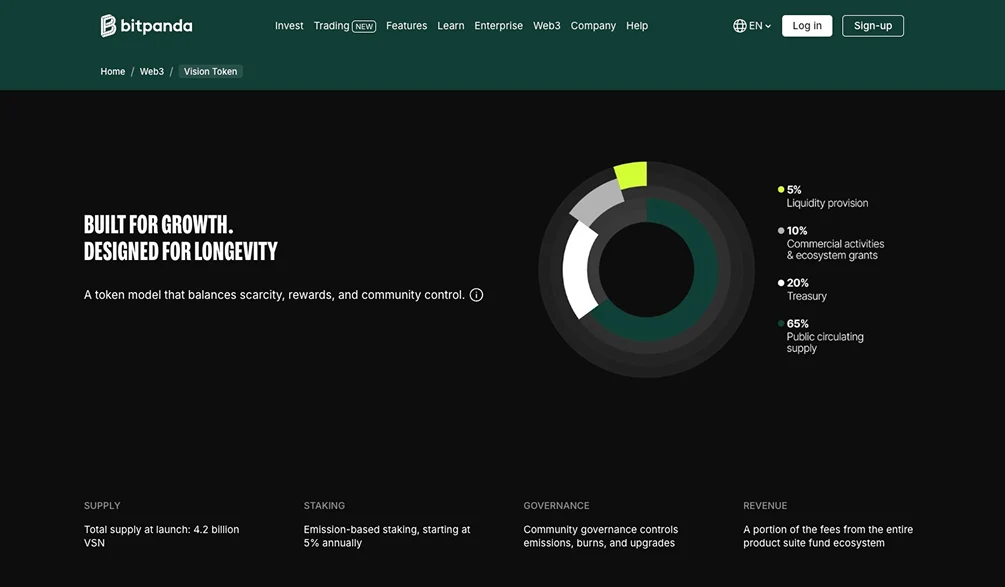
The white paper sets out a supply of 4.2 billion under a protocol emission model rather than a hard cap. VSN powers the Bitpanda Web3 unit. Its projects include the Vision Wallet and a launchpad, along with a protocol for transfers between chains and the planned Vision Chain.
VSN has the following uses on the exchange and in the wallet:
- Fee discount: Using unstaked VSN to pay fees reduces the charge by 20% on eligible buy, sell, and swap orders, as well as savings plans. Card payments are excluded.
- Staking: VSN is listed at 3% to 5% on the broker's staking page. Bitpanda's Vision helpdesk quotes up to 10% APY from emissions.
- Governance: Holders vote on staking rates, reward pools, and protocol upgrades. The next proposal is due with the first revenue-funded buyback.
- Loyalty: Holdings and staking determine early-access rewards and voting power. Fixed VIP tiers have ended, and Bitpanda Club membership now depends on trading activity rather than token holdings.
Announced in March 2026, Vision Chain is a Layer 2 built on Optimism's rollup technology for regulated real-world assets. It remains scheduled for 2026, with developer documentation promised for the third quarter.
The team acknowledged token price pressure in a June community update and confirmed that launch incentives would end. It also tied revenue-funded buybacks to product usage. Buying VSN solely for the fee discount adds exposure to a volatile token whose value may fall by more than the savings.
Is Bitpanda Regulated?
Bitpanda is more comprehensively regulated than any other crypto broker we cover. Every product in the app comes from a licensed group entity, though access is geographically restricted. Accounts are available only to residents of the 46 approved European jurisdictions and the UAE, as detailed on our Bitpanda supported countries page.
Its main authorizations are:
- MiCA: Bitpanda became the first major platform to receive a Markets in Crypto-Assets license with approval from Germany's BaFin in January 2025. It subsequently gained approvals from Malta's MFSA and Austria's FMA in April 2025. MiCA allows a licensed crypto-asset service provider to serve every EEA state under one EU rulebook.
- MiFID II: As an authorized investment firm, Bitpanda Financial Services GmbH can execute orders in real stocks and ETFs. It also issues the derivative contracts behind Cash Plus and the legacy stock products.
- PSD2 e-money: Bitpanda Payments GmbH is an e-money institution. Euro balances in the app are therefore safeguarded e-money rather than bank deposits.
- United Kingdom: Since February 2025, Bitpanda Broker UK Ltd has been FCA-registered as a cryptoasset business. The registration covers only anti-money laundering oversight. UK crypto holdings have no FSCS or Financial Ombudsman coverage.
- United Arab Emirates: Bitpanda Broker MENA DMCC, the Dubai entity, received a full broker-dealer license from VARA in March 2025 and onboards Emirati residents separately.
On August 14, 2026, the FMA fined Bitpanda GmbH 70,000 euros, showing that licensing does not prevent enforcement. Bitpanda had submitted a crypto-asset white paper fewer than 20 working days before publication and distributed marketing before the paper was published. The decision concerned disclosure timing, not custody or withdrawals. Its licenses were unaffected.
Several global exchanges had to withdraw from the EEA after reaching the end of the MiCA transition period on July 1, 2026, without a license. Our MiCA-licensed crypto exchange guide lists the platforms that cleared the same bar.
.webp)
Is Bitpanda Safe?
No platform breach has been recorded in Bitpanda's twelve years of operation. Its custody model rests on European law rather than a discretionary insurance fund. We still treat any broker as a place to trade and invest, not a vault for a lifetime of savings.
Bitpanda's terms describe a trustee structure in which customers remain the beneficial owners of crypto and metals held separately from company assets. If the company becomes insolvent, customers assert a right of separation under Austrian law instead of joining unsecured creditors. Bitpanda states that all client assets are backed one-to-one and are never lent, pledged, or traded.
Account Safety Measures
The following protections apply to every account. We enable those that are optional before making the first deposit:
- Two-factor authentication: An authenticator app generates time-based one-time codes to protect logins and withdrawals. Bitpanda strongly recommends enabling this at signup.
- Password reset confirmation: Email confirmation is required for every reset request. The email also lets the owner freeze the account if they did not make the request.
- API key scoping: MCP and API integration keys can be limited to read-only access and specific IP addresses, with lifetimes capped at one year.
- Proof of funds checks: Bitpanda may request source-of-funds documents for larger accounts. All payouts, including card payments, pause until approval.
Asset Protection
Crypto is held in cold storage that Bitpanda says an external auditor examines, while warm wallets contain only operating liquidity. The company holds ISO 27001 certification and a SOC 2 Type 2 report, and runs a public bug bounty. Real securities are held by a licensed securities custodian. Staked assets are delegated rather than transferred.
Bitpanda does not publish the monthly proof-of-reserves reports built on Merkle trees that Bybit and OKX release. Its transparency depends on supervision and external audits, the norm for a licensed European broker, leaving users with less on-chain verification.
Security History
- Platform: Since 2014, no hack or loss of customer funds from Bitpanda's own infrastructure has been reported.
- Phishing: Fraudulent emails and texts impersonate Bitpanda and regularly target login codes. Bitpanda never requests these codes by phone or message.
.webp)
Bitpanda User Reviews
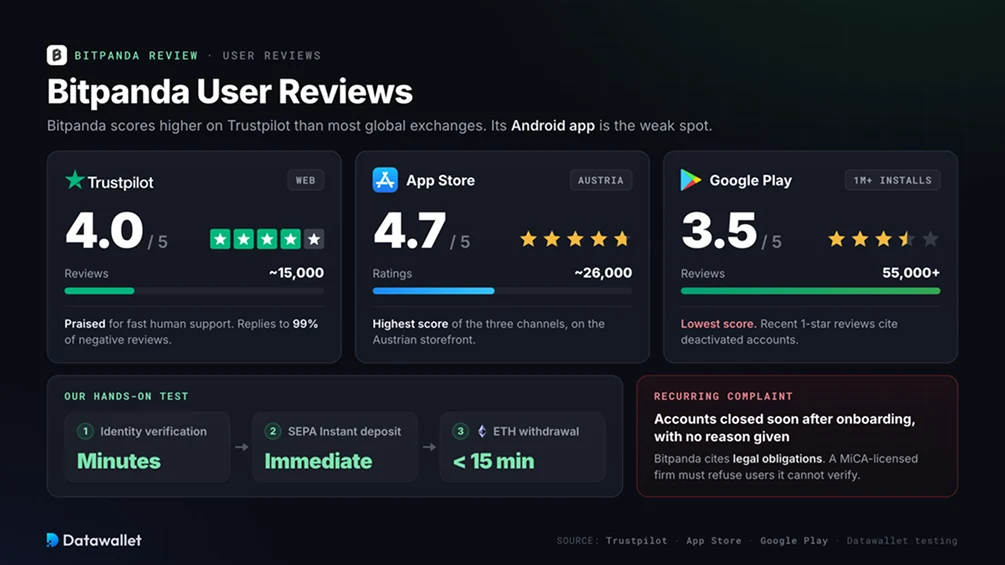
Bitpanda scores higher on Trustpilot than most global exchanges. Its Android app fares poorly, though both channels contain complaints about accounts closed after verification.
- Trustpilot: About 15,000 reviews give Bitpanda a score of 4.0 out of 5. Fast human support and simple deposits draw praise from reviewers. Bitpanda responds to 99% of negative reviews.
- Apple App Store: Around 26,000 ratings on the Austrian storefront average 4.7 out of 5.
- Google Play: More than 55,000 reviews average 3.5 out of 5, with over 1 million installs. Recent one-star reviews report accounts being deactivated soon after onboarding without a stated reason. Bitpanda cites legal obligations in its replies.
Our experience aligns with the higher ratings. Verification took minutes and a SEPA Instant deposit arrived immediately. A small ETH withdrawal to an external wallet was confirmed on-chain within 15 minutes. A MiCA-licensed firm must refuse customers it cannot verify, so anyone coming from an unlicensed exchange should expect stricter onboarding.
Bitpanda Fee Schedule
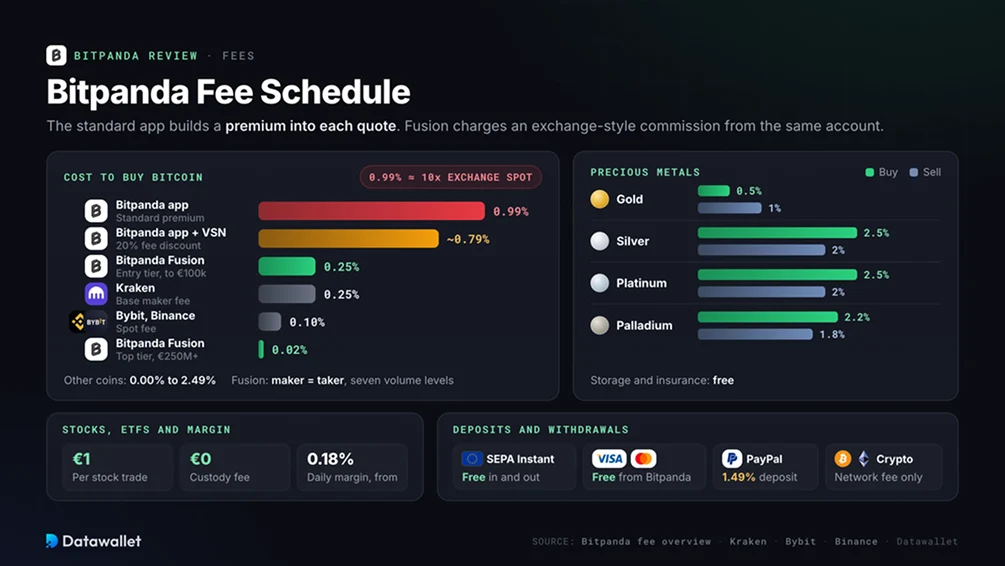
The standard Bitpanda app uses broker pricing, embedding the fee in each quote. Fusion charges a commission per trade, like an exchange. The published fee overview confirms the figures below.
Crypto Fees
- Standard premium: Bitcoin buys and sells carry a 0.99% premium. Each order's trade summary shows the exact fee, ranging from 0.00% to 2.49% depending on the asset and market conditions.
- Fusion commission: Makers and takers pay the same flat rate. It starts at 0.25% for 30-day volume up to 100,000 euros and falls through seven levels to 0.02% above 250 million euros. Our maker vs taker fees guide explains why this flat rate favors market orders.
- VSN discount: Using VSN to pay eligible crypto fees reduces them by 20%, taking the Bitcoin premium to roughly 0.79%.
A standard-app Bitcoin purchase at 0.99% costs almost ten times the 0.10% spot fee at Bybit or Binance. At 0.25%, Fusion's entry rate matches Kraken's base maker fee and is below Coinbase's simple-trade pricing. Cost-sensitive users should use Fusion from their first order.
Stocks, Metals and Margin Fees
- Real securities: Trades cost a fixed 1 euro, without custody fees, spread markups or overnight charges. Stock and ETF savings plans are free.
- Stock margin: Buying carries no fee and selling costs 1 euro. Daily financing starts at 0.18%, with a 1% liquidation fee.
- Precious metals: Gold costs 0.5% to buy and 1% to sell. Silver and platinum rates are 2.5% and 2%, and palladium rates are 2.2% and 1.8%. Storage and insurance are free.
Deposits and Withdrawals
- Euro transfers: SEPA and SEPA Instant deposits and withdrawals are free. Bitpanda also accepts USD, GBP, CHF, TRY, PLN, HUF, CZK, DKK and SEK.
- Cards and wallets: Bitpanda charges no fee for Visa or Mastercard deposits, though the card issuer may charge. PayPal deposits cost 1.49%.
- Crypto withdrawals: Network fees are passed on without markup and adjusted for congestion on chains such as Ethereum and Bitcoin.
Bitpanda Card and Cash Plus
Issued by Transact Payments Malta Limited, the Bitpanda Card is a Visa debit card that can link to any wallet in the app. Users choose a main payment asset and can add a fallback. That asset is sold for euros at checkout, making crypto spending a taxable disposal in most countries. Paying from the euro wallet avoids the event.
- Rewards: Crypto payments earn 1% cashback. Payments funded from euros, metals, stablecoins, or stocks earn nothing.
- Costs: The card and its first shipment are free. There is no monthly fee or foreign exchange fee beyond Visa's markup. Replacements cost 5.90 euros, while ATM withdrawals cost 2% or 2 euros, whichever is higher.
- Limits: Daily limits are 500 euros for ATM withdrawals and 10,000 euros for spending, with spending capped at 280,000 euros per month.
- Eligibility: The card is available to verified residents of a euro-area country and supports Apple Pay.
Cash Plus complements the card by paying a money market yield on idle balances that remain spendable at any time. Bitpanda Financial Services GmbH issues the derivative, whose returns follow central bank rates and carry no deposit guarantee.
Final Thoughts
Bitpanda in 2026 is a licensed European broker with crypto origins. Three MiCA licenses, a MiFID II investment firm, and an e-money institution give it compliance depth no offshore exchange can match. It offers real share ownership and 20x stock margin, with infrastructure embedded in Raiffeisen and other banks.
A 0.99% Bitcoin premium makes this model expensive by exchange standards. Perpetual futures are unavailable, and the Android app rates poorly. The FMA fine showed that even a licensed operator can fall short on disclosure. The postponed IPO and CEO transition add corporate uncertainty during 2027.
For European investors seeking crypto, stocks, ETFs and metals in one regulated account, Bitpanda is the most complete platform we have tested, with tax reporting handled in Austria and Germany. That verdict depends on using Fusion for anything beyond small purchases. Active derivatives traders will still prefer a venue like the one covered in our Bybit review.