Login to Track Your Live Crypto Portfolio
Sign Up and Track Your Live Crypto Portfolio for Free
Forgot your password?
Coinbase Completes Derivatives Stack With CFTC Clearing

This article has been reviewed and verified for accuracy by our editorial team. All claims, data points and platform details are cross-referenced against primary sources.
Some links on this page are affiliate links. Datawallet may earn a commission when you sign up through them, at no extra cost to you. This never influences our editorial ratings, rankings or recommendations.
Some links on this page are affiliate links. Datawallet may earn a commission when you sign up through them, at no extra cost to you. Ratings and rankings reflect our own testing and assessment criteria.

GM. Coinbase won clearing organization approval from the CFTC, completing a regulated derivatives stack that lets it list, broker, and settle fully collateralized contracts entirely in-house.
Elsewhere, Aztec relaunched zk.money after three years, California barred public officials from issuing memecoins, and Bitmine pushed its ether holdings to 4.9% of supply.
Read the full issue below. 👇
Coinbase Completes Derivatives Stack With CFTC Clearing
Coinbase received CFTC approval to register Coinbase Clearing as a derivatives clearing organization, slotting the final piece alongside its existing futures commission merchant and designated contract market registrations. The exchange can now create and settle contracts directly.
That means faster product development and more efficient operations, the company said, describing the USDC-native clearinghouse as unlocking flexibility to bring regulated products to market. Coinbase framed direct settlement of fully collateralized contracts as a first for the firm.
Limits apply. The clearinghouse may handle only fully collateralized futures, options on futures, and swaps, leaving leveraged products with outside partners, including the margined derivatives business and a forthcoming single-stock perpetuals launch.
The stack could eventually support a restricted HIP-3 market, mirroring what Kraken parent Payward proposed through Bitnomial and NinjaTrader. That remains speculative given the collateral restriction, and Payward's own structure still awaits regulatory sign-off.
Aztec Relaunches zk.money for Private Ethereum Payments
Aztec Labs brought back zk.money, a self-custodial wallet hiding payment amounts, balances, and recipients while letting people send to readable names like bob.zk.money. Deposits accept DAI, USDC, and USDT, with the latter two converted into DAI on entry.
Deposits from Ethereum still expose sender and amount publicly, and the early Alpha caps each transfer below $2,500. The zero-knowledge network has not been fully audited, and contributors disclosed a critical V5 flaw in August awaiting a V6 fix.
California Bars Public Officials From Issuing Memecoins
Governor Gavin Newsom signed Assembly Bill 2409, prohibiting state public officers and employees from issuing memecoins. Digital asset platforms are also barred from listing tokens issued after January 2027 in partnership with federal, state, or local officials.
The attorney general, district attorneys, and city attorneys can bring civil actions seeking injunctions and disgorgement. Newsom's office tied the law directly to Trump, who disclosed over $635 million from his own TRUMP token last year.
Bitmine Reaches 4.9% of Ethereum Supply With Latest Buy
Bitmine bought 17,362 ether worth roughly $47 million, lifting holdings to 6,001,302 tokens valued near $16.2 billion. That equals 4.9% of circulating supply, leaving Tom Lee's company 98% of the way toward its stated 5% target.
Some 84% of the ether treasury is staked through MAVAN, generating a projected $358 million annually at a 2.62% yield. The firm has added tokens every week since June 2025, alongside 213 bitcoin and $672 million in cash.
Data of the Day
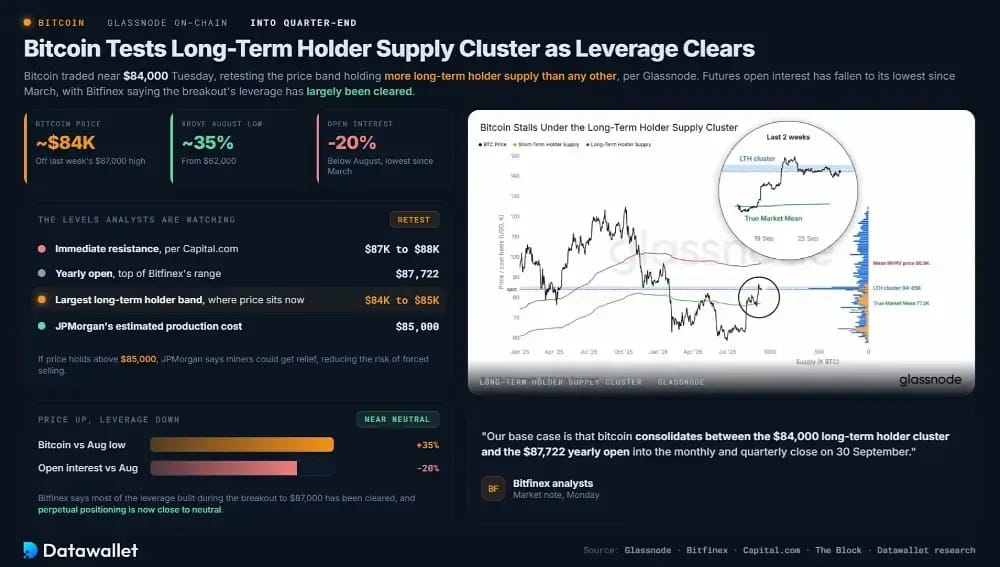
Bitcoin traded near $84,000, retesting the band holding more long-term holder supply than any other, according to Glassnode. JPMorgan pegs $85,000 as estimated production cost, which could ease forced miner selling if sustained.
Coin-denominated open interest fell to its lowest since March, almost 20% below August, with Bitfinex saying leverage from the $87,000 breakout has largely cleared. The 10-year Treasury yield closed at 5.17%, tightening conditions.
More Breaking News
- Senate Democrats called Tether a lifeline for Iran's shadow banking network, though USDT issuer says it supported nearly $550 million in Iran-linked freezes.
- Greece gained four registered providers, its first entries on the MiCA register, as the HCMC categorically rejected claims Lagarde blocked Binance's application.
- Bitwise launched the first NEAR fund on NYSE Arca at a 0.75% fee, staking holdings in-house and positioning NEAR as agentic economy infrastructure.
- Zcash developers released Udon, folding Tachyon calculations into shared cryptography software as ZEC targets more than 50,000 private payments a second long term.
- Bitget's attacker ran two test transfers beneath risk thresholds half an hour before draining $388 million, leaving Bitget blaming a third-party zero-day flaw.
- Citi clients can accept stablecoin payments through Spring, with Coinbase converting tokens to fiat so merchants never hold USDC themselves.
- Aiden Pleterski will represent himself at a four-week Toronto trial, after Canadian investors handed him roughly $40 million and recovered just $3 million.
- Claude Sonnet 5.5 beat Opus 5.5 on Terminal-Bench at half the price, though Anthropic's model burned more tokens per task than any tested.
For the latest updates on digital asset markets, follow us on X @Datawalletcom.
Get tomorrow’s issue in your inbox