



Top 10 Binance Statistics and Trends
These ten figures offer the most useful view of Binance today. The sections below explain each metric and identify its source and data date.
1. Binance Reported 323 Million Registered Users in July
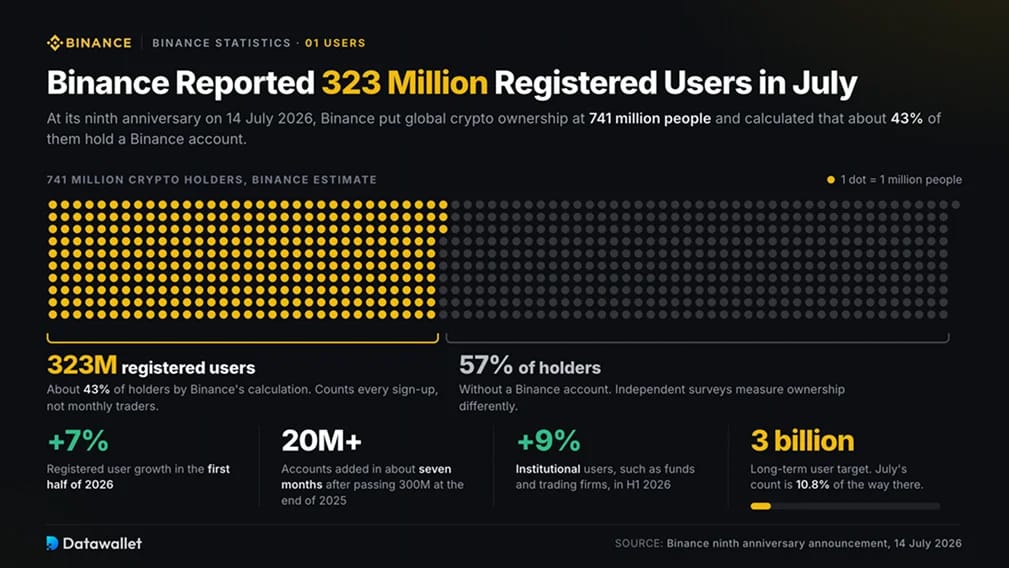
At its ninth anniversary on 14 July 2026, Binance announced more than 323 million registered users. Its user base grew about 7% during the first half of the year, according to the company. This figure counts anyone who created an account, so it exceeds the number of people trading each month.
The announcement also estimated global crypto ownership at 741 million people. Using that estimate, Binance calculated that about 43% of crypto holders have an account on its platform. This is the company's own calculation. Independent surveys use different methods to measure crypto ownership.
Having crossed 300 million users at the end of 2025, Binance added more than 20 million accounts in about seven months. Its institutional user base, including funds and trading firms, grew 9% in the first half of 2026. The company's long-term target is three billion users.
2. Annual Trading Volume Reached $34 Trillion
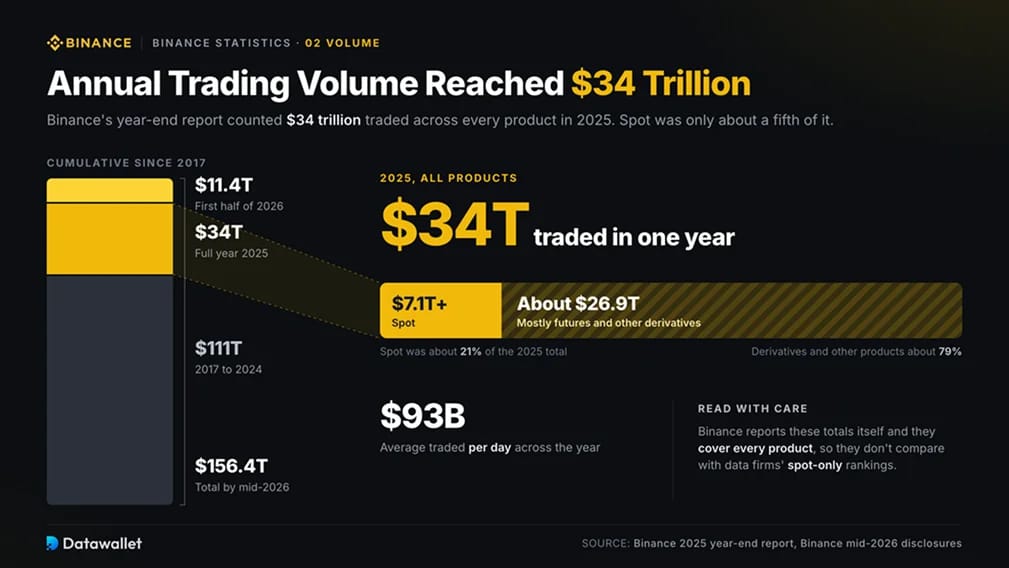
According to its year-end report, Binance processed $34 trillion in trading volume across all products in 2025. More than $7.1 trillion came from spot trading, where users buy and sell the coins themselves. Futures and other derivatives accounted for most of the rest.
That annual total works out to about $93 billion in trading per day. By mid-2026, Binance's cumulative volume since 2017 had reached about $156.4 trillion, including roughly $11.4 trillion added in the first six months of 2026.
Binance reports these figures itself, and they cover every product. They therefore cannot be compared directly with data firms' spot-only rankings.
3. Binance Took 42.7% of Top-10 Spot Volume in Q3
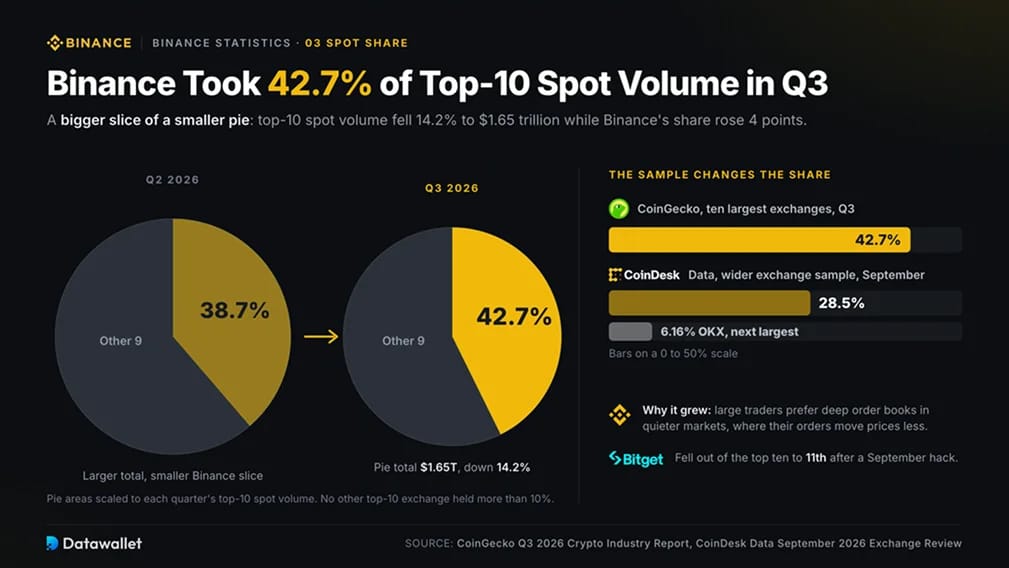
Binance's share of spot volume across the ten largest centralized exchanges rose from 38.7% in the second quarter to 42.7% in the third, according to CoinGecko's third-quarter report. No other exchange in the group held more than 10%. Across all ten, quarterly spot volume fell 14.2% to $1.65 trillion.
The exchange gained share as the overall spot market shrank. Large traders' preference for deep order books during quieter periods is one likely reason, since their orders have less effect on prices there. Following a September hack, Bitget fell out of the top ten to eleventh place.
A broader sample produces a lower share. CoinDesk Data's September exchange review tracked more exchanges and measured Binance's spot share at 28.5%, followed by OKX at 6.16%. Our crypto exchange statistics page explains the differences between these data sources.
4. Binance Handled 45.3% of Exchange Derivatives Volume in September
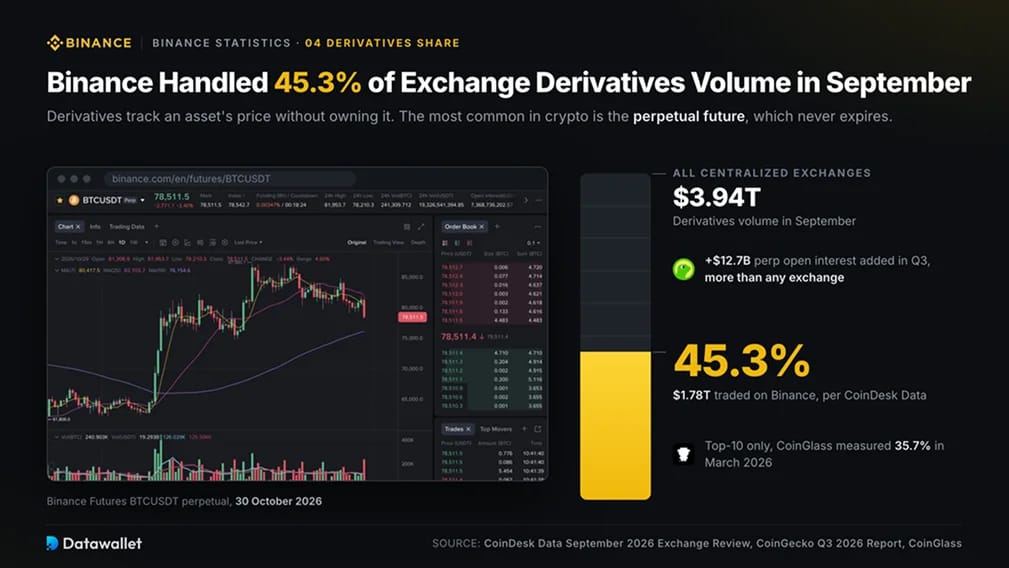
Binance traded $1.78 trillion in derivatives in September, accounting for 45.3% of the $3.94 trillion centralized exchange total, according to CoinDesk Data. Derivatives follow an asset's price without requiring the trader to own it. In crypto, the most common type is the perpetual future, which has no expiry date. Our guide to perpetual and spot trading explains the distinction.
CoinGecko also reported that Binance added $12.7 billion in perpetual open interest during the third quarter, more than any other exchange. Open interest measures the total value of derivatives positions that remain open. Our Bitcoin open interest tracker lets readers follow live positions.
The providers use different measurements. Comparing only the ten largest derivatives exchanges, CoinGlass put Binance's share at 35.7% in March 2026. For a broader view of the market, see our perpetual futures statistics.
5. About $3.3 Billion Left Binance Hot Wallets in a Suspected Hack
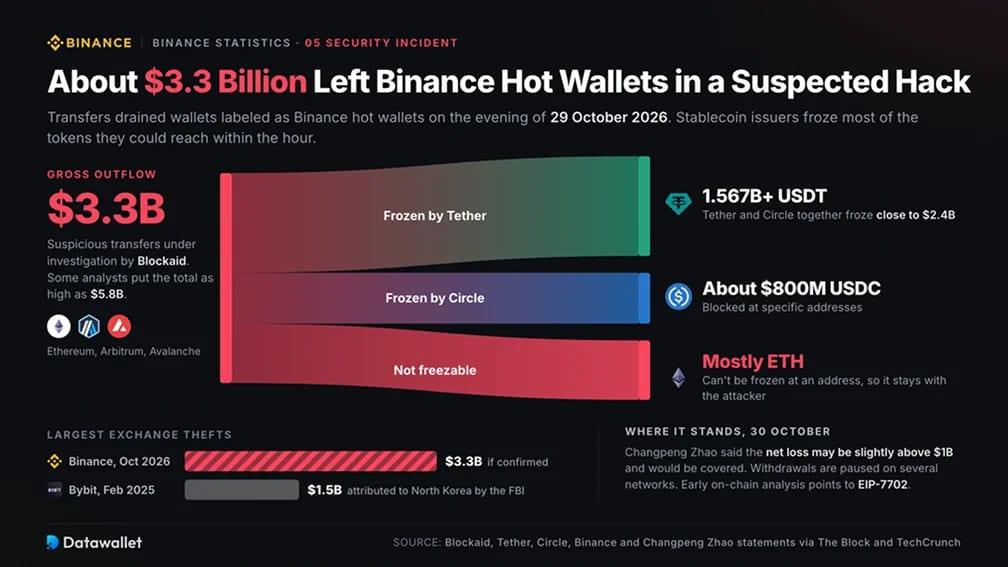
Very large transfers left wallets labeled as Binance hot wallets on the evening of 29 October 2026 (UTC). Exchanges use these internet-connected wallets to pay withdrawals. Security firm Blockaid said it was investigating about $3.3 billion in suspicious transfers across Ethereum, Arbitrum, and Avalanche. Some analysts estimated totals as high as $5.8 billion.
Within the hour, stablecoin issuers used their ability to block tokens at specific addresses. Tether said it froze more than 1.567 billion USDT, while Circle froze about $800 million in USDC. Together, the freezes amounted to close to $2.4 billion.
Much of the stolen ETH remains with the attacker because ETH cannot be frozen this way. Founder Changpeng Zhao wrote that the net loss after the freezes may be slightly above $1 billion and would be covered.
Binance temporarily suspended withdrawals on multiple networks and said user funds are safe. By 30 October, it had published neither a final loss figure nor an explanation of the cause or a repayment plan. Early on-chain analysis points to EIP-7702. Added in the Pectra upgrade, this feature allows a wallet to act like a smart contract once its owner signs an approval with the private key.
Confirmation of these figures would make the theft larger than the $1.5 billion stolen from Bybit in February 2025, which the FBI attributed to North Korea. We will update this section when Binance publishes its official incident report.
6. The SAFU Emergency Fund Holds 15,000 BTC
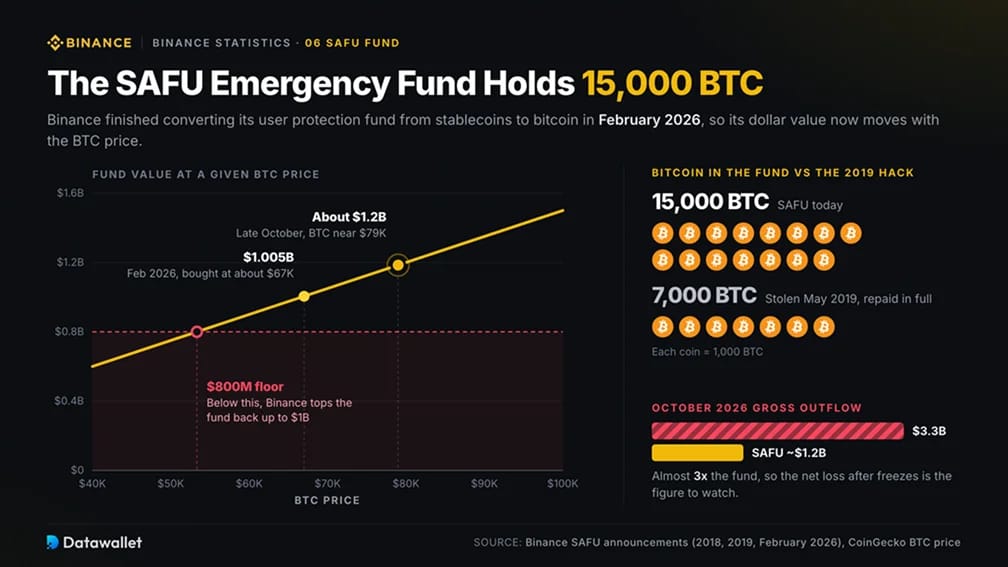
Binance established the Secure Asset Fund for Users, or SAFU, in 2018 to repay users after emergencies such as hacks. The fund held mostly stablecoins until February 2026, when Binance finished converting it into 15,000 BTC. At an average price of $67,000 per bitcoin, the BTC was worth about $1.005 billion.
SAFU's value now moves with the bitcoin price. Binance has said it will replenish the fund to $1 billion if its value falls below $800 million. With bitcoin near $79,000 in late October, the 15,000 BTC balance was worth about $1.2 billion.
The fund was first used in May 2019 after attackers withdrew 7,000 BTC from a Binance hot wallet. Binance covered that loss in full. The gross amount moved in October 2026 is almost three times SAFU's current balance, making the net loss after freezes the most important figure for users to follow.
7. Users Held About 688,600 BTC on Binance in October
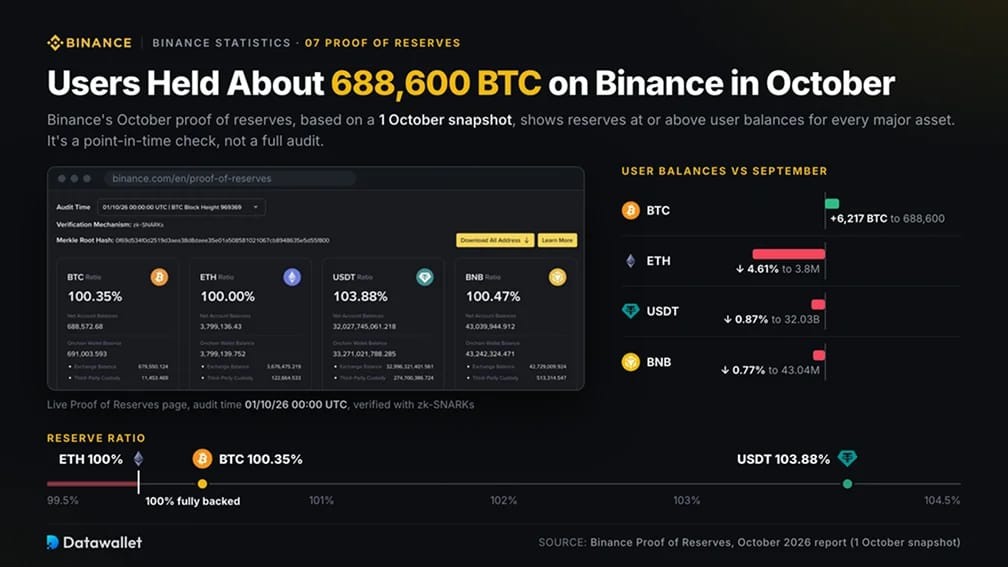
An exchange's proof of reserves report shows whether it holds at least as many coins as users have deposited. Based on a 1 October snapshot, Binance's October proof of reserves showed about 688,600 BTC in user holdings, up 6,217 BTC from September. Its BTC reserve ratio was 100.35%.
Other user balances declined over the month. ETH holdings fell 4.61% to about 3.8 million ETH, while USDT dropped 0.87% to about 32.03 billion. Users held about 43.04 million BNB, a decrease of 0.77%. Reserve ratios stood at 103.88% for USDT and 100% for ETH.
Proof of reserves compares crypto reserves with user balances at a single moment. It is not a full financial audit and does not disclose all of Binance's company debts. November's report, the first after the hack, will show whether reserve ratios remained above 100%.
8. TradFi Perpetual Volume Reached $433.4 Billion in August
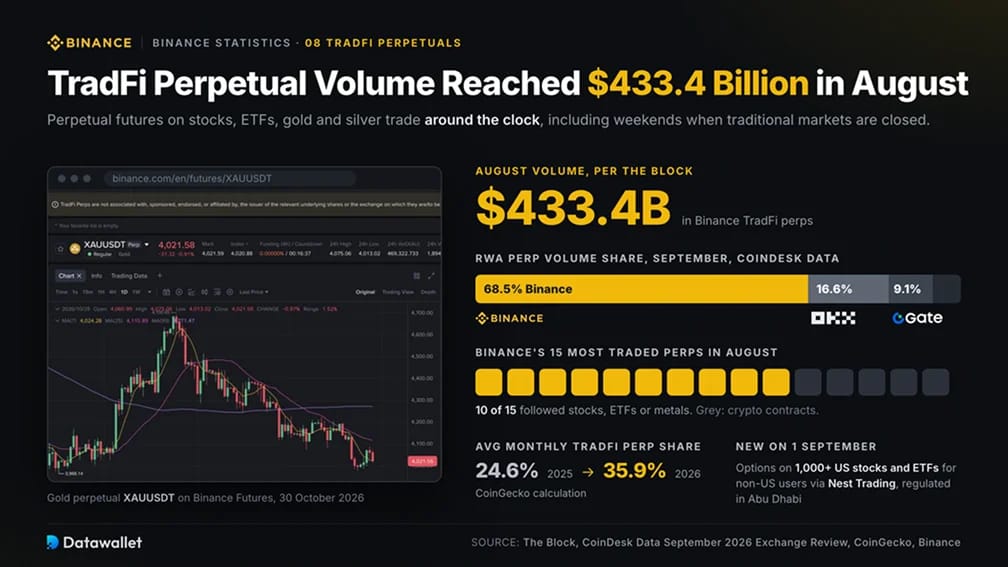
Binance's TradFi perpetual volume reached about $433.4 billion in August, according to The Block. TradFi is short for traditional finance and refers to assets such as stocks, ETFs, gold, and silver. Perpetual futures linked to these assets trade around the clock, including weekends when traditional markets are closed.
CoinDesk Data measured Binance's share of real-world asset (RWA) perpetual volume at 68.5% in September, well ahead of OKX's 16.6% and Gate's 9.1%. Separately, CoinGecko calculated that its average monthly share of TradFi perpetuals increased from 24.6% in 2025 to 35.9% in 2026.
Traditional assets now feature heavily in Binance trading. The company said 10 of its 15 most traded perpetual contracts in August followed these assets. On 1 September, it added options on more than 1,000 US stocks and ETFs for users outside the United States. These are offered through Nest Trading, Binance's broker-dealer regulated in Abu Dhabi.
9. bStocks Passed $1 Billion in Assets Within Four Months
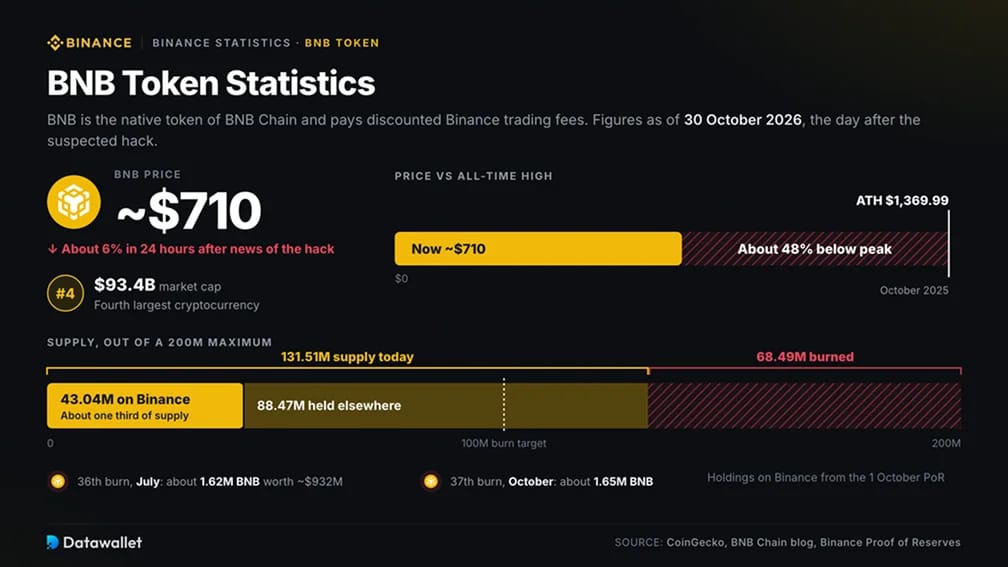
Binance launched bStocks on 11 June 2026 with five stocks and now lists close to 100. These tokenized stocks are blockchain tokens backed one to one by real US shares held with a regulated custodian. By September, a Binance-commissioned research report from The Block valued bStocks at $772 million on-chain, close behind Ondo's $881 million.
In mid-October, Binance said bStocks had passed $1 billion in assets. Data from rwa.xyz on 16 October put the platform first among tokenized stock providers at about $1.2 billion, out of a total market worth about $3.5 billion.
A small number of tokens account for most trading. bStocks generated 83.3% of all tokenized stock volume in July, largely through QQQB. This token follows the Invesco QQQ ETF and had a zero maker fee promotion. Datawallet's guide to tokenized stock trading exchanges compares other platforms.
10. The 37th BNB Burn Removed 1.65 Million Tokens
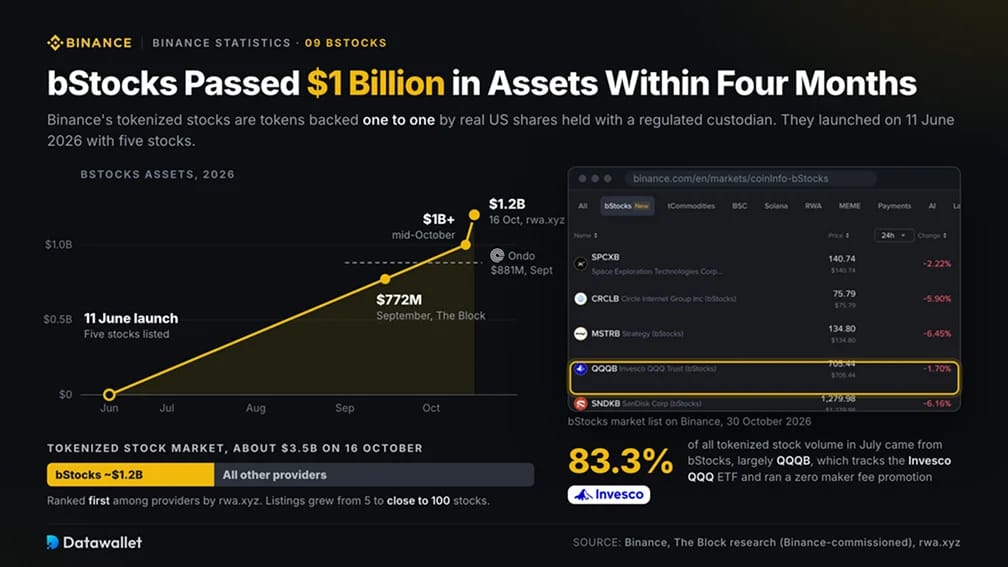
BNB, the native token of BNB Chain, gives Binance users a discount when they use it to pay trading fees. On 19 October 2026, its 37th quarterly burn removed 1,646,196.44 BNB worth about $1.197 billion. Burning permanently removes tokens from supply by sending them to an address that no one controls.
The total supply now stands at 131,512,085 BNB. Burns will stop at 100 million BNB, half the original 200 million supply. The formula depends on BNB's price and the number of blocks produced on BNB Smart Chain. Binance's trading revenue does not enter the calculation.
Each of the last two burns removed about 1.6 million BNB. At that pace, burning the remaining 31.5 million would take roughly 19 to 20 quarters. The actual period may differ because the formula removes fewer tokens as the price rises.
How Many People Use Binance?
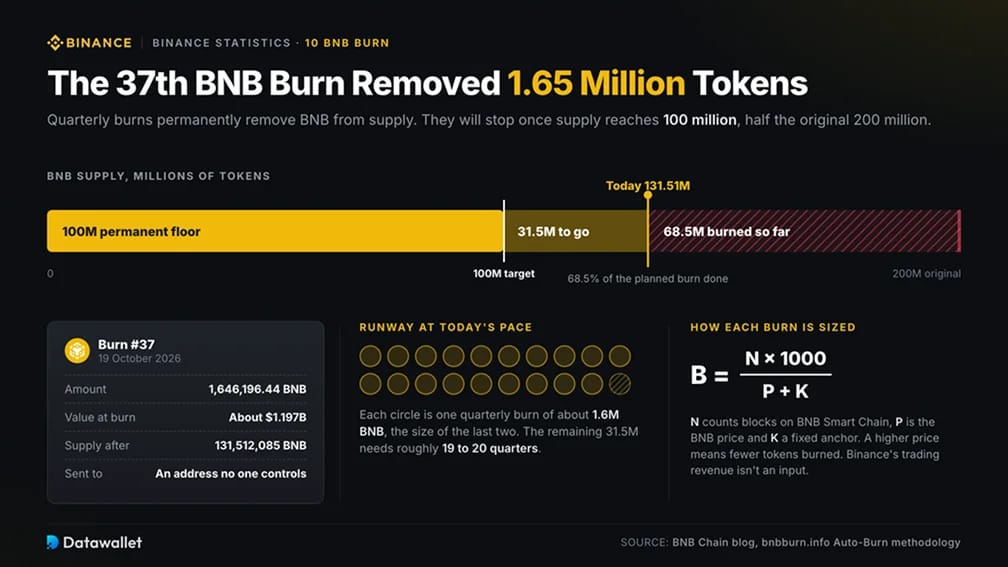
Binance publishes registered user counts but does not disclose monthly active users. Its own announcements provide the following account growth milestones.
- July 2022: Binance's fifth-anniversary letter said it had served more than 120 million users.
- End of 2023: Registered users passed 170 million, up about 30% during the year Binance settled with US authorities.
- November 2024: The company reported serving 240 million users and holding more than $130 billion in user assets.
- End of 2025: Binance crossed 300 million registered users, according to its 2025 year-end report.
- July 2026: At its ninth anniversary, Binance reported 323 million registered users.
Individual products also report user figures. Binance Alpha, the section of Binance Wallet that lists early-stage tokens, recorded 17 million users and more than $1 trillion in trading volume in 2025. That year, more than 1.2 million users tried Smart Money, a feature showing selected traders' positions.
Access varies by country. US residents must use the separate company Binance.US, and several other markets are closed to new accounts. Our Binance restricted countries list shows where the exchange is unavailable.
BNB Token Statistics
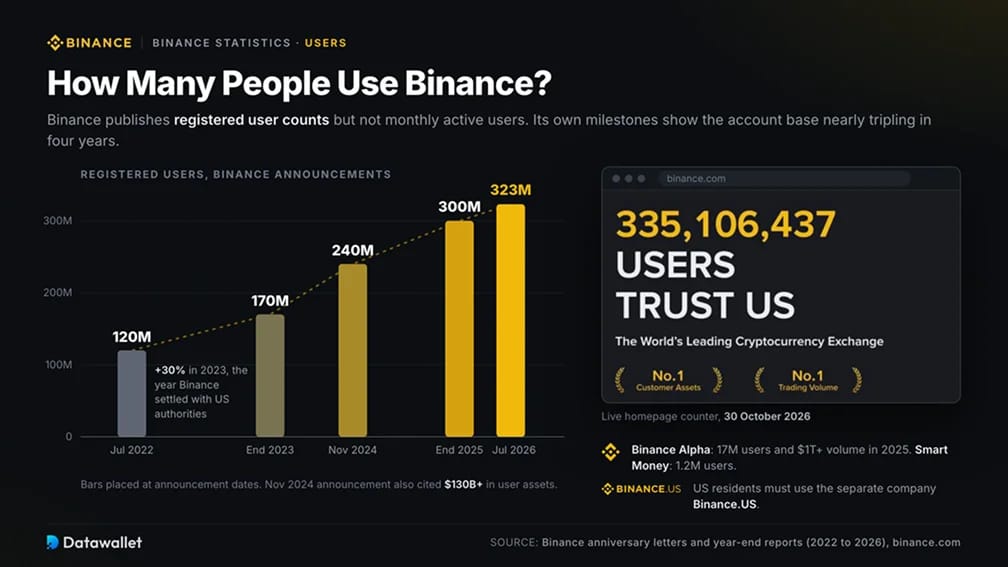
- Price: BNB traded near $710 on 30 October, falling about 6% in 24 hours after news of the hack, according to CoinGecko.
- Market capitalization: About $93.4 billion, making BNB the fourth largest cryptocurrency by market value.
- All-time high: BNB reached $1,369.99 in October 2025. Its current price is about 48% below that peak.
- Supply: The 37th burn brought supply to 131.51 million BNB, from a maximum of 200 million.
- Recent burns: July's 36th burn removed about 1.62 million BNB worth about $932 million. The 37th burn in October removed about 1.65 million BNB.
- BNB on Binance: On 1 October, users held about 43.04 million BNB on the exchange, roughly one third of the total supply.
For live market data, visit Datawallet's BNB price page.
Is Binance Safe?
Binance has experienced two major hot wallet incidents. In May 2019, attackers stole 7,000 BTC using compromised API keys and two-factor codes. The affected wallet held about 2% of Binance's bitcoin, and SAFU covered the loss. October's 2026 incident is many times larger, with the full facts still unpublished.
Most exchange assets are held offline in cold wallets. A smaller portion stays in hot wallets to meet daily withdrawals, and both Binance incidents affected these connected wallets. Any exchange balance is a claim on the company. After a hack, users therefore need to know whether that company has enough capital to cover the shortfall.
Past problems have resulted in repayments. Following the 10 October 2025 market crash, Binance paid $283 million to users affected by tokens losing their price peg on the platform. Through its Together Initiative, it then allocated another $400 million for users who had been liquidated.
The company also says its controls prevented $6.69 billion in potential fraud and scam losses in 2025. It reported handling more than 71,000 law enforcement requests that year. Neither figure has been independently checked.
We suggest keeping only trading balances on exchanges and moving long-term holdings into a self-custody wallet, where you control the private keys. Our Binance review explains account protections such as withdrawal address lists and hardware security keys.
How Is Binance Regulated?
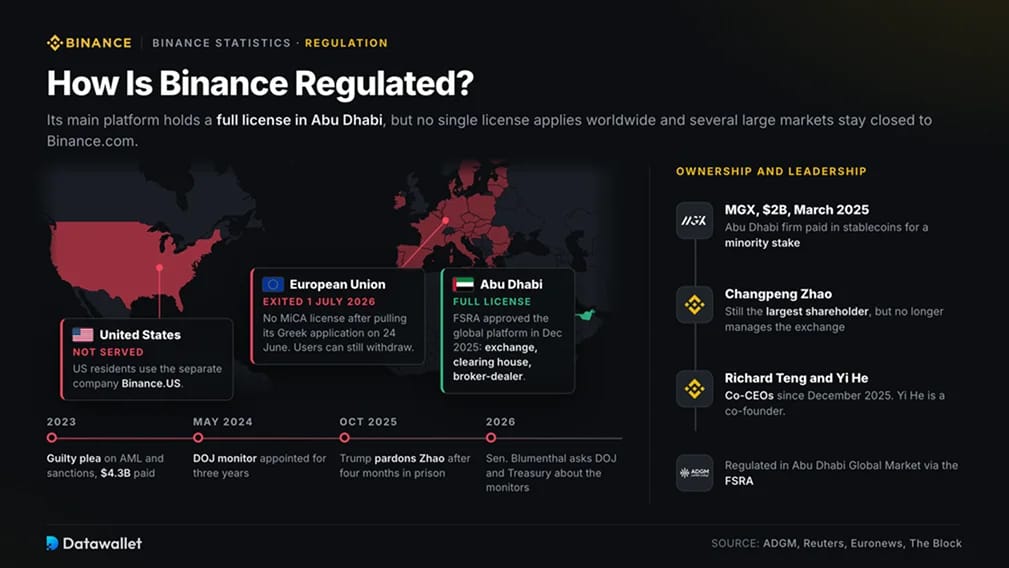
Binance's licenses and registrations differ by country. Its main platform holds a full license in Abu Dhabi, but no single license applies worldwide, and several large markets remain closed to Binance.com.
- United Arab Emirates: The Financial Services Regulatory Authority (FSRA) of Abu Dhabi Global Market approved Binance's global platform in December 2025. Since 5 January 2026, the business has operated through three regulated companies. These comprise an exchange, a clearing house responsible for settling trades and holding user assets, and a broker-dealer.
- European Union: The EU's Markets in Crypto-Assets Regulation, MiCA, required exchanges to obtain a license by 30 June 2026. Binance withdrew its Greek application on 24 June and stopped offering crypto services in France and other EU countries from 1 July. Existing users can still withdraw assets. Binance says it is pursuing a license in another member state. Our guide to MiCA-licensed crypto exchanges lists platforms available to EU users.
- United States: Binance.com does not serve US users. Binance pleaded guilty to anti-money laundering and sanctions violations in 2023 and agreed to pay $4.3 billion. Zhao served four months in prison before President Trump pardoned him in October 2025. In 2026, Senator Richard Blumenthal asked the DOJ and Treasury about Binance's compliance monitors following reports that two Binance partners served Iran-linked entities. Binance disputes parts of that reporting.
- Ownership and leadership: Abu Dhabi investment firm MGX invested $2 billion in Binance in March 2025, paying in stablecoins for a minority stake. Zhao remains the largest shareholder but no longer manages the exchange. Richard Teng and co-founder Yi He have served as co-CEOs since December 2025.
What's Next for Binance?
- The hack report: Binance's most urgent task is to establish the loss after freezes and explain how it will repay users. Its official report should also clarify how the attacker gained control of the hot wallets.
- A return to the EU: A MiCA license from one member state would allow Binance to serve all 27 EU countries again. Regulators will likely weigh its compliance record and the October incident before granting approval.
- More traditional assets: US stocks, stock options, bStocks, and TradFi perpetuals are central to Binance's growth plan. How regulators treat perpetual contracts on stocks will determine the scope for expansion.
- US compliance terms: The DOJ monitor appointed in May 2024 has a three-year term. Bloomberg reported in 2025 that Binance was discussing an early end to the monitorship. Any decision would alter its compliance obligations.
- BNB supply: Quarterly burns will keep reducing supply toward 100 million BNB. The next burn is due in January 2027.
- Market share after the hack: Binance gained spot share in 2026 despite falling total volume. November and December exchange data will reveal whether users moved assets elsewhere after the incident.
Final Thoughts
Binance approaches the end of 2026 with its largest user base and widest product range since launch. Its spot share grew in a weak market, and it leads trading in contracts on traditional assets. In about four months, it also built a tokenized stock business worth more than $1 billion.
The suspected 29 October hack puts this growth under pressure. Although Binance has repaid users in the past and holds a 15,000 BTC emergency fund, the scale of the incident and its loss of EU access will shape user confidence in the coming months. We recommend checking official Binance channels before moving funds while its incident report remains unpublished.
Our Methodology
These statistics draw on Binance disclosures alongside independent data providers, regulators, and established crypto media. We date each figure because exchange data changes daily and providers track different groups of exchanges.
How We Compiled the Data:
- Company disclosures: Binance announcements and its reserves page supply the user counts, annual volume, product milestones, and proof of reserves figures. We identify these as self-reported.
- Market share data: CoinGecko's quarterly report, CoinDesk Data's monthly exchange review, and CoinGlass provide the spot and derivatives shares. Each figure names its provider because their exchange coverage differs.
- Security incident: Figures for 29 October come from on-chain analysis reported by The Block and TechCrunch, together with public statements from Binance, Tether, Circle, and Zhao. The numbers remained preliminary on 30 October.
- Token data: CoinGecko and the BNB Chain blog provide BNB price, market capitalization, and supply figures.
- Product data: TradFi perpetual and tokenized stock figures are sourced from The Block, CoinDesk Data, CoinGecko, and rwa.xyz.
- Regulation: ADGM, Reuters, Euronews, and The Block supply the licensing and legal details.
- Snapshot date: Unless another date appears in the text, all figures are current as of 30 October 2026.