






Top 10 Crypto Exchange Statistics and Trends
The figures below track where crypto trading takes place and which platforms hold the most customer assets. They draw on the latest quarterly or monthly reports available in October 2026.
1. Top Exchanges Traded $1.65 Trillion in Spot During Q3
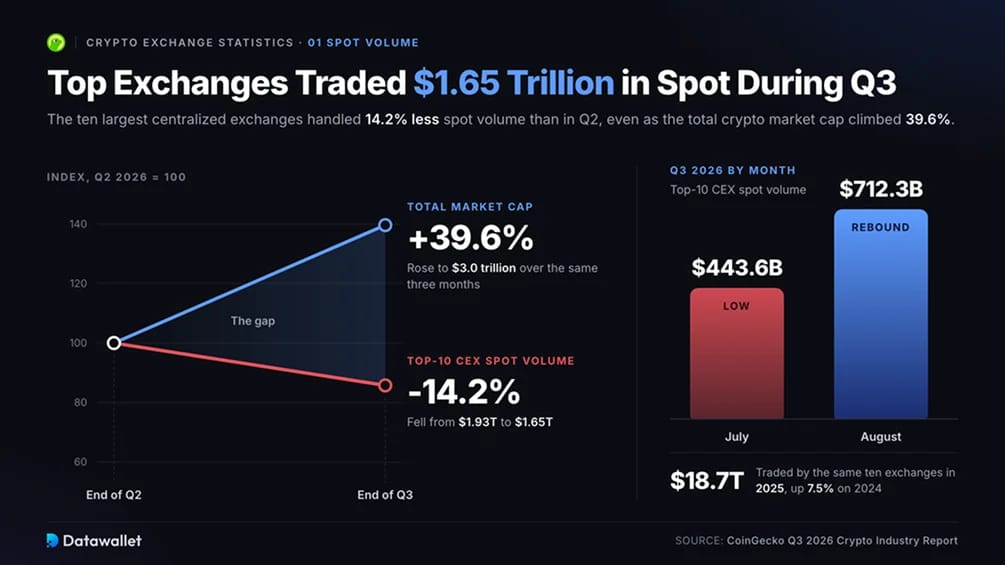
The ten largest centralized exchanges processed $1.65 trillion in spot trades during the third quarter of 2026, according to CoinGecko's Q3 industry report. Volume fell 14.2% from Q2's $1.93 trillion. July was the weakest month at $443.6 billion, before activity recovered to $712.3 billion in August.
Higher prices did not bring spot traders back. Total crypto market capitalization rose 39.6% to $3.0 trillion over those same three months, even as trading declined. Across all of 2025, the same ten exchanges handled $18.7 trillion in spot volume, up 7.5% on 2024.
2. Derivatives Made Up 77.6% of CEX Volume in September
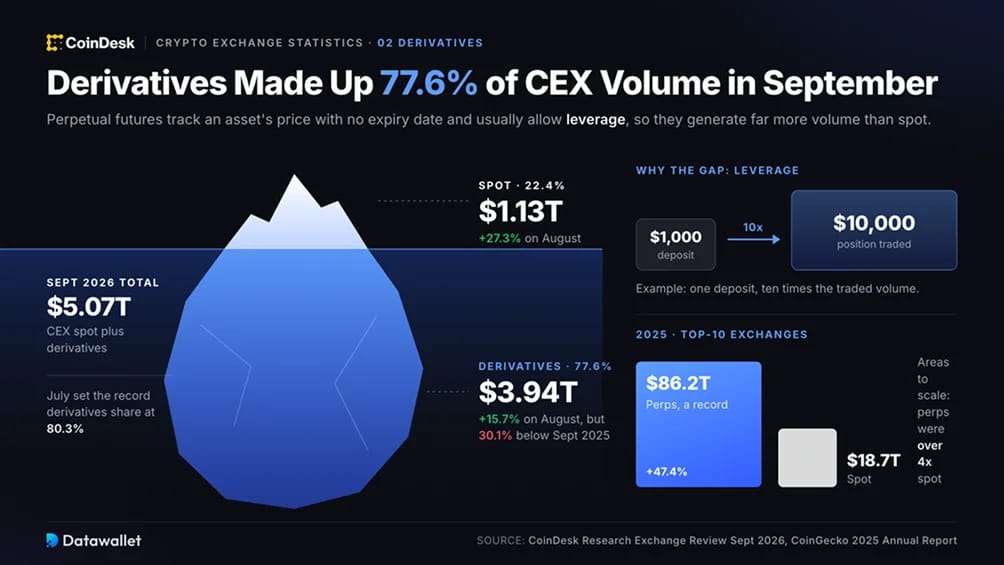
Perpetual futures now account for most centralized exchange volume. These contracts track an asset's price without an expiry date and usually allow leverage, meaning traders can use borrowed funds. In September 2026, centralized derivatives volume increased 15.7% to $3.94 trillion, according to CoinDesk Research's monthly exchange review.
Derivatives represented 77.6% of combined trading, slightly below July's record 80.3%. Spot activity also recovered in September, with volume rising 27.3% to $1.13 trillion. Despite the monthly improvement, derivatives volume remained 30.1% below September 2025.
Much of the gap between spot and derivatives comes from leverage. Traders can open positions many times larger than their deposits, generating far more volume from the same capital than a spot purchase would. The ten largest centralized perpetual futures exchanges traded a record $86.2 trillion in 2025, up 47.4%, according to CoinGecko's 2025 annual report. That exceeded their spot volume by more than four times.
For funding rates and liquidation data, see our crypto perpetual futures statistics and our guide to perpetual versus spot trading.
3. Binance Held 42.7% of Top-10 Spot Volume in Q3
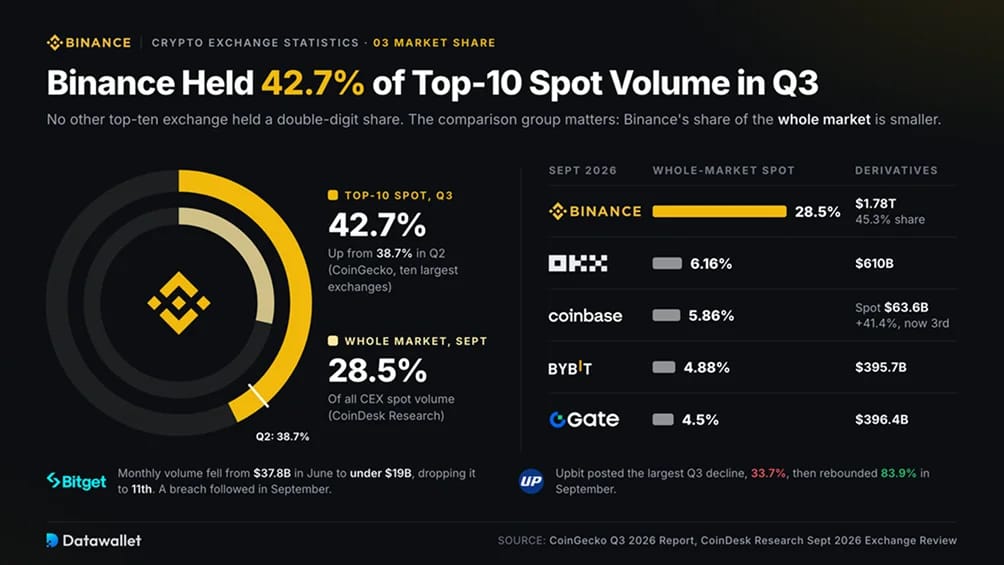
Binance's share of top-ten spot volume rose from 38.7% in Q2 to 42.7% in Q3, according to CoinGecko. No other exchange in the group held a double-digit share. Binance says it now serves over 300 million retail users.
The comparison group matters when reading market share figures. CoinGecko covers the ten largest exchanges, whereas CoinDesk Research measures the wider market.
Centralized exchange market share in September 2026 (CoinDesk Research):
- Binance: 28.5% of spot volume and $1.78 trillion in derivatives volume, a 45.3% share.
- OKX: 6.16% of spot volume and $610 billion in derivatives volume.
- Coinbase: 5.86% of spot volume following a 41.4% monthly increase to $63.6 billion, moving Coinbase into third place.
- Bybit: 4.88% of spot volume and $395.7 billion in derivatives volume.
- Gate: 4.5% of spot volume and $396.4 billion in derivatives volume.
Rankings shifted more below Binance. Monthly volume at Bitget dropped from $37.8 billion in June to under $19 billion in both July and August, pushing it out of CoinGecko's top ten into 11th place. A security breach followed in September. South Korea's Upbit posted the largest quarterly decline at 33.7%, although its volume rebounded 83.9% in September.
4. Futures Open Interest Rose 40.6% in Q3
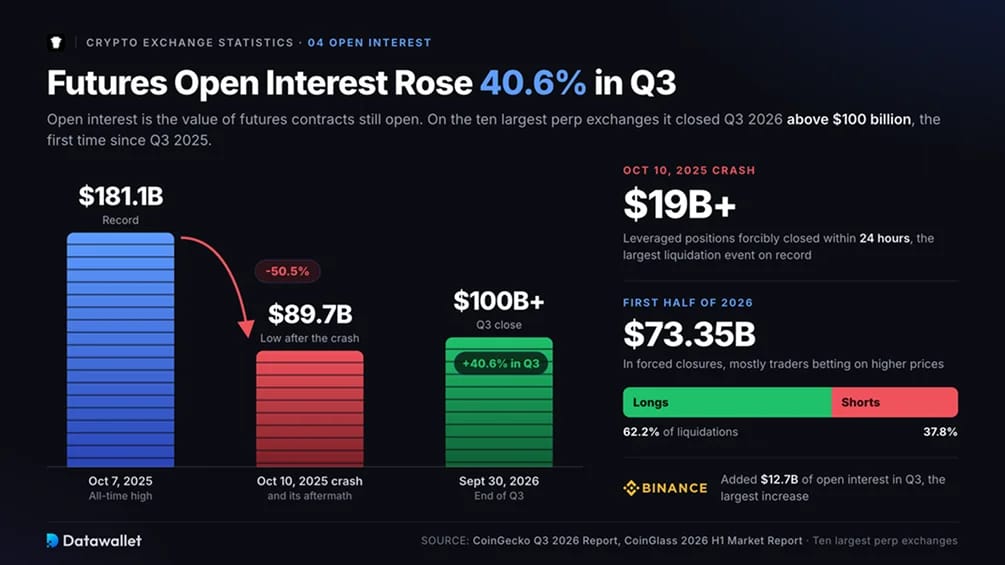
Open interest (OI) measures the total value of futures contracts still open. Across the ten largest perpetual futures exchanges, it increased 40.6% in Q3 2026 to close above $100 billion for the first time since Q3 2025, according to CoinGecko. Binance contributed the largest increase, adding $12.7 billion.
That recovery followed a sharp reset. After reaching a record $181.1 billion on October 7, 2025, open interest fell 50.5% to $89.7 billion following the October 10 crash. More than $19 billion in leveraged positions were forcibly closed within 24 hours, making it the largest liquidation event on record.
Liquidations have remained common in 2026. The first half of the year saw $73.35 billion in forced closures, with traders betting on higher prices accounting for 62.2%, according to CoinGlass's first-half market report. Our open interest dashboard shows current levels by exchange.
5. DEXs Reached a Record 24% of CEX Spot Volume
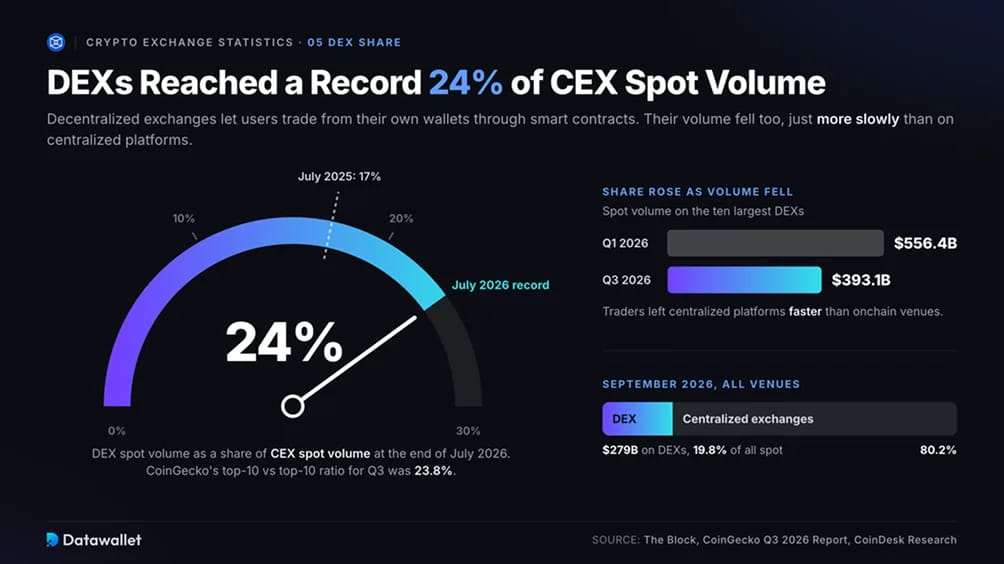
Decentralized exchanges use smart contracts to let users trade directly from their own wallets. At the end of July 2026, DEX spot volume reached a record 24% of centralized spot volume, compared with 17% a year earlier, according to The Block. CoinGecko's narrower comparison of the ten largest venues on each side put the Q3 ratio at 23.8%.
The gain in share came despite falling DEX volume. CoinGecko recorded $393.1 billion in Q3 spot trades on the ten largest DEXs, down from $556.4 billion in Q1 2026. Traders left centralized platforms faster than they left onchain venues.
Across all venues, DEX spot volume totaled $279 billion in September, or 19.8% of all spot trading, according to CoinDesk Research. The main protocols are compared in our ranking of the best decentralized exchanges.
6. Robinhood Chain Took 18% of DEX Volume in September
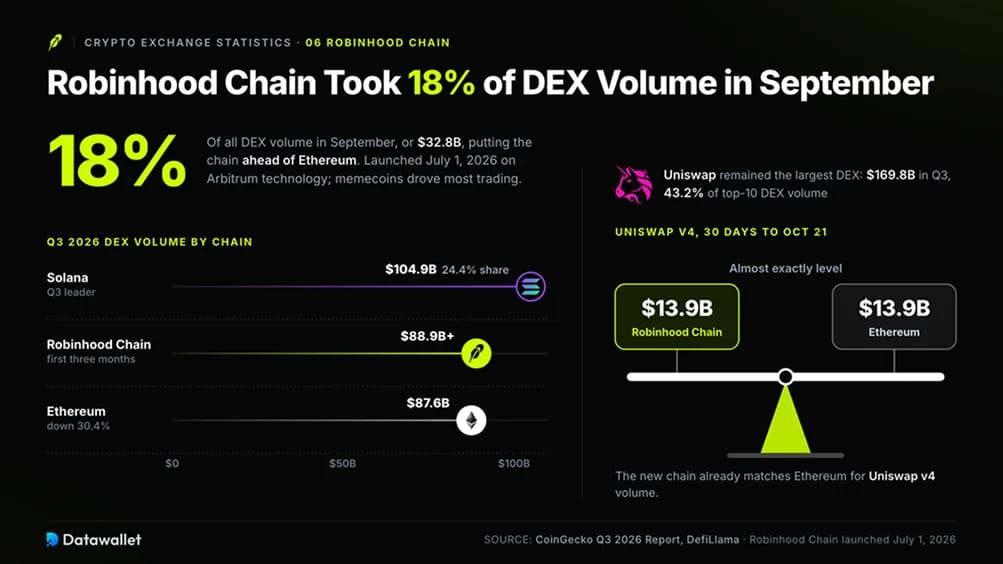
A brokerage drove this year's biggest change in onchain trading. Robinhood launched Robinhood Chain, a separate blockchain built on Arbitrum technology, on July 1, 2026. By September, the chain was processing $32.8 billion in monthly DEX volume. Its 18% share put it ahead of Ethereum for the month, according to CoinGecko.
Memecoins, tokens driven mainly by online hype, generated most of the activity. Within three months, total DEX volume on the chain passed $88.9 billion. Solana still led Q3 with $104.9 billion and a 24.4% share, while Ethereum's DEX volume declined 30.4% to $87.6 billion. Our Robinhood Chain statistics track the network's growth.
At the protocol level, Uniswap remained the largest DEX, processing $169.8 billion in Q3 trades and holding 43.2% of top-ten DEX volume. DefiLlama data for the 30 days to October 21 shows almost identical Uniswap v4 volume on Robinhood Chain and Ethereum, at about $13.9 billion each.
7. Onchain Venues Handled 13.7% of Futures Volume in September
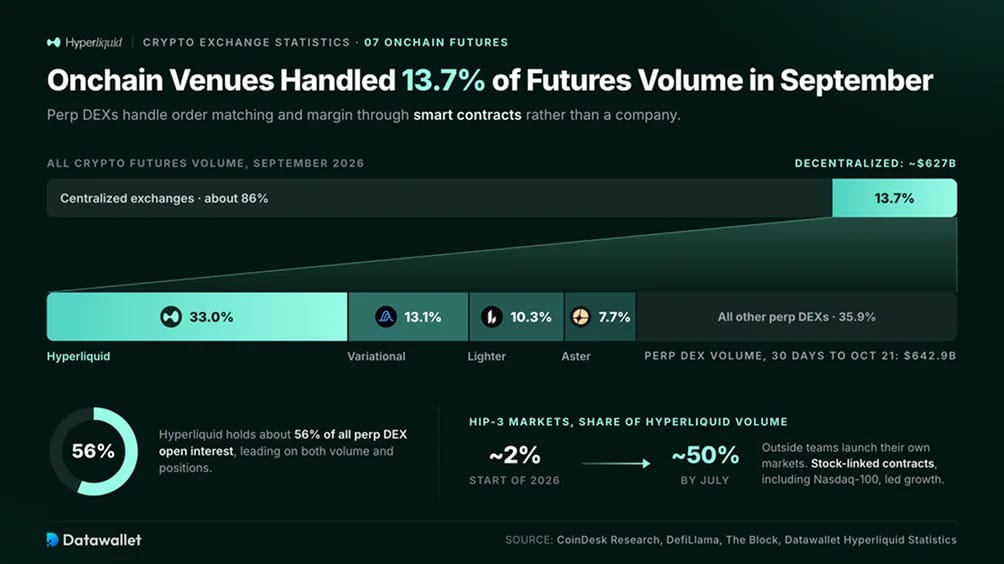
Blockchain-based platforms are taking a larger role in futures trading. CoinDesk Research recorded about $627 billion in decentralized futures volume in September 2026, roughly 13.7% of the total. Perp DEXs, or decentralized perpetual futures exchanges, handle order matching and margin through smart contracts rather than a company.
Hyperliquid leads these venues in both volume and open interest. Of the $642.9 billion in perp DEX volume recorded by DefiLlama over the 30 days to October 21, Hyperliquid accounted for 33.0%. Variational followed at 13.1%, ahead of Lighter at 10.3% and Aster at 7.7%. Our Hyperliquid statistics also show that the platform holds about 56% of all perp DEX open interest.
Markets launched through HIP-3, an upgrade allowing outside teams to create their own markets, grew from about 2% of Hyperliquid's volume at the start of 2026 to about 50% by July, The Block reported. Stock-linked contracts, including Nasdaq-100 and single-stock markets, led the increase. Our list of the best decentralized perpetuals exchanges compares the main venues.
8. RWA Perps Hit a Record $602 Billion in August
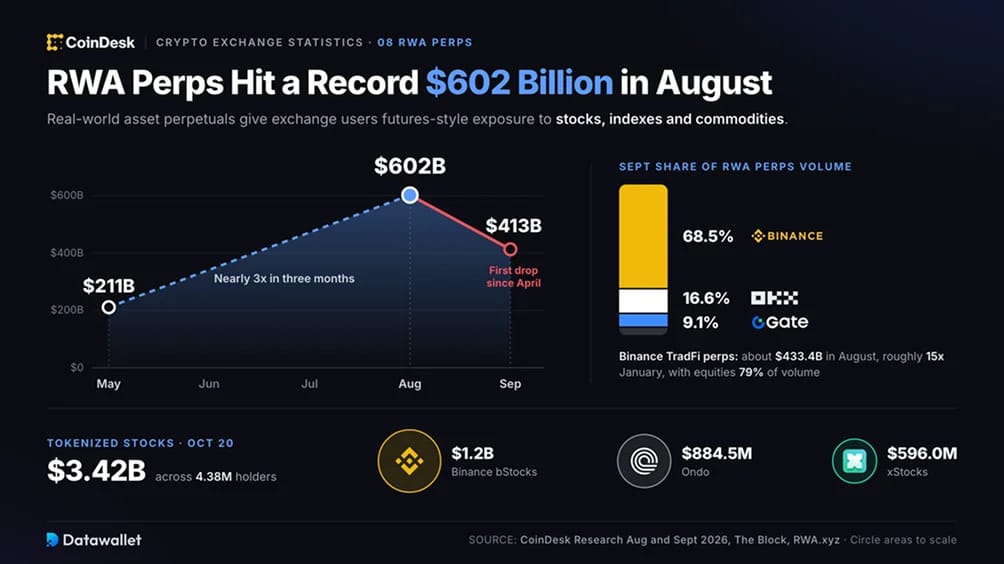
Futures-style contracts now give crypto exchange users access to stocks, indexes and commodities. Monthly volume in these real-world asset (RWA) perpetuals reached a record $602 billion in August 2026, according to CoinDesk Research's August review. That was nearly three times May's $211 billion. September brought the first monthly decline since April, with volume easing to $413 billion.
Binance held 68.5% of September RWA perps volume, followed by OKX at 16.6% and Gate at 9.1%. Its traditional finance perpetuals had processed about $433.4 billion in August, roughly 15 times January's level, according to The Block. Equities accounted for 79% of that volume.
The smaller tokenized stock market is also growing. These blockchain tokens represent or track real shares. As of October 20, RWA.xyz recorded $3.42 billion in tokenized stock value across 4.38 million holders. Binance's bStocks led at $1.2 billion, followed by Ondo at $884.5 million and xStocks at $596.0 million. Our guides to RWA perps and tokenized stock exchanges explain how the products work.
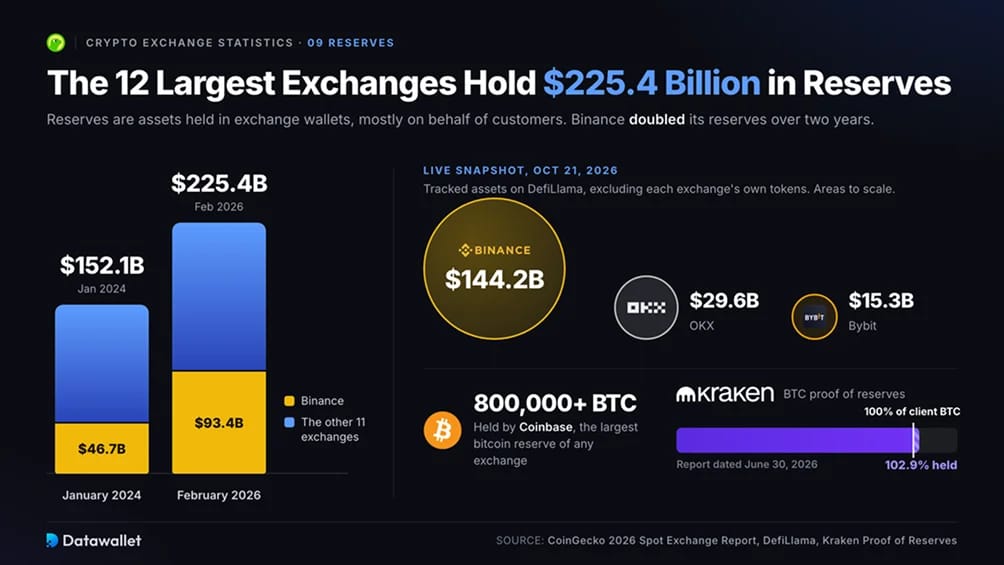
9. The 12 Largest Exchanges Hold $225.4 Billion in Reserves
Exchange reserves consist of assets held in exchange wallets, mostly on behalf of customers. Reserves at the 12 largest centralized exchanges increased from $152.1 billion in January 2024 to $225.4 billion in February 2026, according to CoinGecko's 2026 spot exchange report. Over that period, Binance doubled its reserves from $46.7 billion to $93.4 billion.
Coinbase held the largest bitcoin reserve of any exchange, at over 800,000 BTC, CoinGecko found. Live balances change quickly, however. On October 21, 2026, DefiLlama's exchange transparency dashboard showed $144.2 billion in tracked Binance assets, excluding its own tokens. OKX followed with $29.6 billion and Bybit with $15.3 billion.
Users can check whether an exchange holds at least as many assets as it owes customers through proof of reserves (PoR) reports. Kraken's latest report, dated June 30, 2026, puts bitcoin reserves at 102.9% of client balances. These reports provide a snapshot. They cannot show debts outside customer balances or changes after the reporting date.
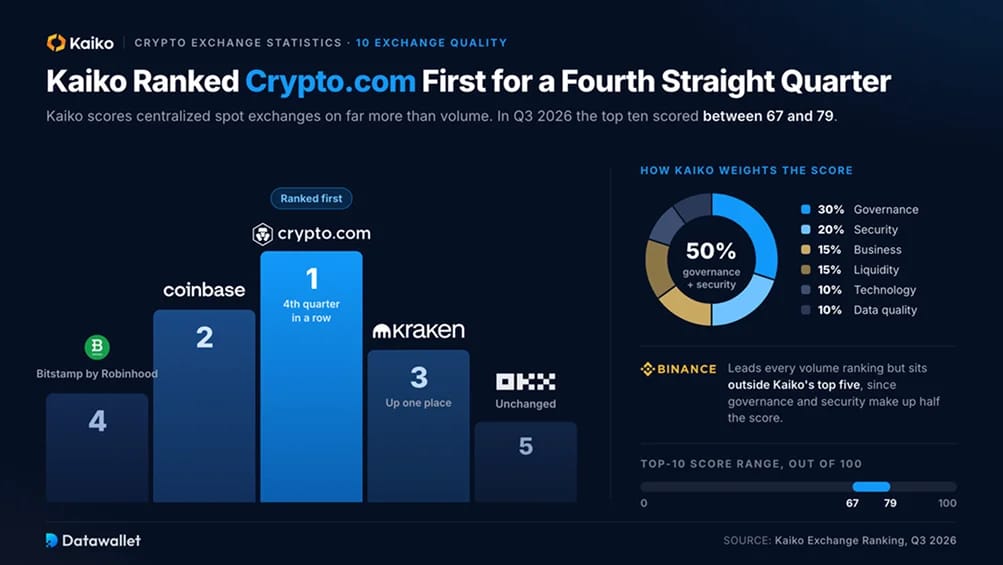
10. Kaiko Ranked Crypto.com First for a Fourth Straight Quarter
Exchange quality requires more than a volume comparison. Kaiko scores centralized spot exchanges across governance (30%), security (20%), business strength (15%), market liquidity (15%), technology (10%) and data quality (10%).
Crypto.com retained first place for the fourth consecutive quarter in the Q3 2026 Kaiko Exchange Ranking. Coinbase came second, while Kraken climbed one place to third. Bitstamp by Robinhood moved to fourth and OKX stayed fifth. The top ten scored between 67 and 79.
Although Binance leads every volume ranking, it sits outside Kaiko's top five because governance and security account for half of the score.
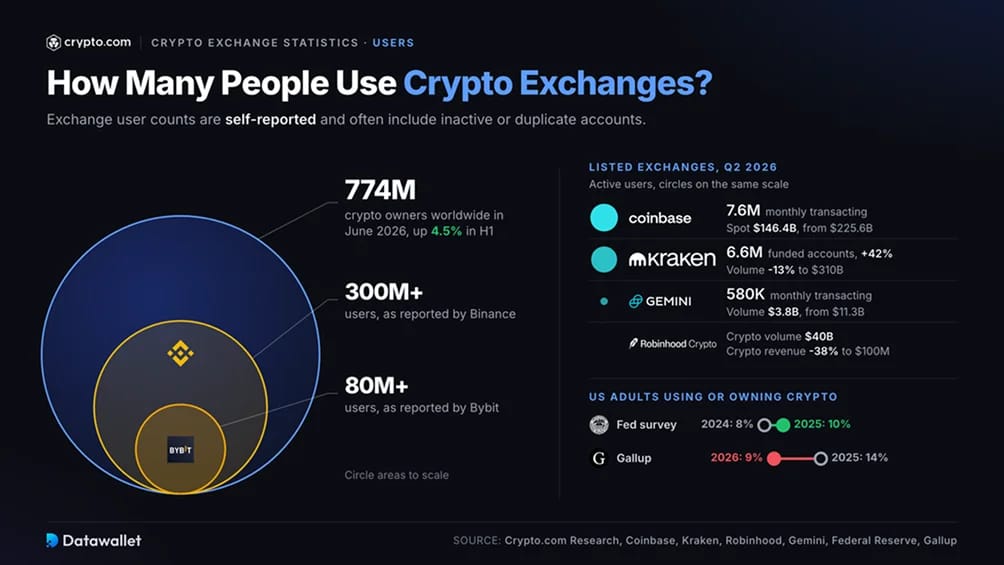
How Many People Use Crypto Exchanges?
About 774 million people owned crypto in June 2026, a 4.5% increase during the first half of the year, according to Crypto.com research. Binance reports over 300 million users, and Bybit reports over 80 million. Such exchange counts are self-reported and often include inactive or duplicate accounts, overstating the number of regular traders.
Listed companies' active user figures offer a clearer view. Their results show a sharp slowdown in retail trading during 2026.
Active users and volume at listed exchanges in Q2 2026:
- Coinbase: Its quarterly filing reported 7.6 million monthly transacting users. Total spot volume fell to $146.4 billion from $225.6 billion a year earlier.
- Kraken: Funded accounts increased 42% year over year to 6.6 million, although platform volume declined 13% to $310 billion, The Block reported.
- Robinhood: Crypto volume across its app and Bitstamp totaled $40 billion. Crypto revenue fell 38% to $100 million, according to its Q2 results.
- Gemini: The exchange had 580,000 monthly transacting users and $3.8 billion in trading volume, down from $11.3 billion a year earlier.
US surveys present a mixed picture. In the Federal Reserve's household survey, 10% of US adults reported using crypto in 2025, up from 8% in 2024. A June 2026 Gallup poll put ownership at 9%, down from 14% in 2025. Different survey periods and definitions account for the differing measures. Our crypto adoption statistics cover global ownership trends.
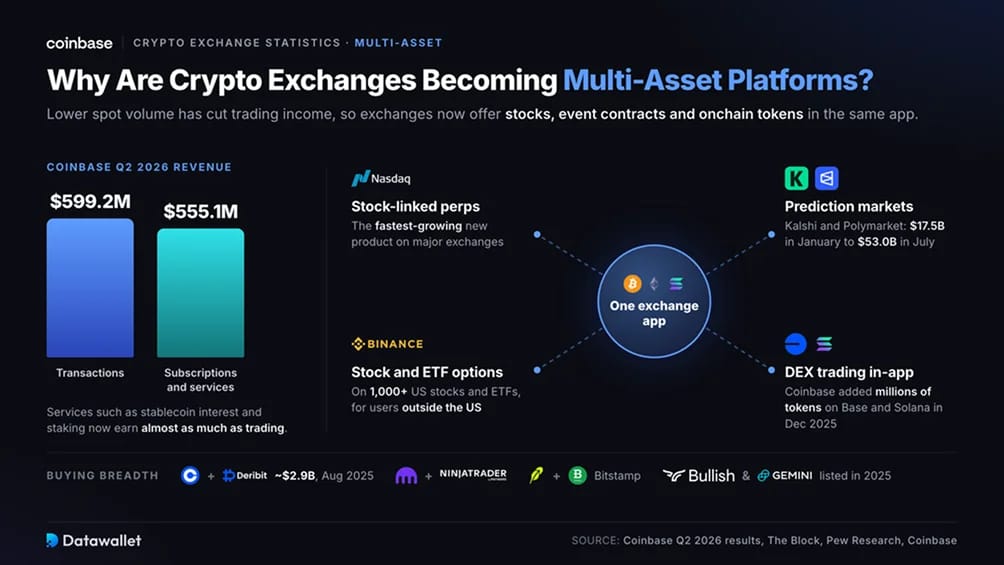
Why Are Crypto Exchanges Becoming Multi-Asset Platforms?
Lower spot volume has reduced trading income, prompting many crypto exchanges to offer stocks, event contracts and onchain tokens within the same app. Coinbase's Q2 2026 revenue illustrates the shift. It earned $599.2 million from transactions and $555.1 million from subscriptions and services, including stablecoin interest and staking. Services now generate almost as much revenue as trading.
Among the new products, stock-linked perpetuals have grown fastest. Binance has also introduced options on more than 1,000 US stocks and ETFs for users outside the United States.
Prediction markets let users trade contracts tied to the outcomes of real events. Their expansion is covered in our prediction market statistics. Combined trading volume at Kalshi and Polymarket reached $53.0 billion in July 2026, up from $17.5 billion in January, according to Pew Research.
Onchain trading is becoming part of centralized exchange apps too. Coinbase added DEX trading for millions of tokens on Base and Solana to its main app in December 2025. Swap tools operated by OKX and Binance search across DEXs for the best price, much like the DEX aggregators used by onchain traders.
Acquisitions reflect the same push to broaden services. In August 2025, Coinbase bought options exchange Deribit for about $2.9 billion. Kraken acquired futures broker NinjaTrader, while Robinhood now operates Bitstamp. Bullish and Gemini listed on US stock exchanges in 2025. Kraken paused its own listing plans in March 2026.
What Is a Crypto Exchange?
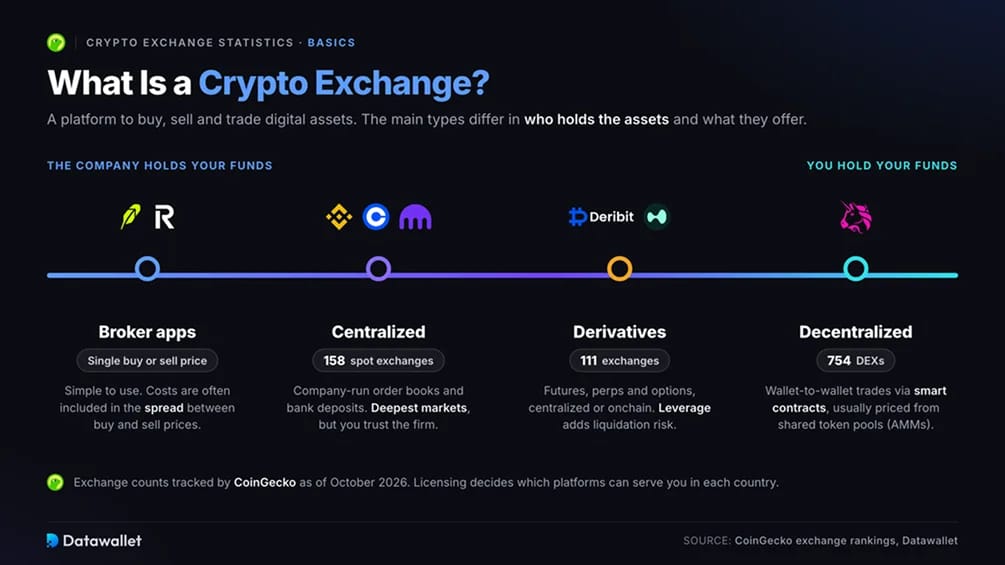
A crypto exchange lets users buy, sell and trade digital assets such as bitcoin, ether and stablecoins. As of October 2026, CoinGecko tracks 158 centralized spot exchanges, 111 derivatives exchanges and 754 decentralized exchanges. Who holds the assets and how prices are set vary by platform, as do the products available.
The main types of crypto exchanges are:
- Centralized exchanges: A company holds customer funds and matches buy and sell orders through its own order book. It also manages identity checks and bank deposits. These platforms offer the deepest markets for major assets, but users must trust the company with their funds.
- Decentralized exchanges: Trades settle directly between wallets through smart contracts, usually using automated market makers (AMMs) that price trades from shared token pools. Users retain control of their funds and take responsibility for wallet security, network fees and smart contract risk.
- Derivatives exchanges: Specializing in futures, perpetuals and options, these platforms can be centralized or onchain. Leverage and short selling increase potential gains as well as liquidation risk. Our ranking of the best crypto futures exchanges compares the main options.
- Broker apps: Robinhood, Revolut and similar apps display a single buy or sell price without showing the order book. They are simple to use, though costs are often included in the spread, the gap between buying and selling prices.
Licensing determines which platforms can serve customers in each country. Use our Exchange Finder to find those available where you live.
How Are Crypto Exchanges Regulated?
Which exchanges you can use depends on where you live and where each platform holds a license.
The changes that matter most for exchange users:
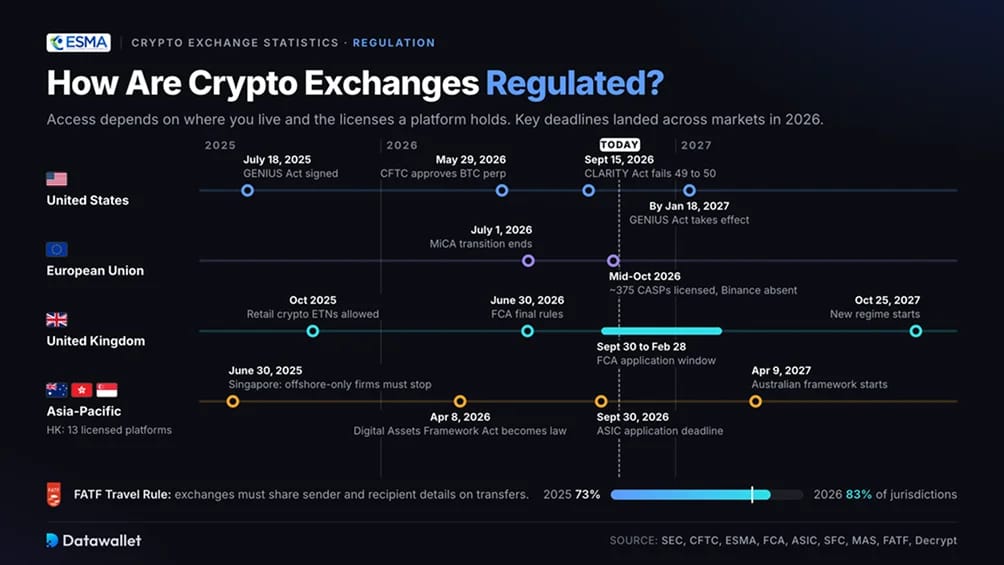
- United States: In March 2026, US securities and commodities regulators jointly stated that most crypto assets are not securities. The Commodity Futures Trading Commission approved the first US-listed bitcoin perpetual contract on May 29, 2026, and several regulated perpetual exchanges in the USA now offer them. The broader CLARITY Act failed a Senate vote 49 to 50 on September 15, 2026.
- European Union: Since July 1, 2026, exchanges need a license under the Markets in Crypto-Assets Regulation (MiCA) to take on new EU customers. ESMA's interim register listed about 375 authorized firms by mid-October, including Coinbase, OKX, Crypto.com, Bybit and Kraken. Binance is not on it after it withdrew its Greek application in June. Our list of MiCA-licensed exchanges compares the authorized options.
- United Kingdom: The FCA's new crypto regime opened for applications on September 30, 2026 and takes effect on October 25, 2027.
- Asia-Pacific: Australia's digital asset licensing framework commences on April 9, 2027, and ASIC had recorded more than 45 applications by early September 2026. Hong Kong's regulator lists 13 licensed trading platforms.
What Are the Risks of Crypto Exchanges?
Exchange users must trust the platform with their funds. Leverage can cause rapid losses, while regulatory changes can restrict the services available to them.
The main risks to watch are:
- Hacks and theft: More than $3.4 billion was stolen from crypto platforms and users between January and early December 2025, including about $1.5 billion from Bybit in February, according to Chainalysis. In the first half of 2026, TRM Labs recorded $972 million in thefts across a record 207 incidents.
- Exchange breaches: On September 24, 2026, Bitget lost $387.5 million from its hot and warm wallets, internet-connected wallets used for withdrawals. Chainalysis attributed the theft to North Korean actors, putting their 2026 total above $1 billion. Bitget said its user protection fund covers the loss.
- Leverage and liquidations: Rapid price movements can trigger automatic closures of leveraged positions. Some exchanges also use auto-deleveraging during extreme events, reducing profitable positions to cover losses the platform cannot absorb.
- Custody and insolvency: The safety of funds held on an exchange depends on the company's controls and finances. Reserve reports do not disclose every liability.
- Loss of access: Platforms may block your country or withdraw products. Accounts can also be frozen during compliance reviews. Binance's withdrawn MiCA application illustrates how quickly EU access can become uncertain.
- Smart contract risk: Contract exploits, fake tokens and malicious approvals threaten DEX users. KelpDAO and Drift, both DeFi protocols, suffered the two largest hacks of the first half of 2026. Regularly revoking token permissions reduces exposure to compromised contracts.
- Unreliable volume data: Different exchange samples and filters can produce widely differing figures across data providers. Smaller exchanges may also inflate reported activity through wash trading, in which the same party trades with itself.
Final Thoughts
Crypto exchange data for 2026 points to a market trading less but holding more. Spot volume declined through the middle of the year. By the end of Q3, exchange reserves and futures open interest had recovered, along with onchain activity.
Newer products drove the strongest growth, including onchain perpetuals and stock-linked contracts. A blockchain built by a brokerage also gained ground. Centralized exchanges continue to handle most trading and nearly all bank deposits, and many are adding these products to retain users within their apps.
Give licensing in your country, published reserves and security history as much weight as fees and coin selection when choosing an exchange. Volume rankings identify where traders are active. Quality rankings and regulatory registers help establish which platforms meet stricter standards.
Our Methodology
This page draws on quarterly and monthly exchange reports, onchain dashboards, company filings and regulator publications available on October 21, 2026. Where providers reported different figures, we identified the source and the exchange group it measures.
How the data was compiled:
- Exchange volume: CoinGecko quarterly and annual reports supply top-ten exchange volume and market share. CoinDesk Research monthly exchange reviews provide whole-market spot and derivatives figures.
- Derivatives: Open interest, liquidations and RWA perpetuals volume come from CoinGlass's half-year report and CoinDesk Research.
- Onchain trading: Sources include DefiLlama dashboards, CoinGecko chain and protocol data, and The Block's DEX-to-CEX ratio.
- Reserves and quality: We used CoinGecko reserve figures and DefiLlama exchange transparency data, alongside exchange proof of reserves pages and the Kaiko Exchange Ranking.
- Company data: Figures come from SEC filings and investor releases from Coinbase, Robinhood and Gemini, plus company data reported by The Block.
- Regulation and security: We consulted publications from ESMA, the SEC, the CFTC, the FCA, ASIC, the SFC, MAS and FATF, as well as research from Chainalysis and TRM Labs.
- Snapshot caveat: Live dashboard figures, including DefiLlama data and CoinGecko exchange counts, are dated October 20 to 21, 2026 and change daily.
.webp)