



Top 10 Aave Statistics and Trends
As of November 2026, Aave still leads all onchain lenders, although most of its core metrics are below last year’s levels.
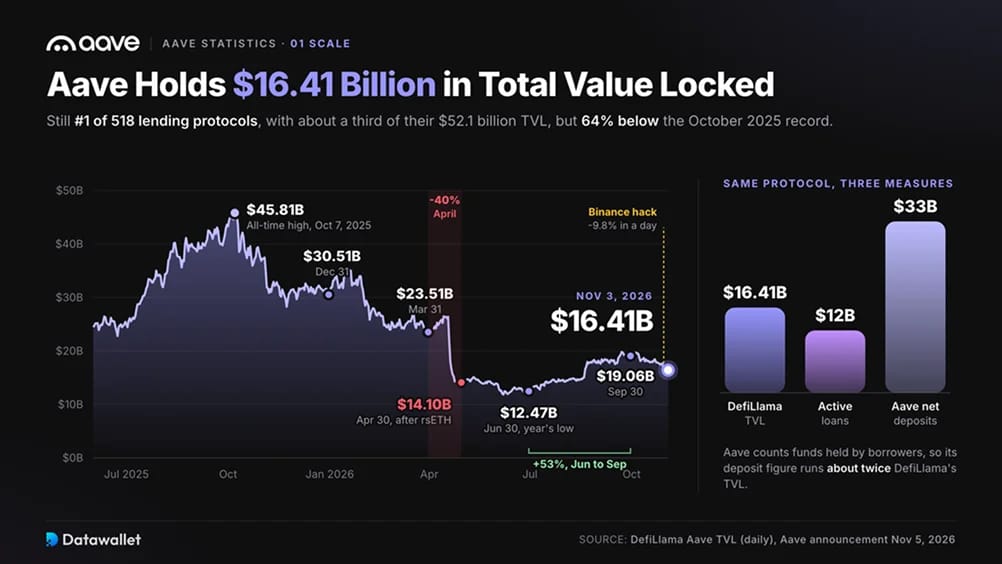
1. Aave Holds $16.41 Billion in Total Value Locked
DefiLlama’s Aave dashboard recorded $16.41 billion in TVL on November 3. It counts only the assets still available in Aave’s lending pools. If a user borrows funds and deposits them again, that dollar counts once.
Aave includes funds held by borrowers in its deposit total, which puts its figure at about twice DefiLlama’s TVL. In its November 5 announcement, Aave reported $33 billion in net deposits and $12 billion in active loans. Our TVL tracker explains how definitions vary by provider.
Aave TVL at key dates (DefiLlama):
- October 7, 2025: $45.81 billion, the all-time high
- December 31, 2025: $30.51 billion
- March 31, 2026: $23.51 billion
- April 30, 2026: $14.10 billion, after the rsETH exploit
- June 30, 2026: $12.47 billion, the year’s low
- September 30, 2026: $19.06 billion
- November 3, 2026: $16.41 billion
Returning deposits lifted TVL about 53% from June to September. During the Binance hack, it fell 9.8% between DefiLlama’s October 29 and October 30 readings. Aave still ranked first among the 518 lending protocols DefiLlama tracked in late October, accounting for about a third of their combined $52.1 billion in TVL.
2. Active Loans Sit Near $12 Billion, About 47% of the Market
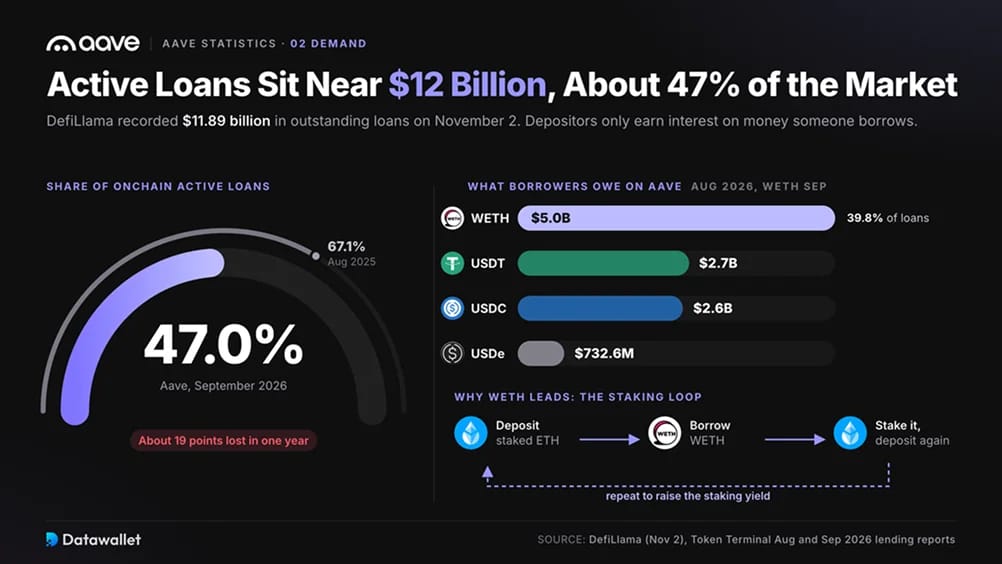
Depositors earn interest only on funds someone borrows, making active loans the clearest measure of demand for a lending protocol. On November 2, DefiLlama recorded $11.89 billion in outstanding loans on Aave.
Aave’s lead has narrowed over the past year. The Token Terminal September report put Aave’s share of active loans at 47.0% across the lending projects it tracks. Its August report put the share at 47.8%, down 19.3 percentage points from August 2025.
WETH, the tokenised form of ETH used by lending apps, accounted for $5.0 billion, or 39.8% of active loans, in September. That made it Aave’s most borrowed asset. Much of the demand comes from users who deposit staked ETH tokens, borrow WETH and repeat the process to increase their staking yield. Our guide to leveraged staking explains how this strategy, known as looping, works and where it can fail.
Most of the remaining debt is in stablecoins. Token Terminal recorded $2.7 billion in USDT loans and $2.6 billion in USDC loans in August. Borrowers also owed $732.6 million in USDe, Ethena’s synthetic dollar.
3. Ethereum Holds About 79% of Aave Deposits
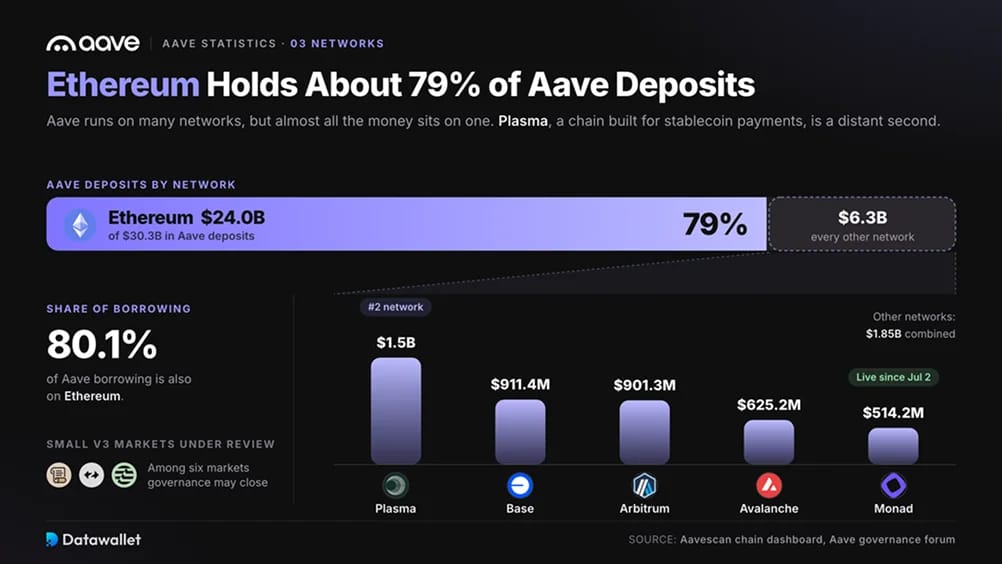
Of the $30.3 billion in Aave deposits tracked by Aavescan’s chain dashboard, $24.0 billion sits on Ethereum. That gives Ethereum about 79% of deposits and, by the same source, 80.1% of borrowing.
Largest Aave networks by deposits (Aavescan):
- Ethereum: $24.0 billion
- Plasma: $1.5 billion
- Base: $911.4 million
- Arbitrum: $901.3 million
- Avalanche: $625.2 million
- Monad: $514.2 million
Second-ranked Plasma was designed for stablecoin payments. Monad reached sixth place despite its Aave V3 market opening only on July 2, 2026.
Governance has reviewed plans to close six V3 markets with little activity, including Scroll, zkSync and Aptos. Every deployment requires ongoing risk monitoring and code updates. For the Aave DAO, the governing body of token holders, maintaining a small market can cost more than the market earns.
4. Aave V4 Deposits Passed $1.5 Billion
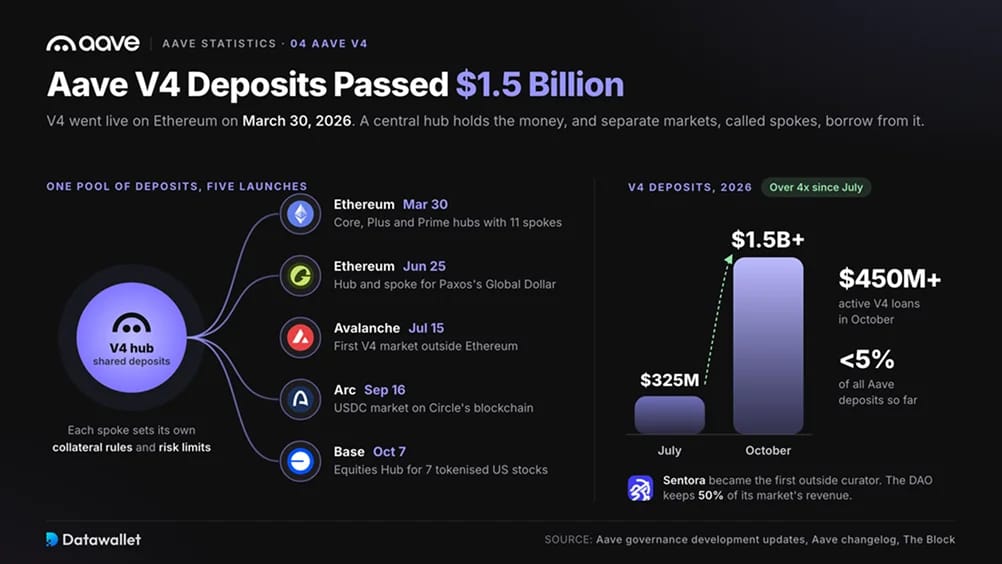
After more than two years in development, Aave V4 went live on Ethereum on March 30, 2026. Its hub-and-spoke design lets separate borrowing markets draw on a shared pool of deposits. The hub holds the funds. Each market, or spoke, sets its own collateral rules and risk parameters to help contain a problem if one arises.
Deposits exceeded $325 million in July and passed $1.5 billion in October, when active V4 loans also topped $450 million. V4 deposits are now more than four times their July level, though they still account for less than 5% of Aave’s total. The Aave changelog records five V4 launches.
Aave V4 markets so far:
- Ethereum, March 30: Core, Plus and Prime hubs with eleven spokes
- Ethereum, June 25: a hub and spoke for Paxos’s Global Dollar (USDG)
- Avalanche, July 15: the first V4 market outside Ethereum
- Arc, September 16: a USDC market on Circle’s blockchain
- Base, October 7: an Equities Hub for tokenised shares of seven large US companies
Sentora became V4’s first external market curator in October. It sets collateral rules, rates and risk parameters for its market. The DAO retains ownership of the contract and receives 50% of the market’s revenue.
On Base, the tokenised stocks market attracted more than $9 million in deposits and nearly $4 million in loans. Governance later added tokenised SpaceX shares as collateral.
5. GHO Averaged $679 Million in September
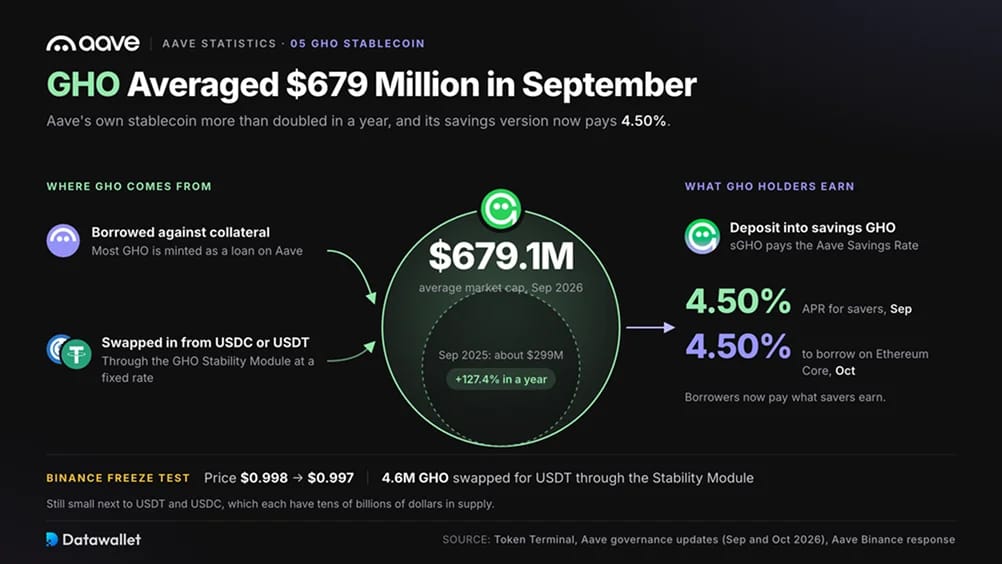
GHO, Aave’s stablecoin, averaged $679.1 million in market cap in September, up 127.4% from September 2025, according to Token Terminal. Users create most GHO by borrowing it against collateral on Aave. The rest comes from users exchanging USDC or USDT for GHO through the GHO Stability Module.
Holders who deposit GHO into savings GHO (sGHO) earn the Aave Savings Rate. Governance sets the rate, which rose to 4.50% annual percentage rate (APR) in September. The cost of borrowing GHO on Ethereum Core rose to 4.50% in October, matching the yield savers receive. Our stablecoin interest rates comparison tracks other dollar yields.
During the Binance freeze, GHO’s price edged down from $0.998 to $0.997. Holders exchanged about 4.6 million GHO for USDT through the GHO Stability Module, a contract that swaps GHO and other stablecoins at a fixed rate.
GHO remains small compared with USDT and USDC. Each has a supply worth tens of billions of dollars, as our stablecoin statistics show.
6. Horizon Holds About $376 Million in Real-World Assets
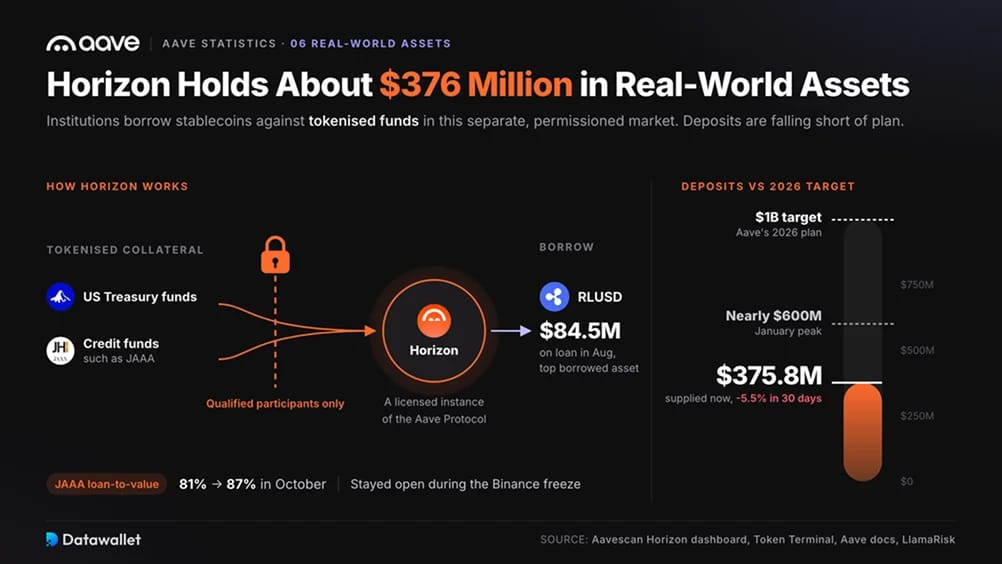
Institutions use Horizon to borrow stablecoins against tokenised real-world assets (RWAs), including US Treasury funds and credit funds. Aave’s documentation describes this separate market as a licensed instance of the protocol. Only qualified participants can post collateral.
Aavescan puts Horizon deposits at $375.8 million, down 5.5% over 30 days. Deposits had approached $600 million in January, against a target of $1 billion in Aave’s 2026 plan. The decline suggests RWA lending still relies on a few large institutional users.
Ripple’s RLUSD is Horizon’s most borrowed asset, with $84.5 million in outstanding loans in August, according to Token Terminal. In October, LlamaRisk raised the loan-to-value (LTV) ratio on the JAAA credit fund from 81% to 87%, allowing users to borrow a larger share of their collateral’s value.
Horizon stayed open during the Binance freeze because the attacker could not use its permissioned collateral. Our tokenisation statistics cover the wider market for tokenised funds and bonds.
7. Monthly Fees Fell to About $36 Million
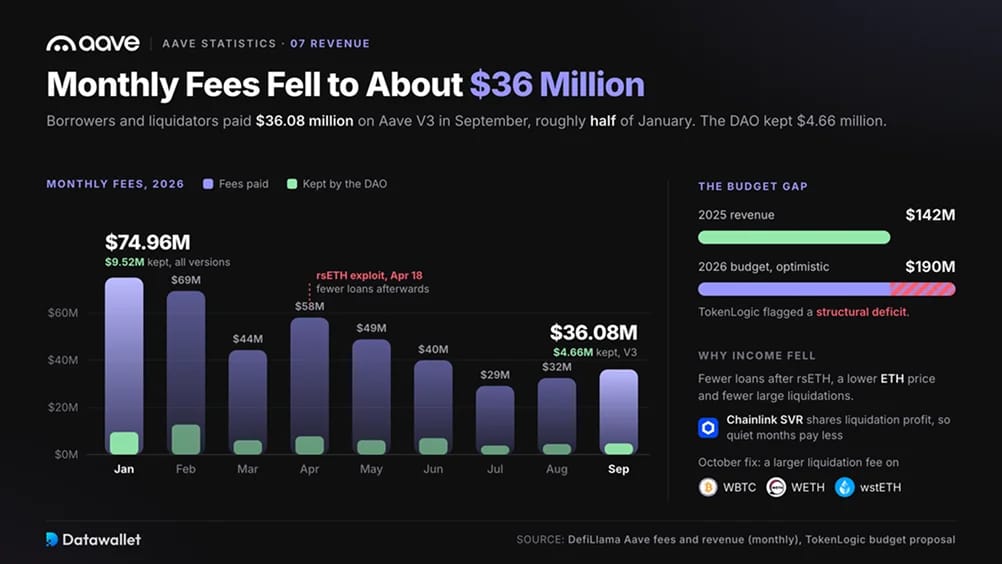
Borrowers and liquidators paid $36.08 million in interest and other fees on Aave V3 in September, according to DefiLlama. The DAO treasury retained $4.66 million as revenue. Most of its share comes from the reserve factor, the fixed portion of borrower interest that goes to the treasury.
Monthly fees have roughly halved since January, when Aave earned $74.96 million across all versions and kept $9.52 million. A TokenLogic budget proposal put 2025 revenue at $142 million. Its optimistic estimate for the 2026 operating budget was $190 million, leaving a structural deficit.
Fewer outstanding loans after the rsETH exploit and a lower ETH price cut fee income. Large liquidations also became less frequent. Through Chainlink’s Smart Value Recapture (SVR) system, Aave receives part of the profit on each liquidation. That income tends to rise in volatile months and fall when markets are quiet.
Governance raised the liquidation protocol fee on Ethereum Core for WBTC, WETH and wstETH in October. The treasury now receives more of the bonus on each liquidation of those assets.
8. AAVE Buybacks Have Been Paused Since April 19
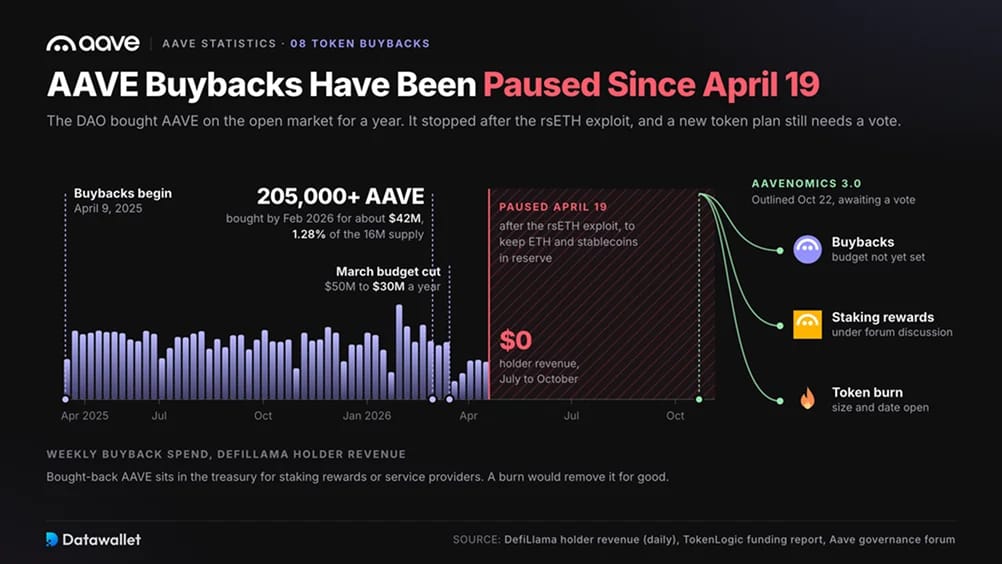
The DAO began buying AAVE on the open market on April 9, 2025. By February 2026, it had spent about $42 million on more than 205,000 AAVE, equivalent to 1.28% of the 16 million token supply, according to TokenLogic’s funding report. Falling fee income led governance to cut the annual buyback budget in March from about $50 million to $30 million.
Following the rsETH exploit, TokenLogic paused all buybacks from April 19. Keeping stablecoins and ETH in the treasury gave the DAO reserves while the size of the loss was unclear. DefiLlama recorded zero holder revenue for Aave V3 from July through October.
Stani Kulechov outlined Aavenomics 3.0 on Aave’s October 22 quarterly livestream. The plan pairs buybacks with staking rewards and a token burn. Forum members have opened a staking discussion. The buyback budget, the number of tokens to burn and the start date still await a formal vote.
Repurchased AAVE stays in the treasury, where governance can use it to pay staking rewards or service providers. Burning those tokens would permanently remove them from supply.
9. The rsETH Exploit Left Up to $230 Million in Potential Bad Debt
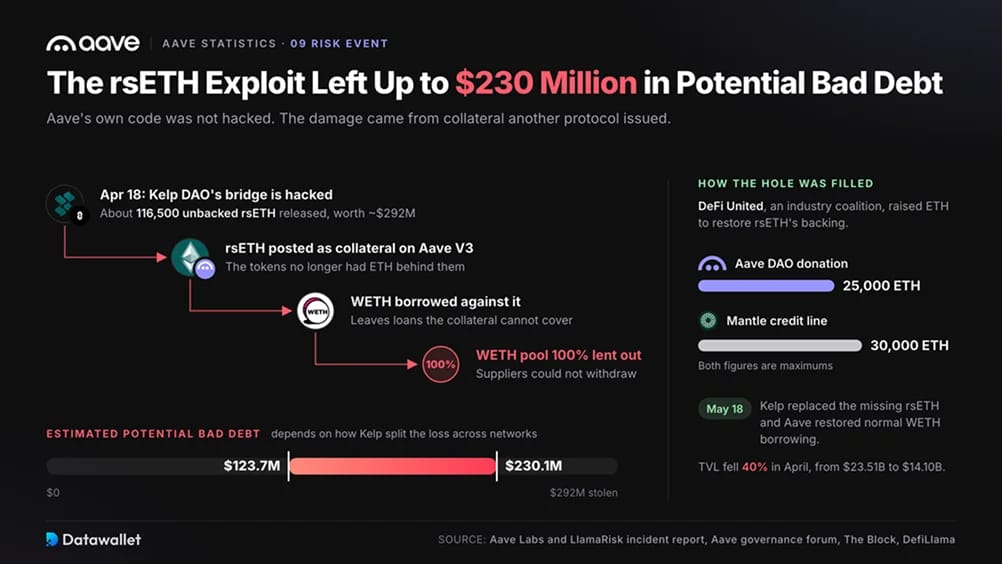
An attacker exploited Kelp DAO’s LayerZero-based cross-chain bridge on April 18, releasing about 116,500 unbacked rsETH. Each rsETH is a liquid restaking token that serves as a receipt for ETH staked and restaked through Kelp. The Block valued the stolen tokens at about $292 million.
The attacker then deposited the unbacked rsETH on Aave V3 as collateral and borrowed WETH against it. That left Aave facing bad debt, the portion of a loan its collateral can no longer cover. In their incident report, Aave Labs and LlamaRisk estimated potential bad debt at $123.7 million to $230.1 million. The amount depended on how Kelp allocated the loss between Ethereum and other networks.
Depositors rushed to withdraw. WETH utilisation reached 100%, leaving suppliers unable to withdraw WETH until borrowers repaid their loans. DefiLlama recorded a 40% drop in month-end TVL, from $23.51 billion in March to $14.10 billion in April.
DeFi United, an industry coalition, collected ETH from protocols and individuals to restore rsETH’s backing. The Aave DAO voted to donate up to 25,000 ETH, and Mantle approved a credit line of up to 30,000 ETH for Aave. Kelp replaced the missing rsETH. On May 18, Aave restored normal WETH borrowing limits.
10. Aave Froze 292 Reserves During the Binance Hack
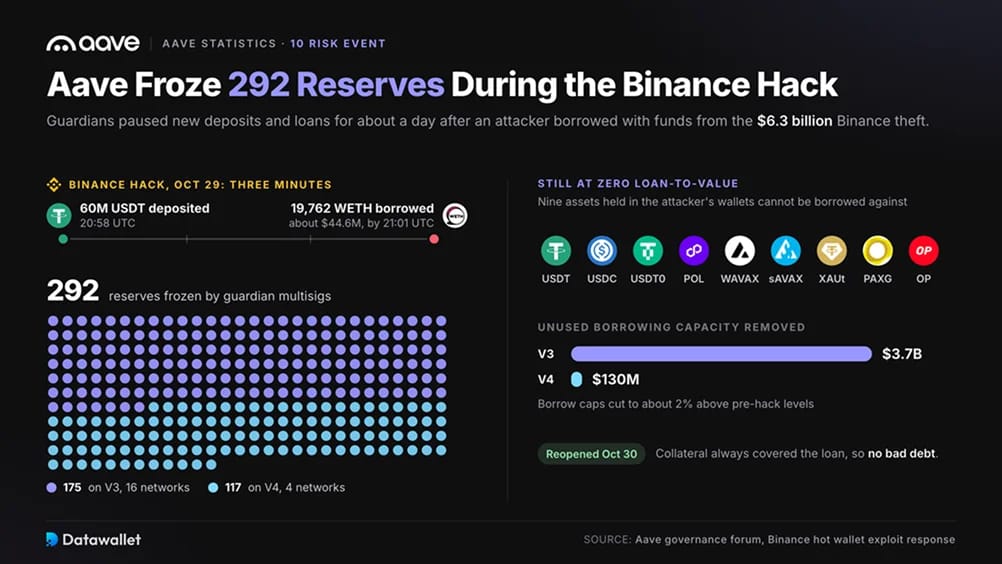
On October 29, attackers stole about $6.3 billion from Binance hot wallets, the largest crypto theft on record. Our ranking of the biggest crypto hacks compares it with earlier thefts. Between 20:58 and 21:01 UTC, a wallet linked to the attacker deposited 60 million USDT on Aave V3 and borrowed 19,762 WETH, worth about $44.6 million.
Aave’s guardian multisigs, small groups of key holders with limited emergency powers, froze 175 V3 reserves across 16 networks and 117 V4 reserves across four. The freeze blocked new deposits and loans but allowed existing users to repay or withdraw. According to Aave’s governance response, the attacker’s collateral exceeded the value of the loan throughout, leaving no bad debt.
Markets reopened on October 30. Nine assets held in the attacker’s wallets still have a zero LTV, so users cannot borrow against them. The restriction applies to USDT, USDC, USDT0, POL, WAVAX, sAVAX, XAUt, PAXG and OP.
Risk stewards also lowered borrow caps on the largest markets to about 2% above their pre-hack levels. The cuts removed about $3.7 billion in unused borrowing capacity on V3 and $130 million on V4. Our Binance statistics cover the incident from the exchange’s side.
AAVE Token Statistics
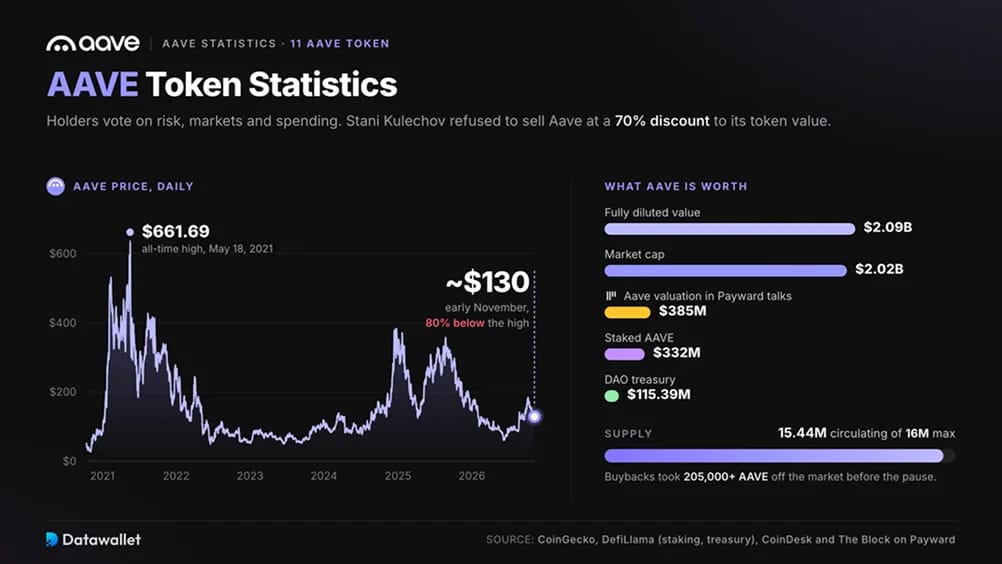
AAVE holders use the Aave DAO’s governance token to vote on risk settings, new markets and treasury spending.
Key AAVE token figures:
- Price: about $130 on CoinGecko in early November, roughly 80% below the May 18, 2021 high of $661.69
- Market value: $2.02 billion in market cap and $2.09 billion in fully diluted valuation
- Supply: 15.44 million AAVE circulating out of a fixed maximum of 16 million
- Staking: about $332 million in staked AAVE, close to 16% of market cap, according to DefiLlama
- Treasury: $115.39 million on DefiLlama, held mostly in AAVE
- Buybacks: more than 205,000 AAVE repurchased from April 2025 until purchases stopped in April 2026
- New institutional holder: a Payward fund and its clients bought an undisclosed amount of AAVE on the open market in November
Payward’s purchase followed a disagreement over valuation. In June, CoinDesk reported that Payward, Kraken’s parent company, was discussing a 15% stake in Aave at a $385 million valuation. Kulechov rejected that framing, saying Aave would not sell at a 70% discount to the token’s value.
The Umbrella system now covers bad debt with staked GHO and staked aTokens. Users receive aTokens when they supply assets to Aave. Under Umbrella, staked AAVE bears less bad-debt risk and continues to earn DAO rewards.
Is Aave Safe?
Aave’s smart contracts have a strong security record, though users suffered losses in 2026. At the V4 launch, The Block reported that no Aave deployment dating back to V1 had ever been hacked. The year’s incidents originated outside the protocol code. One involved an oracle, the service that supplies market prices to Aave. The others involved collateral issued by another protocol and funds stolen from an exchange.
Main incidents in the past 12 months:
- March 10, oracle error: a configuration error in Aave’s CAPO price oracle put wstETH about 2.85% below its market price. As a result, 34 accounts lost about $26 million in wstETH to liquidations that should not have happened. The DAO moved to reimburse the affected users.
- April 18, rsETH exploit: unbacked Kelp DAO collateral left Aave facing up to $230.1 million in potential bad debt. The DeFi United coalition later covered the shortfall.
- October 29, Binance hack: after an attacker borrowed $44.6 million in WETH, Aave froze 292 reserves for about a day. Aave suffered no losses.
An incorrect oracle price can make a healthy loan appear unsafe and trigger automated liquidations. In March, a small configuration error cost users money within minutes even though the protocol incurred no bad debt.
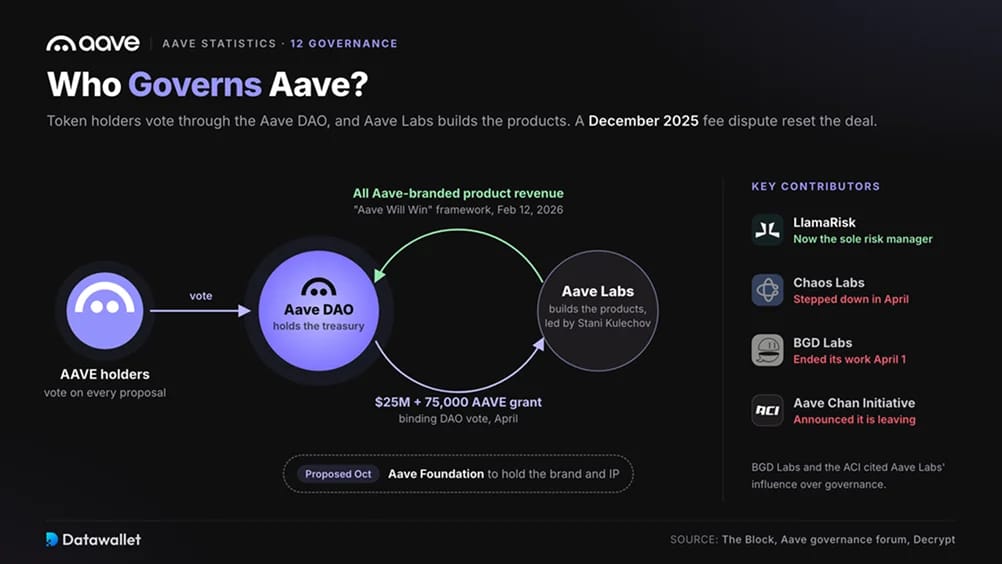
Fewer firms now manage Aave’s risk. Chaos Labs stepped down in April after three years as its main risk manager, leaving LlamaRisk as the sole risk manager. Long-time technical contributor BGD Labs also ended its work for the DAO. Aave Labs has proposed a security-focused V3.8 upgrade, with audits by Certora and other firms planned before any vote.
We recommend checking your health factor regularly and keeping borrowing below the maximum LTV by a comfortable margin. The health factor tells you how close your loan is to liquidation. Our ranking of crypto lending platforms compares Aave’s risk controls with those of other lenders.
Who Governs Aave?
AAVE holders vote on protocol proposals through the Aave DAO, a decentralised autonomous organisation. Kulechov’s company, Aave Labs, builds most of Aave’s products and its main website. In December 2025, a dispute arose when Aave Labs directed swap fees from the website to a company address.
Aave Labs proposed the Aave Will Win framework on February 12, 2026, settling the main dispute. Under the agreement, all revenue from Aave-branded products goes to the DAO treasury. In return, the DAO approved a $25 million grant and 75,000 AAVE for Aave Labs in a binding April vote.
One of the largest voting delegates, the Aave Chan Initiative, announced it would leave the DAO. BGD Labs ended its work on April 1. Both cited concerns about Aave Labs’ influence over governance decisions.
In October, Aave Labs proposed incorporating an Aave Foundation and appointing an independent director as the first phase of its establishment. The foundation is expected to hold the Aave brand and intellectual property on the DAO’s behalf.
How Is Aave Regulated?
The Aave Protocol runs as open software on public blockchains. Regulation applies mainly to the companies operating its websites, apps and fiat services.
- United States: on December 16, 2025, the Securities and Exchange Commission (SEC) closed its four-year investigation into the Aave Protocol without taking enforcement action.
- European Union: the Central Bank of Ireland authorised Push Virtual Assets Ireland Limited, an Aave Labs subsidiary, as a crypto-asset service provider under the Markets in Crypto-Assets Regulation (MiCA). The licence applies only to Push’s service for converting euros to stablecoins and back.
- Institutional markets: Horizon limits collateral deposits to qualified participants, allowing regulated funds and asset managers to use the market.
- Consumer products: access to the Aave App depends on local law. Its terms block users in sanctioned and restricted jurisdictions.
What's Next for Aave?
Aave is working on new forms of collateral and a closer link between protocol revenue and the AAVE token.
Developments to watch:
- Aavenomics 3.0 vote: a formal proposal should specify how much the DAO would spend on buybacks, how staking would work and how many tokens it would burn.
- Native bitcoin collateral: Babylon has proposed two V4 spokes for borrowing against BTC that stays on the Bitcoin network. Neither would require wrapped tokens or custodians.
- Fixed-rate loans: on November 6, Aave Labs acquired the team and technology behind Avon, a fixed-rate lending protocol, to build fixed-rate credit on V4.
- Custody-based institutional loans: a September proposal outlined a V4 hub where institutions could borrow stablecoins while a regulated custodian holds their collateral.
- Aave App rollout: early access to the savings app opened on iOS in August. Android and web users remain on a waitlist.
- More V4 networks: following launches on four networks this year, Aave Labs plans to assess a V4 deployment on Tempo.
Final Thoughts
Aave enters the final months of 2026 with $16.41 billion in TVL and about $12 billion in active loans, still ahead of every other onchain lender on both measures. Its share of active loans fell from about two-thirds to under half in a year. Fee income roughly halved between January and September.
The year’s incidents put Aave’s design under more pressure than its code. An oracle error, unbacked collateral and a hacked exchange each required guardians and outside partners to act within hours. V4’s spokes are designed to contain a failure within one market. The next major incident will test whether they can.
Borrowers should check which Aave version and network their market uses and stay well below its maximum LTV. For AAVE holders, the Aavenomics 3.0 vote will determine how protocol revenue reaches the token.
Our Methodology
We checked every figure between November 3 and November 7, 2026. Where providers reported different totals, we identified the source alongside the figure and explained what each provider counted.
Sources Behind the Data:
- DefiLlama: historical TVL, active loans, monthly fees and revenue, treasury holdings and staked AAVE
- Token Terminal: active loans and market share, borrowing by asset, GHO market cap and Horizon borrowing
- Aavescan: deposits and borrowing by network, plus total assets supplied on Horizon
- Aave governance forum and documentation: incident reports, buyback decisions, development updates and the V4 changelog
- CoinGecko: AAVE price, market cap and circulating supply
- News coverage: The Block, Decrypt and The Defiant for the dates and details of major events
- Snapshot caveat: crypto figures change daily. Providers also use different definitions for TVL, deposits and active loans.