




Compare the Best Crypto Lending Platforms
1. Nexo
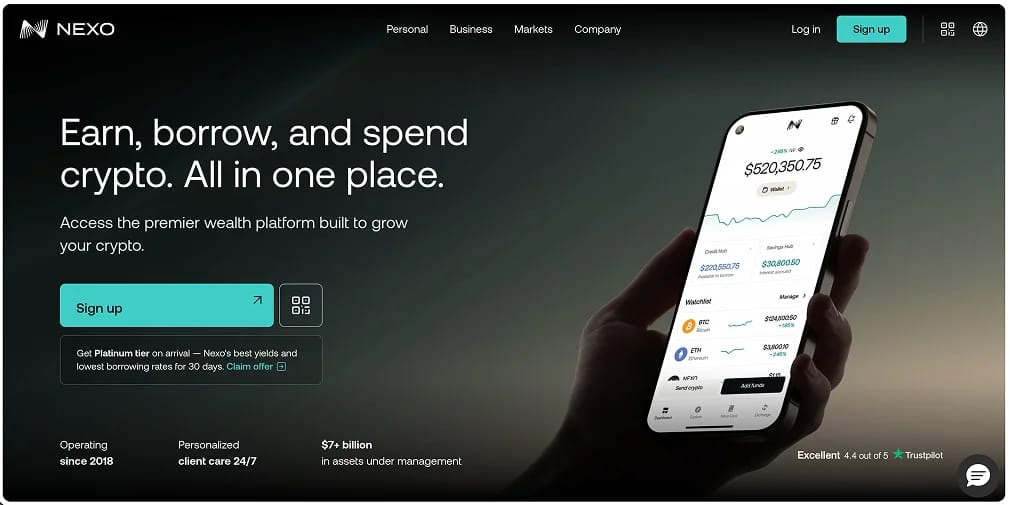
Nexo ranks first. It is the only lender listed here that has paid interest and processed withdrawals without interruption since 2018. Nexo survived the 2022 contagion and now operates through regulated structures in the US, EEA, and UK. The platform reports roughly $11 billion in client assets and more than $371 billion in processed transactions.
Its credit line was also the most flexible product we tested. There is no fixed term, repayment schedule, or credit check.
Rates depend on the proportion of NEXO tokens in your portfolio. Borrowing starts at 1.9% a year for Platinum clients who hold at least 10% of their portfolio in NEXO and maintain an LTV below 20%. Rates rise through the Gold and Silver tiers, reaching 18.9% for Base accounts with no NEXO holdings. BTC and ETH qualify for a 50% credit line, while stablecoins allow up to 90%. Automatic partial repayment begins at approximately 83.3% LTV.
We borrowed USDC against ETH during a 9% overnight decline. The app issued two LTV alerts before touching the collateral, and adding more collateral took less than a minute.
Nexo withdrew from the US in 2022 before paying a $45 million settlement to the SEC and state regulators over its former Earn product. It relaunched for American clients on 16 February, using trading infrastructure supplied by NYSE-listed Bakkt and yield products administered through an SEC-registered investment adviser.
EEA clients are served through MiCA-licensed custodian Tangany and brokerage DLT Finance. The credit line remains subject to Nexo's own terms because lending sits outside MiCA's current scope. A January consent order from California's DFPI concerning pre-exit lending licences leaves a blemish on its record, but no competitor covers as many markets through licensed entities.
Pros
- Open-ended credit line with no fixed term or repayment schedule, with rates from 1.9% a year for Platinum clients below 20% LTV.
- Payouts available in USD, EUR, GBP, or stablecoins to a bank account or Nexo balance. The Nexo Card can spend from the same credit line.
- Eight years of continuous operation without freezing withdrawals, including throughout the 2022 lender collapses.
- Available again in the US through Bakkt and serving the EEA through MiCA-licensed partners.
Cons
- Accessing the 1.9% headline rate requires holding 10% of your portfolio in NEXO tokens, adding a token position to the loan.
- Base-tier borrowing costs 18.9%, more than any other centralised option on this list.
- Repayment within the first 45 days attracts the highest rate regardless of loyalty tier, making very short loans expensive.
- Nexo's own MiCA authorisation remains under application, while US availability varies by state and product.
2. Aave
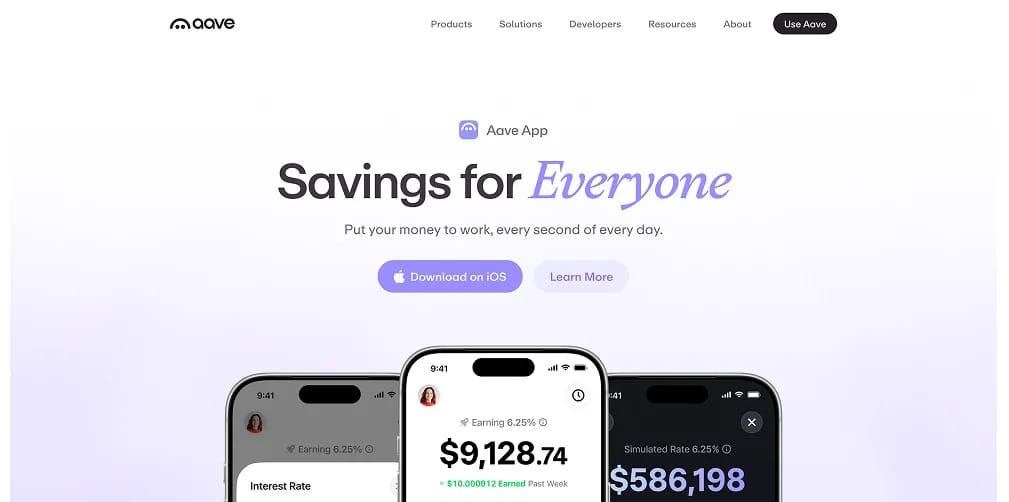
Aave is the only platform in this ranking where a company never takes custody of your collateral. Users deposit WBTC, ETH, or a liquid staking token, which is a tradeable receipt for staked ETH, into a smart contract. They can then borrow stablecoins and manage the position from any wallet without an identity check.
Total deposits across Aave's versions and supported chains reached $14.49 billion in mid-May, with approximately $11.1 billion borrowed. No competing protocol held more.
Aave V4 launched on Ethereum in late March using a hub-and-spoke model. Liquidity sits in a central hub, while specialised markets apply their own collateral rules. Avalanche followed in late July, then Arbitrum on 17 August. V3 continues to operate, and users are not forced to migrate.
When we checked, stablecoin borrowing across the protocol averaged about 3.9% a year. The rate changes with every block and climbed into double digits during last autumn's volatility.
Aave uses bots to liquidate positions as soon as the health factor, its measure of collateral relative to debt, falls below one. Penalties differ by asset, and borrowers receive no grace period.
We tested on Base and Arbitrum because Ethereum mainnet gas can make smaller loans uneconomic. DefiLlama records one security incident in March involving $862,000 after oracle manipulation. That loss was small relative to the protocol's size, but Aave replaces counterparty exposure with code risk. Our best DeFi projects guide examines the broader ecosystem.
Pros
- Non-custodial structure keeps collateral away from company balance sheets that could freeze withdrawals or fail.
- DeFi lending's deepest liquidity, with stablecoin borrowing near 4% during calm markets.
- V4 spokes and efficiency mode support higher LTVs when borrowers use correlated assets.
- No KYC, with direct access available from any jurisdiction through a wallet and internet connection.
Cons
- Variable borrowing rates can rise quickly when demand increases.
- Liquidation is immediate and automated, without a margin call window.
- Ethereum mainnet gas can make loans below a few thousand dollars inefficient.
- Regulators in Singapore, the EU, and the UK distinguish between direct DeFi use and access through a company interface, so licensed front ends may impose restrictions.
3. Coinbase
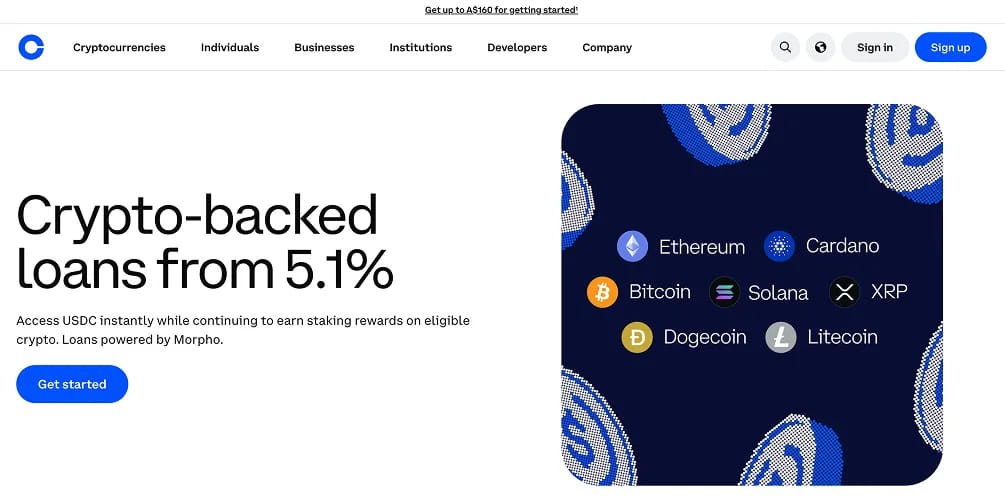
Coinbase provides the simplest onchain borrowing experience in the US by placing its familiar interface over the Morpho protocol on Base. After a user taps Borrow and pledges BTC, Coinbase converts the asset one-to-one into cbBTC, its tokenised representation of Bitcoin. The cbBTC enters a Morpho smart contract, and USDC reaches the borrower's balance in less than a minute.
Current limits are $5 million against Bitcoin, $1 million against Ethereum, and $100,000 against SOL, ADA, XRP, LTC, or DOGE. Coinbase does not treat the loan draw as a taxable event.
Morpho's open market determines the rate, which has fallen as low as 5%. Loans have no deadline or minimum monthly payment, while eligible collateral continues earning staking rewards. A position must maintain at least a 133% collateral ratio, equivalent to a 75% starting LTV. Liquidation occurs with a penalty once the loan reaches 86% of the collateral's value. Originations exceeded $1 billion within nine months of launch and reached $1.25 billion by November.
Only US customers can access the product, excluding New York residents. Coinbase has committed to expanding into other countries but has not provided dates. Borrowing at the 75% maximum leaves little room, since a 25% collateral decline can trigger liquidation. We kept our test position below 40% LTV for that reason.
Repayment converts cbBTC back into BTC without a fee. Our Coinbase review covers the wider exchange, while the guides to buying crypto with Chase and Bank of America explain how to fund an account before pledging collateral.
Pros
- USDC loans settle in under a minute, with Bitcoin-backed limits reaching $5 million.
- Market-based rates from roughly 5%, without monthly payments or a repayment deadline.
- Eligible collateral continues earning staking rewards while pledged.
- The interface is supported by Coinbase's S&P 500 listing and state licences.
Cons
- Restricted to US customers outside New York.
- An 86% liquidation threshold provides little protection when borrowing near the 75% maximum.
- Users must create an onchain smart wallet, which may confuse first-time borrowers.
- Loans pay out only in USDC, requiring conversion before the funds can be spent as dollars.
4. Ledn
Ledn is designed for borrowers whose main concern is how their Bitcoin will be handled after they pledge it. The Toronto-founded company places each loan's collateral in segregated addresses. Neither Ledn nor its funding partners may lend those assets onward, avoiding the rehypothecation model that contributed to several lender failures in 2022.
Ledn has never lost client funds and publishes proof of reserves. This year, it issued a $188 million asset-backed security rated BBB- by S&P, marking the first investment-grade rating for a crypto loan book.
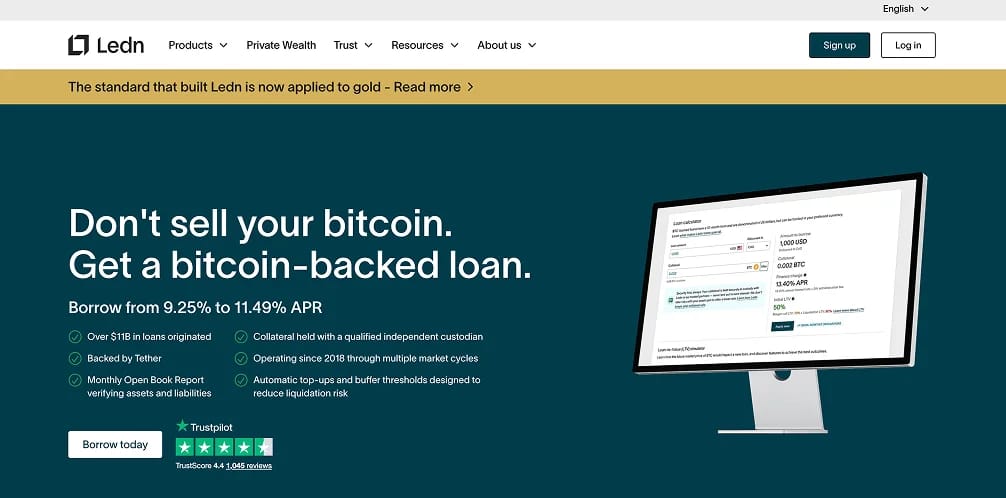
Bitcoin is the sole accepted collateral. Loans start at 50% LTV, range from $1,000 to $1 million, and use 12-month terms. Borrowers can receive USD, USDC, or local currencies such as CAD and EUR. Interest accrues each day but is not due until closing, removing the need for monthly payments.
Our CAD loan was funded in approximately nine hours. When BTC declined, the automatic top-up feature drew additional collateral from our account balance.
Rates range from 11.49% for smaller loans to 9.25% on larger balances. Borrowers outside the US and Canada also pay a 2% administrative fee at origination. Margin calls occur at 70% LTV, followed by liquidation at 80%.
Ledn is unavailable in Quebec, New Brunswick, Nova Scotia, and Saskatchewan, reflecting Canada's province-by-province approach to crypto lending. Canadians transferring funds from RBC or TD can check our bank guides for relevant limits.
Pros
- Collateral is never re-lent, and S&P has assigned the loan book an investment-grade rating.
- Straightforward 12-month structure with daily interest accrual and no monthly repayments.
- Bank-account payouts in USD, CAD, and other local currencies, with USDC also supported.
- Alerts and automatic top-ups help reduce unexpected liquidation risk.
Cons
- Borrowing rates between 9.25% and 11.49% are the highest among the centralised lenders listed.
- Only Bitcoin qualifies as collateral.
- Customers outside Canada and the US pay a 2% origination fee.
- Residents of four Canadian provinces cannot use the service.
5. Binance
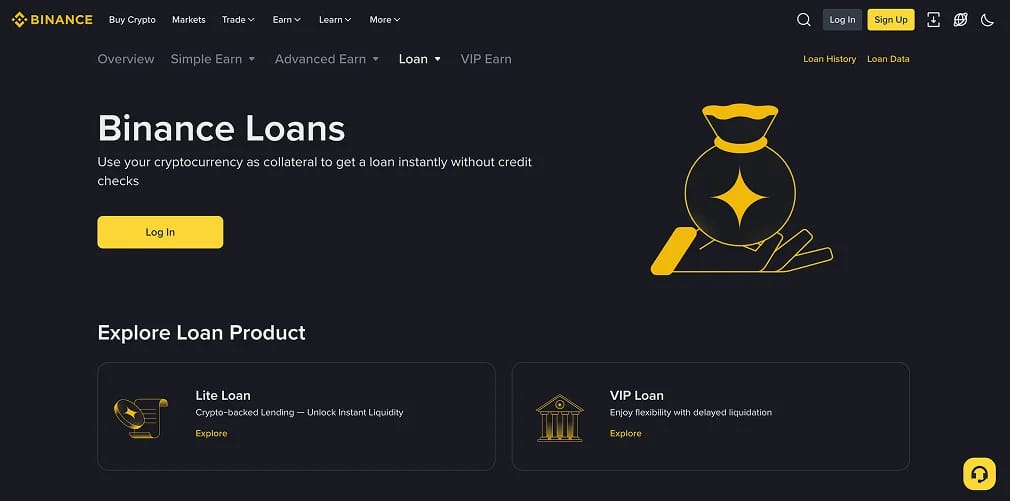
Binance operates the broadest loan desk by collateral selection. Existing users can borrow against assets already held on the exchange without moving them elsewhere.
Flexible Loans have open terms and variable hourly rates. With Fixed Rate Loans, borrowers propose a rate that lenders can accept. The new Lite Loan allows users to borrow up to 1,000 USDT against BTC without price-based liquidation during the first 30 days. Assets pledged through Flexible Loans continue earning Simple Earn yield.
Binance issues a margin call at 85% LTV and liquidates positions at 91%. Liquidation carries a fee equal to 2% of the borrowed amount. Unpaid Lite Loans accrue penalty interest at a simple annual rate of 36%.
Initial LTV limits depend on the asset. Major coins typically allow around 70% to 75%, while smaller tokens receive much lower limits. Each collateral and loan pair remains isolated.
This is a crypto-in, crypto-out service. Users seeking fiat must first buy crypto on the exchange, then sell the loan proceeds. Access also depends on jurisdiction. Americans are sent to Binance.US, which has no lending product, and UK retail users face FCA financial promotions restrictions. Our Binance restricted countries page covers other affected markets.
The 2023 US Department of Justice settlement remains a concern in Binance's compliance history. Our Binance review examines the full exchange.
Pros
- The largest collateral selection in this ranking, with more than 400 assets supported at the institutional level.
- Flexible, fixed-rate, Lite, and VIP products cover loans from $200 to treasury-scale balances.
- Pledged assets continue earning through Simple Earn.
- Isolated positions prevent one liquidation from affecting separate loans.
Cons
- Fiat payouts are unavailable, so reaching cash requires selling the borrowed assets on the exchange.
- The 91% liquidation threshold and 2% fee are severe when collateral is volatile.
- Retail users in the US and UK cannot access the product, with several other markets also restricted.
- Regional bans and Binance's compliance record create uncertainty around continued access.
6. YouHodler
YouHodler takes sixth place because it serves borrowers seeking the largest possible advance against a fixed amount of crypto over a short period. LTV reaches 90%, the highest in this comparison, with more than 50 collateral assets and a minimum loan of $100. Terms last 30, 60, or 180 days and can be extended.
Borrowers may receive EUR, USD, CHF, or GBP in a bank account, with card payouts also available. This produced the fastest cash-in-hand result during our European testing.
The Swiss company maintains virtual asset service provider registrations in Italy, Spain, and Argentina. In Switzerland, it operates under the self-regulatory organisation framework for financial intermediaries. YouHodler serves approximately 100 countries but excludes the US, and it does not hold its own MiCA authorisation.
Interest begins near 3% annually. However, each term carries a loan fee of roughly 1.7% to 7.5% of principal, depending on its length and LTV. Every extension adds another 2% fee.
Borrowing at 90% LTV provides almost no buffer, as a 10% decline in collateral can close the position. The combination of high LTV and per-term fees also makes short-term borrowing considerably more expensive than its headline rate implies. That cost places YouHodler last in the ranking.
The product can work as a 30-day bridge against stablecoins or blue-chip assets. It is poorly suited to use as a long-term credit line.
Pros
- Maximum LTV of 90%, providing more cash per unit of collateral than any other listed platform.
- A $100 minimum, support for more than 50 collateral assets, and payouts to cards or bank accounts.
- Registered as a VASP in Argentina, Italy, and Spain, with oversight through a Swiss SRO.
- Loan approval and payout took minutes during our European tests.
Cons
- Per-term charges and 2% extension fees push the true borrowing cost well above the advertised interest rate.
- Positions at 90% LTV can be liquidated after an approximate 10% price decline.
- US residents are excluded, and YouHodler lacks a MiCA authorisation in its own name.
- The shared interface for loans and leveraged trading makes the distinction between them less clear.
How to Choose a Crypto Lending Platform
Choosing a crypto lending platform requires checking who controls your collateral and what occurs during liquidation. The payout currency and the regulator responsible for the lender also matter.
- Confirm custody and rehypothecation first: Establish whether the lender may re-lend your collateral, a practice known as rehypothecation. Ledn and Coinbase's Morpho loans prohibit it, while Aave keeps collateral in a smart contract under your control. Nexo and Binance disclose that assets may be used within their operations. Every major lender failure in 2022 involved collateral that had been re-lent.
- Map the liquidation ladder before borrowing: Binance sends a warning at 85% LTV before liquidating at 91%. Ledn uses thresholds of 70% and 80%, while Nexo begins automatic partial repayment at roughly 83%. Borrowing at half the permitted LTV gives you a better chance of receiving an alert instead of losing your coins during a 30% drawdown.
- Price the whole loan, not the rate: Nexo's 1.9% rate depends on holding NEXO tokens. Ledn adds a 2% origination fee outside North America, YouHodler applies per-term charges, and DeFi rates fluctuate. Use each platform's calculator to compare the full cost for your intended amount and duration.
- Match the payout to your bank: Nexo and Ledn can transfer fiat directly to a bank account. Coinbase supplies USDC that can be converted one-to-one into dollars, whereas Aave and Binance pay stablecoins. Direct fiat access is important when the funds are intended for something such as a house deposit.
- Check the regulator for your country: A Swiss licence does not automatically authorise a lender to serve customers in Australia or the UK. The regional overview below identifies the relevant supervisors and markets where retail borrowing is prohibited.
Crypto Lending Regulation by Region
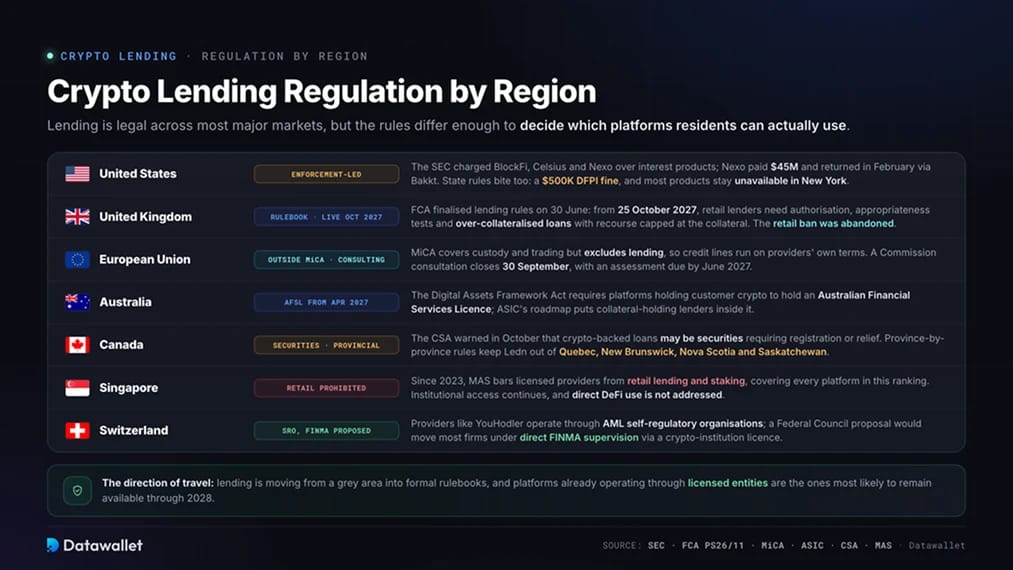
Crypto lending is legal across most major markets, but the applicable rules differ. Those differences determine which platforms residents can access.
- United States: Securities enforcement shaped crypto lending during 2022 and 2023, when the SEC charged BlockFi, Celsius, and Nexo over their interest products. After paying a $45 million settlement, Nexo returned in February through Bakkt and an SEC-registered adviser. Coinbase instead routes its loans through Morpho's onchain market. State rules continue to apply. California's DFPI fined Nexo $500,000 in January for lending without the required licences before its departure, and California loans are now issued through a licensed affiliate. Most products remain unavailable in New York. Our best crypto exchanges in the USA guide explains the broader licensing framework.
- United Kingdom: Parliament approved the Cryptoassets Regulations on 4 February, followed by the FCA's final lending and borrowing rules in PS26/11 on 30 June. Starting 25 October 2027, firms lending to UK retail customers must obtain FCA authorisation and conduct appropriateness testing. Loans must be over-collateralised, with recourse restricted to the pledged collateral so borrowers cannot owe more than they deposited. The FCA abandoned an earlier proposal to ban retail lending. Financial promotions rules remain applicable until the new regime begins. Our best crypto exchanges in the UK guide lists registered providers.
- European Union: MiCA has applied since December 2024, with its transition period ending on 1 July. It regulates custody, brokerage, and trading but excludes borrowing and lending from its scope. Nexo can therefore serve EEA customers through licensed partners while keeping its credit line under separate terms. A Commission consultation opened on 20 May to consider adding lending, with submissions due by 30 September and an assessment expected by June 2027. Our best MiCA-licensed crypto exchanges guide details the scope of CASP authorisation.
- Australia: Passed on 1 April, the Digital Assets Framework Act requires platforms holding customer crypto to secure an Australian Financial Services Licence from April 2027. ASIC's implementation roadmap places lenders that hold collateral within this framework. Australians can currently use Nexo, Ledn, and Aave. Our best crypto exchanges in Australia guide covers local deposit methods.
- Canada: On 22 October, the Canadian Securities Administrators reminded crypto-backed lenders that their products may constitute securities and require registration or exemptive relief. The CSA also publishes a list of lenders with relief. Regulation occurs at the provincial level, explaining why Ledn is available across most of Canada but not in Saskatchewan, Quebec, New Brunswick, or Nova Scotia. Our best crypto exchanges in Canada guide identifies registered platforms.
- Singapore: Since 2023, the Monetary Authority of Singapore has prohibited licensed providers from facilitating lending or staking for retail customers. The rule covers all six platforms in this ranking. Institutional and accredited investors can still participate, while direct DeFi activity is not addressed by the prohibition.
- Switzerland: Providers such as YouHodler operate through anti-money-laundering self-regulatory organisations instead of holding a FINMA licence. A Federal Council consultation launched last October proposes introducing a crypto-institution licence under the Financial Institutions Act. Most firms would move under direct FINMA supervision if the proposal takes effect.
Crypto lending is gradually moving from a regulatory grey area into formal rulebooks. Platforms already using licensed entities are more likely to remain operational through 2028.
How Are Crypto Loans Taxed?
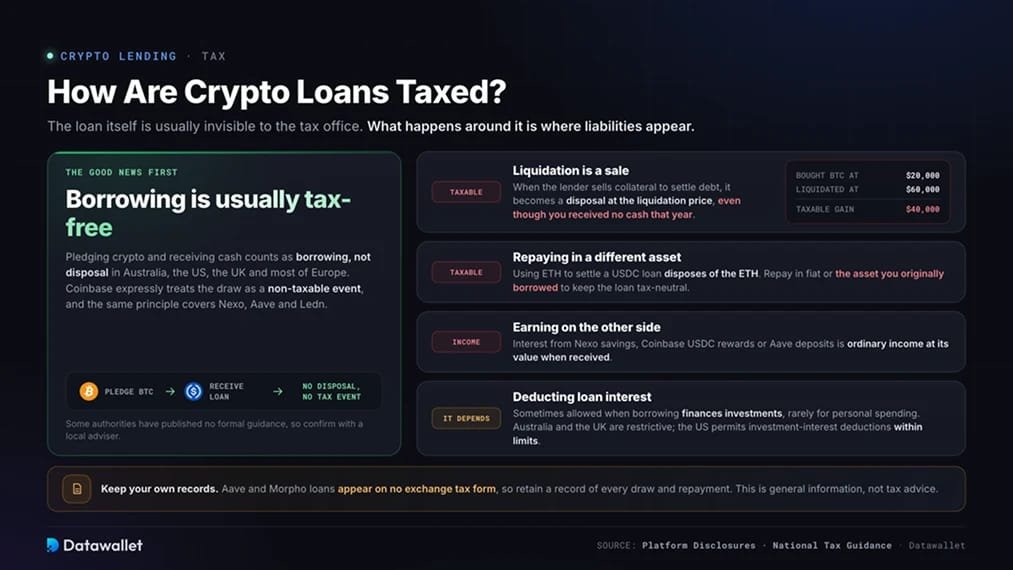
Receiving a crypto-backed loan is generally not taxable. A liability may still arise from liquidation, repayment with a different asset, or interest earned through lending.
- The loan itself is usually tax-free: Pledging crypto and receiving cash generally counts as borrowing rather than disposal in Australia, the US, the UK, and most European countries. Coinbase expressly states that it does not treat the borrow as a taxable event. The same principle applies to loans from Nexo, Aave, and Ledn. Some authorities have not published formal guidance, so confirm the position with a local adviser.
- Liquidation is a sale: When a lender sells collateral to settle debt, the transaction becomes a disposal at the liquidation price. Someone who bought BTC at $20,000 and has it liquidated at $60,000 realises a $40,000 gain despite receiving no cash that year.
- Repaying in a different asset is also a sale: Using ETH to settle a USDC loan disposes of the ETH. Repayment in fiat or the asset originally borrowed helps keep the loan tax-neutral.
- Interest deductibility varies: Some countries permit deductions when borrowed funds finance investments, but rarely when they pay for personal expenses. Australia and the UK apply restrictive rules, while the US permits investment interest deductions within specified limits.
- Earning on the other side is income: Interest from Nexo savings, Coinbase USDC rewards, or Aave deposits is ordinary income based on its value when received. Our best stablecoin interest rates guide compares lending returns. The best low-tax crypto countries guide covers jurisdictions with lighter treatment.
This information is not tax advice. Aave and Morpho loans do not appear on exchange tax forms, making it important to retain your own records of every repayment and draw.
Funding Collateral and Receiving Loan Proceeds
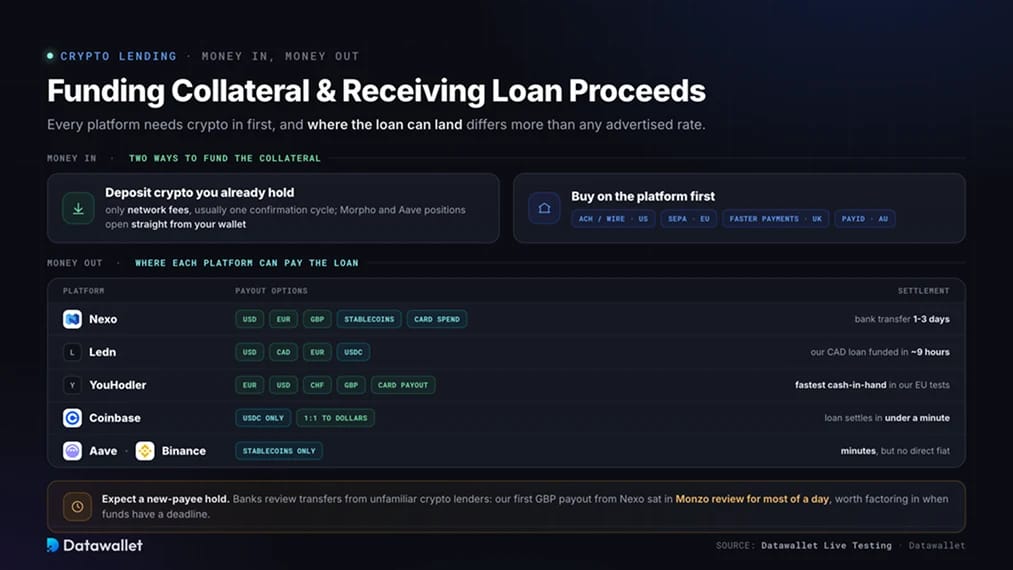
All six platforms require crypto collateral. Borrowers must first move coins into the relevant position, then arrange for the loan proceeds to reach their bank account if fiat is needed.
- Deposit crypto you already hold: Moving assets from an exchange or wallet to Nexo, Ledn, or YouHodler incurs only network fees and usually takes one confirmation cycle. Morpho and Aave positions open directly from your wallet.
- Buy on the platform first: Crypto purchases by bank transfer are available through Binance, Coinbase, Nexo, and YouHodler. US customers can fund Coinbase and Nexo with ACH or wire transfers. European customers can use SEPA, while Faster Payments serves British users and PayID is available in Australia. Our Revolut and Monzo guides discuss UK banks most likely to question a transfer. The CommBank guide explains Australian payment holds.
- Choose the payout currency deliberately: Nexo supports bank transfers in USD, EUR, and GBP. Ledn offers USD, CAD, and EUR, while YouHodler adds CHF and card payouts. Coinbase provides USDC convertible one-to-one into dollars. Aave and Binance pay only in stablecoins. Bank transfers generally take one to three business days, compared with minutes for stablecoins.
- Expect a new-payee hold: Banks may review transfers involving an unfamiliar crypto lender. Our first GBP payout from Nexo remained under Monzo review for most of a day before clearing, which should be considered when funds are needed by a deadline.
How to Borrow Against Crypto
Opening a crypto-backed loan typically takes about fifteen minutes through a centralised provider or five minutes through a DeFi protocol. Keeping the amount well below the available limit reduces liquidation risk.
- Pick the platform for your country and collateral: Choose Nexo for an open-ended fiat credit line across most supported markets. Coinbase suits US borrowers seeking onchain rates, while Ledn provides ring-fenced custody for Bitcoin loans. Aave offers non-custodial borrowing, Binance accepts less common collateral, and YouHodler targets short-term European loans at high LTV.
- Verify and deposit collateral: Centralised platforms require identification and a selfie, sometimes accompanied by proof of address. Send a small test amount before transferring the full balance. Check that the assets appear in the collateral or credit wallet rather than the trading account.
- Set the loan amount below the maximum: Where the maximum LTV is 50%, limit the loan to around 25% to 30%. Select the payout asset, enter the amount, and review the liquidation level displayed on the confirmation screen.
- Set alerts and know your top-up path: Enable LTV notifications and keep additional collateral available in the account or a connected wallet. Ledn users can activate automatic top-ups. Responding to a 3am margin call is only practical when adding collateral takes one tap.
- Repay in the borrowed asset and withdraw: Using the same stablecoin or currency may avoid a taxable disposal. Once the debt is cleared, confirm that the collateral has been released and return long-term holdings to self-custody. Our best crypto wallets guide compares the available options.
Users interested in funding loans rather than taking them can review our best USDT yield opportunities guide.
Final Thoughts
Nexo ranks first for combining a flexible credit line with the broadest regulated footprint. It is operating again in the US through Bakkt, serves Europe through MiCA-licensed partners, and continued paying customers throughout the industry's worst lending crisis.
Aave is the strongest choice for users unwilling to place collateral with a company. Coinbase packages DeFi borrowing for American retail users, while Ledn offers a conservative Bitcoin-only product backed by an investment-grade loan book. Binance leads on collateral breadth for existing exchange users. YouHodler fits short-term borrowers who need the highest advance per coin.
Regulators targeted lending heavily after 2022 and are now creating dedicated frameworks for it. The FCA has confirmed an implementation date, the European Commission is consulting, and enforcement is already underway through the CSA and DFPI. Platforms will need licensed entities or a clear plan to remain available through this transition.
Test any lender with a small amount before pledging substantial collateral. Borrow one-tenth of the available limit, monitor the LTV through a volatile session, then repay and withdraw. The timing of alerts, speed of top-ups, and real payout times reveal more about the service than its advertised rate.
Our Methodology
We registered with every platform and completed identity checks using accepted documents from Australia, the EEA, the UK, and the US. Testing involved depositing BTC, ETH, and stablecoins as collateral before drawing both fiat and stablecoin loans. We kept each position open through at least one collateral decline of 8% or more, then repaid the balance and withdrew all funds. Scores cover six criteria.
- Trust Score: Our proprietary rating out of 5 considers regulatory status in major jurisdictions and operating history through the 2022 lending failures. It also evaluates transparency, enforcement records, custody arrangements, and rehypothecation policies.
- Borrowing Cost: We examined headline interest rates, token ownership conditions, origination charges, extension fees, and minimum interest periods. The comparison included the total cost of borrowing $10,000 for 90 days.
- Collateral Treatment: Our review established whether pledged assets are segregated, ring-fenced, or re-lent. We also checked whether collateral continues earning during the loan and how quickly it becomes available after repayment.
- Liquidation Mechanics: We documented liquidation and margin-call thresholds, penalty charges, alert timing, and the process for adding collateral during live market volatility.
- Funding and Payout: Tests covered crypto deposits, fiat purchase options, and loan payouts in USD, EUR, GBP, CAD, and stablecoins. We measured settlement speeds and recorded bank holds.
- Regulatory Coverage: Licences, partner arrangements, registrations, and exemptive relief were verified across Australia, Canada, the EEA, Singapore, Switzerland, the UK, and the US.
We excluded insolvent platforms, lenders without an active product in at least two major markets, and services unable to demonstrate where customer collateral is stored. Testing took place between April and August. Regulatory details were checked again after the FCA issued its policy statements on 30 June.