

What Are RWA Perps?
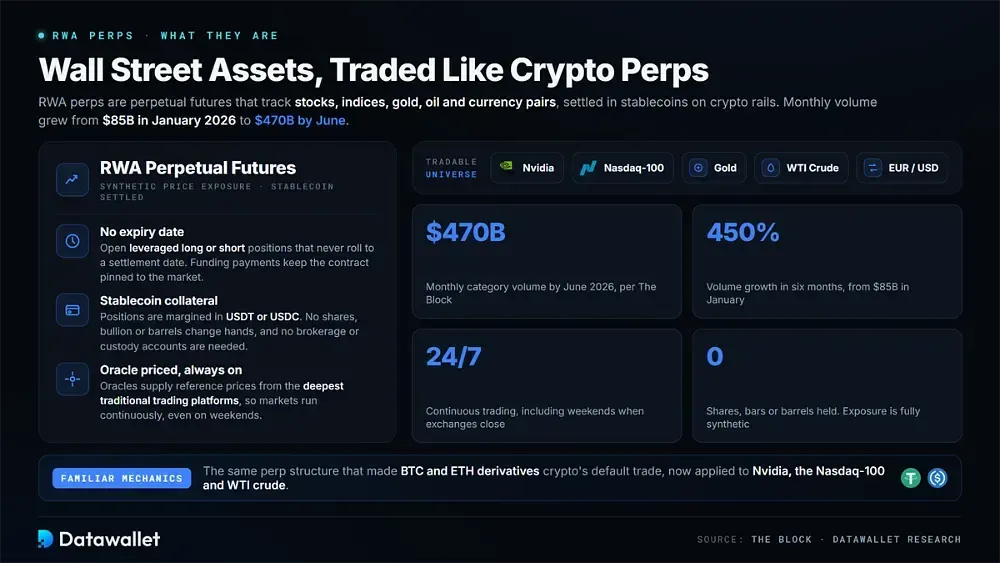
RWA perps are perpetual futures contracts that track the prices of real-world assets, including stocks, indices, gold, oil, and currency pairs. They settle in stablecoins through crypto infrastructure rather than traditional financial systems.
Like other perpetual futures, these contracts have no expiry date. Traders can open leveraged long or short positions, while periodic funding payments help keep contract prices aligned with the underlying market.
No actual shares, bullion, or barrels change hands. Instead, traders hold synthetic price exposure backed by stablecoin collateral, with oracles supplying reference prices from the deepest traditional trading platforms. This structure removes the need for conventional custody arrangements, brokerage accounts, and settlement infrastructure, allowing markets to operate continuously, even on weekends.
Crypto traders are already familiar with the instrument. Perpetual futures have been the default way to trade Bitcoin and Ethereum for years, as explained in our guide to perpetual vs spot trading. RWA perps apply the same mechanics to assets such as Nvidia, the Nasdaq-100, and WTI crude oil.
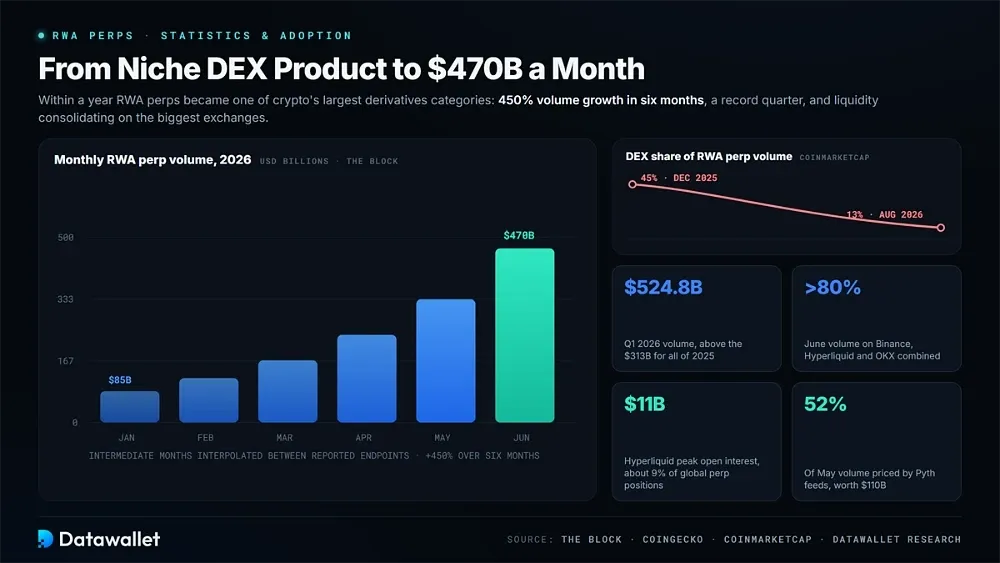
Demand accelerated as regulation eased and market infrastructure matured. According to The Block, monthly volume increased from roughly $85 billion in January 2026 to about $470 billion by June. That expansion has made RWA perps one of crypto's fastest-growing product categories and established a direct connection between DeFi and Wall Street.
How Do RWA Perps Work?
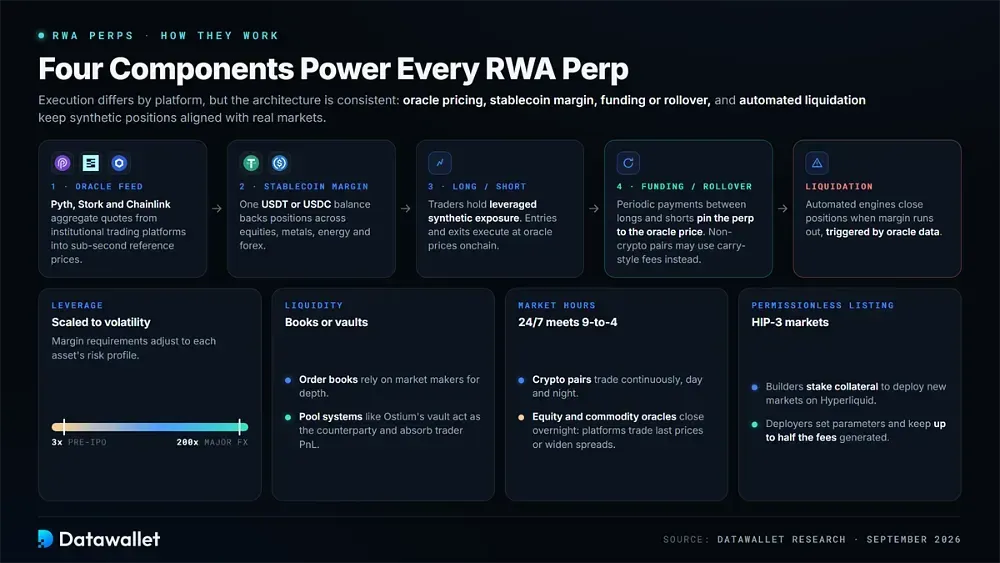
RWA perps rely on four core components: oracle pricing, stablecoin margin, funding or rollover mechanisms, and automated liquidation. Execution methods differ between platforms, but the underlying architecture is broadly consistent.
Here is how the core mechanics fit together in practice:
- Oracles: Providers such as Pyth, Stork, and Chainlink aggregate quotes from institutional trading platforms. Their sub-second reference prices determine entries, exits, and liquidations onchain.
- Collateral: Positions use USDT or USDC as margin rather than the underlying asset. A single stablecoin balance can therefore support trading across equities, metals, energy, and forex markets.
- Funding: Long and short traders make periodic payments to keep perpetual contract prices aligned with oracle prices. Live funding rates provide a way to monitor positioning across major exchanges.
- Rollover: Some platforms replace conventional funding payments on non-crypto pairs with carry-style holding fees. These reflect interest-rate differentials, storage costs, and borrow rates normally encountered in traditional futures markets.
- Leverage: Limits depend on the asset's volatility profile. Thinly priced pre-IPO markets may cap leverage at 3x, while major forex pairs can offer up to 200x, with margin requirements adjusted accordingly.
- Liquidity: Central limit order books rely on market makers to provide liquidity. Pool-based systems, including Ostium's vault, instead act as the counterparty and absorb trader profits and losses.
- Market hours: Crypto pairs trade continuously, whereas equity and commodity oracles depend on traditional exchanges that close overnight. Platforms must either continue trading against the latest available prices or widen spreads to manage the resulting risk.
- Permissionless listing: Hyperliquid's HIP-3 framework allows builders to stake collateral and deploy new markets. They can also configure trading parameters and retain up to half the fees their markets generate.
RWA Perps vs Tokenized Stocks
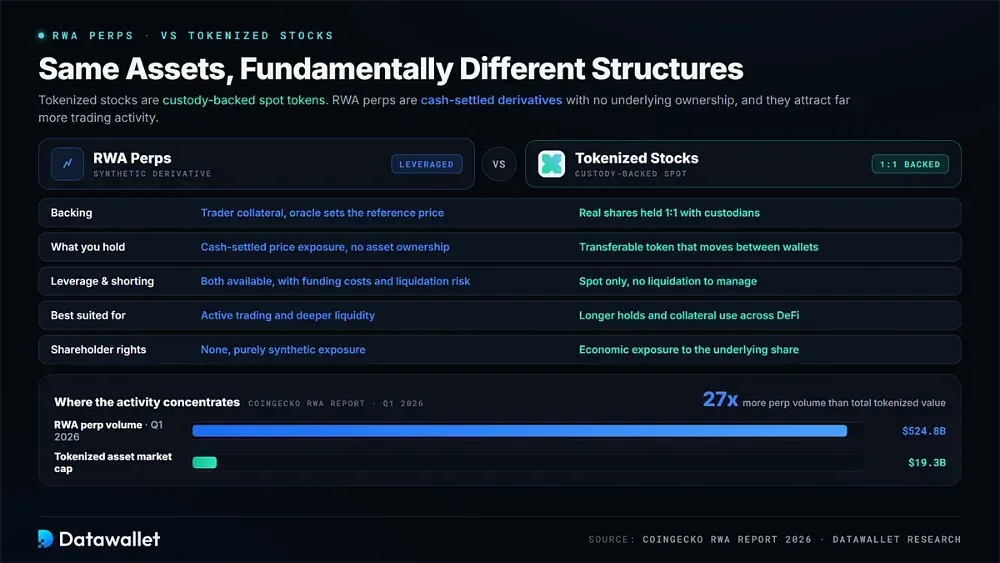
RWA perps and tokenized stocks provide exposure to similar assets but have fundamentally different structures.
Tokenized stocks such as xStocks are backed one-to-one by real shares held with custodians. Holders receive transferable spot exposure that can move between wallets. RWA perps, by comparison, are cash-settled derivatives without underlying asset ownership. Their backing consists of trader collateral, while oracle data determines the reference price.
These structural differences affect how each product can be used. Perps offer leverage, short exposure, and deeper liquidity, but traders must account for funding costs and liquidation risk. They also receive no shareholder rights.
Tokenized equities are better suited to longer holding periods and collateral use across DeFi. We examine custody-backed products separately in our guide to the best tokenized stock trading exchanges.
Derivatives account for substantially more trading activity than the spot market. CoinGecko's RWA Report recorded $524.8 billion in RWA perp volume during Q1 2026, compared with approximately $19.3 billion in total tokenized asset market capitalization. Our tokenization statistics show a similar pattern: value accrues to tokens, while trading activity remains concentrated in perpetual futures.
Best RWA Perps Platforms
RWA perp trading is divided between centralized exchanges and onchain platforms. CEXs now process most category volume, while DEXs pioneered the market and continue to offer broader asset coverage. The appropriate platform depends on jurisdiction, custody preferences, leverage requirements, and willingness to complete KYC.
Centralized Exchanges
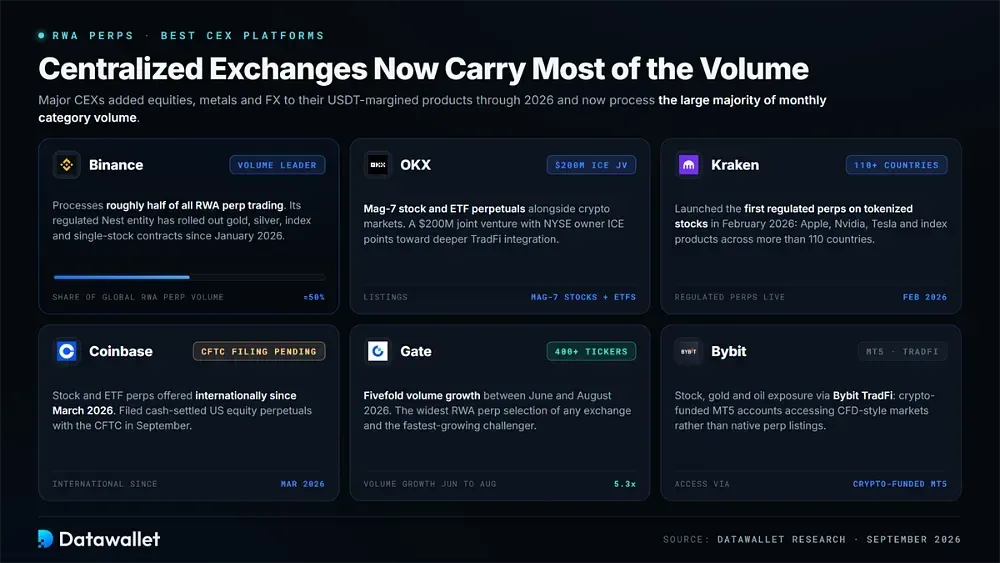
Major centralized exchanges expanded into RWA perps throughout 2026, adding equities, metals, and FX to the USDT-margined derivatives products their customers already use.
These platforms now account for the large majority of monthly category volume.
These are the centralized platforms leading RWA perps right now:
- Binance: Leads global RWA perp volume, processing roughly half of all trading activity. Through its regulated Nest entity, Binance has steadily introduced gold, silver, index, and single-stock contracts since January 2026.
- OKX: Offers Mag-7 stock and ETF perpetuals alongside its existing crypto markets. Its $200 million joint venture with NYSE owner ICE points toward deeper integration with traditional financial markets.
- Kraken: Launched what it described as the first regulated perpetual futures on tokenized stocks in February 2026. Its offering covers Apple, Nvidia, Tesla, and index products across more than 110 countries.
- Coinbase: Has offered stock and ETF perps internationally since March 2026. In September, it also filed cash-settled US equity perpetual contracts with the CFTC, with regulatory approval still pending.
- Gate: Recorded more than fivefold volume growth between June and August 2026. With over 400 listed tickers, it offers the widest selection of RWA perpetual markets and is the fastest-growing challenger.
- Bybit: Provides stock, gold, and oil exposure through its Bybit TradFi division. Traders use crypto-funded MT5 accounts to access conventional CFD-style markets rather than native perpetual listings.
Decentralized Platforms
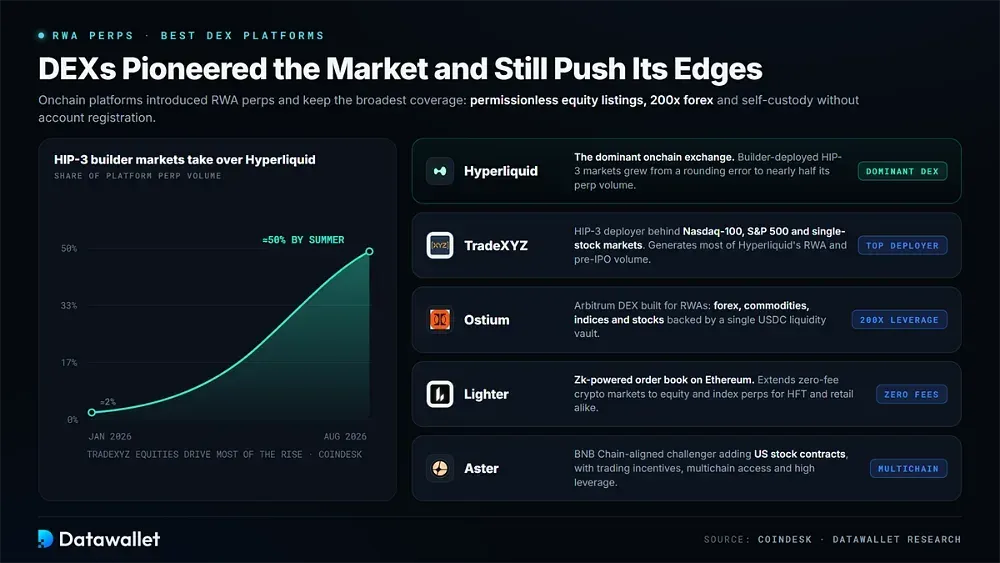
Onchain DEXs introduced RWA perps and continue to expand the range of tradable markets. Their offerings extend from permissionless equity listings to forex contracts with 200x leverage.
Self-custody and the ability to trade without conventional account registration remain central features for traders across different jurisdictions.
The standout decentralized platforms for trading RWA perps include:
- Hyperliquid: The dominant onchain exchange, where builder-deployed HIP-3 markets expanded from roughly 2% of total platform perpetual volume in January 2026 to nearly half by summer.
- TradeXYZ: The HIP-3 deployer responsible for Nasdaq-100, S&P 500, and single-stock perpetual markets. It generates the overwhelming majority of Hyperliquid's RWA trading activity and accounts for most pre-IPO volume across the ecosystem.
- Ostium: An Arbitrum perps DEX built specifically for real-world assets. Its markets cover forex, commodities, indices, and stocks, with leverage of up to 200x supported by a single USDC liquidity vault.
- Lighter: A zk-powered order book exchange built on Ethereum. It has expanded its zero-fee crypto markets to include equity and index perps, targeting both high-frequency traders and retail participants.
- Aster: A BNB Chain-aligned challenger that has added US stock contracts to its existing crypto perpetual markets. Its offering emphasizes trading incentives, multichain access, and high leverage limits.
Pre-IPO Perpetuals
Pre-IPO perpetuals provide price exposure to companies that have yet to list shares on public exchanges.
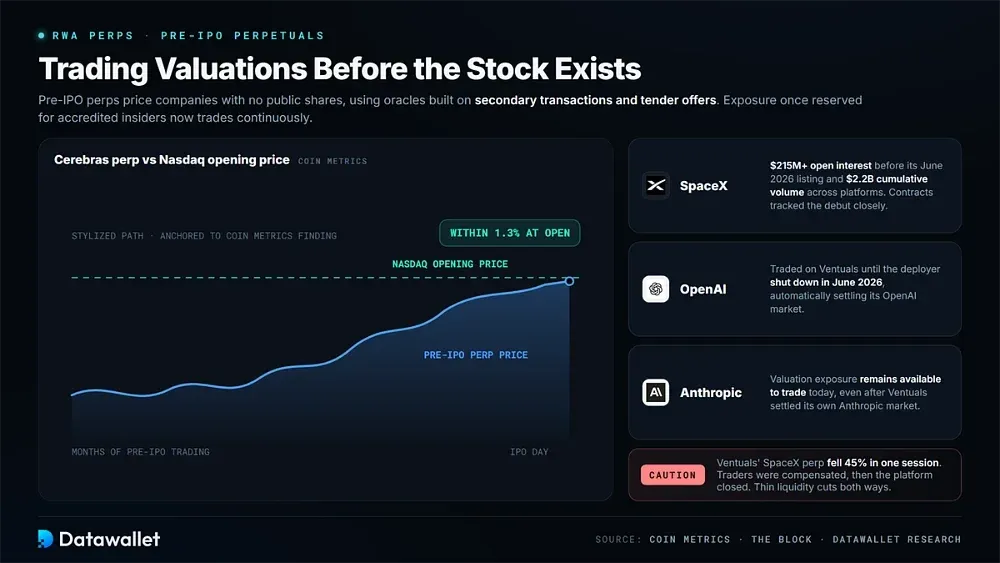
Contracts referencing SpaceX, OpenAI, and Anthropic use oracle prices derived from secondary transactions, tender offers, and market positioning. Traders can therefore gain continuous exposure to company valuations that were previously accessible mainly to accredited insiders and venture capital funds.
Some contracts have tracked eventual public-market prices closely. Coin Metrics found that Cerebras perpetuals traded within 1.3% of the stock's eventual Nasdaq opening price. SpaceX contracts also accumulated more than $215 million in open interest ahead of the company's June 2026 listing, which we cover in our SpaceX IPO explainer.
Anthropic exposure remains available to trade, as detailed in our pre-IPO guide. Despite these examples of pricing accuracy, pre-IPO perpetuals remain volatile markets with limited liquidity. Deployer Ventuals compensated traders after its SpaceX contract fell 45% in a single session. The platform subsequently shut down entirely in June 2026, automatically settling its OpenAI and Anthropic markets.
How to Trade RWA Perps on Hyperliquid
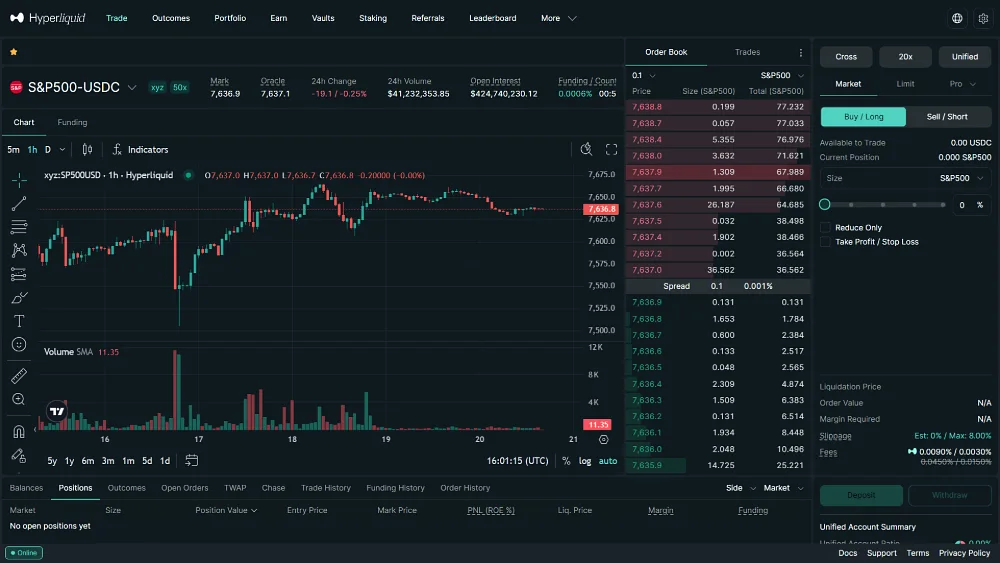
Trading RWA perps on Hyperliquid involves connecting a wallet, depositing supported collateral, and selecting a HIP-3 market before configuring leverage, placing orders, and managing positions.
Follow these steps to open and manage an RWA perpetual position:
- Access Hyperliquid: Open Hyperliquid, select Connect, and either link an EVM wallet or enter your email and authenticate using the six-digit verification code.
- Enable Trading: If connected by wallet, click Enable Trading and sign the gasless approval in your wallet; email accounts can proceed directly to funding.
- Deposit USDC: For direct stablecoin funding, select Deposit, choose Arbitrum USDC, enter the amount, and approve the transfer with ETH available for network gas.
- Alternative Funding: Alternatively, deposit supported BTC, ETH, ENA, SOL, or other listed assets using the displayed network and address; sell them for collateral afterward.
- Check Collateral: Confirm the selected HIP-3 market's collateral asset before trading. XYZ markets use USDC, while other deployers may require USDH or USDT.
- Select Market: On the Trade page, open the market selector and choose an available HIP-3 equity, index, or commodity perpetual contract from its deployer.
- Configure Position: Choose Long or Short, set leverage within the market's permitted range, select your margin mode, and enter the position size.
- Place Order: Select Market or Limit execution, review the order details and liquidation price, then click Place Order and Confirm to submit your trade.
- Manage Position: Use the Positions panel to monitor liquidation risk and hourly funding, adjust isolated margin, configure take-profit or stop-loss orders, and close your position.
Statistics & Adoption
Within a year, RWA perps developed from a niche product available on a handful of DEXs into one of crypto's largest derivatives categories. The following figures draw on The Block, CoinGecko, CoinDesk, Coin Metrics, CoinMarketCap research, and DefiLlama data through September 2026.
Key metrics as of September 2026:
- Monthly volume: The Block recorded an increase from approximately $85 billion in January 2026 to roughly $470 billion in June, representing 450% growth over six months.
- Quarterly record: According to CoinGecko's RWA Report, RWA perp volume reached $524.8 billion in Q1 2026, surpassing the $313 billion recorded throughout 2025.
- Exchange concentration: Binance, Hyperliquid, and OKX collectively processed more than 80% of category volume in June. Binance alone accounted for nearly half of global trading activity.
- HIP-3 growth: CoinDesk reported that builder-deployed markets expanded from approximately 2% of Hyperliquid's perpetual volume in early 2026 to roughly half, with TradeXYZ equities driving much of the increase.
- Open interest: Hyperliquid's total perpetual open interest reached a 2026 high near $11 billion. The exchange accounted for approximately 9% of outstanding perpetual positions globally.
- Oracle share: Pyth Network supplied price feeds for $110 billion in RWA perp trading volume during May 2026, representing roughly 52% of the entire market.
- Pre-IPO depth: Coin Metrics recorded $2.2 billion in cumulative SpaceX perpetual volume across trading platforms before the June IPO. Contract prices also tracked the company's eventual market debut remarkably closely.
- Fastest riser: CoinMarketCap research measured 5.3x volume growth at Gate between June and August. Monthly trading reached $64.8 billion across 405 listed tickers, giving the exchange the broadest available market selection.
- CEX shift: The same dataset shows decentralized exchanges losing volume share, falling from approximately 45% of RWA perp trading in December 2025 to 13% by August 2026.
- Onshore path: The CFTC's 2026 order and policy statement established a supervised US framework, as analyzed by Katten. Coinbase and Kraken subsequently filed stock perpetual contracts in September.
The market is moving toward a common product structure across global CEXs, regulated US futures exchanges, and permissionless onchain platforms. As these markets expand, competition increasingly centers on which exchanges attract and retain liquidity. Our broader crypto perpetual futures statistics place these developments in the context of the wider derivatives market.
RWA Perps Regulation
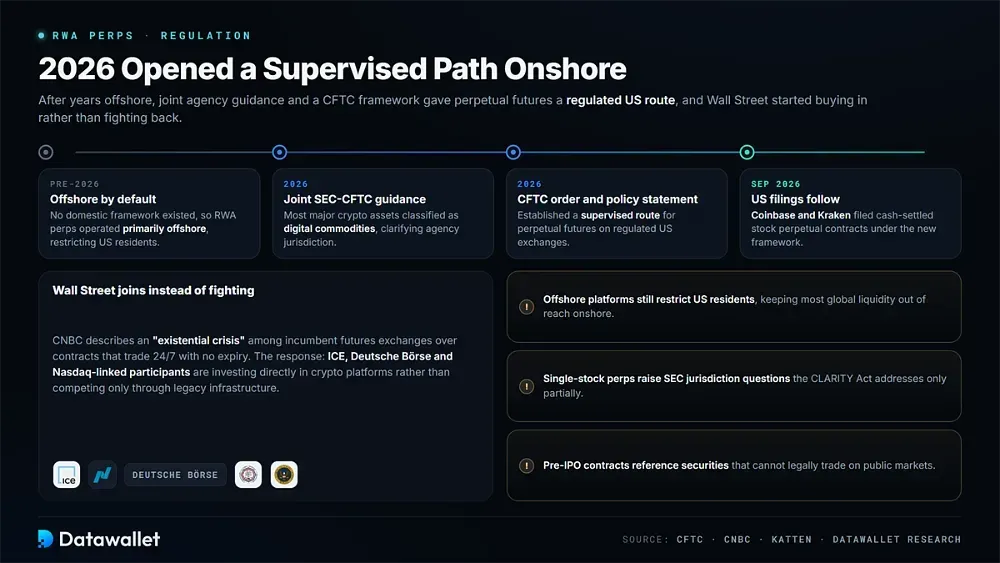
RWA perps operated primarily offshore for years because US law provided no established domestic framework for these products.
The regulatory position changed during 2026. Joint SEC-CFTC guidance classified most major crypto assets as digital commodities, while the CFTC issued an order and policy statement establishing a supervised route for perpetual futures trading on regulated exchanges.
Traditional financial institutions have responded to these developments. CNBC describes concerns among incumbent futures exchanges about contracts that trade continuously without expiry dates. Meanwhile, ICE, Deutsche Börse, and Nasdaq-linked participants are investing directly in crypto platforms rather than competing exclusively through existing market infrastructure.
Important legal uncertainties remain. Offshore platforms continue to restrict US residents, while single-stock perpetuals raise SEC jurisdiction questions that the CLARITY Act addresses only partially. Pre-IPO contracts present additional complications because they reference securities that cannot legally trade on public markets.
Risks of Trading RWA Perps
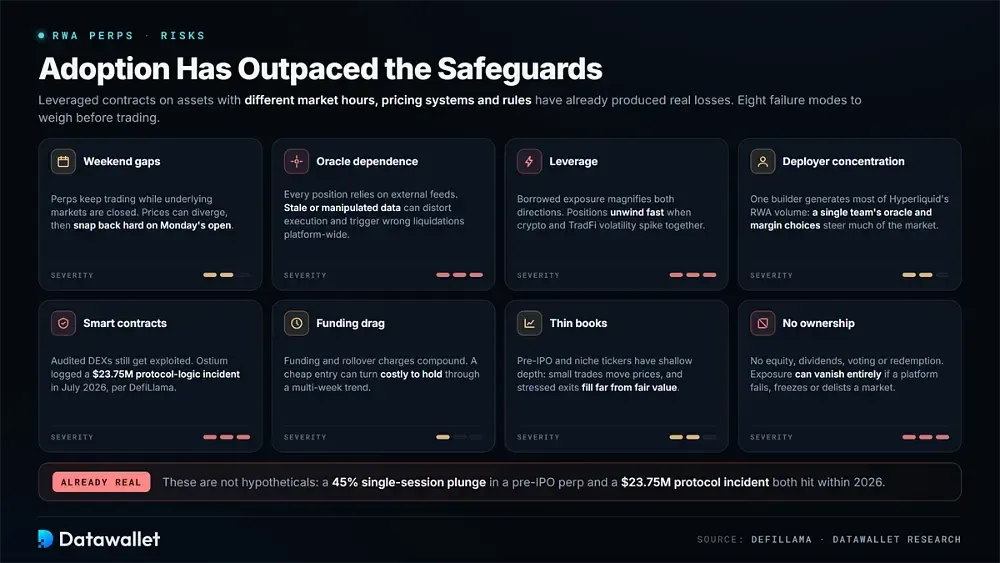
RWA perp adoption has advanced faster than safeguards in some parts of the market, with several failure scenarios already resulting in losses. Understanding these risks is essential when trading leveraged contracts linked to assets whose underlying markets may operate under different hours, pricing systems, and regulatory requirements.
Key risks every RWA perps trader should weigh carefully:
- Weekend gaps: Some platforms continue trading while the underlying markets are closed. Weekend developments can cause perpetual prices to diverge substantially from reference values, with sharp adjustments when traditional markets reopen on Monday.
- Oracle dependence: Every position relies on external price feeds. Stale, manipulated, or faulty data can distort execution prices and trigger incorrect liquidations across an entire trading platform.
- Leverage: Borrowed exposure magnifies both gains and losses. Our crypto liquidations tracker illustrates how rapidly leveraged positions can unwind when volatility rises simultaneously across correlated crypto and traditional markets.
- Deployer concentration: A single builder generates most of Hyperliquid's RWA volume. Consequently, one team's oracle selection and margin parameters influence a substantial portion of the market.
- Smart contracts: Onchain DEXs remain vulnerable to exploits even when their contracts have undergone audits. According to DefiLlama's protocol incident records, Ostium experienced a $23.75 million protocol-logic incident in July 2026.
- Funding drag: Periodic funding payments and rollover charges accumulate over time. A position that appears inexpensive to open can become costly to maintain through a sustained trend lasting several weeks.
- Thin books: Pre-IPO contracts and less frequently traded tickers often have limited order book depth. Relatively small trades can move prices sharply, while positions closed during periods of market stress may execute far from fair value.
- No ownership: Perpetual contracts provide no equity ownership, dividends, voting rights, or redemption claims. Exposure can disappear entirely if a trading platform fails, freezes activity, or delists a market without notice.
Final Thoughts
RWA perps address a genuine limitation of traditional market infrastructure by providing global, continuous access to leveraged exposure across markets that remain geographically fragmented and subject to conventional trading restrictions.
Trading volumes have expanded considerably, but the market is also highly concentrated. A small group of exchanges, one dominant deployer, and two oracle networks now carry systemic weight.
For exposure to the sector beyond derivatives, see our roundup of the best RWA projects.
RWA perps should be treated as leveraged instruments. Positions need conservative sizing and hedging where possible, with a clear understanding that holding a perpetual contract does not confer ownership of the underlying asset.