
For the past two years, perpetual futures venues have largely followed the Hyperliquid playbook: launch an order book, attract market makers and subsidise liquidity through points. Variational is taking a different view, arguing that this model starts to break down once trading expands beyond a small group of leading crypto assets.
Instead, it uses a peer-to-peer protocol where each position sits in its own escrow contract, while a single in-house desk provides every quote. The resulting economics support zero fees and loss refunds while making commodity perpetuals viable in markets that many competing venues cannot sustain.
With the $VAR token generation event confirmed for Q4 2026, this guide covers Variational's underlying structure, the markets available to traders and the risks that come with its design.
What is Variational?
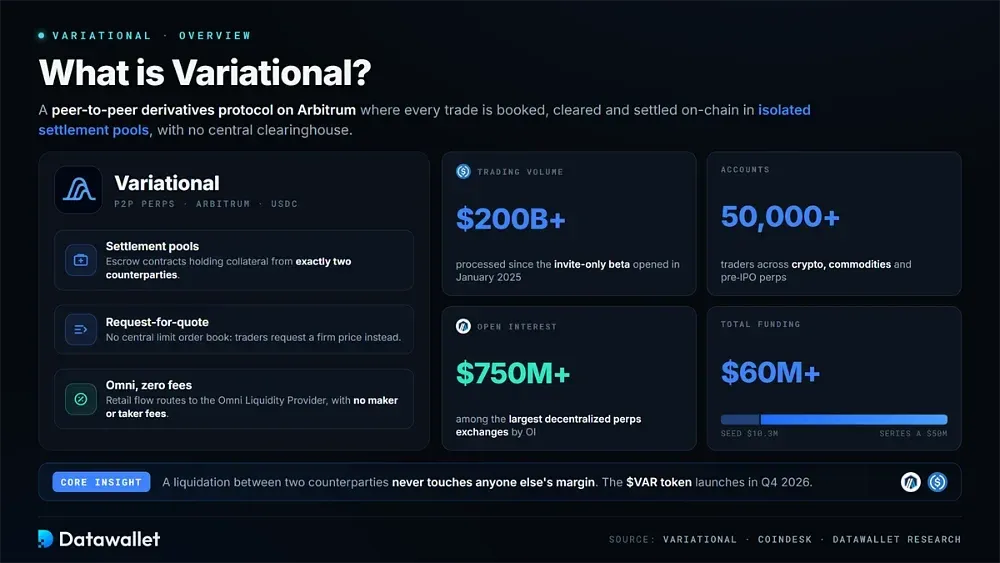
Variational is a peer-to-peer derivatives trading protocol built on Arbitrum. Trades are booked, cleared and settled on-chain through isolated escrow smart contracts known as settlement pools. Each pool contains collateral from exactly two counterparties and automatically enforces pre-agreed rules covering margin, funding payments and liquidation, without relying on a centralised clearinghouse.
The protocol does not use a central limit order book. Instead, it operates through a request-for-quote model. Omni, its first application, sends all retail flow to the Omni Liquidity Provider, a vertically integrated market-making desk that combines pricing from centralised exchanges, DEXs and OTC venues while charging no maker or taker fees.
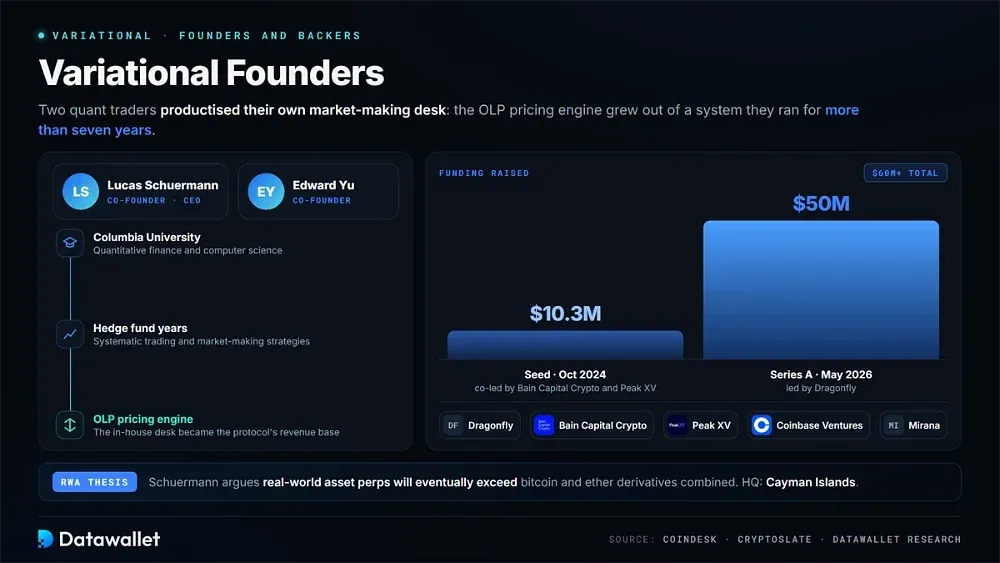
The project first raised a $10.3 million seed round in October 2024, co-led by Bain Capital Crypto and Peak XV Partners. A $50 million Series A led by Dragonfly followed in May 2026, bringing total funding to more than $60 million.
Variational opened its invite-only beta in January 2025. Since then, it has processed over $200 billion in volume across more than 50,000 accounts, while open interest has exceeded $750 million. That places it among the largest decentralized perpetuals exchanges by open interest ahead of the Q4 2026 token launch.
How Does Variational Work?
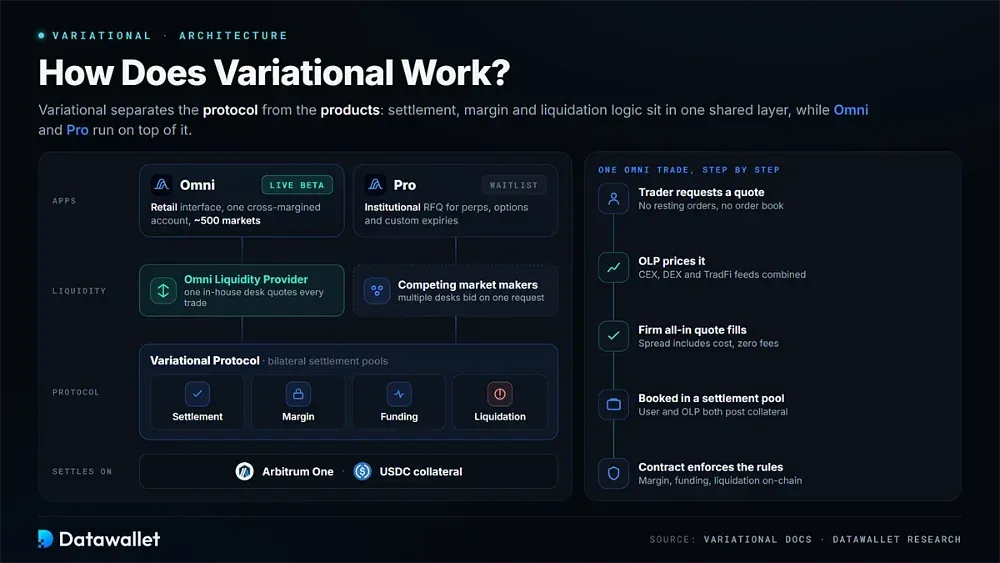
Variational separates the underlying protocol from the products that run on it. Settlement, margin and liquidation logic sit at the protocol layer. Omni provides the retail trading interface, while Pro is designed for institutional users.
1. Settlement Pools and Peer-to-Peer Clearing
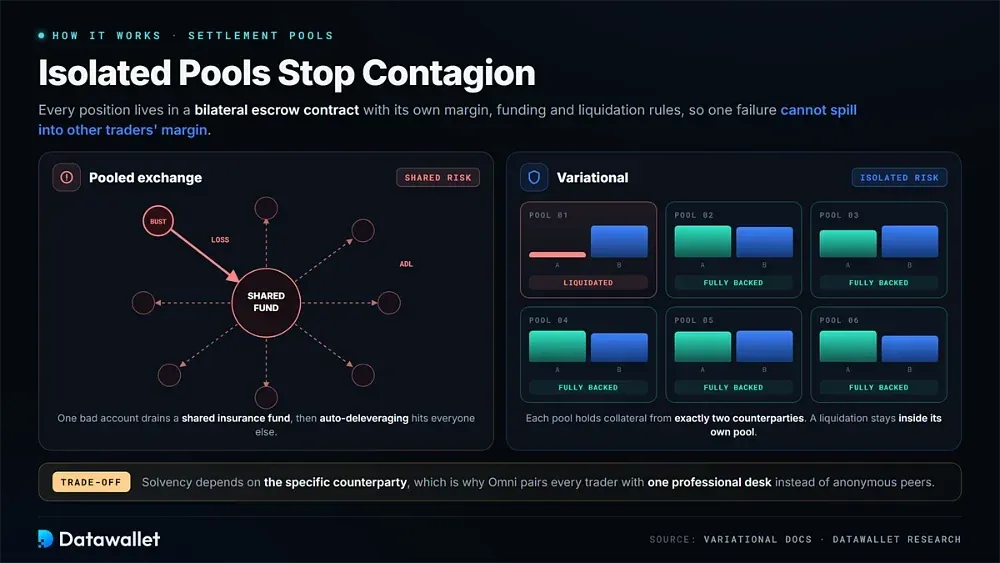
Every Variational position is held in a bilateral settlement pool, an escrow smart contract used by two counterparties that each post collateral. Margin requirements, funding mechanics and liquidation thresholds are written into the contract, which continues enforcing those rules for as long as the positions remain open.
A liquidation between those two parties therefore does not affect anyone else's margin. If one settlement pool becomes insolvent, healthy pools remain fully collateralised and continue paying out normally. This removes the contagion and socialised-loss risk exchange-style venues can face when auto-deleveraging spreads through shared insurance funds.
The compromise is greater dependence on counterparty quality than users face on a pooled exchange. Solvency depends on the specific entity across the settlement pool, which is why Omni matches every retail trader with one professional desk rather than pairing users with anonymous peers.
2. Omni
Omni is the first application built on the Variational Protocol and the product most retail traders use. It provides one cross-margined account for perpetual contracts across crypto and traditional assets, with roughly 500 live markets. Execution is gasless, and USDC collateral is deposited directly on Arbitrum One.
Because Omni requests quotes rather than relying on resting orders, it can support assets that would be difficult to bootstrap through an order book. Its listing engine has supported more than 1,000 markets at peak, including major cryptocurrencies, long-tail altcoins, newly launched tokens and commodity contracts priced against external reference markets.
Execution comes through an all-in quoted price. The spread incorporates the trading cost rather than separating fees from slippage. Major pairs offer leverage of up to 50x, while take-profit, stop-loss, limit and trigger orders work much like their equivalents on centralised trading venues.
3. The Omni Liquidity Provider (OLP)
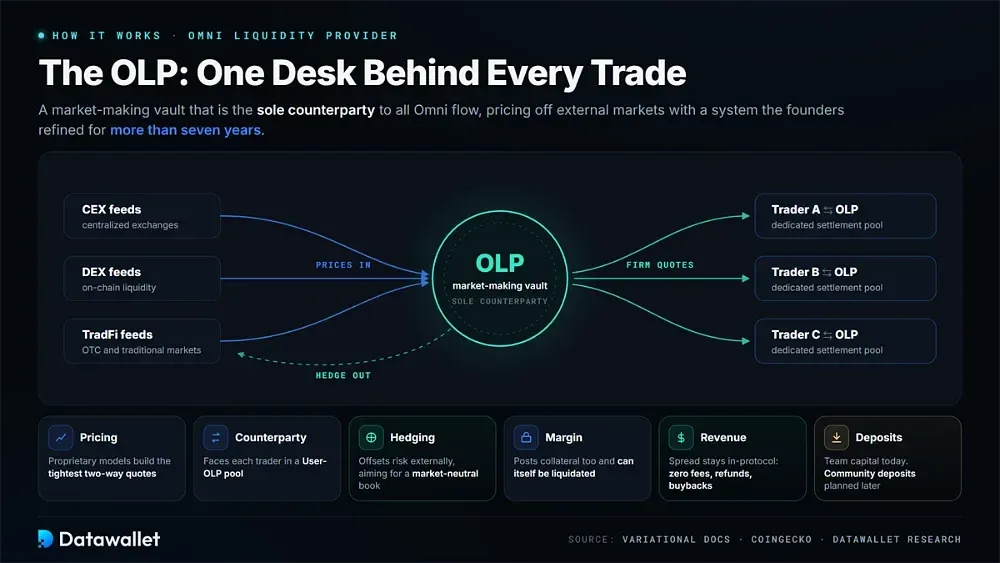
The OLP is a market-making vault and the sole counterparty to every trade placed through Omni. Its pricing engine draws on CEX, DEX and TradFi data feeds and is based on a system the founders have refined for more than seven years.
The OLP's role covers several distinct functions:
- Pricing: Proprietary algorithms process real-time information from centralised exchanges, DEXs and traditional markets to produce the tightest viable two-way quotes.
- Counterparty: Each trader faces OLP through a dedicated User-OLP settlement pool rather than trading directly against anonymous peers.
- Hedging: OLP offsets directional risk across external venues, earning spread while aiming to keep its overall book close to market-neutral over time.
- Margin: The user and OLP post collateral under the same settlement-pool rules, so the desk can itself be liquidated if it breaches margin requirements.
- Revenue: Spread income remains inside the protocol instead of flowing to external market makers, helping fund zero fees, loss refunds and treasury buybacks.
- Deposits: Team capital currently seeds the vault. Community deposits are planned after OLP establishes a market-neutral track record on mainnet.
4. Variational Pro
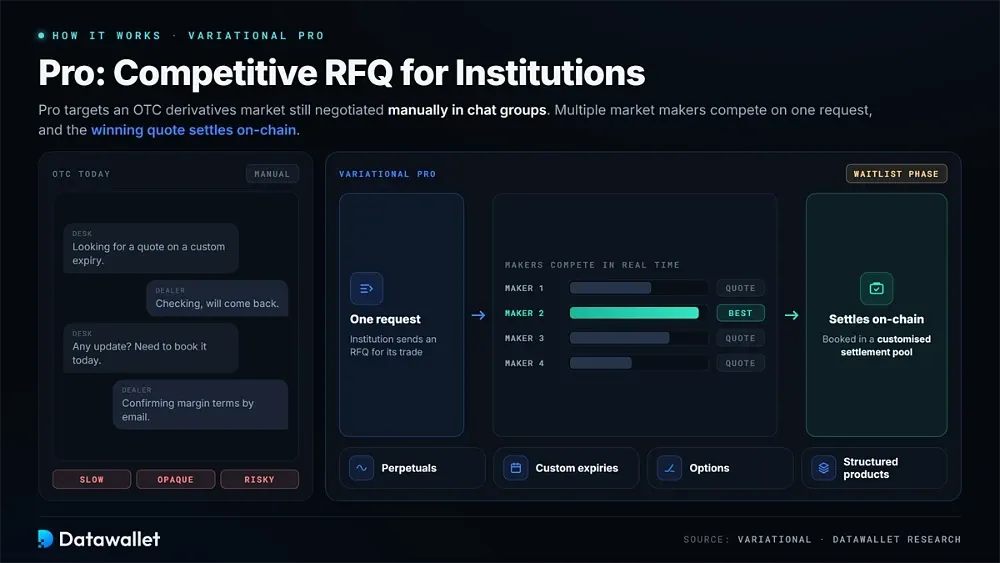
Pro is Variational's institutional application. It targets an over-the-counter derivatives market where many transactions are still negotiated manually through chat groups. The product expands the RFQ system by allowing multiple professional market makers to compete in real time for one request, after which the winning quote settles on-chain.
Settlement pools can be customised, allowing Pro to handle bilaterally agreed expiries, options and structured products in addition to conventional perpetuals. Its competitive set therefore includes traditional crypto OTC brokers and options platforms rather than only retail perpetual DEXs.
Pro is still in a waitlist phase as the team concentrates on Omni. Variational nevertheless describes the product as its long-term entry point into institutional flow, with the goal of automating the booking, clearing and margin processes that currently make bilateral derivatives slow, opaque and operationally risky.
Variational Markets
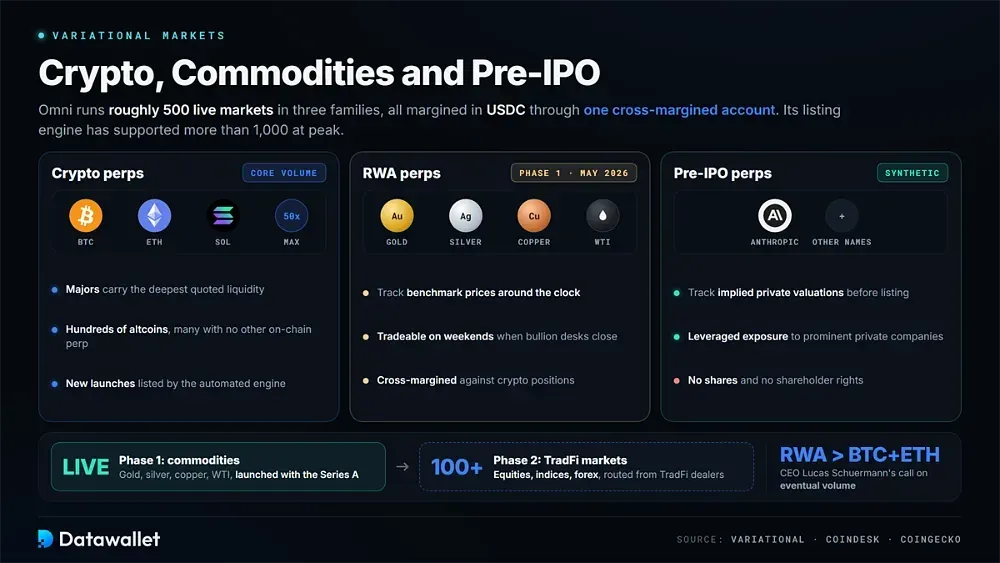
Omni has expanded beyond crypto-only perpetuals to include commodities and private-company exposure. Every market is margined in USDC through a single cross-margined account. Three market families currently account for the main product categories.
1. Crypto Perpetuals
Crypto perpetuals remain the core source of Omni's trading volume. Coverage runs from BTC and ETH to long-tail tokens that are rarely available on order-book venues. Since OLP draws liquidity from external markets, new listings can be added quickly without separate incentive campaigns.
The crypto perp range includes:
- Majors: BTC, ETH and SOL contracts offer up to 50x leverage and have the platform's deepest quoted liquidity.
- Altcoins: Hundreds of mid-cap and long-tail pairs are available, including many with no other on-chain perpetual listing.
- New launches: The automated engine can list newly issued tokens, giving traders early exposure while allowing them to define their risk.
2. RWA Perpetuals
Commodity perpetuals launched in May 2026 as Phase 1 of Variational's real-world asset rollout, coinciding with the Series A. The contracts follow benchmark prices around the clock and settle in USDC, reflecting the broader expansion of perpetual futures beyond cryptocurrency markets.
Live RWA markets include:
- Gold: Perpetual exposure tracks spot gold pricing and remains tradeable on weekends, when traditional bullion desks are closed.
- Silver and copper: Precious and industrial metals contracts can be cross-margined against crypto positions within the same account.
- WTI crude oil: The energy benchmark perpetual became notable weekend price-discovery territory during periods of geopolitical volatility.
3. Pre-IPO Perpetuals and TradFi Expansion
Omni also supports pre-IPO perpetuals, synthetic contracts that track the implied valuations of private companies before a public listing. Traders can take leveraged exposure to prominent private names, including those discussed in our guide to trading Anthropic pre-IPO futures, without owning shares or receiving shareholder rights.
Phase 2 of the RWA roadmap calls for more than 100 traditional markets covering equities, indices and forex. Rather than building liquidity through on-chain order books, Variational plans to route it directly from TradFi dealers. CEO Lucas Schuermann has argued that RWA perps will eventually exceed BTC and ETH volumes combined.
That strategy brings Variational into direct competition with builder-deployed Hyperliquid markets operating under HIP-3, as well as dedicated RWA venues such as Ostium. Each is pursuing on-chain TradFi exposure through a different market structure.
How to Trade on Variational Omni
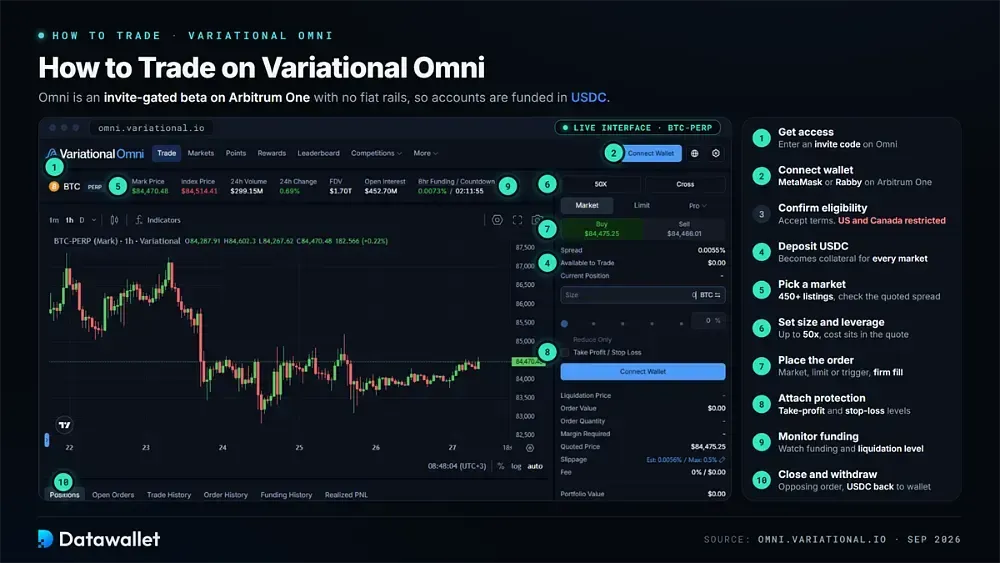
Omni remains an invite-gated private beta on Arbitrum One. Public mainnet is scheduled to open in the weeks preceding the $VAR TGE. There are no fiat funding rails, so accounts must be funded with crypto.
A typical first session looks like this:
- Get access: Visit omni.variational.io and enter a valid access code. The private beta remains invite-only until public mainnet launches.
- Connect wallet: Link an EVM wallet such as MetaMask or Rabby on Arbitrum One, or sign in on mobile through the QR code flow.
- Confirm eligibility: Accept the terms of service. US and Canadian residents are designated Restricted Persons and cannot trade.
- Deposit USDC: Send USDC on Arbitrum to your Omni account, where it becomes collateral for every supported market.
- Pick a market: Browse more than 450 listings spanning crypto, commodities and pre-IPO names, and review the quoted spread before choosing position size.
- Set leverage: Select your size and leverage, up to 50x, while remembering that the quoted all-in price already includes execution cost.
- Place the order: Submit a market, limit or trigger order. OLP provides a firm quote that fills immediately after acceptance.
- Attach protection: Set take-profit and stop-loss levels to limit the effect of sharp moves while you are away from the platform.
- Monitor funding: Follow funding payments and the estimated liquidation level in the positions panel as the market moves.
- Close and withdraw: Exit with an opposing order, then transfer USDC back to your Arbitrum wallet whenever you choose.
Variational Fees, Spreads and Funding
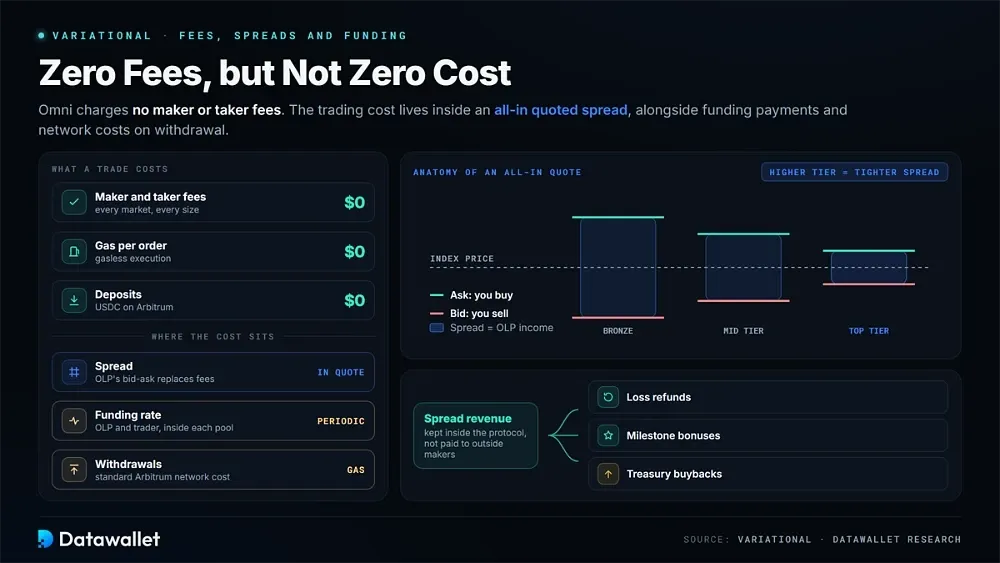
Omni advertises permanently zero trading fees, although that does not make execution costless. Trading costs are built into quoted spreads, making it important to understand pricing alongside funding and rewards before deciding how large a position to take.
The full cost picture breaks down as:
- Trading fees: Maker and taker fees are zero across every market and position size, and individual orders do not require gas payments.
- Spread: OLP earns the difference between its bid and ask, replacing the maker-taker fees used by other venues.
- Spread discounts: Higher reward tiers receive tighter effective spreads, similar to VIP fee structures on conventional exchanges.
- Funding rates: Periodic payments keep perpetual prices aligned with index values and flow between OLP and the trader inside each pool.
- Withdrawals: Depositing into Omni is free, while standard Arbitrum network costs apply when USDC is withdrawn.
- Revenue recycling: Spread revenue is used for loss refunds, milestone bonuses and treasury buybacks rather than being paid to outside market makers.
Omni Loss Refunds Explained
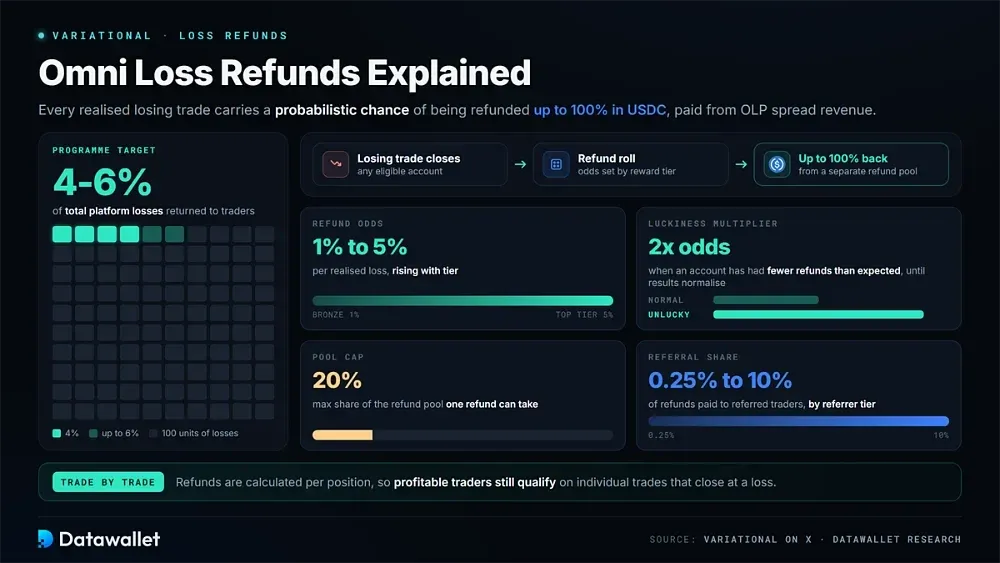
Loss refunds are Omni's defining reward mechanic and are enabled by the vertically integrated OLP structure. Whenever an eligible account realises a losing trade, there is a probabilistic chance that as much as 100% of the loss will be refunded in USDC. The programme is designed to return about 4-6% of total platform losses.
The mechanism works through several moving parts:
- Refund odds: Every realised loss has a 1% to 5% probability of a refund, determined by the account's reward tier starting from Bronze.
- Luckiness Multiplier: If an account has received fewer refunds than statistical expectations imply, its odds double until results normalise.
- Referral share: Referrers receive between 0.25% and 10% of refunds paid to referred traders, depending on the referrer's own tier.
- Pool cap: One refund cannot exceed 20% of the dedicated refund pool, preventing a single trade from exhausting it.
- Funding source: Refund payments come from OLP spread revenue stored in pools separate from the vault's trading capital.
- Profitability neutral: Refunds are calculated trade by trade, meaning profitable traders can still receive them on individual positions that close at a loss.
Variational Points and the $VAR Airdrop
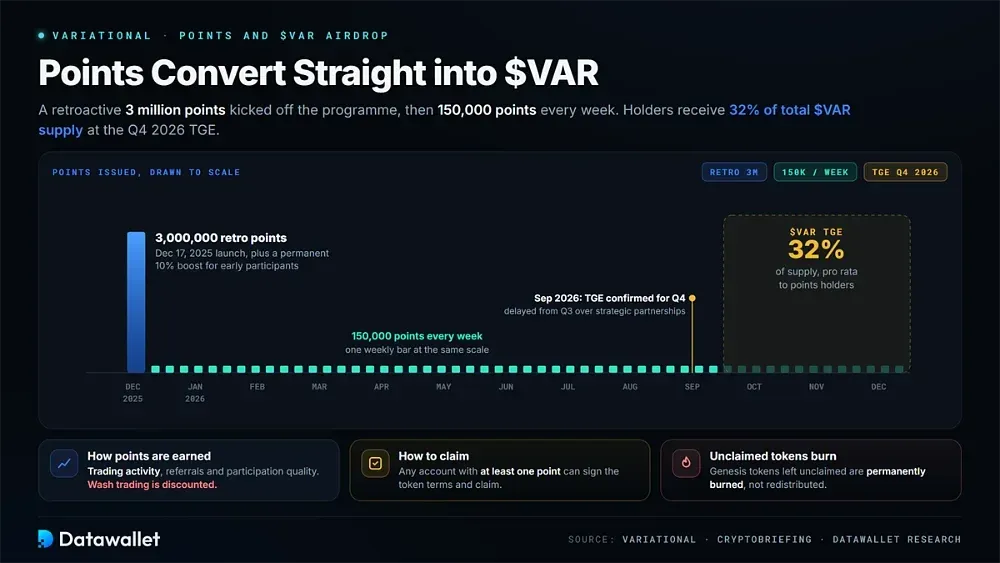
Omni introduced its points programme on December 17, 2025, including a retroactive distribution of 3 million points to existing traders. Early participants also received a permanent 10% boost. Since launch, another 150,000 points have been allocated each week according to trading activity, referrals and participation quality, while wash trading is explicitly discounted.
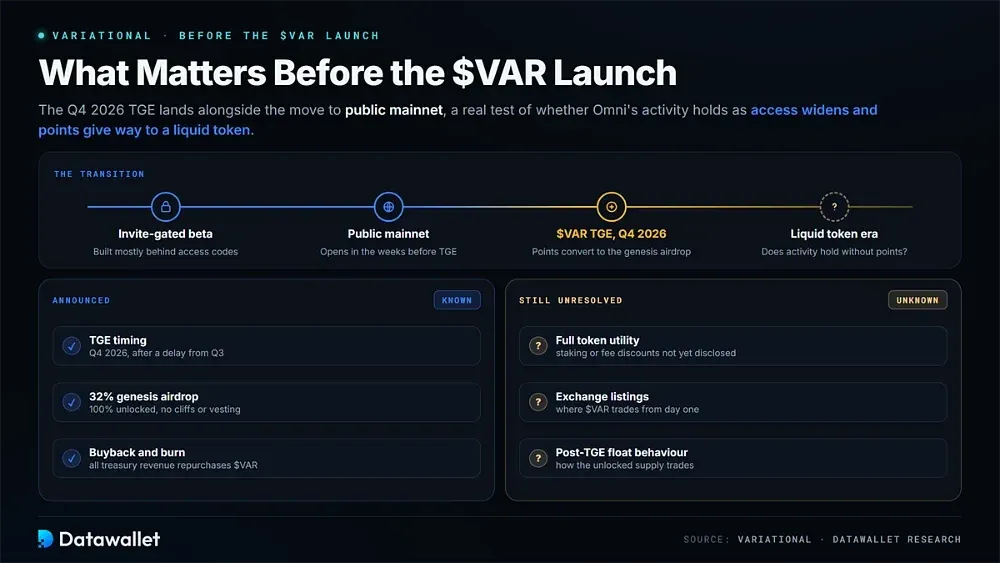
Those points convert directly into the genesis airdrop. In September 2026, Variational confirmed that the $VAR TGE is set for Q4 2026. Points holders will receive 32% of total token supply on a proportional basis, and accounts with at least one point can sign the token terms and claim.
Weekly point distributions will continue through the TGE. The launch was delayed from its previous Q3 target because of unannounced strategic partnerships that the team says will reshape its TradFi ambitions. Anyone following upcoming airdrops should also note that unclaimed genesis tokens will be permanently burned rather than redistributed.
$VAR Tokenomics
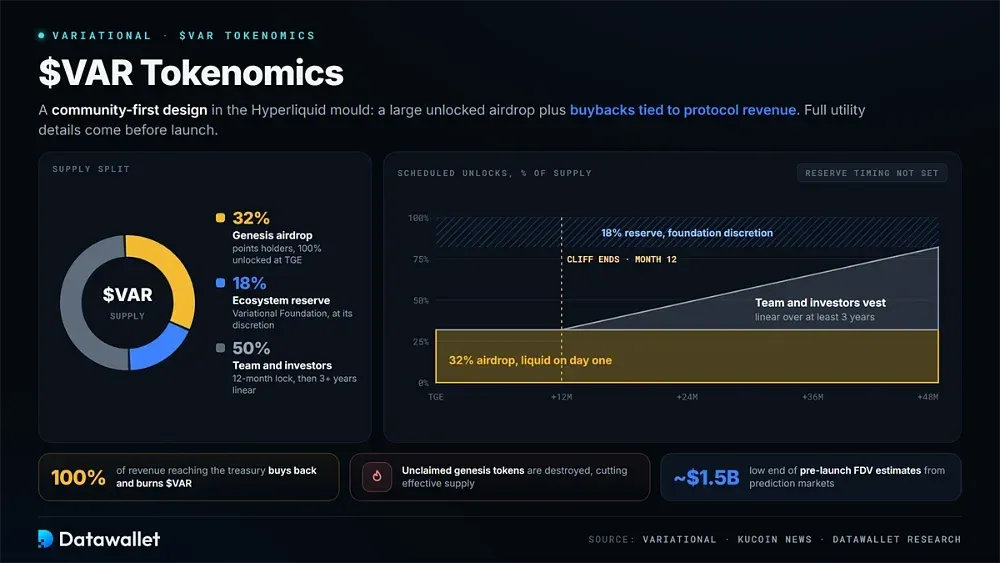
The initial $VAR design follows the community-first model popularised by Hyperliquid, combining a large unlocked airdrop with aggressive buybacks tied to protocol revenue. Variational has said that full utility details, including any potential staking or fee-discount functions, will be announced before launch.
The announced structure divides supply into three buckets:
- Genesis distribution: 32% of supply goes to points holders and will be 100% unlocked at TGE, with no cliffs or vesting.
- Ecosystem reserve: 18% is controlled by the Variational Foundation for growth initiatives, with allocation decisions left to the foundation's discretion.
- Team and investors: 50% remains locked for 12 months after TGE before vesting linearly over at least three more years.
- Buyback and burn: All revenue reaching the treasury, or 100%, will be used to repurchase $VAR on the open market and burn it.
- Unclaimed burns: Any genesis tokens left unclaimed by eligible users will be permanently destroyed, further reducing effective circulating supply.
- Valuation debate: Pre-launch estimates from prediction and analytics markets ranged from around $1.5 billion FDV to substantially more speculative figures.
What Matters Before the $VAR Launch
The Q4 2026 token generation event will mark more than the start of $VAR trading. It also coincides with Variational's transition toward public mainnet, when a platform developed largely inside an invite-gated beta will face a broader user base without the same access constraints.
That makes the period around launch an important test of whether Omni's activity can remain strong as participation expands and the existing points programme gives way to a liquid token.
Several details are still unresolved.
Variational has not yet disclosed the full utility of $VAR, including whether it will have functions beyond the announced distribution and revenue-linked mechanics. Listings and post-TGE float behaviour are also unknown.
Those disclosures will determine how closely the token is tied to actual protocol use, rather than simply serving as the endpoint for the points campaign, and should provide a clearer picture of how Variational intends to align users with the platform after launch.
Is Variational Safe?
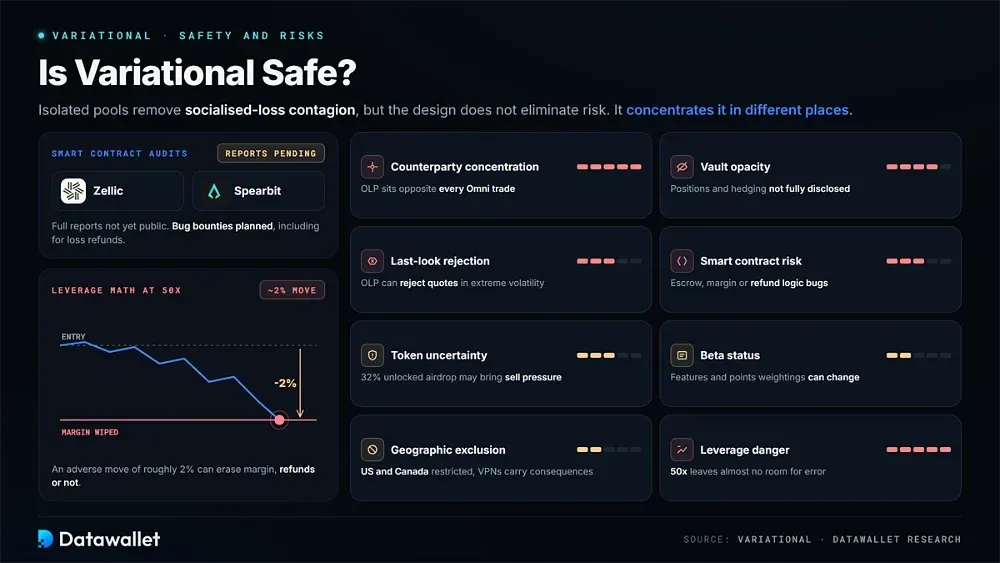
Variational's smart contracts have undergone audits by Zellic and Spearbit, two respected security firms. Full public reports had not been released at the time of writing, and the team has indicated that bug bounties are planned around features including loss refunds. Its peer-to-peer pool structure also removes the socialised-loss contagion seen on pooled venues during events such as the October 10 crash.
The architecture does not eliminate risk. Instead, it concentrates risk in different parts of the system, making it important for traders to understand their exposure before depositing meaningful amounts of capital.
Key risks include:
- Counterparty concentration: OLP stands opposite every Omni trade, making its solvency fundamental to all settlement pools on the platform.
- Vault opacity: OLP does not fully disclose its positions or hedging performance, so users depend on team reporting when assessing the vault's health.
- Last-look rejection: During extreme volatility, the RFQ structure allows OLP to reject quotes, potentially preventing fills when traders most want to execute.
- Smart contract risk: Audits lower the likelihood of vulnerabilities but cannot eliminate exploitable bugs in escrow, margin or refund logic.
- Beta status: Omni is still a gated private beta, meaning features, points weightings and access rules can change at the team's discretion.
- Geographic exclusion: Users in the US and Canada are restricted, while VPN circumvention can carry legal and eligibility consequences.
- Leverage danger: With 50x leverage, an adverse move of roughly 2% can wipe out margin entirely, regardless of the refund programme.
- Token uncertainty: Final $VAR utility and listings remain unknown, as does post-TGE float behaviour. A 32% fully unlocked airdrop also creates the possibility of early sell pressure.
How Does Variational Compare to Hyperliquid?
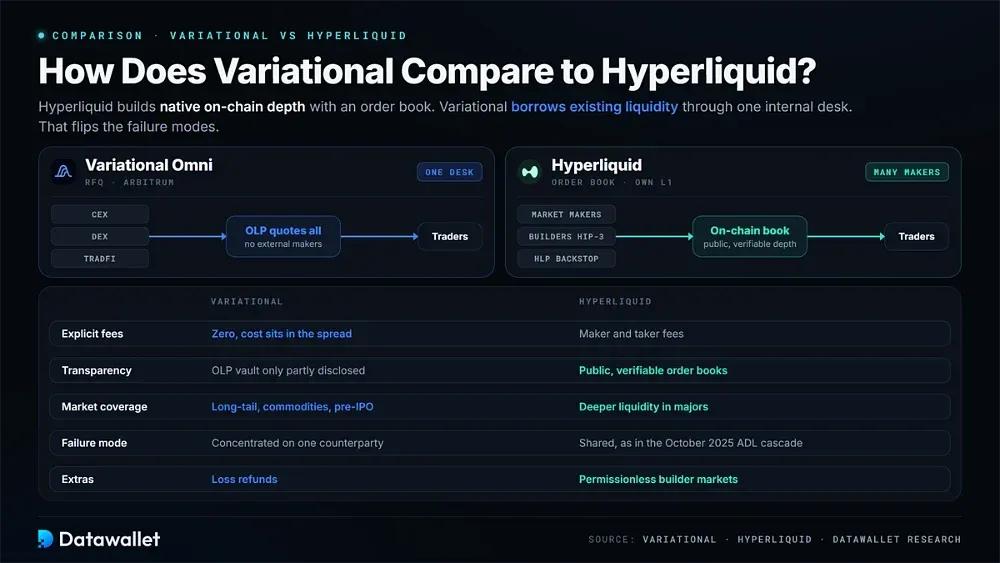
Hyperliquid remains the benchmark. It operates a fully on-chain order book on its own Layer 1, with the HLP vault backstopping liquidations while external market makers provide most quotes. Variational reverses that structure: it uses no order book or external makers, relying instead on one internal desk to quote all markets on Arbitrum.
The central difference lies in where liquidity originates. Hyperliquid develops native on-chain depth and allows builders to deploy markets permissionlessly. Variational draws on existing CEX, DEX and TradFi liquidity through OLP, arguing that order books cannot efficiently anchor thousands of thin RWA markets without continuous incentives.
The two structures also produce different failure modes. Hyperliquid users share exposure to system-wide events such as the October 2025 auto-deleveraging cascade. Omni users instead face concentrated exposure to a single counterparty whose operations are only partially transparent. Order-book competitors such as Lighter are structurally closer to Hyperliquid.
In practical terms, traders are choosing between fees and spreads as well as transparency and market coverage. Hyperliquid provides public, verifiable order books and deeper liquidity in major markets. Variational combines zero explicit fees with loss refunds and access to long-tail commodity and pre-IPO markets that order books seldom support.
Variational Founders
Variational was co-founded by CEO Lucas Schuermann and Edward Yu. Their backgrounds overlapped in quantitative finance and computer science, including time at Columbia University. Before building the protocol, both spent years operating systematic trading and market-making strategies at hedge funds.
The OLP pricing engine developed directly from the market-making system the founders had run and refined for more than seven years across traditional and crypto venues. Instead of bringing in outside liquidity providers, Variational effectively productised that internal trading desk and made its profitability the protocol's revenue base.
Schuermann has become the project's main public advocate for its RWA thesis. He told CoinDesk that real-world asset perpetuals will eventually exceed bitcoin and ether derivatives combined. The Cayman Islands-based company is backed by Dragonfly, Bain Capital Crypto, Peak XV, Coinbase Ventures and Mirana.
Final Thoughts
Variational is among the few perpetuals projects trying to establish a genuinely different market structure instead of building another faster order book. Its isolated settlement pools and vertically integrated liquidity operation work together with spread-funded rewards as one coherent system rather than a set of disconnected features.
The zero-fee trading and loss-refund model is backed by economics that order-book competitors cannot easily reproduce. Its RWA and pre-IPO catalogue also reaches markets the Hyperliquid ecosystem is only starting to address. The Q4 2026 $VAR launch, including a fully unlocked 32% airdrop and buybacks funded by total treasury revenue, will test whether that structure can build durable loyalty.
The central limitation is equally clear: the same desk prices, fills and stands behind every Omni trade. Traders willing to exchange order-book transparency for broader market coverage and tighter all-in costs may find Omni compelling, but position sizing still needs to account for high leverage and the system's single point of counterparty trust.