





Datawallet Newsletter · Issue #870
Blur to Shut Frontend as NFT Volume Sinks 99%

This article has been reviewed and verified for accuracy by our editorial team. All claims, data points and platform details are cross-referenced against primary sources.
- Data accuracy verified
- Sources cross-referenced
- Platform details confirmed
Some links on this page are affiliate links. Datawallet may earn a commission when you sign up through them, at no extra cost to you. This never influences our editorial ratings, rankings or recommendations.
Read our full disclosureGM. Blur will shut down its frontend next month as monthly NFT trading volume sinks below $7 million from a $1.43 billion peak, sending BLUR down more than 20%.
Elsewhere, Ledger confirmed a seed-stealing implant in CryptoBilis units, Trezor cut its reseller network from January 2027, and South Korea blocked 27 unregistered exchanges including KuCoin.
Pour a coffee and scroll through the full rundown below. 👇
01
Blur to Shut Frontend as NFT Volume Sinks 99%
NFT marketplace Blur will shut down its frontend next month, though its onchain marketplace protocol stays live and BLUR keeps control of the fee switch. Its lending product Blend stops matching new loans on November 12, leaving borrowers until then to repay or let positions default.
Monthly volume on Blur peaked near $1.43 billion in March 2023 and had collapsed below $7 million exactly three years later, per The Block's data. The BLUR token sank more than 20% on the news to around $0.015, a roughly $44 million market cap against highs above $5.
The exit lands days after Blast, the Ethereum Layer 2 built by Blur founder Tieshun Roquerre and the same core team, said it would wind down, followed by Abstract. Roquerre had vowed in early 2023 to build the Binance of NFTs, the year he publicly revealed his identity.
Critics long accused Blur of incentive-driven trading that rewarded airdrop farming and suspected wash trading while squeezing creator royalties. Its low-royalty policy intensified the marketplace wars and dented revenue at Yuga Labs, the company behind Bored Ape Yacht Club, and its Blast ties raised questions over token-fueled growth.
1/ The https://t.co/zPQ1jqR7pT frontend will be deprecated on November 12, 2026. This deprecation only applies to the frontend. The Blur marketplace protocol will remain operational on-chain, and $BLUR will continue to control its fee switch.
— Blur (@blur_io) October 12, 2026
02
Ledger Confirms Seed-Stealing Implant as MediaMarkt Halts Sales
Ledger's Donjon security team confirmed a hardware implant inside signers sold by Southeast Asian reseller CryptoBilis that captures the 24-word recovery phrase during setup and transmits it over LTE through a provisioned eSIM. The implant leaves the Secure Element and operating system untouched, so tampered devices sign transactions normally.
MediaMarkt Saturn pulled affected Ledger devices from its stores and website on October 13 after a German customer reported an implant, though no funds were lost. Ledger still calls the $86 million loss estimate unverified and urged victims to contact law enforcement before opening their Ledger signer.
Update on Ledger devices at MediaMarkt Saturn 🔽 As of Oct. 13th, MediaMarkt Saturn has stopped, with Ledger’s alignment, the sale of Ledger devices in their stores and online while the investigation continues, following the report of an implant from one customer in Germany. No loss of funds were reported. We have no indication that Ledger's infrastructure, systems or services were compromised. Ledger Support is reviewing user reports, and Ledger’s cybersecurity experts, the Donjon will be examining the devices we receive: https://t.co/QzukOZdEzq. If you have questions about a device you bought, contact Ledger Support at https://t.co/QzukOZdEzq. Ledger will never call you, message you directly or ask for your 24-word recovery phrase. Many claims and figures circulating online are unverified. Scammers often try to take advantage of incidents like this. Rely only on official Ledger and MediaMarkt Saturn channels for updates. We will share more as the investigation continues.
— Ledger (@Ledger) October 13, 2026
03
Trezor Ends Reseller Authorizations From January 1, 2027
Trezor told partners their reseller authorization ends on January 1, 2027, cutting its network after Ledger found spy implants in wallets sold through CryptoBilis. The company insists there is not a single piece of evidence its devices were compromised, calling the cut a preventive step to vet sellers closely.
Affected Trezor resellers get no new stock but may sell remaining inventory through the holiday season, while those kept face tighter sourcing and storage rules. Rival OneKey revoked CryptoBilis too, offering free replacements for devices bought there between March 1 and October 13, regardless of model.
To the resellers who helped build Trezor: thank you, and I’m sorry 💔 https://t.co/RK7KBJOshp
— Danny (@Dantoshi) October 13, 2026
04
South Korea Blocks 27 Unregistered Crypto Exchange Websites
South Korea's Financial Intelligence Unit is blocking websites of 27 unregistered crypto exchanges, including KuCoin, BitMart and MEXC, after the Korea Communications Standards Commission approved the measures following reviews on October 6 and 7. Overseas sites will be blocked, while domestically operated ones face service termination.
The crackdown extends last year's mobile app restrictions, and regulators can now seek blocks without a court ruling or proof of customer losses. The FIU has referred 44 operators to investigators, only 28 providers hold registration, and an estimated $110 billion left Korean exchanges in 2025.
JUST IN: South Korea blocks access to KuCoin, MEXC and BingX websites among 27 platforms. • Blocked: Phemex, Poloniex, BTCC, and Bitmart. • Prior bans already removed their mobile apps. https://t.co/AJSVqR6M0r
— Bitcoin Archive (@BitcoinArchive) October 13, 2026
05
Data of the Day
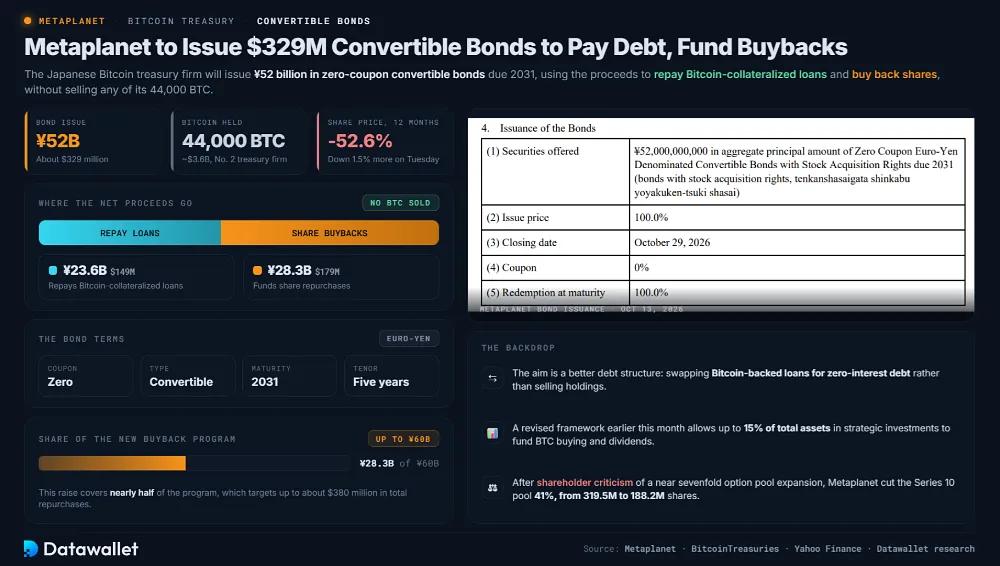
Metaplanet will issue 52 billion yen, about $329 million, in zero-coupon euro-yen convertible bonds due in 2031. Roughly 23.6 billion yen ($149 million) will repay bitcoin-collateralized loans and about 28.3 billion yen ($179 million) will fund share buybacks under a program targeting up to 60 billion yen.
The structure trims reliance on loans without selling any of its 44,000 BTC, worth $3.6 billion, which make it the second-largest bitcoin treasury firm. Shares still closed 1.5% lower in Tokyo, extending a 52.6% 12-month slide, following September backlash over an expanded executive stock option pool.
06
More Breaking News
- Sberbank secured approval to trade crypto as Russia's largest bank joined the central bank's exchange register, planning to open crypto trading to all clients on December 1.
- Interactive Brokers added Ethereum staking for eligible clients through zerohash, crediting rewards as additional staked ETH that compounds, its first step beyond crypto trading and transfers.
- A London court ruled Chinese law governs victims' claims to 61,000 BTC seized from fraudster Zhimin Qian, boosting the UK's chances of keeping the roughly $5 billion haul.
- Strive added 3,311 BTC for $280 million, its largest buy since January, lifting holdings to 32,773 BTC, still 11,227 BTC behind second-placed public bitcoin treasury Metaplanet.
- Bitmine added 12,532 ETH worth about $31.9 million, lifting holdings to 6.03 million ETH, while Tom Lee said the Ethereum treasury firm is nearly done stacking.
- Strategy bought 250 more BTC for $21.5 million, lifting its holdings to a record 848,250 BTC, and spent $192.4 million repurchasing its STRC preferred stock.
- Binance will shut its mining pool and cloud mining on November 10, retiring a legacy unit as the exchange pivots toward AI trading tools and US stock options.
- Meta released its Muse Wonder models, the first frontier-class releases from its Superintelligence Labs, with API pricing of $4 per million input tokens matching Claude Opus 5.5.
For the latest updates on digital asset markets, follow us on X @Datawalletcom.


