



Compare Top Prediction Markets
1. Polymarket
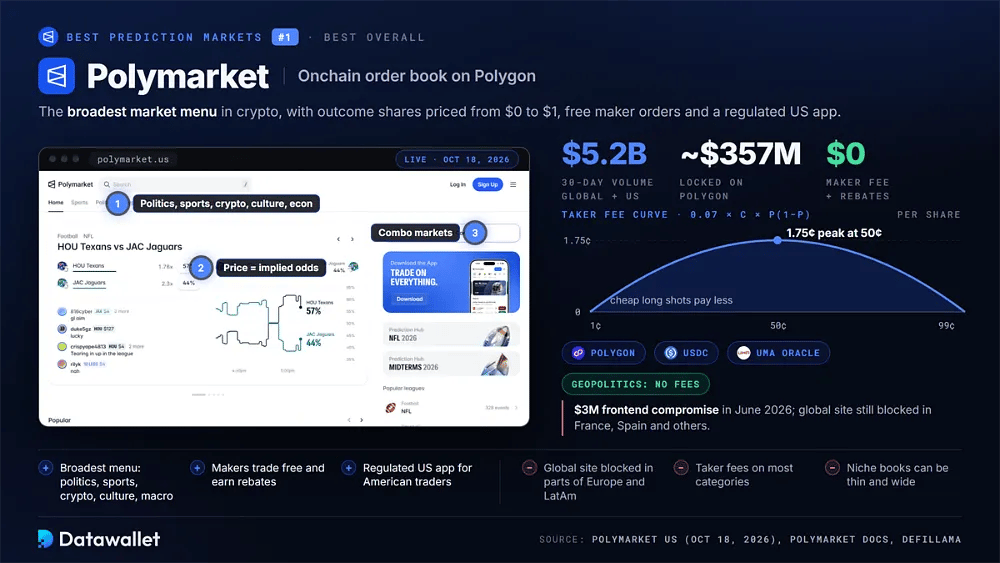
Polymarket keeps our top spot because no crypto-native venue matches its market breadth, brand recognition and settlement transparency. DefiLlama shows roughly $357 million locked on Polygon and $5.2 billion in 30-day volume across its global exchange and US app, with new political, sports, macro and AI markets appearing daily.
Trading runs through a central limit order book where outcome shares price between $0 and $1. Takers pay a category-based fee of up to 0.07 × C × p(1−p), while makers trade free and earn rebates. Geopolitical markets carry no fees, and newer combo markets let traders bundle several outcomes into one position.
The weak spots are access and operational risk. Polymarket's global site remains blocked in France, Spain and several other jurisdictions, and its share of sector volume has slipped as Kalshi's sports business surged. A $3 million frontend compromise in June 2026 also showed that onchain settlement does not remove every risk.
Pros
- Broadest market menu across politics, sports, crypto, culture and macro events.
- Makers trade free and earn rebates funded by taker fees.
- Regulated US app adds a compliant route for American traders.
Cons
- Global exchange remains blocked in several European and Latin American countries.
- Taker fees now apply to most categories outside geopolitics.
- Niche markets can still show thin books and wide spreads.
2. Kalshi
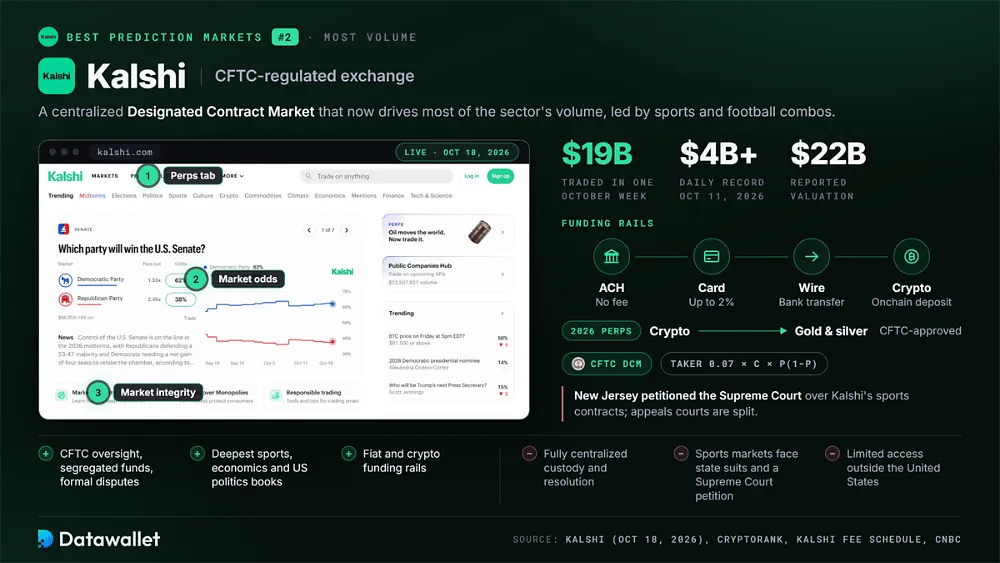
Kalshi ranks second because it now drives most of the sector's volume, even though it is a centralized, CFTC-regulated exchange. CryptoRank data shows Kalshi processing $19 billion in a single October week, and it set a daily record above $4 billion on October 11 as football combos surged.
Its structure is the selling point. Kalshi operates as a Designated Contract Market, charges a published taker fee of 0.07 × C × P(1−P), and supports ACH, card, wire and crypto deposits. In 2026 it also added CFTC-approved perpetual futures on crypto, then gold and silver, widening its product range.
The tradeoff is legal exposure rather than custody risk. New Jersey has petitioned the Supreme Court over Kalshi's sports contracts, and appeals courts are split on whether states can enforce gambling laws. A loss could shrink sports markets, which generate most of Kalshi's activity and underpin its reported $22 billion valuation.
Pros
- CFTC oversight brings surveillance, segregated funds and formal dispute processes.
- Highest liquidity in sports, economics and US political event contracts.
- Fiat and crypto funding rails suit mainstream and Web3 users alike.
Cons
- Fully centralized custody and resolution, so it is not decentralized.
- Sports markets face state lawsuits and a pending Supreme Court petition.
- Access outside the United States is limited and changes often.
3. Predict Fun
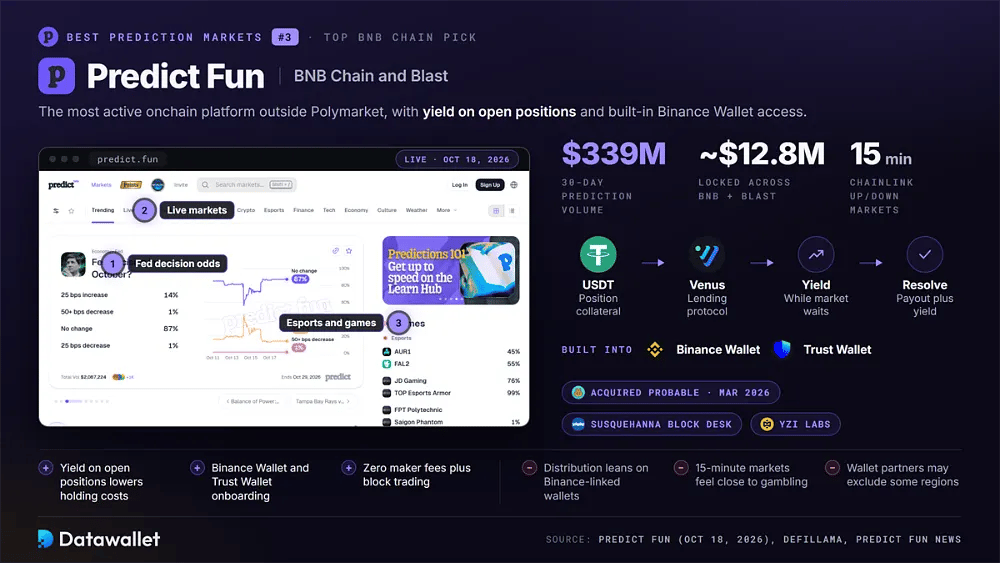
Predict Fun climbs to third because it has become the most active onchain venue outside Polymarket. DefiLlama tracks about $339 million in 30-day prediction volume and roughly $12.8 million locked across BNB Chain and Blast, ahead of every other crypto-native challenger on both measures in mid-October 2026.
Distribution is its edge. Predict Fun powers the prediction tab inside Binance Wallet and Trust Wallet, and its March 2026 acquisition of Probable folded a PancakeSwap-incubated rival into one liquidity pool. Collateral in open positions is routed into Venus Protocol, so USDT keeps earning yield while markets wait to resolve.
Recent launches lean toward faster trading. Chainlink-powered 15-minute crypto and stock up/down markets went live in 2026, and Susquehanna Crypto supplies liquidity for a block-trading desk aimed at larger orders. YZi Labs and Susquehanna also made a follow-on investment, though the platform still has no token and depends on Binance-linked distribution.
Pros
- Yield on open positions reduces the cost of holding long-dated markets.
- Binance Wallet and Trust Wallet integrations simplify onboarding for millions.
- Zero maker fees and block trading support active and larger traders.
Cons
- Heavy reliance on Binance-linked wallets concentrates distribution and regulatory risk.
- Short 15-minute markets can feel closer to gambling than forecasting.
- Regional eligibility through wallet partners may exclude some users.
4. OPINION
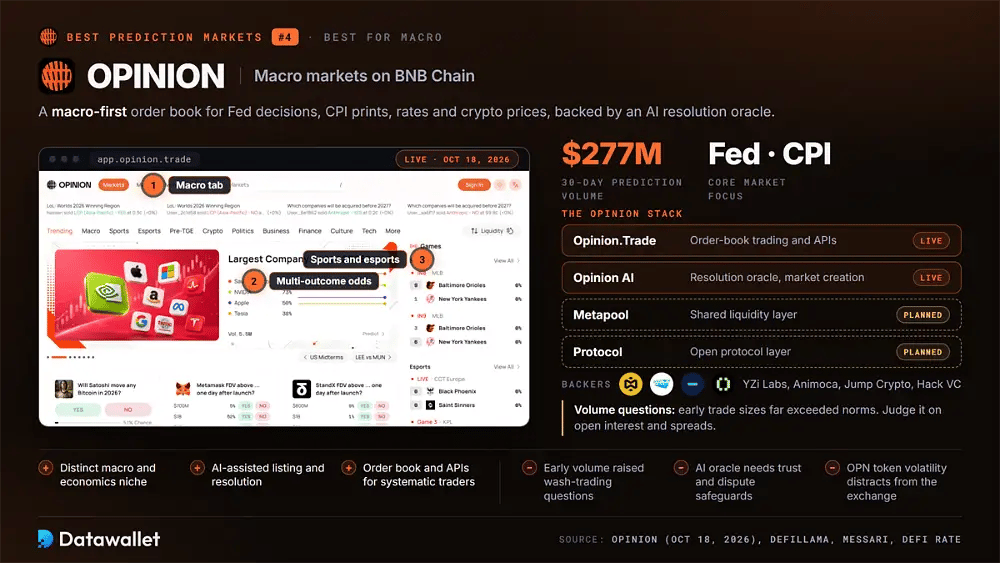
OPINION holds fourth thanks to a clear macro focus and steady activity after a volatile launch year. DefiLlama shows about $277 million in 30-day prediction volume on BNB Chain, with markets centered on Fed decisions, CPI prints, interest rates and crypto prices rather than meme-driven questions.
The platform is built as a stack. Opinion.Trade handles order-book trading, Opinion AI acts as the resolution oracle and market-creation assistant, and planned Metapool and Protocol layers target shared liquidity, according to Messari. Backers include YZi Labs, Animoca Ventures, Jump Crypto and Hack VC across seed and pre-Series A rounds.
Caution is still warranted. DeFi Rate questioned OPINION's early volume because average trade sizes far exceeded industry norms, and the OPN token has fallen sharply from its February 2026 peak. We like the product, but traders should judge it on open interest and spreads rather than headline volume.
Pros
- Macro and economic markets give it a distinct niche among onchain venues.
- AI-assisted market creation and resolution speed up listings and settlement.
- Order-book design and APIs suit systematic and data-driven traders.
Cons
- Earlier volume patterns raised wash-trading questions that still need clarity.
- AI oracle resolution requires trust and transparent dispute safeguards.
- OPN token volatility can distract from the core exchange product.
5. Hyperliquid HIP-4
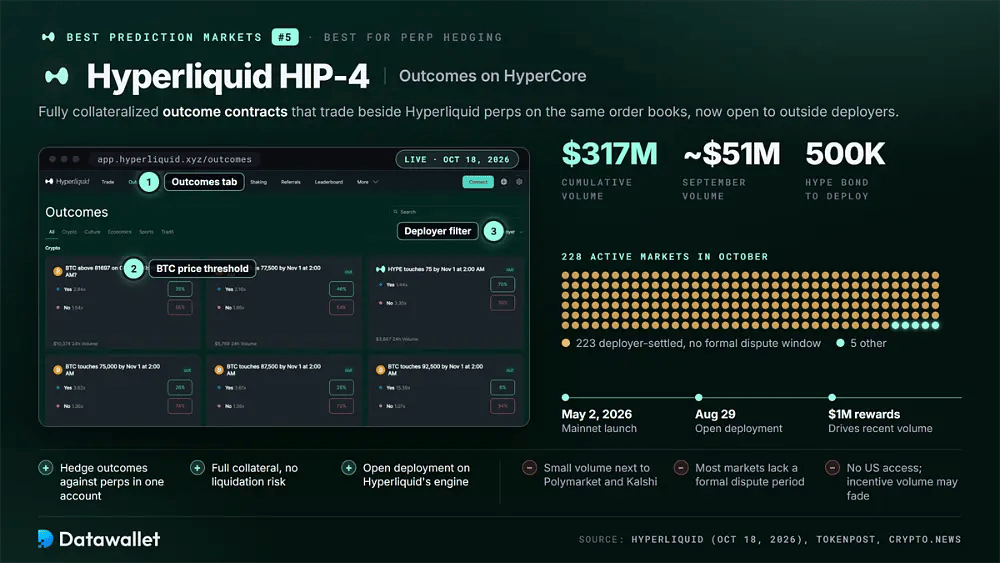
Hyperliquid HIP-4 drops to fifth, not because the design disappointed but because traction has lagged. Since its May 2, 2026 mainnet launch, HIP-4 has logged about $317 million in cumulative volume, including roughly $51 million in September, according to TokenPost, well behind BNB Chain rivals.
The architecture remains compelling. Outcome contracts are fully collateralized, settle between 0 and 1, and trade on the same HyperCore order books as Hyperliquid perps. Since August 29, outside deployers such as Outcome can bond 500,000 HYPE to list markets from validator-approved templates, opening the system beyond the core team.
Resolution is the main concern. Of 228 active markets in October, 223 relied on deployer-controlled settlement without a formal dispute window, and much recent activity came from a $1 million rewards program. Sports and crypto-price markets drive most volume, so depth across macro, politics and culture remains thin for now.
Pros
- Outcomes trade beside perps, letting traders hedge inside one account.
- Full collateralization removes liquidation risk on event positions.
- Open deployment lets new venues build on Hyperliquid's matching engine.
Cons
- Volume remains small relative to Polymarket, Kalshi and BNB Chain rivals.
- Most markets lack a formal dispute period before settlement.
- Not available to US traders, and incentive-driven volume may fade.
6. XO Market
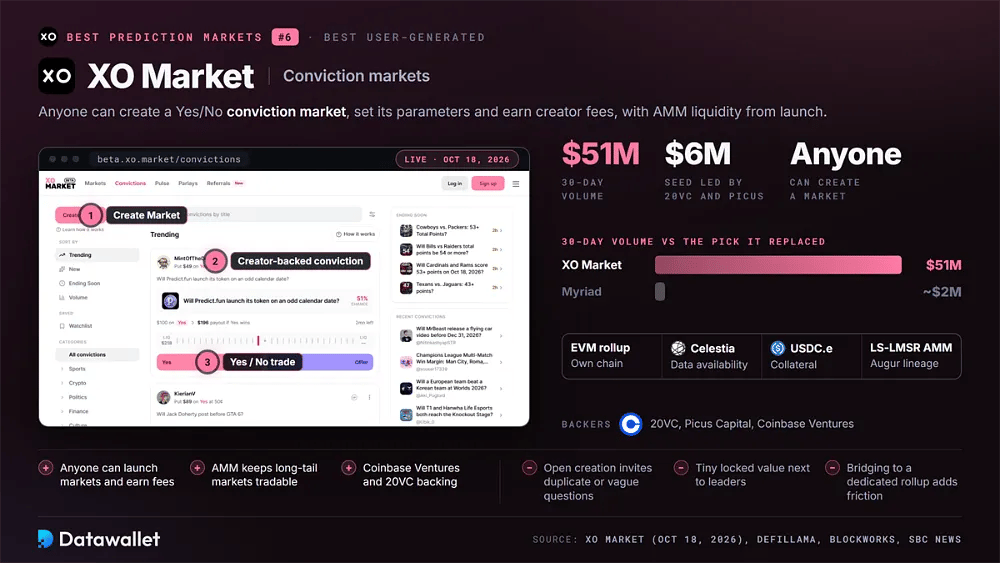
XO Market replaces Myriad Markets as our pick for user-generated forecasting. Instead of a central listing team, anyone can create a Yes/No "conviction market," set its parameters and earn creator fees. DefiLlama records about $51 million in 30-day volume, far above Myriad's roughly $2 million.
The protocol runs on its own EVM rollup using Celestia for data availability, with USDC.e as collateral. It relies on an adaptive liquidity AMM descended from Augur's LS-LMSR model, so niche markets can trade without waiting for professional market makers to quote both sides of every book.
Backing is credible for an early project. XO closed a $6 million seed round led by 20VC and Picus Capital, with Coinbase Ventures participating. Planned XO Vaults aim to let ordinary users supply liquidity, although open market creation also raises moderation, duplication and resolution questions that curated venues avoid.
Pros
- Anyone can launch markets and earn fees from their trading activity.
- AMM liquidity keeps long-tail markets tradable without dedicated market makers.
- Coinbase Ventures and 20VC backing support continued development.
Cons
- Open creation invites low-quality, duplicate or ambiguous market questions.
- Locked value remains tiny compared with leading prediction venues.
- Bridging to a dedicated rollup adds friction for beginners.
7. SX Bet
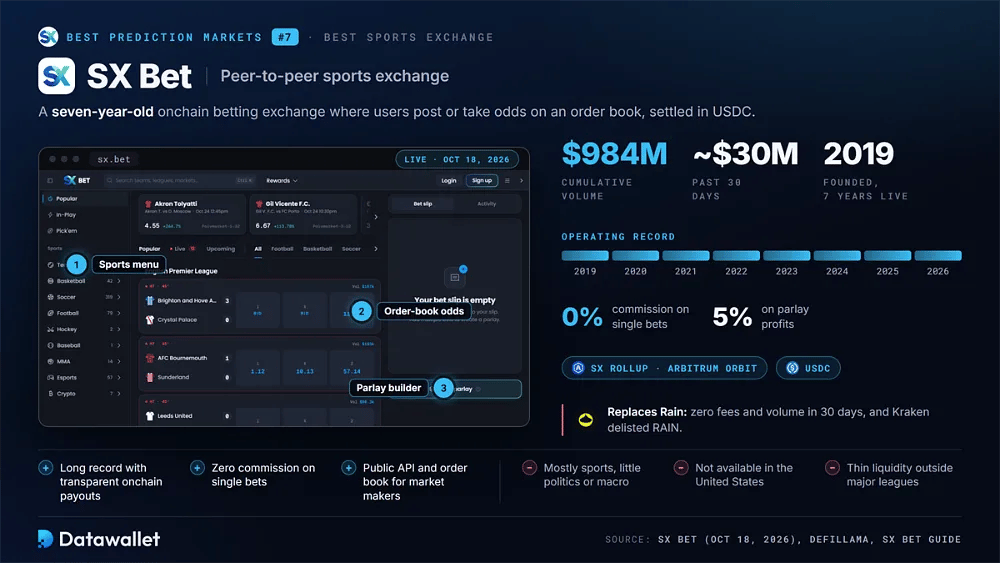
SX Bet replaces Rain as our protocol-level wild card, swapping a token-driven story for a seven-year operating record. Founded in 2019, the peer-to-peer sports exchange has processed about $984 million in cumulative volume, and DefiLlama shows roughly $30 million traded over the past 30 days.
It works like an onchain betting exchange. Users post or take odds through an order book on SX Rollup, an Arbitrum Orbit chain, with Arbitrum access for cross-chain funding. SX Bet's own guide lists 0% commission on single bets and 5% on parlay profits, settled in USDC.
Rain dropped out because its activity collapsed. DefiLlama shows zero Rain fees and volume over the past 30 days despite a multibillion-dollar token valuation, and Kraken has delisted RAIN. SX Bet's own limits are a narrow sports focus and unavailability to users in the United States.
Pros
- Long operating history with transparent onchain settlement and payouts.
- Zero commission on single bets keeps costs low for sports traders.
- Public API and order book suit market makers and arbitrage strategies.
Cons
- Market selection is mostly sports, with limited politics or macro coverage.
- Not available to users in the United States or restricted regions.
- Liquidity outside major leagues can be shallow and slow to fill.
What Is a Decentralized Prediction Market?
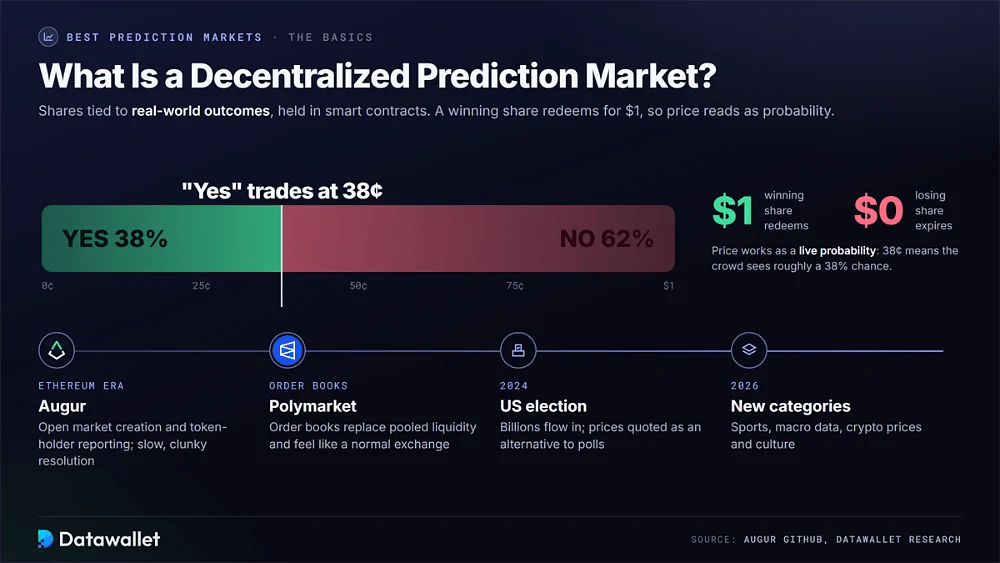
A decentralized prediction market is a trading venue where users buy and sell shares tied to real-world outcomes using a crypto wallet instead of a brokerage account. Smart contracts hold the collateral, match or record trades, and release payouts once the result is confirmed, so no single company controls the money.
Each share represents a claim on one outcome. In a binary market, a winning share redeems for $1 and a losing share expires worthless, which means the trading price works as a live probability estimate. If "Yes" trades at 38 cents, the crowd is pricing roughly a 38% chance the event happens.
The model traces back to Augur, an Ethereum protocol that pioneered open market creation and token-holder reporting. Augur proved the concept but struggled with slow resolution and clunky design, and later platforms such as Polymarket replaced its pooled liquidity with order books that felt closer to a normal exchange.
Mainstream attention arrived with the 2024 US election, when billions flowed into presidential markets and prices became a widely quoted alternative to polls. By 2026 the category had expanded into sports, macro data, crypto prices and culture, with our guide to prediction markets explained covering the fundamentals in more depth.
How Do Prediction Market Contracts Work?
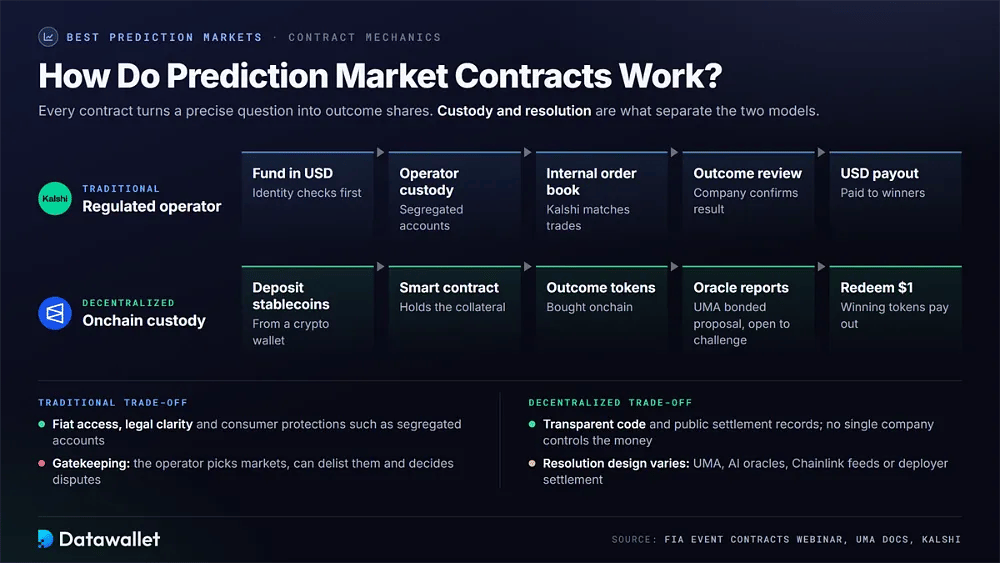
Every prediction market contract turns a precise question into tradable outcome shares. Prices shift as traders react to news, and settlement depends on a defined data source, deadline and resolution process that decides which side ultimately receives the $1 payout.
Traditional Prediction Markets
Traditional, centralized venues list event contracts through a regulated operator that holds customer funds, runs identity checks and settles trades internally. Kalshi, for example, matches buyers and sellers on its own order book and confirms results through an internal outcome review before paying winners in US dollars.
The benefits are fiat access, legal clarity and consumer protections such as segregated accounts. The cost is gatekeeping: the operator chooses which markets exist, can delist contracts under regulatory pressure, and decides disputed outcomes itself. Users trust the company and its regulator rather than transparent code and public settlement records.
Decentralized Prediction Markets
Decentralized venues move custody and settlement onchain. Traders deposit stablecoins, buy outcome tokens through a smart contract, and redeem winning tokens after an oracle reports the result. Polymarket uses UMA's Optimistic Oracle, where a bonded proposer submits an answer that anyone can challenge during a dispute window.
Other designs vary widely. OPINION uses an AI oracle, Predict Fun relies on Chainlink feeds for short crypto and stock markets, and HIP-4 deployers settle many markets directly. That variety matters, because the resolution method, not the interface, determines whether a correct forecast actually gets paid.
Prediction Market Trends Shaping 2026
Prediction markets in 2026 look less like a crypto niche and more like a new exchange category. Record volume, institutional capital, new product types and a federal-versus-state legal fight are reshaping which platforms win traders and why.
Record Volume and Shifting Market Share
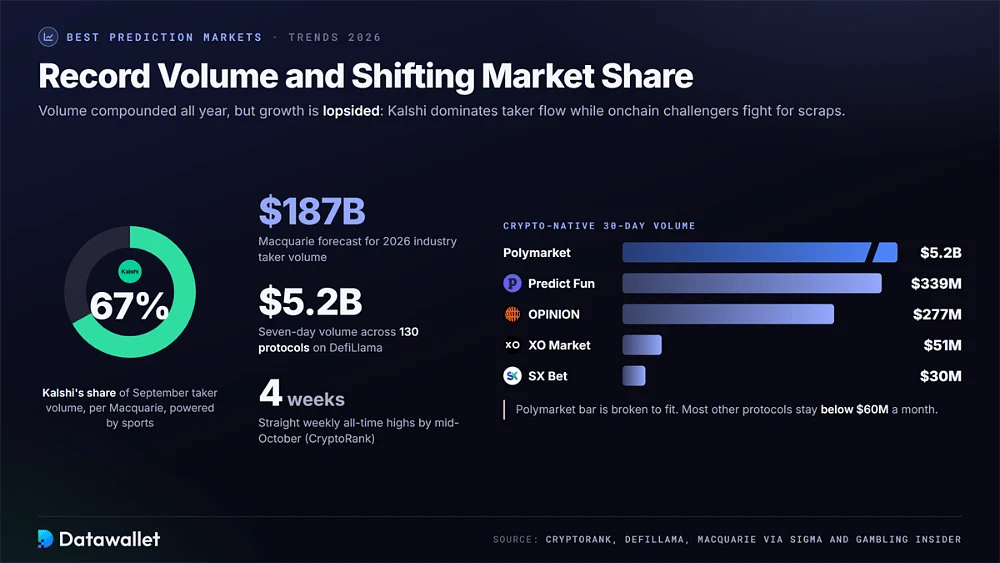
Volume has compounded throughout 2026. CryptoRank recorded a fourth straight weekly all-time high in mid-October, and DefiLlama's prediction market dashboard shows about $5.2 billion in seven-day volume across 130 tracked protocols. Macquarie analysts now forecast roughly $187 billion in industry taker volume for the full year.
The growth is lopsided. Kalshi held about 67% of September taker volume in Macquarie's estimate, powered by sports contracts, while Polymarket leads crypto-native venues by a wide margin. Among onchain challengers, Predict Fun and OPINION each process hundreds of millions monthly, while most other protocols stay below $60 million. Our prediction market statistics page tracks the broader numbers.
Key Themes Driving the Sector
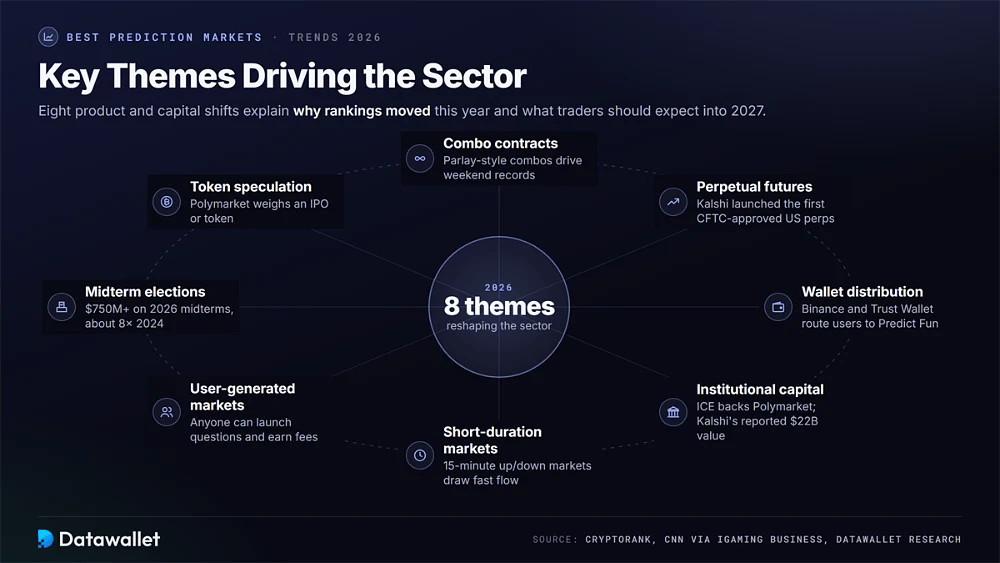
Beyond raw volume, several product and capital trends are changing how prediction markets operate. These themes explain why rankings moved this year and which features traders should expect to see across platforms in 2027.
These are the developments reshaping prediction markets right now:
- Combo Contracts: Parlay-style combos now drive weekend records on Kalshi and Polymarket, letting traders link several outcomes into one position with higher payouts and higher fees.
- Perpetual Futures: Kalshi launched the first CFTC-approved US perps in June 2026, and Polymarket now lists perps too, blurring lines between prediction venues and derivatives exchanges.
- Wallet Distribution: Binance Wallet and Trust Wallet route users directly into Predict Fun, showing how embedded access inside major wallets can rival standalone apps for onboarding.
- Institutional Capital: ICE's backing of Polymarket and Kalshi's reported $22 billion valuation show traditional finance treating event contracts as exchange infrastructure rather than niche consumer betting.
- Short-Duration Markets: Fifteen-minute crypto and stock up/down markets on Predict Fun, Polymarket and HIP-4 attract high-frequency flow but raise concerns about gambling-style product design.
- User-Generated Markets: XO Market and similar protocols let anyone launch questions and earn fees, expanding long-tail coverage while creating new moderation and resolution challenges for platforms.
- Midterm Elections: More than $750 million had traded on 2026 US midterm contracts by mid-October, roughly eight times the 2024 down-ballot total, according to CNN data.
- Token Speculation: Polymarket is reportedly weighing an IPO or native token, while OPINION and Rain show how token valuations can drift far from actual platform usage.
What to Watch Into 2027
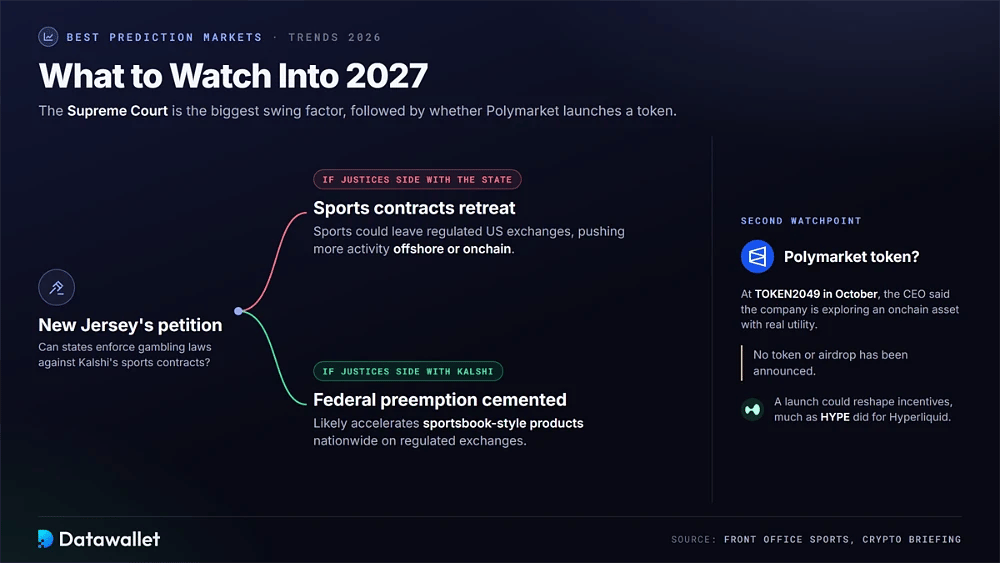
The biggest swing factor is the Supreme Court. If the justices take New Jersey's petition and side with the state, sports contracts could retreat from regulated US exchanges, pushing more activity offshore or onchain. A ruling for Kalshi would cement federal preemption and likely accelerate sportsbook-style products nationwide.
Token decisions are the second watchpoint. Polymarket's CEO said at TOKEN2049 in October that the company is exploring an onchain asset with real utility, though no token or airdrop has been announced. Any launch would reshape incentives across the sector, much as HYPE did for Hyperliquid's ecosystem.
Which Prediction Market Fits Your Strategy?
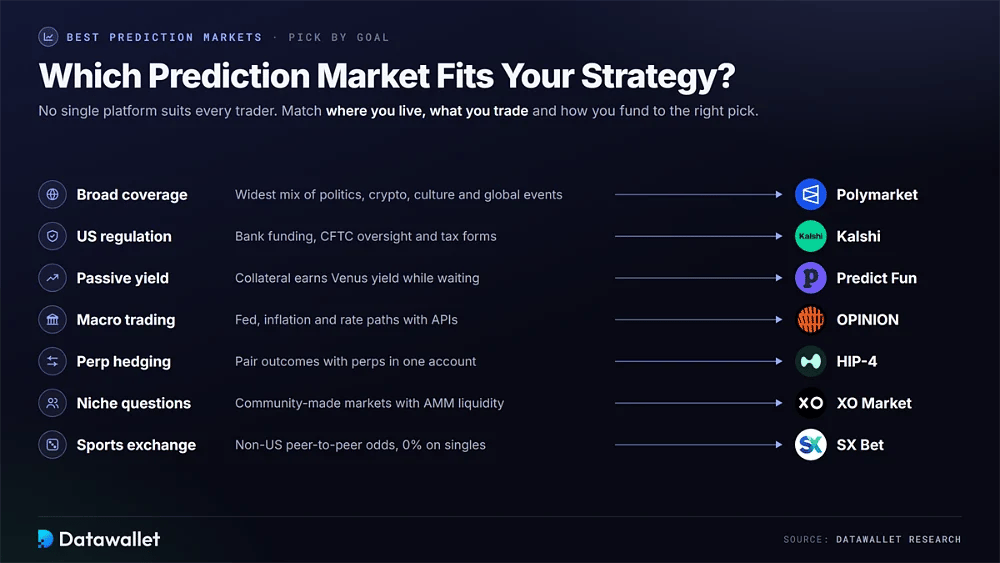
No single venue suits every trader. The right platform depends on where you live, which events you follow, how you fund accounts and whether you value regulation, onchain custody or permissionless market creation.
Match your trading goal to the platform that serves it best:
- Broad Coverage: Polymarket suits traders who want the widest mix of politics, crypto, culture and global events, with self-custody and deep books on headline markets.
- US Regulation: Kalshi fits Americans who prefer bank funding, CFTC oversight and tax forms, especially for sports, economics and election contracts traded in USD.
- Passive Yield: Predict Fun works for BNB Chain users holding long-dated positions, because collateral earns lending yield through Venus while the market waits to resolve.
- Macro Trading: OPINION targets traders focused on Fed decisions, inflation prints and rate paths, offering order-book execution and APIs for systematic strategies on BNB Chain.
- Perp Hedging: HIP-4 helps Hyperliquid users pair outcome positions with perpetual futures, such as hedging a Bitcoin perp with a price-threshold contract in one account.
- Niche Questions: XO Market lets communities create markets on topics curated venues ignore, from local events to creator-driven questions, with AMM liquidity from launch.
- Sports Exchange: SX Bet gives non-US sports traders peer-to-peer odds, zero commission on single bets and low-cost USDC settlement on an Arbitrum-based rollup.
How to Choose a Crypto Prediction Market
Picking a crypto prediction market means weighing legal access, total trading costs, liquidity, settlement rules and chain support together. The best fit matches your jurisdiction, wallet setup, preferred event categories and comfort with centralized versus onchain risk.
Step 1: Check Access and Regulation
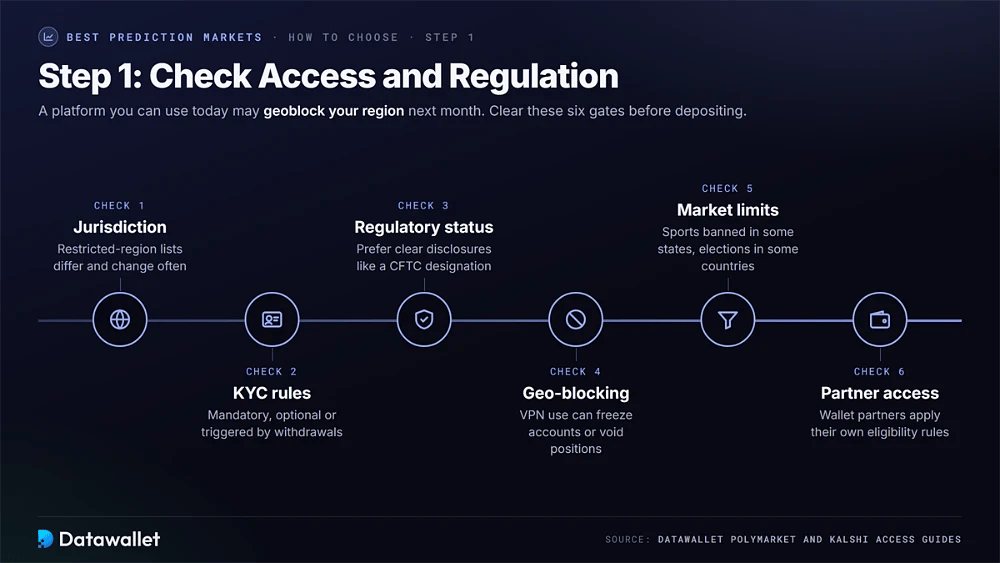
Access rules change faster than most traders expect, and a platform you can use today may geoblock your region next month. Confirming eligibility before depositing protects you from frozen balances and forced position closures.
Run through these checks before funding any account:
- Jurisdiction: Confirm the platform serves your country or state*, since Polymarket, Kalshi and BNB Chain venues each maintain different and frequently updated restricted-region lists.
- KYC Rules: Find out whether identity checks are mandatory, optional or triggered later by withdrawals, fiat deposits, larger balances or access through partner wallets.
- Regulatory Status: Prefer venues with clear disclosures, such as Kalshi's CFTC designation or Polymarket US's licensed exchange, over platforms that never explain their legal position.
- Geo-Blocking: Avoid using a VPN to bypass restrictions, because platforms can freeze accounts, void positions or refuse withdrawals once they detect location spoofing.
- Market Limits: Check category restrictions, since sports contracts face state bans in parts of the US while election markets are prohibited in several countries.
- Partner Access: Wallet integrations like Binance Wallet or Trust Wallet may apply their own eligibility rules, separate from the underlying prediction protocol's terms.
*For complete details, see our Polymarket restricted countries list and Kalshi availability guide before depositing, since geoblocks and close-only rules can change without much notice.
Step 2: Compare Fees and Funding
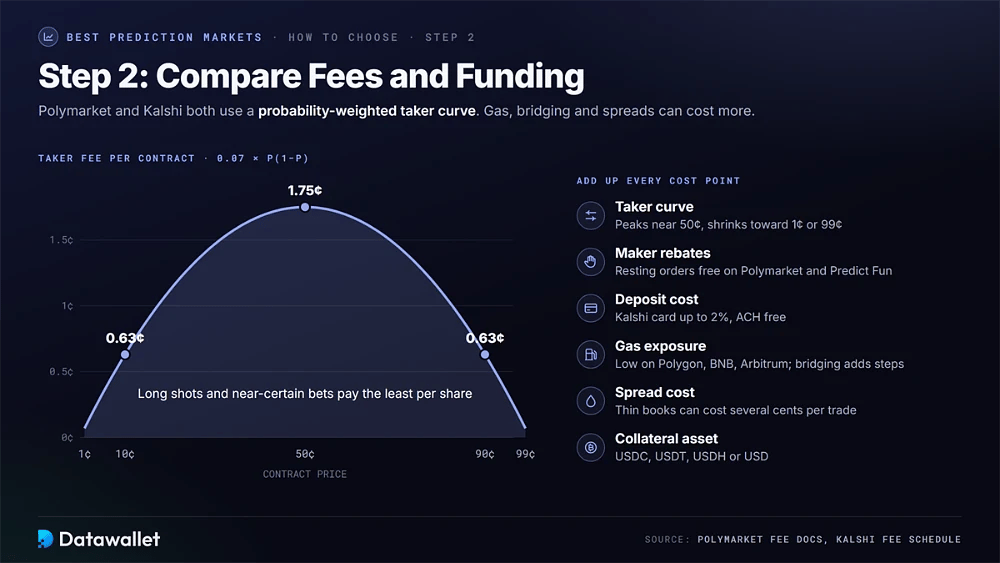
Headline fees rarely tell the full story. Both Polymarket and Kalshi now use probability-weighted taker curves, while onchain venues add gas, bridging and conversion costs that can outweigh the trading fee itself.
Add up these cost points before placing a trade:
- Taker Curve: Polymarket and Kalshi fees peak near 50-cent prices and shrink toward 1 or 99 cents, so cheap long shots cost less per share.
- Maker Rebates: Resting limit orders are free on Polymarket and Predict Fun, and some venues pay rebates, rewarding patient traders who provide liquidity.
- Deposit Cost: Kalshi charges up to 2% on card deposits but nothing on ACH, while onchain venues may route through MoonPay or exchange withdrawals.
- Gas Exposure: Polygon, BNB Chain and Arbitrum keep gas low, but bridging into HyperCore or a dedicated rollup can add steps and small fees.
- Spread Cost: Thin books can cost more than any published fee, because entering or exiting larger positions may push prices several cents against you.
- Collateral Asset: Check whether markets settle in USDC, USDT, USDH or USD, and review the safest stablecoin options before converting funds.
Step 3: Evaluate Liquidity and Market Depth
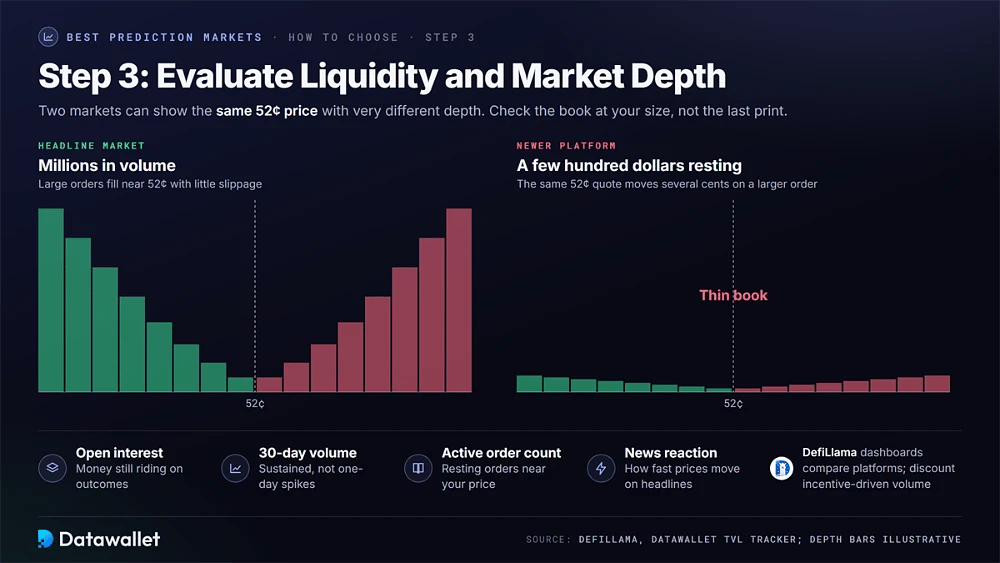
Liquidity separates a usable market from a misleading one. Headline Polymarket and Kalshi markets often carry millions in volume, while newer venues may show attractive prices backed by only a few hundred dollars of resting orders. Always check depth at the price you intend to trade, not just the last print.
Useful signals include open interest, 30-day volume, active order count and how quickly prices react to news. Dashboards like DefiLlama and our total value locked tracker help compare platforms, while incentive-heavy venues deserve extra scrutiny because rewards can inflate activity temporarily.
Step 4: Review Resolution and Oracle Design
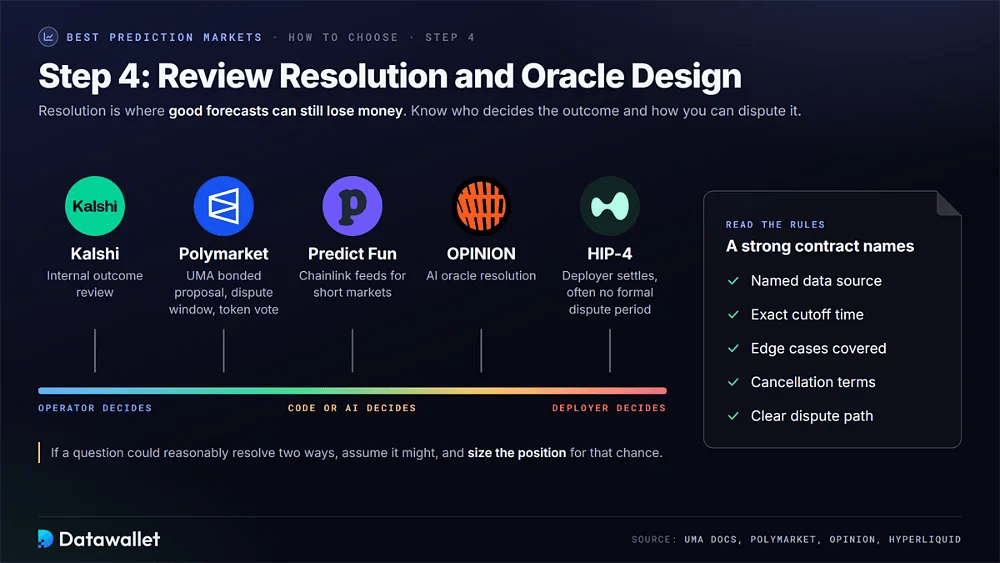
Resolution is where good forecasts can still lose money. Centralized venues decide outcomes internally, Polymarket relies on UMA's bonded proposals and token-holder votes, OPINION uses an AI oracle, and many HIP-4 markets settle directly by deployer without a formal dispute period.
Read every rule before trading. Strong contracts name the data source, cutoff time, edge cases, cancellation terms and dispute path. If a question could reasonably resolve two ways, assume it might, and size your position for the chance that settlement goes against an otherwise correct prediction.
Step 5: Match Chains, Wallets and User Experience
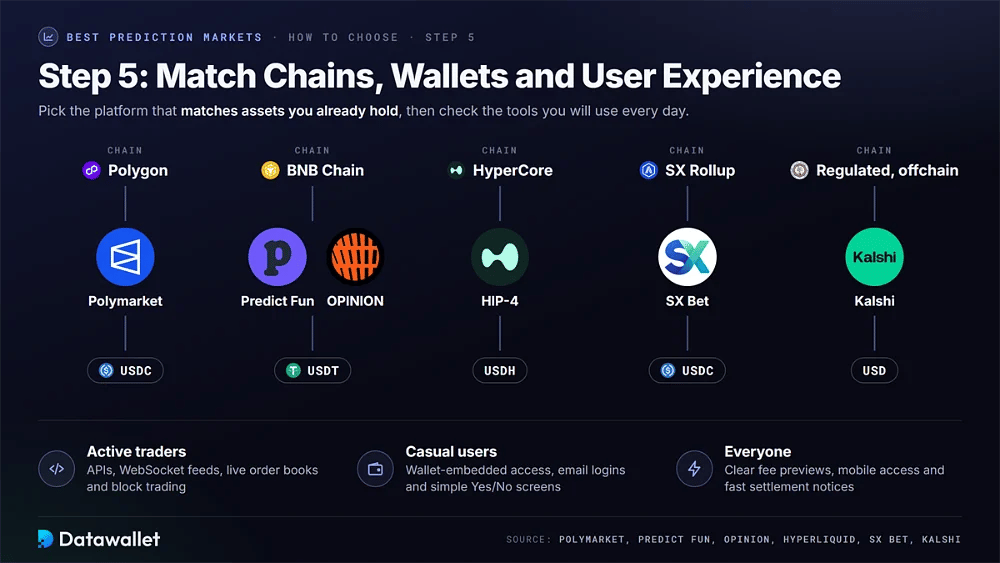
Chain support decides how easily you fund, trade and withdraw. Polymarket runs on Polygon with USDC, Predict Fun and OPINION on BNB Chain with USDT, HIP-4 on Hyperliquid's HyperCore, and SX Bet on its own Arbitrum Orbit rollup, so pick the venue that matches assets you already hold.
For daily use, look for clear fee previews, live order books, mobile access and fast settlement notices. Active traders may want APIs, WebSocket feeds and block trading, while casual users usually benefit more from wallet-embedded access, email logins and simple Yes/No interfaces.
Are Prediction Market Platforms Legal?
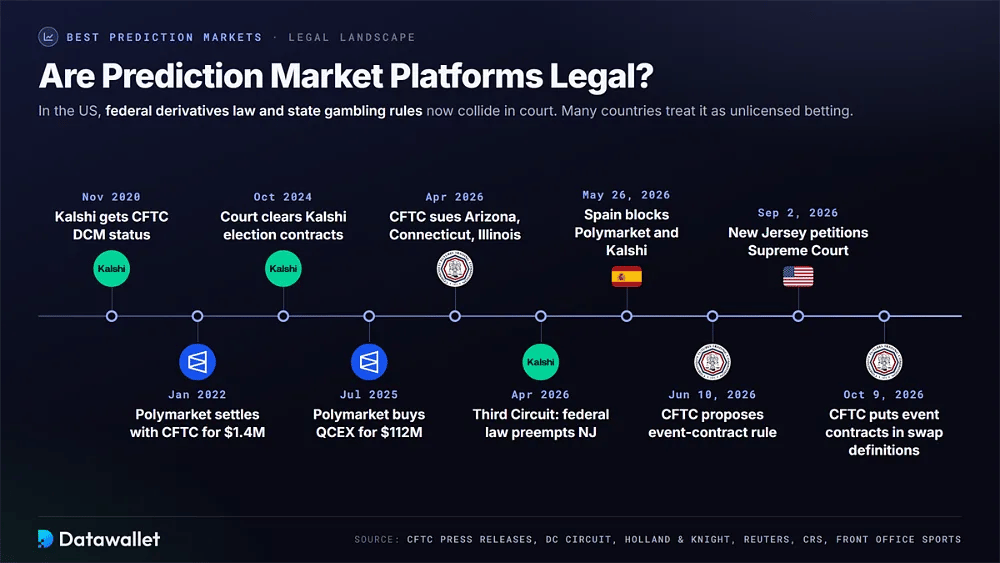
Legality depends on the venue's structure, the event category and your location. In the United States, federal derivatives law and state gambling rules now collide in court, while many other countries treat prediction markets as unlicensed betting.
These dates trace how the legal landscape has shifted:
- Nov. 4, 2020: Kalshi received CFTC designation as a contract market, creating the first federally regulated US exchange built specifically around event contracts for retail traders.
- Jan. 3, 2022: Polymarket settled CFTC charges, paying $1.4 million and agreeing to block US users after offering unregistered event-based binary options.
- Oct. 2, 2024: A federal appeals court let Kalshi list congressional-control contracts, rejecting the CFTC's emergency request and opening regulated US election markets before that year's vote.
- Jul. 21, 2025: Polymarket acquired CFTC-licensed exchange QCEX for $112 million, building the licensed foundation for its later US app launch.
- Apr. 2026: The CFTC sued Arizona, Connecticut and Illinois to defend exclusive federal jurisdiction, later adding New York and other states to its campaign against state enforcement.
- Apr. 2026: The Third Circuit ruled that federal law preempts New Jersey's gambling rules for Kalshi's sports contracts, though other circuits later reached opposite conclusions.
- May 26, 2026: Spain blocked Polymarket and Kalshi during a gambling-license investigation, showing that legality outside the US still depends heavily on national betting regimes.
- Jun. 10, 2026: The CFTC proposed a new event-contract rule codifying case-by-case public-interest reviews, replacing the withdrawn 2024 proposal that would have broadly restricted political and sports contracts.
- Sep. 2, 2026: New Jersey asked the Supreme Court to decide whether states can enforce gambling laws against Kalshi's sports contracts after appeals courts split.
- Oct. 9, 2026: The CFTC issued one rule and proposed another explicitly placing event contracts within swap definitions, strengthening its federal preemption argument in pending litigation.
How Accurate Are Prediction Markets?
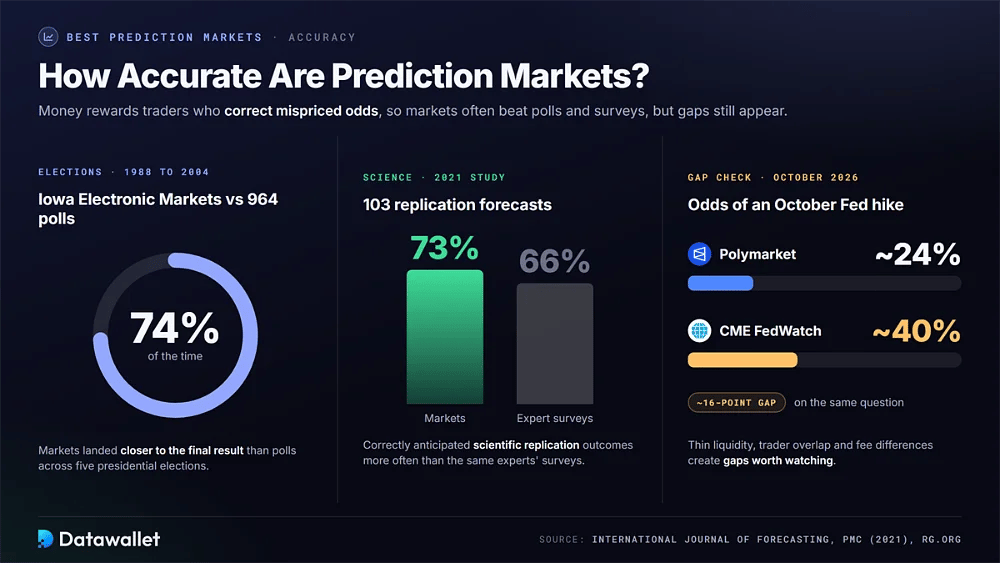
Prediction markets tend to be accurate because money rewards traders who correct mispriced odds. The Iowa Electronic Markets study compared market forecasts with 964 polls across five US presidential elections from 1988 to 2004 and found markets closer to the final result about 74% of the time.
The evidence extends beyond politics. A 2021 analysis of 103 replication forecasts found prediction markets correctly anticipated 73% of scientific replication outcomes, compared with 66% for surveys of the same experts. That edge comes from continuous updating and the incentive to act on private information rather than simply state an opinion.
Accuracy is not guaranteed, though. In October 2026, Polymarket priced an October Fed hike near 24% while CME FedWatch implied roughly 40%, and Polymarket and Kalshi often price identical Bitcoin targets several points apart. Thin liquidity, trader overlap and fee differences all create gaps worth watching.
Risks of Prediction Markets
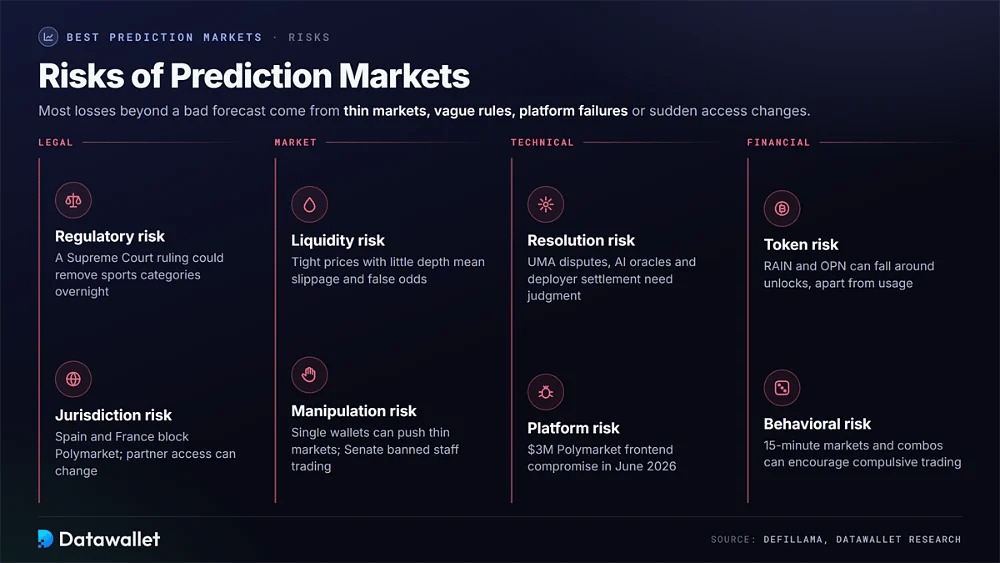
Prediction markets offer useful signals, but they carry legal, technical, financial and behavioral risks. Most losses beyond a bad forecast come from thin markets, vague rules, platform failures or sudden changes in who is allowed to trade.
Understand these risks before committing capital:
- Regulatory Risk: Courts and regulators are still deciding whether event contracts are swaps or gambling, and an adverse Supreme Court ruling could remove entire sports categories overnight.
- Jurisdiction Risk: Spain and France have blocked Polymarket, and access through wallet partners can change quickly, potentially leaving users unable to open new positions or withdraw smoothly.
- Resolution Risk: UMA disputes, AI oracles and deployer-settled HIP-4 markets each introduce judgment calls, so ambiguous wording can turn a correct forecast into a losing trade.
- Liquidity Risk: Many onchain markets show tight prices with little depth behind them, creating slippage, poor fills and misleading probabilities, especially in niche or newly launched questions.
- Manipulation Risk: Thin markets can be pushed by single wallets, and the US Senate banned members and staff from trading after insider-trading concerns grew in 2026.
- Platform Risk: Polymarket suffered a $3 million frontend compromise in June 2026, proving that interfaces, approvals and smart contracts can fail regardless of forecast quality.
- Token Risk: Platform tokens like RAIN and OPN can fall sharply around unlock events and may not reflect real usage, so token exposure adds volatility beyond trading.
- Behavioral Risk: Fifteen-minute markets, combos and app-style interfaces can encourage compulsive trading, which is why regulators increasingly compare some products to casino-style gambling.
Final Thoughts
The 2026 prediction market landscape rewards platforms that combine real liquidity with clear settlement and reliable access. Polymarket remains the best all-round decentralized venue, Kalshi sets the pace on regulated volume, and Predict Fun and OPINION have proven that BNB Chain can sustain meaningful onchain activity.
This year's ranking changes also carry a lesson. Myriad Markets and Rain looked promising on announcements and token charts, yet their trading activity faded, while quieter platforms like SX Bet kept processing real volume. Durable usage, not launch hype or token valuation, is the signal worth following.
Before trading, start with jurisdiction, total costs and resolution rules rather than the biggest market of the day. Prediction markets can sharpen your view of what the crowd expects, but legal shifts, thin books and disputed outcomes can change the risk profile quickly.
Our Methodology
We ranked each prediction market on practical usefulness for traders in late 2026, not headline volume or decentralization alone. Scores combine onchain data, official documentation, fee schedules, regulatory filings and current coverage of each platform's growth, incidents and legal exposure.
Every platform was assessed against these criteria:
- Trust Score: Our proprietary 5-point rating weighs regulatory status, operating history, custody model, security incidents, transparency, backers and the quality of public documentation for each platform.
- Activity Data: We compared 30-day volume, TVL, fees and open interest from DefiLlama, cross-checked token data on CoinGecko and CoinMarketCap, and removed platforms with collapsing usage.
- Market Access: We reviewed supported regions, geoblocking, KYC expectations, wallet integrations and whether eligible users can realistically deposit, trade and withdraw without unnecessary friction.
- Fees: We analyzed published taker and maker schedules, rebates, deposit charges, gas exposure and spread costs, since probability-weighted fee curves change real costs across price levels.
- Funding Rails: We checked stablecoin support, bank transfers, card options, bridges and embedded wallet access to judge how easily new users can move funds onto each platform.
- Chain Support: We mapped each venue's footprint across Polygon, BNB Chain, HyperCore, Arbitrum, dedicated rollups and off-chain regulated infrastructure, noting settlement assets for each.
- Resolution Design: We examined oracle models, dispute windows, deployer-controlled settlement, AI resolution and rule clarity, because settlement quality determines whether correct forecasts actually pay out.
- Product Fit: We scored each platform on its strongest use case, from broad event coverage and regulated contracts to yield, macro trading, user-generated markets and sports exchanges.
We excluded platforms with negligible recent volume, unclear access, thin documentation or unresolved custody concerns. Research was last updated in October 2026 using DefiLlama dashboards, CoinGecko and CoinMarketCap data, official docs, regulator releases and current market coverage.