


Which Countries Does Kalshi Restrict?
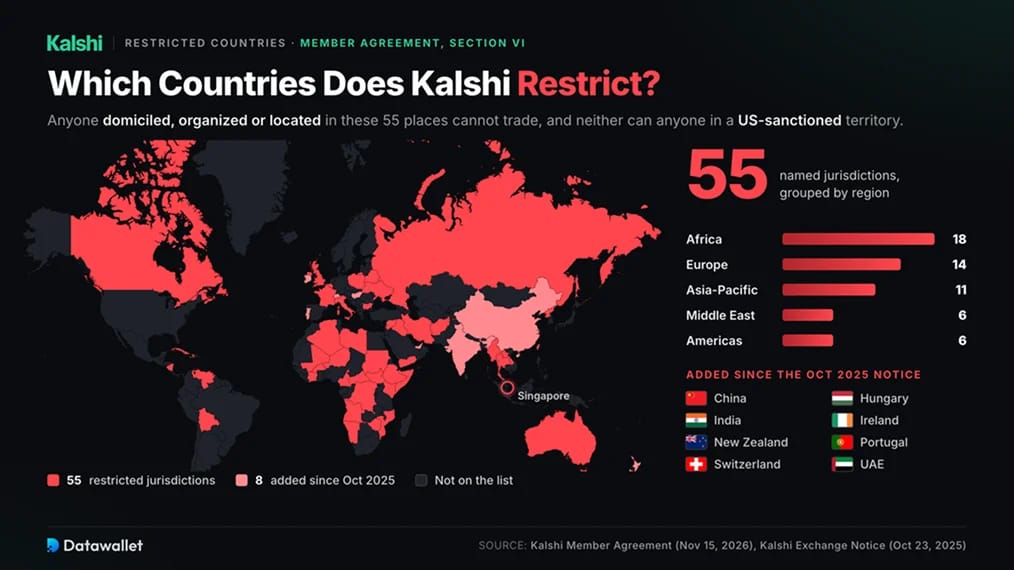
Kalshi restricts 55 named jurisdictions. Section VI of the Kalshi Member Agreement bars anyone who is domiciled in, organized in, or located in one of them from trading event contracts. An event contract is a Yes or No position that pays $1 if the stated outcome happens and nothing if it does not.
The same section extends the restriction to any place under comprehensive country-wide, territory-wide or regional economic sanctions imposed by the United States. A territory can therefore be closed to trading even when the agreement does not name it.
Kalshi Restricted Countries List
The table groups the 55 jurisdictions by region, as the agreement read on November 15, 2026.
Kalshi's exchange notice of October 23, 2025 named 47 jurisdictions. We compared that notice with the current agreement and found eight additions, which are China, Hungary, India, Ireland, New Zealand, Portugal, Switzerland and the United Arab Emirates. No country has been removed.
The Ukraine entry also widened, from five regions in the 2025 notice (Crimea, Donetsk, Luhansk, Zaporizhzhia and Kherson) to the whole country in the current agreement.
How the Restriction Applies
The agreement tests where a person lives (domicile), where a company is registered (organization) and where the trader is at the moment of the trade (location). Citizenship does not appear in the clause.
A member from an eligible country cannot trade during a visit to a restricted one. Kalshi's help center says members can use their accounts abroad only when access follows the geographic rules in the agreement.
A person in a restricted country may still be able to view prices, because the agreement states that the list does not by itself prohibit membership or non-trading access. Kalshi also keeps full discretion to refuse, suspend or revoke any membership.
Why Does Kalshi Restrict These Countries?
Kalshi has not published the criteria behind its list. The entries track US sanctions law and foreign rules on gambling and financial contracts, the legal risks a US exchange takes on with foreign customers.
1. US Sanctions Programs
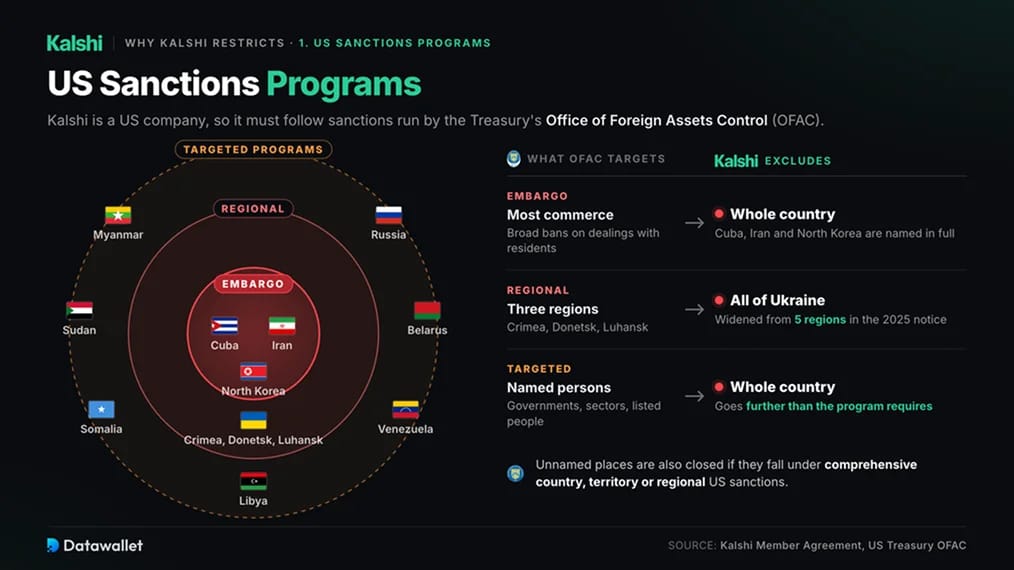
Kalshi is a US company, so it must follow the sanctions administered by the Office of Foreign Assets Control (OFAC), the Treasury unit that prohibits dealings with certain countries, regions and persons.
- Embargoed Jurisdictions: Cuba, Iran and North Korea are under broad US embargoes that prohibit most commercial dealings with their residents.
- Regional Sanctions: Crimea and the Donetsk and Luhansk regions of Ukraine are under region-wide US sanctions.
- Targeted Programs: Russia, Belarus, Venezuela, Myanmar, Sudan, Somalia and Libya have programs aimed at governments, sectors or named persons. Kalshi excludes each of these countries in full, which goes further than a targeted program requires.
2. Gambling and Derivatives Law Abroad
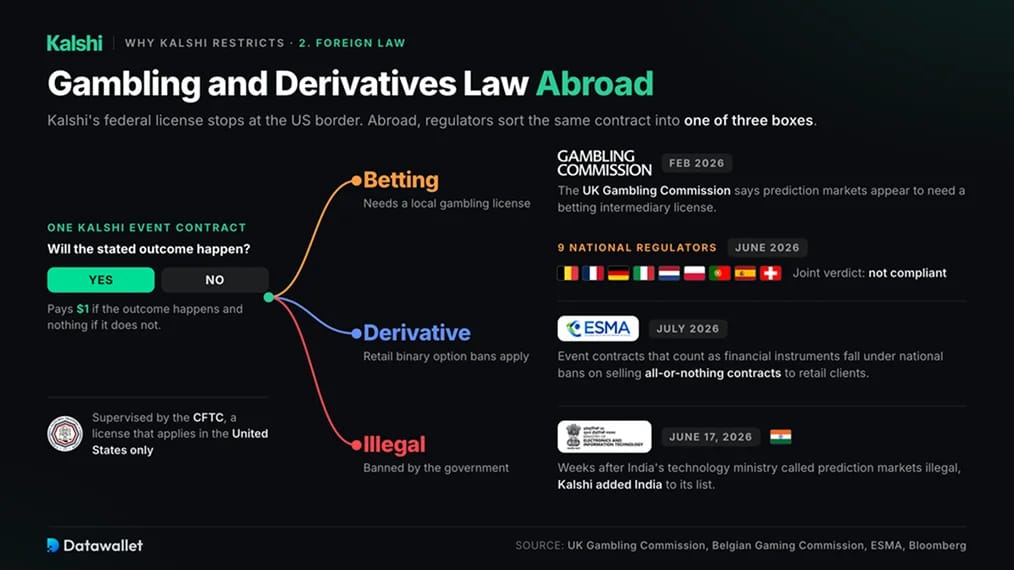
Kalshi's federal license applies in the United States only. Many foreign regulators classify event contracts as betting that needs a local license. Others treat them as derivatives, meaning contracts whose value depends on an outside price or event, that cannot be sold to retail (non-professional) clients.
- United Kingdom: The Gambling Commission said in February 2026 that prediction markets appear to need a betting intermediary license, and that unlicensed operators must not transact with consumers in Great Britain.
- European Gambling Regulators: Authorities from Belgium, France, Germany, Italy, the Netherlands, Poland, Portugal, Spain and Switzerland issued a joint statement in June 2026 that prediction markets do not comply with their national rules.
- EU Securities Rules: The European Securities and Markets Authority (ESMA) reminded firms in July 2026 that event contracts which qualify as financial instruments fall under national bans on selling binary options, meaning all-or-nothing contracts, to retail clients.
- India: Kalshi added India in an agreement dated June 17, 2026, weeks after the technology ministry called prediction market platforms illegal, Bloomberg reported.
Which Governments Block Kalshi Outside Its List?
Kalshi can be blocked in a country that its own list does not name. Brazil, Spain and the Czech Republic are absent from the Member Agreement, yet each ordered internet providers to cut access to kalshi.com in 2026 because its regulator treats the service as unauthorized.
In Brazil, Resolution 5,298 of the National Monetary Council bans derivatives tied to sports, politics, elections and entertainment, and it leaves contracts on economic and financial benchmarks legal.
Spain's gambling regulator opened sanction proceedings against Kalshi and Polymarket and ordered the block as a precaution until the case ends. The Czech Ministry of Finance placed kalshi.com on its list of unauthorized internet games, which obliges providers to block a listed site within 15 days.
Kalshi has added countries to its own list after local enforcement began, as it did with India. Residents of a country with an active blocking order should follow that order, even if the Member Agreement has not yet changed.
Kalshi Supported Countries
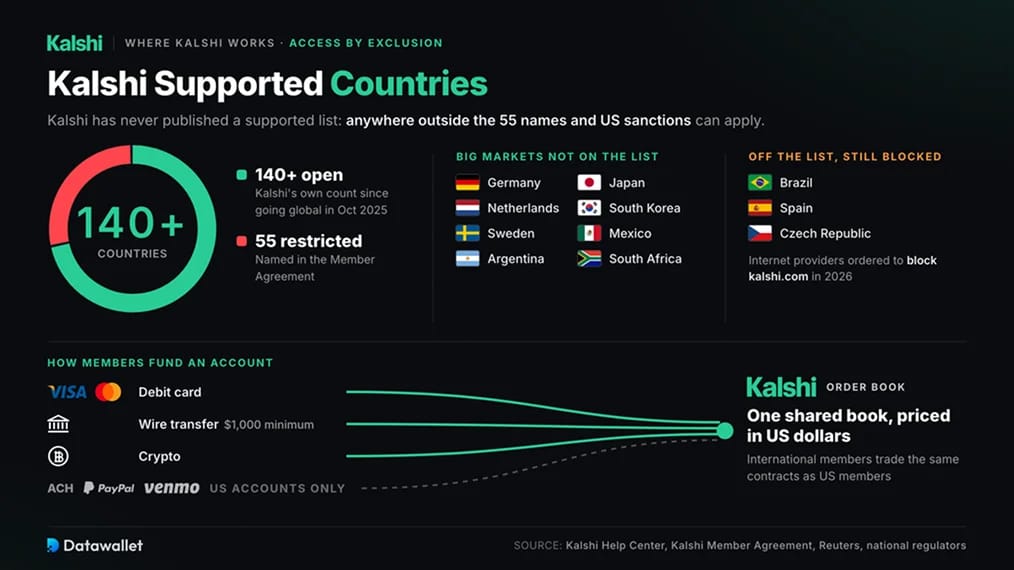
Residents of any country outside the 55 names and outside US sanctions can apply, because Kalshi defines access by exclusion. The exchange opened to customers outside the United States in October 2025 and said it was available in more than 140 countries, but it has never published a list of supported countries.
Large markets absent from the restricted list include Germany, the Netherlands, Sweden, Japan, South Korea, Mexico, Argentina and South Africa. Absence from the list does not confirm that trading is legal under local law. Kalshi's sign-up guidance states that each user is responsible for confirming that their use is lawful.
International members trade the same US-regulated contracts as US members, in one shared order book (the common list of buy and sell offers) priced in US dollars. Kalshi's transfers page lists Visa or Mastercard debit cards, wire transfers with a $1,000 minimum, and crypto as their deposit methods. Bank transfers through ACH (the US clearing system), PayPal and Venmo are limited to US accounts.
Which US States Restrict Kalshi?
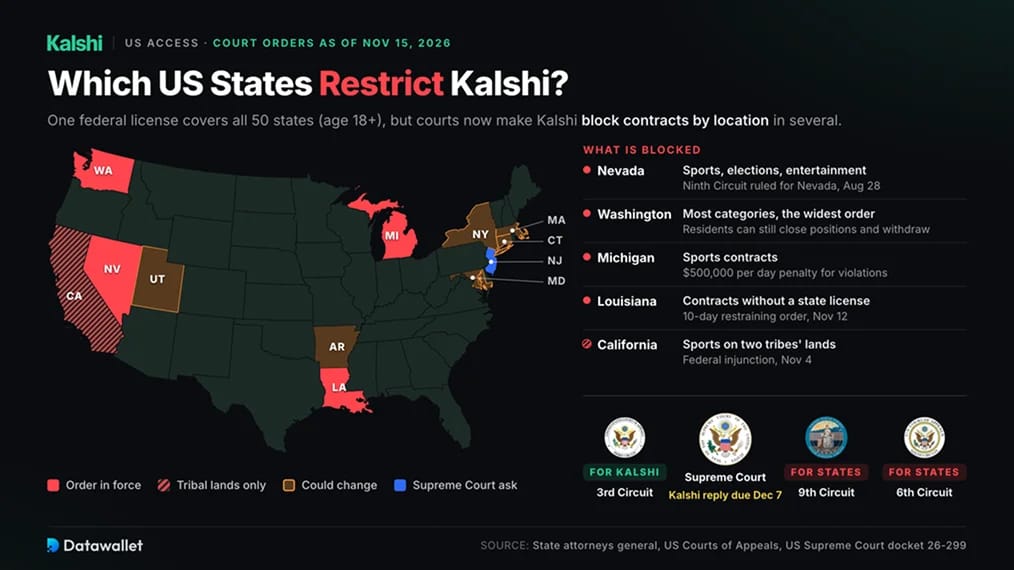
All 50 states fall under Kalshi's federal license, and the minimum age is 18. State attorneys general and gaming regulators argue that its sports contracts are unlicensed sports betting, and several have won court orders that require Kalshi to block contracts by location.
The table shows the orders in force on November 15, 2026.
The Nevada and Michigan orders leave other categories, such as crypto and weather contracts, available. The Washington order is the widest, although residents can still close positions and withdraw funds. Michigan's injunction, a court order that applies while the case continues, carries a penalty of $500,000 per day for violations.
In Louisiana, a state judge issued a 10-day restraining order on November 12, 2026 against Kalshi and nine other operators, The Block reported. The case has since moved to federal court, where Kalshi is asking a judge to stop the state from enforcing its gambling law.
States Where Access Could Change
- New York and Connecticut: On November 3, 2026, the Second Circuit appeals court refused to protect Kalshi from state enforcement while its appeals continue. New York's lawsuit asks for a nationwide halt, which led the Commodity Futures Trading Commission (CFTC), the federal derivatives regulator, to issue an emergency order telling the exchange to keep operating.
- Massachusetts and Maryland: Massachusetts won the first injunction against Kalshi's sports contracts in January 2026, and that order is paused while the state's highest court decides the appeal. Maryland agreed to delay enforcement until the Fourth Circuit rules.
- Utah: Utah filed felony charges against Kalshi and its two co-founders on October 28, 2026. A separate civil suit asks a court to order location blocking for Utah residents.
- Arkansas: Arkansas sued Kalshi on November 4, 2026. Eight days later, the Department of Justice and the CFTC sued Arkansas to stop the state action.
Why the Courts Disagree
Kalshi and the CFTC say event contracts are swaps, a type of derivative that only the federal regulator may supervise. The states say sports contracts are gambling. The Third Circuit sided with Kalshi in April 2026, while the Ninth Circuit and the Sixth Circuit sided with the states.
New Jersey has asked the Supreme Court to settle the conflict, and the court docket shows Kalshi's response is due on December 7, 2026. The CFTC also proposed a rule in October 2026 that would define sports, political, cultural and weather contracts as swaps, with public comments due by November 18. State availability can change with a single order until one of these processes ends.
Kalshi Product Availability by Location
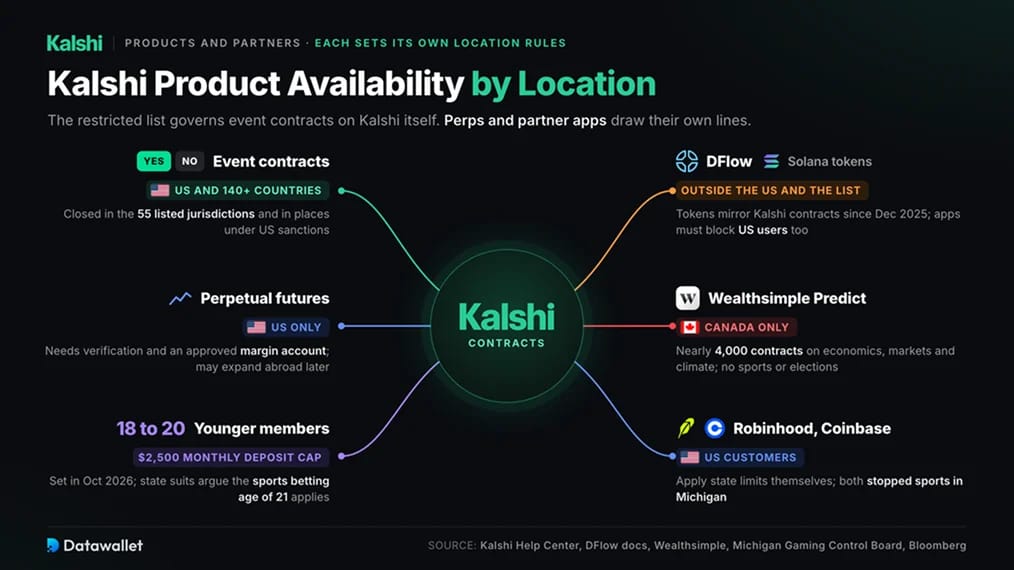
The restricted list governs event contracts on Kalshi's own platform, while other Kalshi products and partner apps apply their own location rules.
- Perpetual Futures: Kalshi perpetuals, which are contracts with no expiry date traded with borrowed funds, are open only to US-based users who pass verification and receive approval for a margin account, the account type that permits borrowing. Kalshi's access guide says international availability may expand in the future.
- Tokenized Markets: Since December 2025, partners such as DFlow issue Solana tokens that mirror Kalshi contracts. DFlow's compliance rules require apps to block users in the United States and in every jurisdiction on Kalshi's list.
- Canada: Canadians cannot trade on Kalshi directly. Wealthsimple Predict offers nearly 4,000 Kalshi contracts on economic indicators, financial markets and climate under approval from the Canadian investment regulator, with no sports or election markets.
- US Brokers: Robinhood and Coinbase list Kalshi contracts for US customers and apply state limits themselves. Both agreed to stop sports contracts in Michigan, and Robinhood's restricted countries differ from Kalshi's.
- Users Aged 18 to 20: Kalshi set a $2,500 monthly deposit limit for this age group in October 2026. Several state lawsuits argue that the sports betting age of 21 should apply.
Does Kalshi Require KYC?
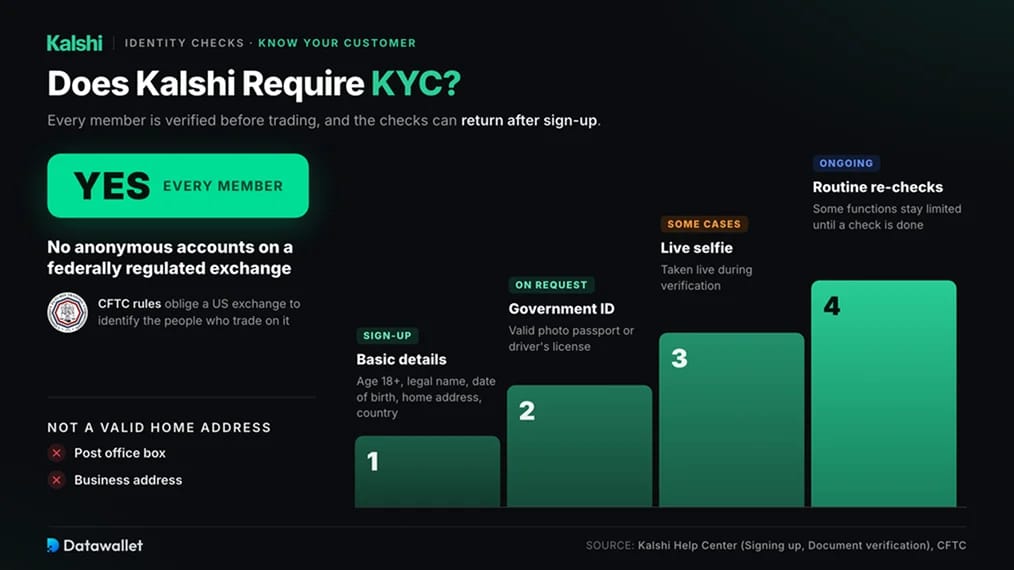
Yes. Kalshi requires identity verification, known as Know Your Customer (KYC), from every member, because CFTC rules oblige a US exchange to identify the people who trade on it.
Applicants must be 18 or older and provide their legal name, date of birth, residential address and country of residence. Kalshi can then request a government-issued photo ID, which means a valid passport or driver's license, and in some cases a live selfie.
Kalshi states that verification prompts may appear again after sign-up as part of routine compliance reviews, and some account functions stay limited until the check is complete. A post office box or a business address is not accepted as a home address.
Can You Use a VPN to Access Kalshi?
A VPN (virtual private network) does not make a restricted user eligible. It hides the internet address of a device, and the Member Agreement applies to where a person lives and where they are located. Each member confirms that they are outside the restricted jurisdictions, and a false confirmation is a breach that allows Kalshi to suspend or close the account.
The Washington order required Kalshi to move from checks based on internet address and residency to multi-source geolocation, which reads several device signals at once.
A person who trades from a prohibited location cannot rely on the protections of a local license. India's technology ministry has also told VPN providers to stop carrying traffic to blocked prediction market sites.
Kalshi Licenses and Regulation
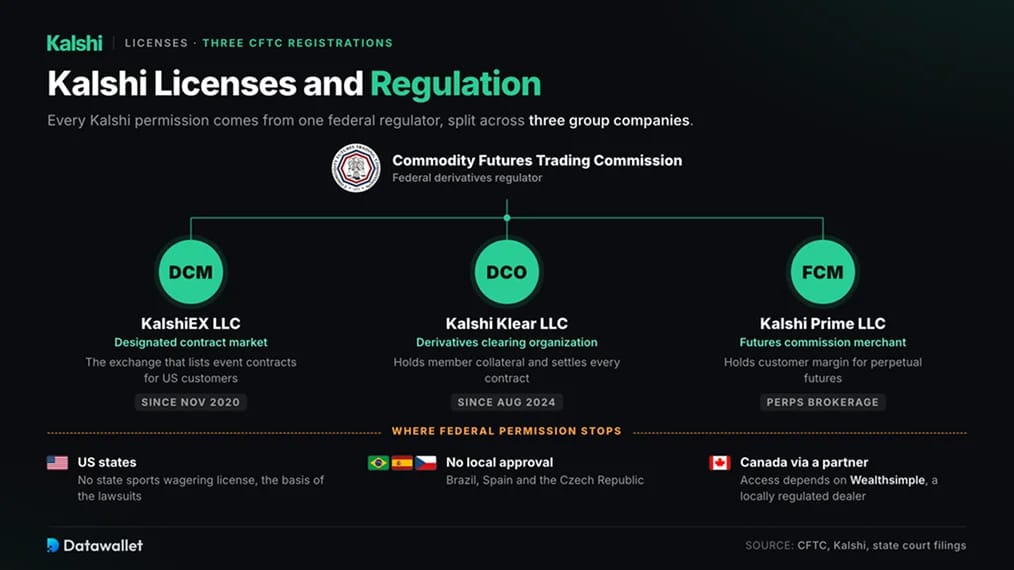
Kalshi's permissions all come from the CFTC, and separate group companies hold the exchange, clearing and brokerage registrations.
- KalshiEX LLC: The CFTC designated the exchange as a contract market in November 2020, which allows it to list event contracts for US customers under federal supervision.
- Kalshi Klear LLC: The clearing company has been a registered derivatives clearing organization since August 2024. It holds member collateral and settles every contract.
- Kalshi Prime LLC: The brokerage is a registered futures commission merchant, which is the registration needed to hold customer margin for perpetual futures.
- US States: Kalshi holds no state sports wagering license, and that gap is the basis of the state lawsuits.
- Other Countries: Kalshi lacks local authorization in Brazil, Spain and the Czech Republic, and Canadian access depends on Wealthsimple, a locally regulated dealer.
What to Do if Kalshi Is Restricted in Your Country
No single platform replaces Kalshi in every restricted country. Polymarket's restricted countries overlap with Kalshi's list and include the United Kingdom, France, Italy, Australia and Singapore, so residents of those countries are excluded from both platforms.
Residents elsewhere should start with what their own regulator permits. Canadians have a licensed option in Wealthsimple Predict, and UK residents can use betting exchanges licensed by the Gambling Commission. Our Polymarket vs Kalshi comparison and our guide to the best decentralized prediction markets explain how other platforms set their own location rules, including products accessed with a crypto wallet such as Hyperliquid's HIP-4 outcome markets.
About Kalshi
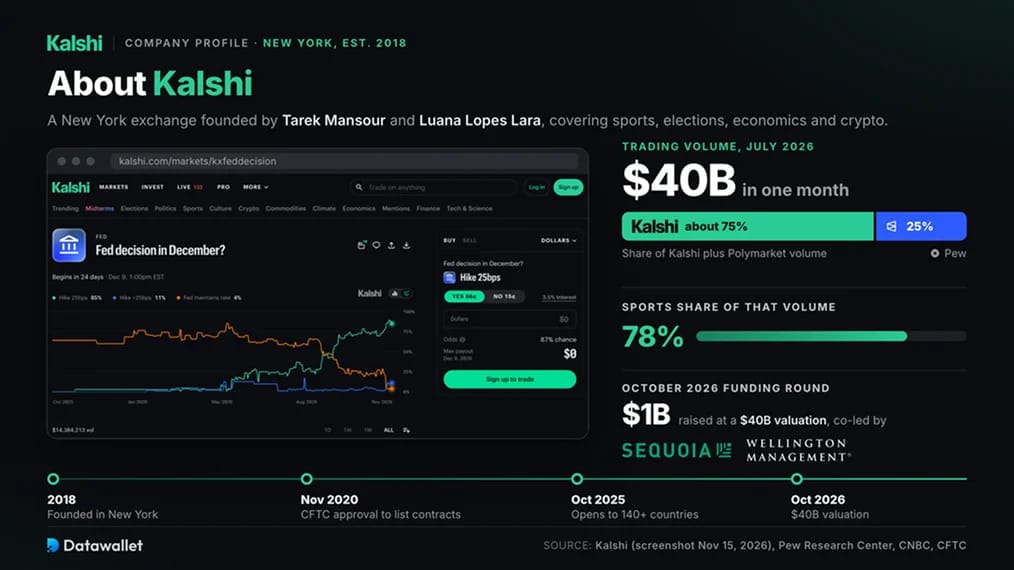
Kalshi is a New York exchange founded in 2018 by Tarek Mansour and Luana Lopes Lara. It received federal approval to list event contracts in 2020, and it now covers sports, elections, economics, weather, culture and crypto.
Pew Research Center measured about $40 billion in Kalshi volume in July 2026, roughly three quarters of the combined total with Polymarket, and sports made up about 78% of it. Our prediction market statistics page tracks these figures.
In October 2026, Kalshi raised $1 billion at a $40 billion valuation in a round co-led by Sequoia Capital and Wellington Management. The company said it plans to build a broader exchange beyond event contracts. Readers new to the format can start with our explainer on how prediction markets work.
Final Thoughts
Kalshi's restricted list is the first check for any trader outside the United States, and it is no longer the only one. The 55 named jurisdictions now sit beside national blocking orders in Brazil, Spain and the Czech Republic, and beside US court orders that change contract availability from one state to the next.
The Supreme Court will decide whether to hear New Jersey's case after Kalshi responds in December 2026, and the CFTC is taking comments on its proposed swap rule. Read the current Member Agreement and check your local regulator before you deposit, because both can change at short notice.