







Best Gate Alternatives Compared
Gate rebranded from Gate.io in May 2025 and spent the following year building licensed local entities, securing MiCA authorisation through Malta, VARA approval in Dubai, and an Australian registration. Its restricted list still names more than 30 jurisdictions, so access remains the deciding factor for most switchers.
We weighted regional licensing, fee structure, reserve transparency, and product depth against our Gate review findings, then compared each platform directly in the table below:
1. Bybit
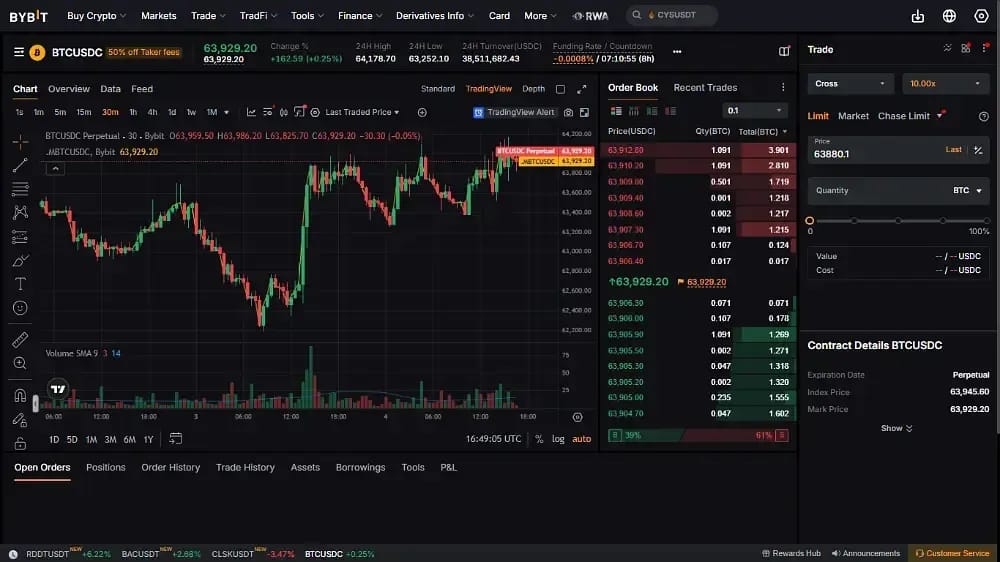
We rank Bybit as the strongest all-round Gate alternative, pairing comparable derivatives depth with a cleaner execution layer and better regulatory footing across Europe. Serving over 60 million users, it runs a MiCA-licensed entity through Austria's FMA alongside a UAE platform operator licence.
Its trading engine is where the gap shows, as our Bybit versus Gate comparison details. Running identical perpetual strategies on both, we found Bybit's Unified Trading Account far more coherent, letting spot, futures and options share a single collateral pool rather than forcing constant internal transfers.
What we like most is how it handled adversity. Bybit absorbed a $1.5 billion hack in February 2025 and covered every customer loss from its own balance sheet without ever freezing withdrawals. We recommend it for most switchers, though our Bybit review sets out the caveats.
Pros
- Superior execution: The Unified Trading Account pools collateral across spot, futures and options, removing the constant internal transfers Gate requires.
- Proven resilience: Bybit reimbursed a $1.5 billion hack in full within 72 hours, a stress test almost no competitor has survived.
- European licensing: A MiCA authorisation through Austria gives EEA traders regulated access that Gate's Malta entity only partially matches.
Cons
- Fewer listings: Roughly 1,300 assets against Gate's 3,500-plus means micro-cap hunters will still find gaps in coverage.
- No US access: American traders cannot use Bybit at all, so Gate's US arm actually serves them better here.
- Slightly higher taker fee: At 0.055%, futures takers pay marginally more than Gate's 0.05% on identical volume tiers.
2. Kraken
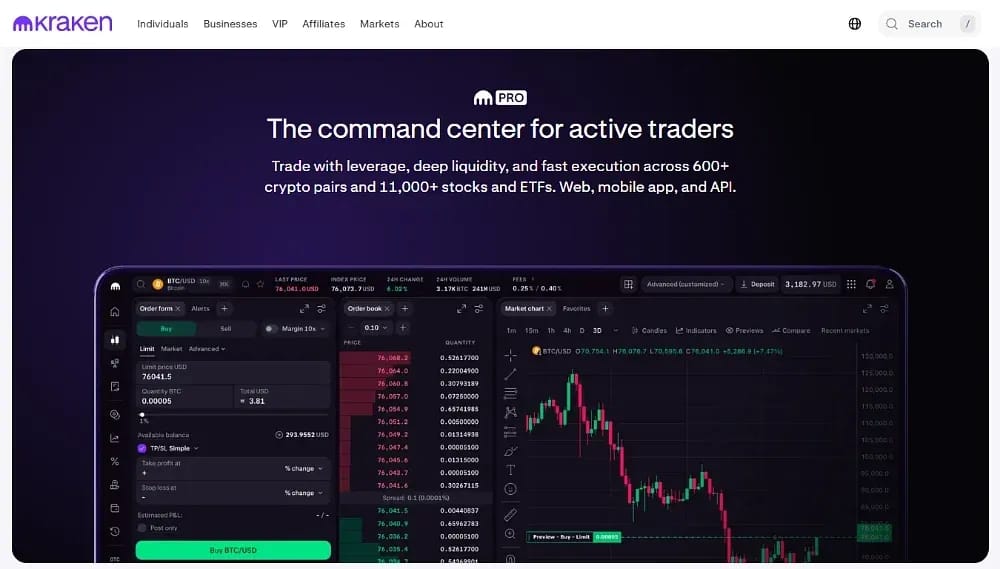
We recommend Kraken to anyone leaving Gate specifically over compliance concerns, since it is the regulatory heavyweight here. It secured a US Federal Reserve master account in March 2026 and launched CFTC-regulated perpetual futures in the United States that June.
We think that distinction matters practically rather than symbolically. A master account means direct Federal Reserve settlement rather than dependence on correspondent banks, while CFTC oversight gives American derivatives traders genuine statutory protections that Gate cannot offer in any jurisdiction.
Kraken has also built the reference product among tokenised stock platforms. Its xStocks catalogue passed 100 listings with more than $30 billion in transaction volume across 125,000 holders, each token backed one-to-one by shares in regulated custody. Testing its Pro terminal, we found execution noticeably more predictable during volatile sessions.
Pros
- Unmatched regulation: A Federal Reserve master account, CFTC-regulated perpetuals and MiCA authorisation via Ireland exceed every rival on this list.
- Thirteen-year record: Kraken has operated since 2011 without a major custodial breach, a track record Gate's Bter-era history cannot match.
- Tokenised equities: xStocks offers 100-plus stock and ETF tokens with dividend reinvestment and on-chain withdrawal to Solana or Ethereum.
Cons
- Lower leverage: A 50x ceiling on futures sits well below the 125x that Gate, Bybit and OKX all offer active traders.
- Narrower catalogue: Around 400 listed assets means most small-cap and newly launched tokens that draw traders to Gate never appear here.
- Regional product gaps: Stocks, xStocks and derivatives each use separate entities, so availability varies considerably by country.
3. OKX
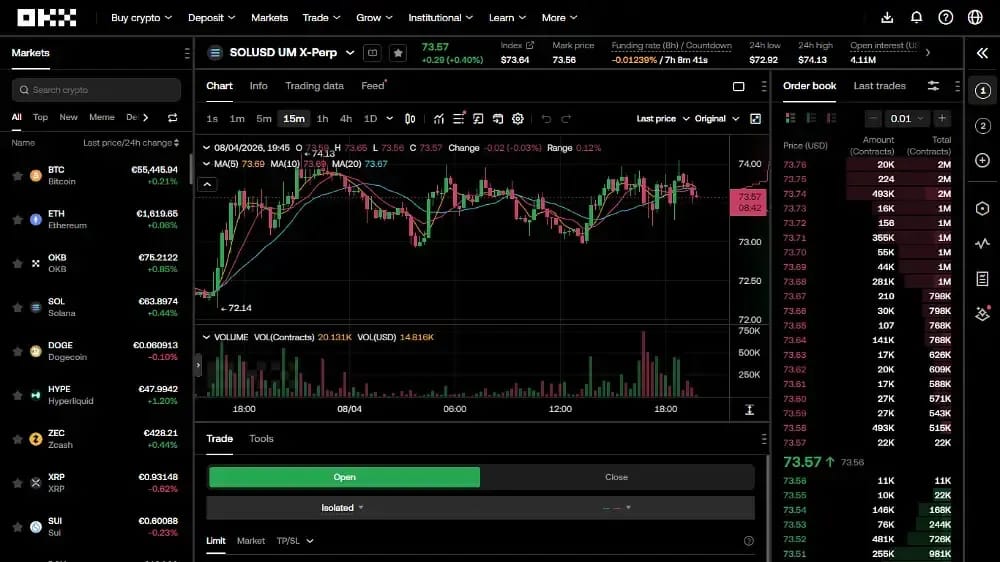
OKX was the first major centralised exchange to obtain MiCA CASP authorisation, securing it through Malta in January 2025 and passporting across 30 EEA states. For European readers locked out of Gate, we consider that head start the single most valuable thing it offers.
Institutional validation followed. Intercontinental Exchange, which owns the New York Stock Exchange, invested at a $25 billion valuation in March 2026 and took a board seat. We read that diligence as a stronger governance signal than any marketing claim, though not a substitute for licensing.
The platform matches Gate on leverage at 125x while adding a more capable Web3 wallet spanning 100-plus chains, as our OKX review covers. It relaunched US spot trading in April 2025 following a $505 million DOJ settlement, though derivatives remain unavailable and New York and Texas stay excluded.
Pros
- MiCA pioneer: First major exchange authorised under MiCA, with passporting across 30 EEA states and no transition-deadline exposure.
- Institutional backing: ICE's investment and board seat at a $25 billion valuation signal governance standards well above typical offshore venues.
- Deep Web3 integration: A wallet covering 100-plus chains connects centralised trading to DeFi more effectively than Gate's equivalent tooling.
Cons
- Compliance history: A €1.1 million Malta AML fine and the $505 million DOJ settlement remain recent enough to warrant consideration.
- Interface complexity: The sheer product breadth overwhelms newer traders in much the same way Gate's dashboard does.
- Limited US derivatives: American users get spot trading only, with New York and Texas residents excluded entirely from the platform.
4. Coinbase
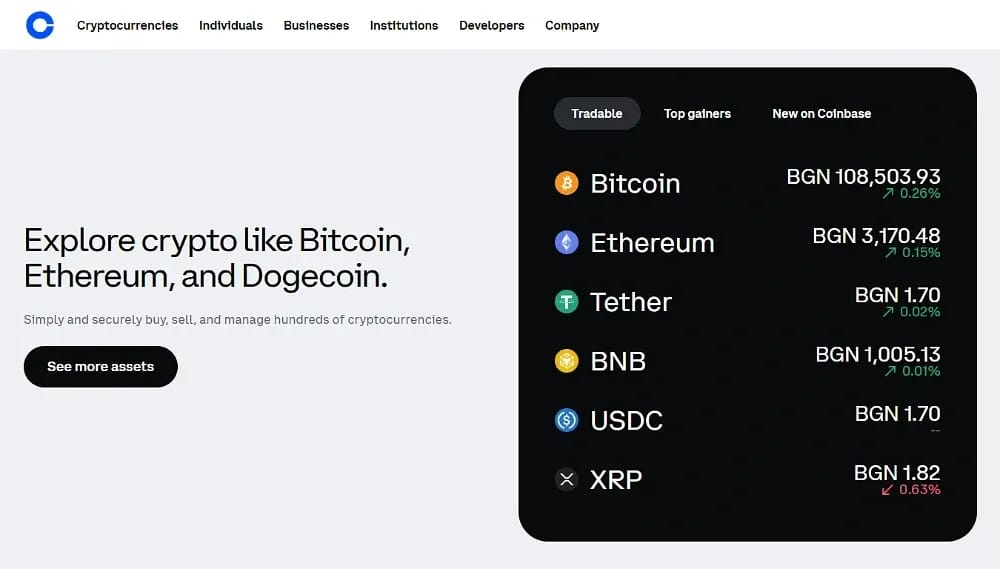
We recommend Coinbase to American traders above everything else here, since Gate's US arm offers only a fraction of the main catalogue. Listed on Nasdaq under COIN, it files quarterly with the SEC and holds money transmitter licences in every US state.
Europe strengthened its position further. Coinbase secured MiCA authorisation through Luxembourg and courted Binance's displaced EU users in June 2026 with transfer bonuses across Germany, France, Italy and Poland. We rate that dual-continent licensing as rare among exchanges of this size.
What we dislike is the cost, as our Coinbase review sets out. Simple Trade charges roughly 1.5% on a retail purchase against Gate's 0.2% spot fee, and futures cap at 20x. We would steer active traders elsewhere on fees alone.
Pros
- Strongest regulation: Nasdaq listing, SEC filings, every US state licence and MiCA authorisation create unmatched legal clarity for retail users.
- Best fiat rails: ACH, wire, card and PayPal deposits work seamlessly, where Gate offers no US fiat access whatsoever.
- Beginner friendly: A clean interface and built-in education make it far more approachable than Gate's dense single-dashboard layout.
Cons
- Expensive trading: Simple Trade costs roughly 1.5% per order, making it several times pricier than Gate for active traders.
- Low leverage: A 20x ceiling on perpetuals will frustrate anyone accustomed to the 125x available on Gate, Bybit and OKX.
- Limited altcoins: Around 300 listed assets excludes most of the micro-cap tokens that draw traders to Gate initially.
5. Bitget
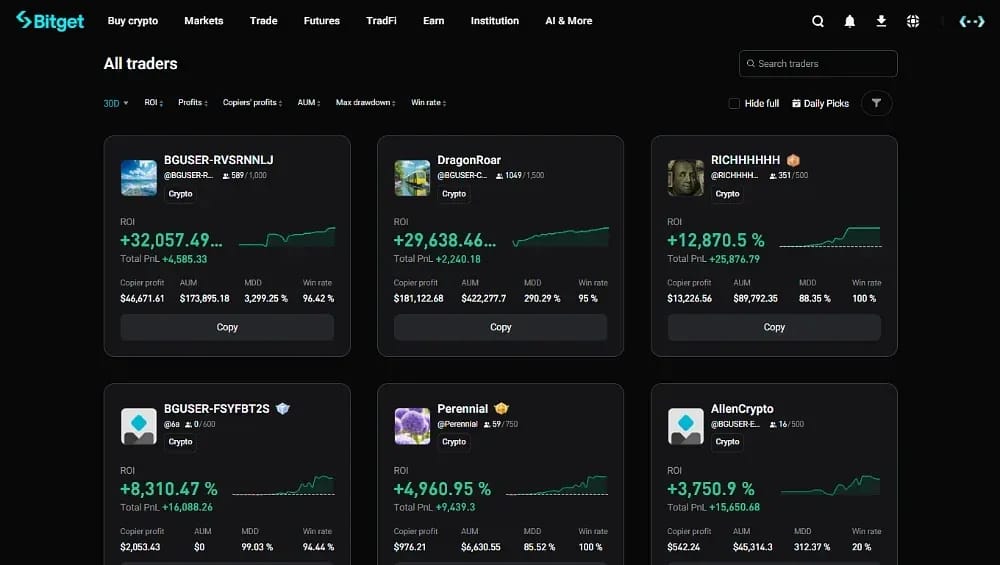
Bitget has built the largest social trading operation in crypto, serving roughly 120 million users with verified provider rankings sorted by drawdown and return. If you used Gate's copy trading and found it thin, we consider this the clearest upgrade available anywhere.
The depth difference is substantial across copy trading platforms. Bitget supports mirroring on both spot and futures with transparent leaderboards, while Gate restricts the feature to futures and publishes far less provider data. Testing several traders, we found its per-position risk controls genuinely granular.
We like that its automation stack extends the advantage through grid, DCA and futures bots with public ROI tracking, plus a demo mode for testing first. What we dislike is the regulatory picture: Bitget's MiCA application stayed pending through mid-2026, and it blocks US users entirely.
Pros
- Largest copy trading: Roughly 120 million users and verified provider rankings make it the deepest social trading network available anywhere.
- Complete bot suite: Grid, DCA and futures bots with public ROI metrics and a demo mode outclass Gate's more experimental tooling.
- Wide catalogue: Around 800 supported assets sits closer to Gate's breadth than most regulated alternatives manage to offer.
Cons
- MiCA still pending: Authorisation had not been granted by mid-2026, leaving European access less certain than at OKX or Kraken.
- No US service: American traders are blocked entirely, removing it from consideration for anyone leaving Gate over US restrictions.
- Cluttered interface: The volume of campaigns and products can overwhelm users who simply want straightforward spot trading.
6. Binance
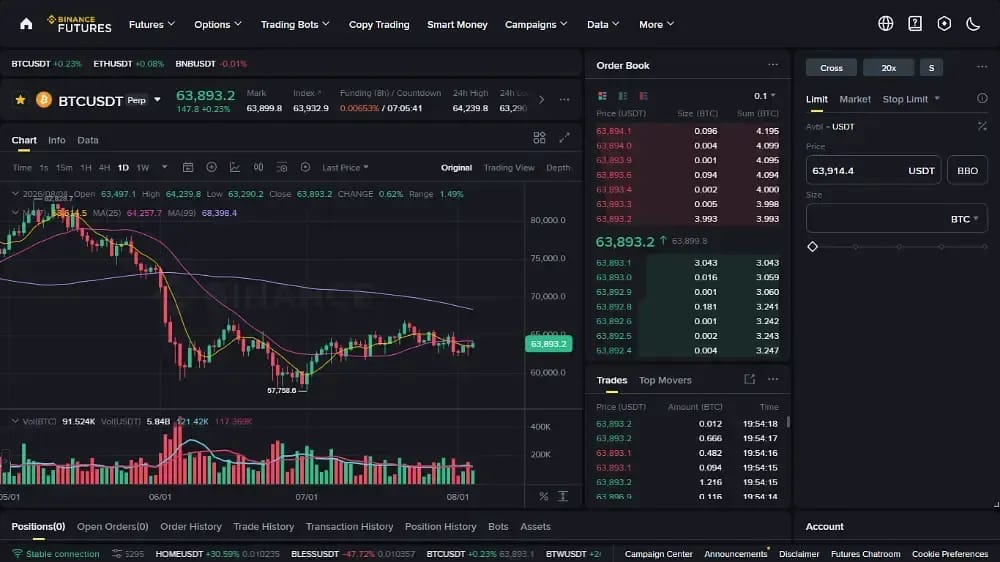
Binance still commands the deepest order books in crypto, and for pure execution quality on major pairs we found nothing here competes. If you are leaving Gate over thin mid-cap liquidity rather than regulatory access, we think Binance solves that comprehensively.
Its European position deteriorated sharply, which is precisely why we rank it last on this list. Binance suspended certain EU services from 1 July 2026 after failing to secure MiCA authorisation, with its Greek application rejected before it pivoted across to France.
We therefore recommend it conditionally rather than outright, as our Binance review explains. It remains under a five-year DOJ monitorship and stays unlicensed in the UK, Netherlands, Ontario and Nigeria. Comparing fills directly, we still measured its spreads tightest everywhere.
Pros
- Deepest liquidity: Order book depth exceeds every alternative here, delivering the tightest spreads and lowest slippage on large orders.
- Widest derivatives: Options, leveraged tokens and an enormous futures catalogue give product breadth Gate has never matched.
- Low fees at scale: Spot costs fall to roughly 0.075% with BNB discounts, undercutting nearly every regulated competitor on this list.
Cons
- EU suspension: Services were withdrawn from European users in July 2026 after the platform missed MiCA authorisation entirely.
- Ongoing monitorship: A five-year DOJ compliance monitorship from the 2023 settlement continues to constrain operations and expansion.
- Broad restrictions: The UK, Netherlands, Ontario and Nigeria all block or refuse to license the platform for retail users.
Why Look for Gate Alternatives?
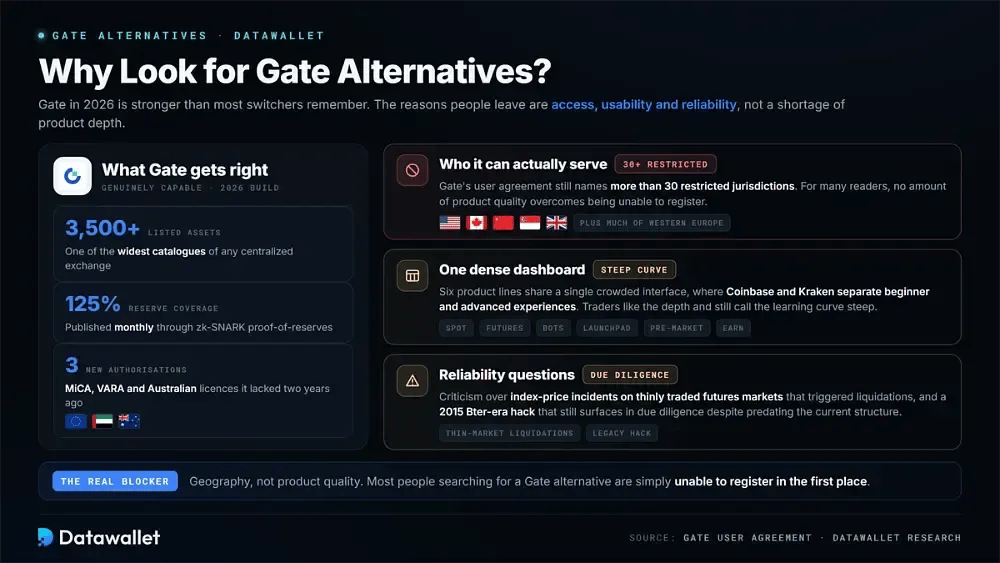
Gate is a genuinely capable exchange, and the 2026 version is stronger than the platform most switchers remember. It lists more than 3,500 assets, publishes monthly zk-SNARK proof-of-reserves showing a 125% coverage ratio, and now holds MiCA, VARA and Australian authorisations it lacked two years ago.
The problem is who it can actually serve. Gate's user agreement still names more than 30 restricted jurisdictions, including the United States, Canada, mainland China, Singapore, the United Kingdom and much of Western Europe. For many readers, no amount of product quality overcomes simply being unable to register.
Usability is the second recurring complaint. Gate packages spot, futures, bots, launchpad, pre-market and earn products into one dense dashboard, where Coinbase and Kraken separate beginner and advanced experiences. Traders describe the learning curve as steep even when they appreciate the underlying depth.
Reliability concerns round out the picture. Gate has faced criticism over index-price incidents on thinly traded futures markets that triggered liquidations, and its 2015 Bter-era hack still surfaces in due diligence despite predating the current structure. Our Gate safety analysis examines those claims in detail.
The 2026 MiCA Deadline Reshaped Your Options
The single biggest change to exchange selection this year had nothing to do with fees, features or product depth. Europe's MiCA transition period ended on 1 July 2026, and the resulting sort separated properly licensed venues from everyone else almost overnight.
Which Exchanges Cleared the Bar
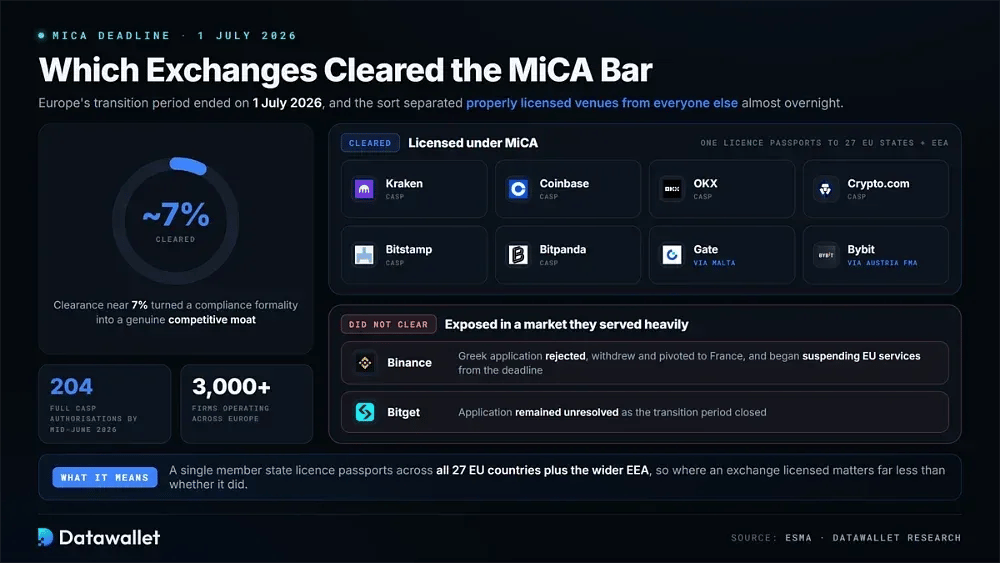
Approximately 204 crypto-asset service providers held full CASP authorisation by mid-June 2026, out of more than 3,000 firms operating across Europe. That clearance rate near 7% turned a compliance formality into a genuine competitive moat for the exchanges that made it through.
Kraken, Coinbase, OKX, Crypto.com, Bitstamp and Bitpanda all secured licences, as did Gate through Malta. Bybit obtained authorisation via Austria's FMA for its European entity. A single member state licence passports across all 27 EU countries plus the wider EEA, so where an exchange licensed matters less than whether it did.
The notable absence was Binance. Its Greek application was rejected, it withdrew and pivoted to France, and it began suspending EU services from the deadline. Bitget's application also remained unresolved, leaving both platforms exposed in a market they previously served heavily.
What This Means for Switchers
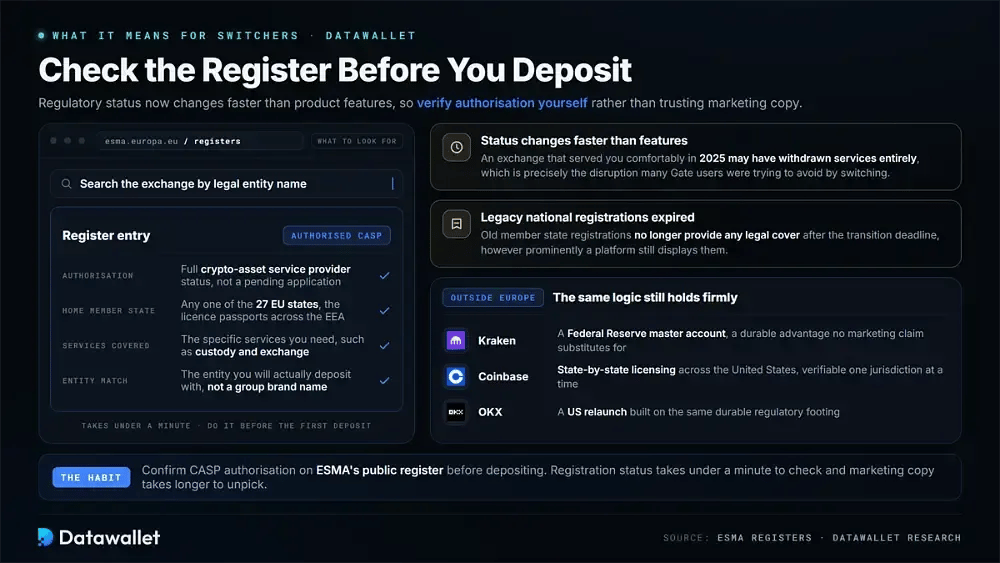
For European readers, the practical takeaway is that regulatory status now changes faster than product features. An exchange that served you comfortably in 2025 may have withdrawn services entirely, which is precisely the disruption many Gate users were trying to avoid by switching in the first place.
The safer approach is verifying CASP authorisation directly on ESMA's public register before depositing rather than trusting marketing copy. Registration status takes under a minute to confirm, and legacy national registrations no longer provide any legal cover after the transition deadline.
Outside Europe the same logic still holds firmly. Kraken's Federal Reserve master account, Coinbase's state-by-state licensing and OKX's US relaunch are all durable advantages, and our guides to the best exchanges in Europe and the United States map the regional options in detail.
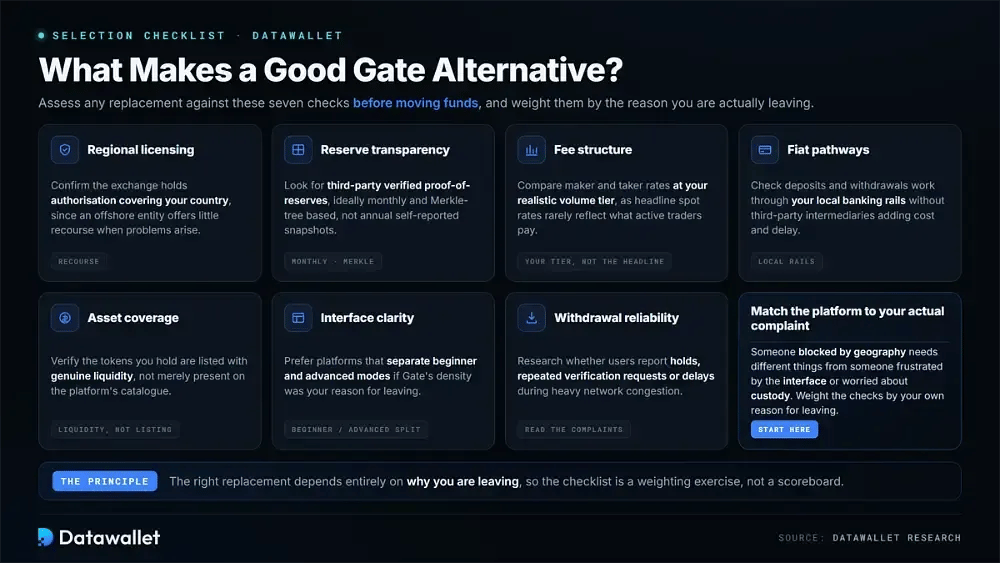
What Makes a Good Gate Alternative?
The right replacement depends entirely on why you are leaving. Someone blocked by geography needs different things from someone frustrated by the interface or worried about custody, so match the platform to your actual complaint rather than chasing whichever CEX tops a futures exchange ranking.
Assess any Gate alternative against the following before moving funds:
- Regional licensing: Confirm the exchange holds authorisation covering your country, since an offshore entity offers little recourse when problems arise.
- Reserve transparency: Look for regular third-party verified proof-of-reserves, ideally monthly and Merkle-tree based rather than annual self-reported snapshots.
- Fee structure: Compare maker and taker rates at your realistic volume tier, as headline spot rates rarely reflect what active traders actually pay.
- Fiat pathways: Check that deposits and withdrawals work through your local banking rails without third-party intermediaries adding cost and delay.
- Asset coverage: Verify the specific tokens you hold are listed with genuine liquidity, not merely present on the platform's catalogue.
- Interface clarity: Prefer platforms separating beginner and advanced modes if Gate's density was your reason for leaving it behind.
- Withdrawal reliability: Research whether users report holds, repeated verification requests, or delays during periods of heavy network congestion.
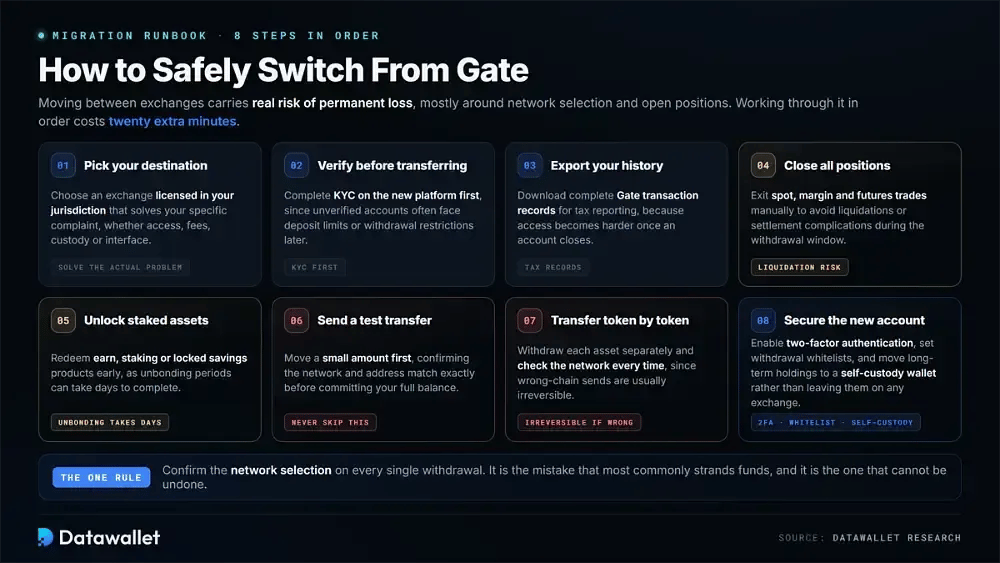
How to Safely Switch From Gate to Another Exchange
Moving between exchanges carries real risk of permanent loss if handled carelessly, particularly around network selection and open positions. Working through it methodically costs twenty extra minutes and prevents the mistakes that most commonly strand funds.
Follow these steps in order when transferring away from Gate:
- Pick your destination: Choose an exchange licensed in your jurisdiction that solves your specific complaint, whether access, fees, custody or interface.
- Verify before transferring: Complete KYC on the new platform first, since unverified accounts often face deposit limits or withdrawal restrictions later.
- Export your history: Download complete Gate transaction records for tax reporting, because access can become harder once an account closes.
- Close all positions: Exit spot, margin and futures trades manually to avoid liquidations or settlement complications during the withdrawal window.
- Unlock staked assets: Redeem any earn, staking or locked savings products early, as unbonding periods can take days to complete.
- Send a test transfer: Move a small amount first, confirming the network and address match exactly before committing your full balance.
- Transfer token by token: Withdraw each asset separately, checking the network selection every time, since wrong-chain sends are usually irreversible.
- Secure the new account: Enable two-factor authentication, set withdrawal whitelists, and move long-term holdings to a self-custody wallet rather than leaving them on any exchange.
Final Thoughts
Gate in 2026 is a materially better exchange than its reputation suggests, having earned MiCA, VARA and Australian authorisations during the year while maintaining comfortably the widest altcoin catalogue in the industry. The reason to leave is rarely product quality anymore, it is simply availability.
Bybit is our top alternative for most traders, matching Gate's derivatives depth with cleaner execution and European licensing. Kraken suits anyone prioritising regulation, OKX offers the strongest EU position, Coinbase serves American users best, and Bitget wins decisively on copy trading.
Whichever you choose, verify licensing for your country before depositing rather than after, using ESMA's public CASP register or your local regulator. The MiCA deadline showed how quickly access disappears, and the right exchange is only useful if it can still legally serve you.
Our Methodology
We assessed each platform by opening and funding real accounts, completing full identity verification, executing both spot and futures trades, timing actual withdrawals, and comparing every observed fee against published schedules rather than relying on marketing claims or aggregated third-party star ratings.
Six criteria shaped the final ranking, weighted toward what actually determines whether a platform works for you:
- Regulatory coverage: We verified licences on official registers including ESMA's CASP list, checking which entity serves each region and what protections apply.
- Fee accuracy: We compared maker and taker rates at multiple volume tiers against published fee schedules, including hidden instant-buy spreads.
- Reserve transparency: We reviewed proof-of-reserves frequency, verification method, third-party attestation and whether users can independently verify their own balances.
- Product depth: We tested spot, derivatives, copy trading, bots and earn products, measuring how each compares directly against Gate's equivalent tooling.
- Access reality: We confirmed which countries each platform genuinely serves, distinguishing marketing claims from what the user agreement actually permits.
- Execution quality: We measured fill prices and slippage across liquid and volatile conditions, comparing order book depth on identical trading pairs.
Exchange licensing and fee structures shifted unusually fast throughout 2026, particularly around the MiCA deadline, so our testing cycle ran from March through July, with every figure re-checked against primary sources including official fee schedules and public regulatory registers before publication.
.webp)