




What is Jumper?
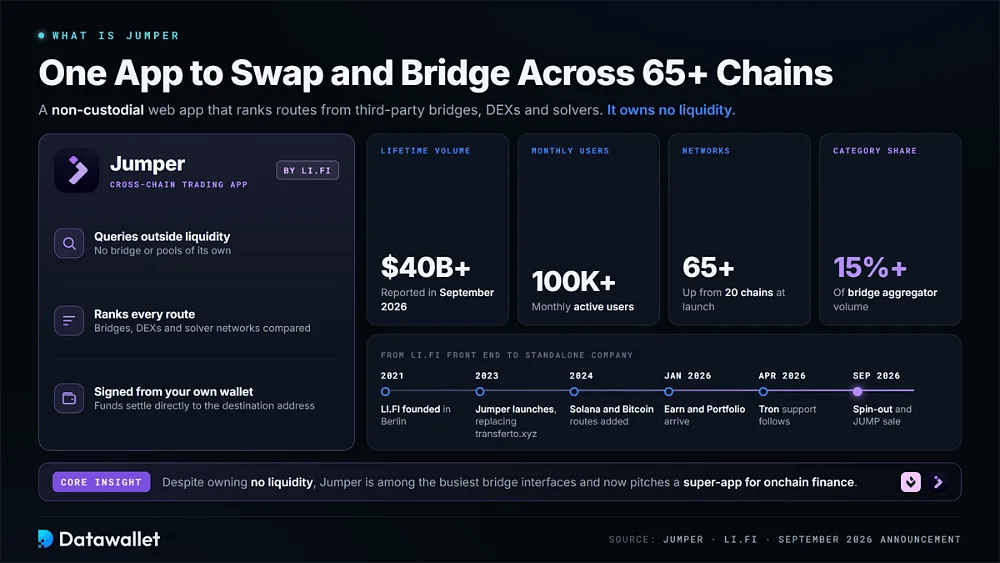
Jumper is a non-custodial web app for swapping, bridging and managing crypto across blockchains. It does not run its own bridge or liquidity pools. Instead, the app queries third-party bridges, decentralized exchanges and solver networks, ranks the resulting routes, and lets users sign from their own wallets. Funds settle directly to the destination address.
The product originated inside LI.FI, a cross-chain infrastructure company founded in Berlin in 2021 by Philipp Zentner and Max Klenk. LI.FI introduced Jumper in 2023 as its consumer front end, replacing the earlier transferto.xyz interface. Its first release supported 20 chains, more than 15 bridges and 30 DEXs.
Coverage expanded steadily. Solana and Bitcoin routes were added in 2024, with Tron following in April 2026. Jumper's documentation now lists more than 65 supported networks. Earn and Portfolio arrived in January 2026, followed later that year by Advanced order types, private swaps and a tokenized stock hub.
Jumper's scale is a major part of its significance. The company's September 2026 announcement reported more than $40 billion in lifetime volume, over 100,000 monthly active users and a share above 15% of bridge aggregator volume. Despite owning no liquidity, that puts Jumper among the busiest cross-chain bridge interfaces.
That announcement also marked a strategic separation. Jumper is being carved out of LI.FI into a standalone company led by chief executive Marko Jurina, with capital raised through a JUMP token sale rather than equity. The company now presents itself as a super-app for onchain finance spanning spot trading, yield, perpetual futures and real-world assets.
How Does Jumper Work?
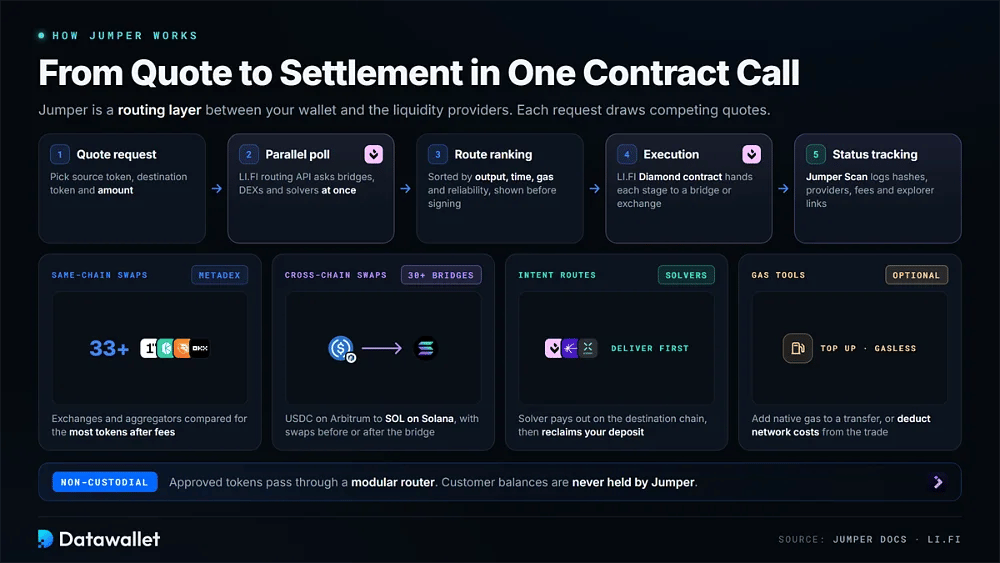
Jumper acts as a routing layer between a user's wallet and the venues supplying liquidity. A request generates competing quotes from integrated providers. Once the user selects a path, a single smart contract call executes the route across the required chains.
Here is how a Jumper transaction moves from quote to settlement:
- Quote request: The user chooses a source token, destination token and amount. Jumper sends the request to LI.FI's routing API, which polls integrated bridges, DEXs and solvers in parallel.
- Route ranking: LI.FI verifies the returned routes and sorts them using expected output, execution time, gas cost and reliability. Each figure appears on the review screen before the user signs anything.
- Same-chain swaps: Trades that stay on one network use a MetaDEX layer comparing more than 33 exchanges and DEX aggregators. It selects the route expected to return the most tokens after fees.
- Cross-chain swaps: Transfers between networks can combine one of 30-plus bridges with swaps before or after the bridge. For example, a user can send USDC on Arbitrum and receive SOL on Solana within one flow.
- Contract execution: Approved tokens pass through LI.FI's Diamond contract, a modular router that delegates each stage to the appropriate bridge or exchange. Customer balances are never held by Jumper.
- Intent routes: Some quotes use solver networks including LI.FI Intents, Relay and Across. The solver delivers funds on the destination chain first and later reclaims the user's deposited funds.
- Gas tools: Gas Top Up includes a small amount of the destination network's native token in a transfer. On supported pairs, gasless swaps instead deduct network costs from the trade.
- Status tracking: Jumper Scan logs each swap and bridge with transaction hashes, providers, fees and explorer links. Delayed transfers can be searched using a wallet address or transaction ID.
Top Jumper Use Cases
Jumper has moved well beyond the bridge interface it started with. By October 2026, users could access spot routing and yield deposits alongside advanced orders, tokenized equities and a rewards system connecting activity across those products.
1. Swapping and Bridging Across Chains
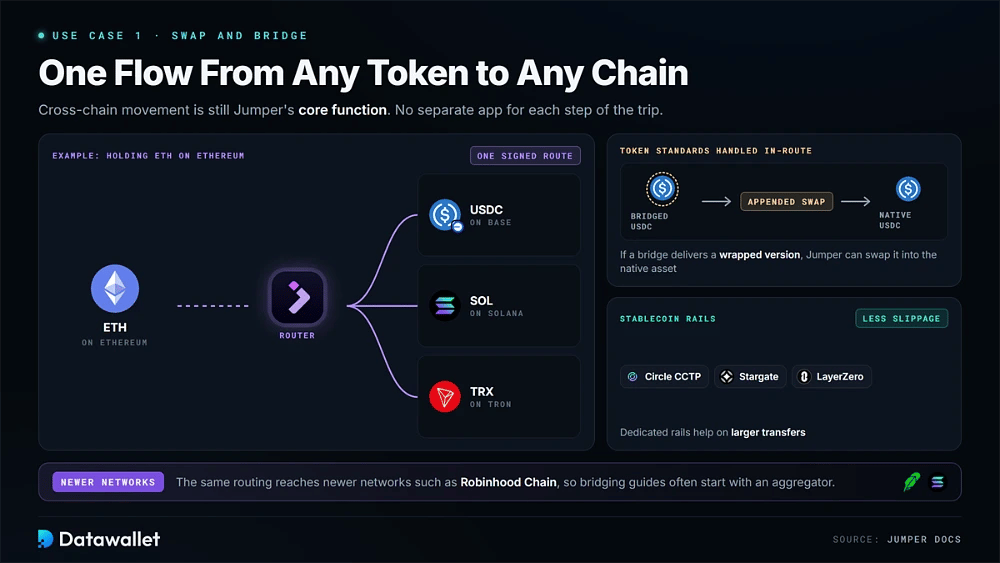
Cross-chain movement remains Jumper's core function. Someone holding ETH on Ethereum can receive USDC on Base, SOL on Solana or TRX on Tron without opening separate apps for each step. The same routing reaches newer networks, which is why guides to bridging to Robinhood Chain or Solana often start with an aggregator.
Token standards are handled within the route. If a bridge delivers a wrapped or bridged version of USDC, Jumper can append a swap into the native asset. Stablecoins may also move through Circle's CCTP or LayerZero-based rails such as Stargate, helping reduce slippage on larger transfers.
2. Earning Yield Through One-Click Deposits
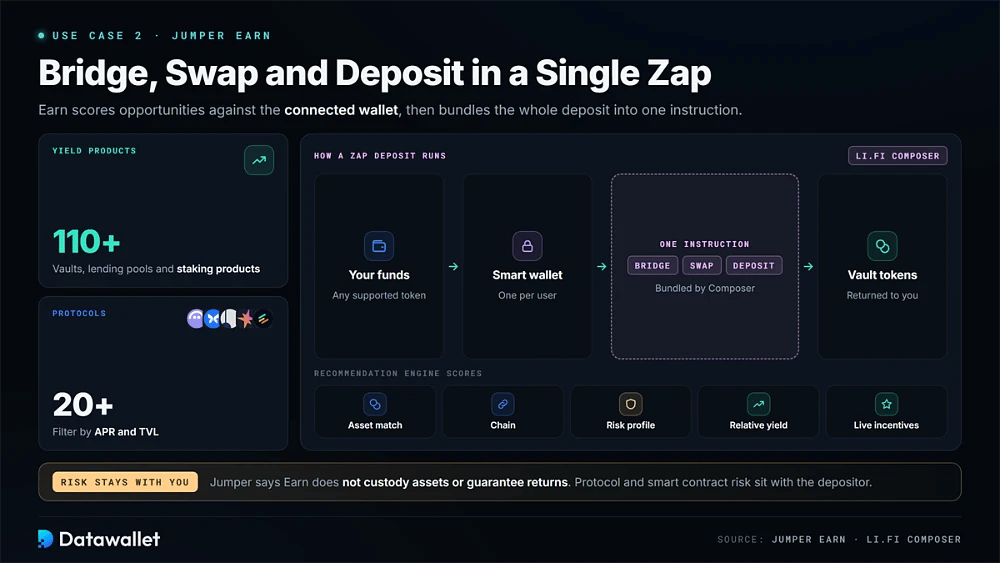
Jumper Earn lists more than 110 vaults, lending pools and staking products from over 20 protocols. Its recommendation engine examines the connected wallet and scores opportunities using asset match, chain and risk profile, as well as relative yield and live incentives. APR and TVL filters resemble those used by dedicated stablecoin yield trackers.
Deposits use a zap structure. Funds first enter a per-user smart wallet, where LI.FI's Composer bundles the bridge, swap and vault deposit into a single instruction before returning vault tokens. Jumper says Earn does not custody assets or guarantee returns, leaving protocol and smart contract risk with the depositor.
3. Advanced Orders, Perps and Private Swaps
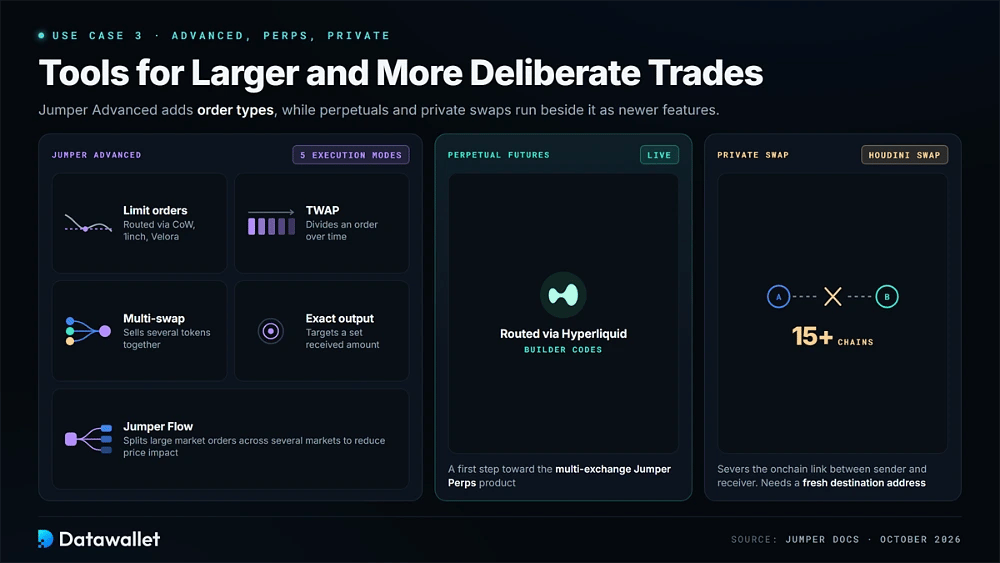
Jumper Advanced is designed for larger or more deliberate trades. Limit orders route through CoW, 1inch and Velora, while TWAP execution divides an order over time. Multi-swap can sell several tokens together, and exact-output mode targets a specific received amount. Jumper Flow distributes large market orders across venues to reduce price impact.
Two newer features operate alongside Advanced. Perpetual futures are routed through Hyperliquid builder codes as an initial step toward the multi-venue Jumper Perps product. Private Swap, powered by Houdini Swap, severs the onchain link between sender and receiver across more than 15 chains and requires a fresh destination address.
4. Trading Tokenized Stocks and RWAs
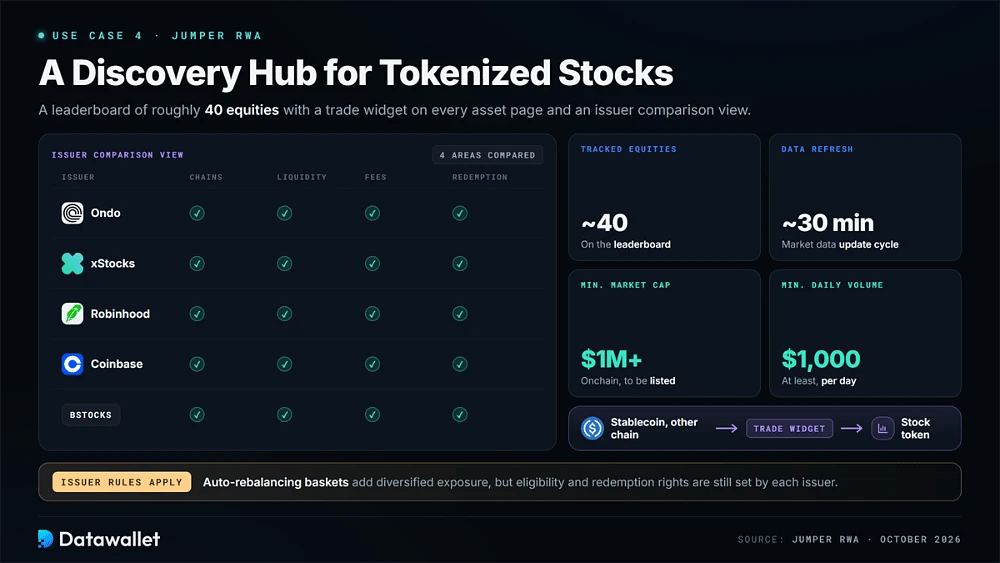
Jumper RWA serves as a discovery and trading hub for tokenized stocks. Its leaderboard follows roughly 40 equities with an onchain market cap above $1 million and at least $1,000 of daily volume. Issuers represented include Ondo, xStocks, Robinhood, Coinbase and bStocks. Market data updates about every 30 minutes.
Each asset page includes a trade widget, allowing a user to move from a stablecoin on another chain directly into the token. The comparison view outlines differences between issuers in areas such as chains, liquidity, fees and redemption. Auto-rebalancing asset baskets provide diversified exposure, while eligibility and redemption rights remain determined by each issuer.
5. Portfolio Tracking and Jumper Pass Rewards
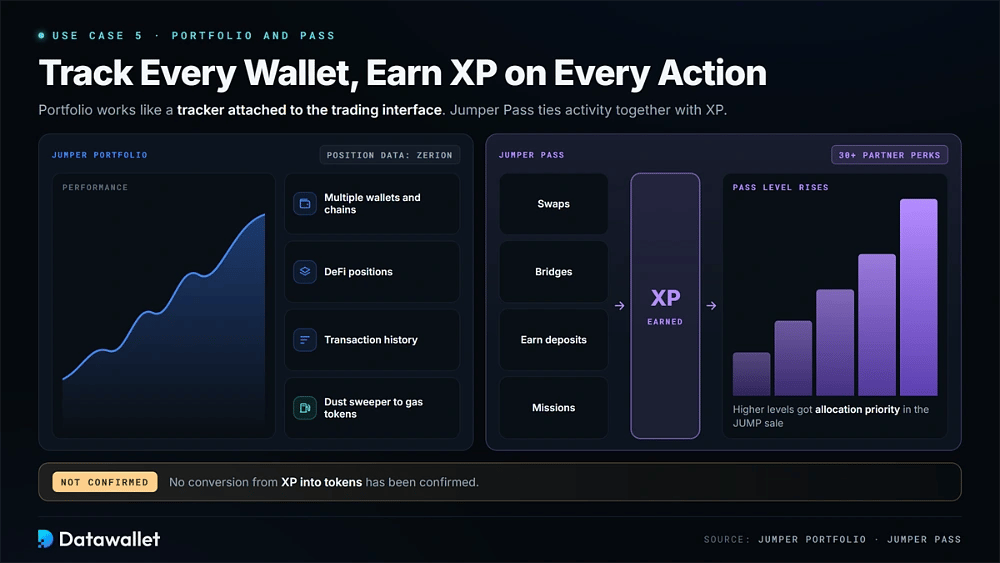
Jumper Portfolio combines token balances and DeFi positions across multiple wallets and chains. It includes performance charts and transaction history, plus a dust sweeper that converts small balances into gas tokens. Zerion supplies the position data. In practice, it operates like a crypto portfolio tracker attached to the trading interface.
Jumper Pass connects activity across the product. Swaps, bridges, Earn deposits and missions produce XP, raising the wallet's Pass level and unlocking more than 30 partner perks. XP also influenced the JUMP sale: higher levels received allocation priority. No conversion from XP into tokens has been confirmed.
How Jumper's Product Stack Fits Together
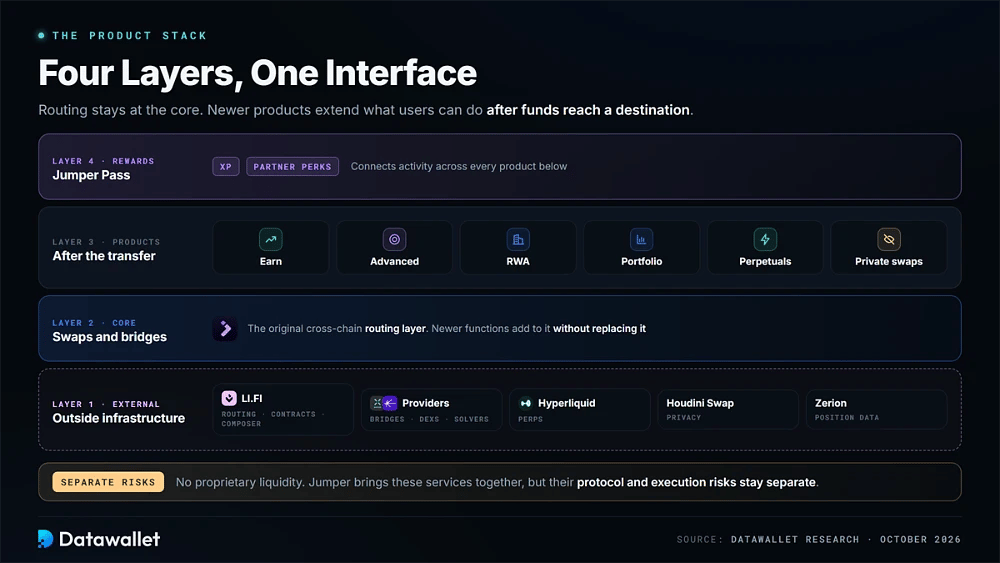
Swaps and bridges remain the core routing layer, while Earn, Advanced, RWA and Portfolio extend what users can do after funds reach a destination. Jumper Pass connects those activities through XP and partner perks. Perpetuals and private swaps add further trading functions without replacing the original cross-chain service.
The products still rely on external infrastructure rather than proprietary liquidity. LI.FI supplies routing, contracts and Composer, while providers such as bridges, exchanges, solvers, Hyperliquid, Houdini Swap and Zerion handle specific functions. Jumper's interface brings these services together, but their underlying protocol and execution risks remain separate.
Jumper Statistics and Trends
Jumper entered October 2026 as one of the largest consumer front ends in bridge aggregation, although its fee stream remained small. The figures below come from its DefiLlama page, company announcements and LI.FI's monthly changelog.
Key Jumper metrics as of early October 2026:
- Lifetime volume: Jumper reports processing more than $40 billion since launch. DefiLlama separately records about $25.8 billion in bridge volume and $12.3 billion in same-chain swaps, or roughly $38.1 billion combined.
- Bridge flow: About $864 million moved across chains through Jumper during the previous 30 days, with $150 million transferred over seven days. Ethereum, Arbitrum and Base contributed the largest amounts.
- Market share: DefiLlama's bridge aggregator rankings show roughly $5.6 billion in monthly sector volume. That puts Jumper near 15% of the category, consistent with the company's own claim.
- Swap volume: Same-chain MetaDEX trades reached about $180 million over 30 days, approximately one-fifth of bridge volume. Cross-chain transfers therefore remained the larger source of activity.
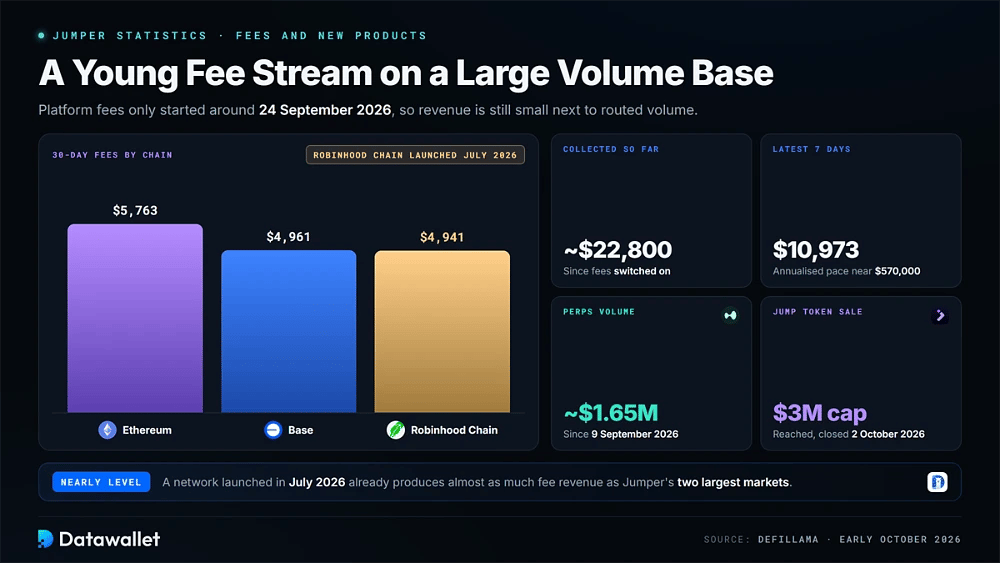
- Fee revenue: Platform fees started around 24 September 2026. DefiLlama records roughly $22,800 collected since then, including $10,973 in the latest seven days, equivalent to an annualised pace near $570,000.
- Fee chains: Ethereum produced $5,763 in 30-day fees, followed by Base at $4,961 and Robinhood Chain at $4,941. A network launched in July 2026 was therefore almost level with Jumper's two largest markets.
- Perps volume: Hyperliquid builder-code trading began on 9 September 2026 and accumulated about $1.65 million in volume, still a small base ahead of the full Jumper Perps launch.
- Token sale: The JUMP sale reached its $3 million cap and closed on 2 October 2026. TokenPost reported roughly $16 million pledged within one day, nearly eight times the target.
- Coverage: Jumper's documentation lists 65-plus chains, over 30 bridges and 33 DEXs. In August 2026, LI.FI retired Hop and Celer cBridge after integrating Layerswap, Paxos and Superset.
Jumper Fees Explained
For most of its history, Jumper promoted itself as a fee-free service. That model changed in late September 2026, when the platform introduced tiered charges on standard routes. Many third-party reviews still reflect the previous structure, making the current fee schedule worth checking directly.
Jumper platform fee tiers
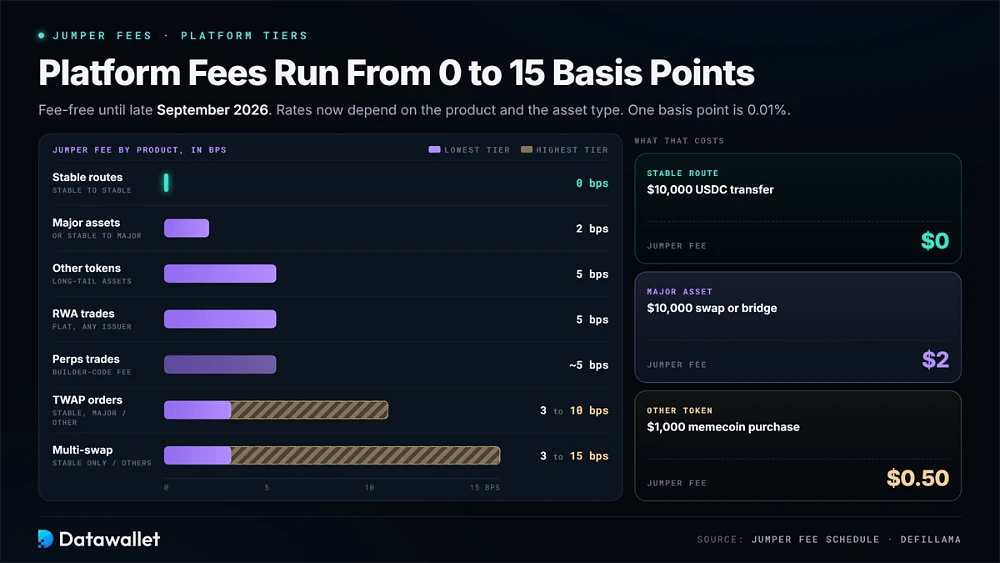
The published fee schedule expresses charges in basis points, with one basis point equal to 0.01%. The rate varies according to the product and whether a transaction involves stablecoins, major assets or other tokens.
These are the fees Jumper itself charges on each product:
- Stable routes: Stablecoin-to-stablecoin swaps and bridges carry a listed fee of 0 bps. A $10,000 USDC transfer therefore pays network gas and any charges imposed by the underlying bridge or solver, but no Jumper platform fee.
- Major assets: Swaps and bridges between major tokens, or from a stablecoin into a major token, cost 2 bps. That works out to $0.20 per $1,000 traded and $2 on $10,000.
- Other tokens: A route involving a long-tail asset costs 5 bps, the highest standard rate. A $1,000 memecoin purchase would therefore incur a Jumper fee of $0.50.
- RWA trades: Jumper RWA applies a flat 5 bps fee to every transaction, regardless of issuer or chain. Network, issuer and route charges may apply separately.
- Multi-swap: Batch sales through Jumper Advanced cost 3 bps when they involve only stablecoins. Major and other tokens are charged 15 bps, making multi-swap the platform's most expensive tool.
- TWAP orders: Time-sliced orders cost 3 bps for stable and major assets, rising to 10 bps for other tokens. Those charges are added to the fees of the underlying venues.
- Perps trades: Perpetuals sent to Hyperliquid include a builder-code fee that goes to Jumper. DefiLlama's adapter recorded $29 in fees on $57,850 of volume on 30 September, or about 5 bps.
Network, provider and slippage costs
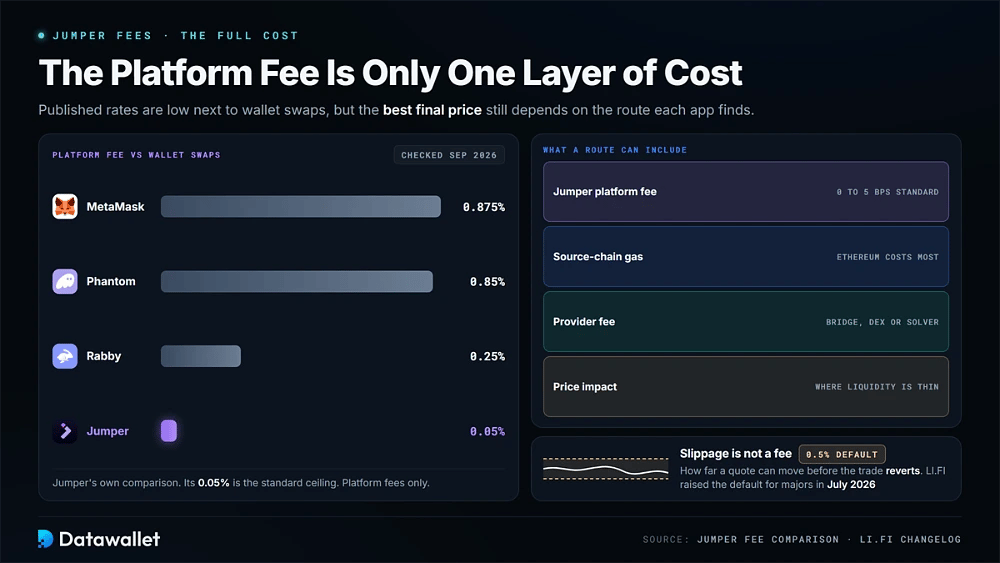
Jumper's platform charge represents only part of the total transaction cost. Routes can also include source-chain gas, fees from the chosen bridge, DEX or solver, and price impact where liquidity is limited. Ethereum remains the most expensive origin, so checking the current gas price can be useful before a large transfer.
Slippage is not a fee. It defines how far a quoted price can move before execution before the transaction reverts. In July 2026, LI.FI increased its default for major assets to 0.5%. Jumper Advanced allows traders to choose a value manually or leave the setting on Auto.
The published rates are low compared with wallet swaps. Jumper's own comparison, checked in September 2026, lists MetaMask at 0.875%, Phantom at 0.85% and Rabby at 0.25%. These figures cover platform fees only; the best final price still depends on the route each application finds.
Why Jumper Is Spinning Out of LI.FI
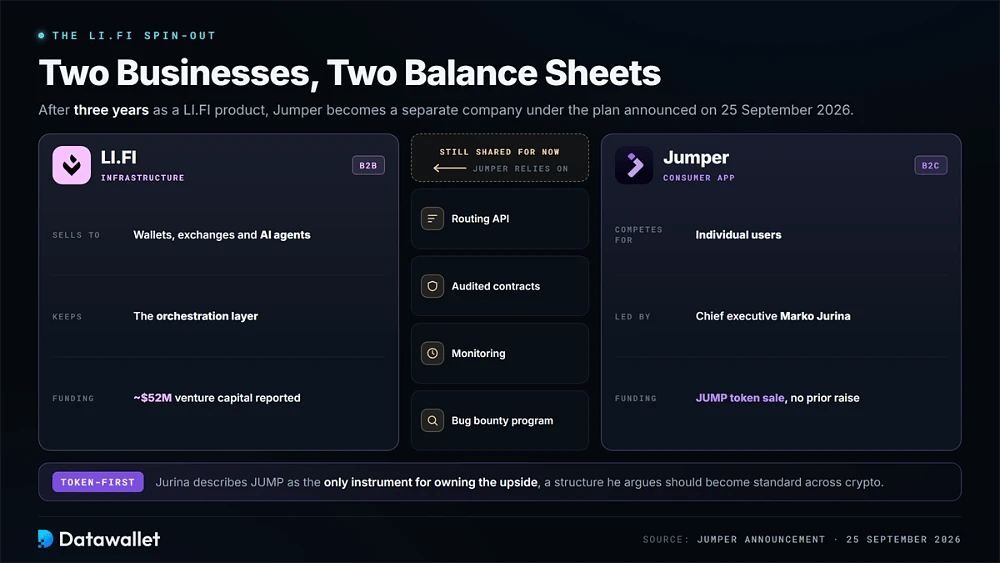
Jumper operated as a LI.FI product for three years. Under the plan announced on 25 September 2026, it becomes a separate venture with independent capital, leadership and a distinct roadmap. LI.FI retains the orchestration layer used by wallets, exchanges and AI agents, while Jumper focuses on the consumer-facing application.
The separation makes the distinction between the two businesses clearer. LI.FI sells routing infrastructure to other companies and has reported roughly $52 million in venture funding. Jumper competes for individual users and had never raised capital before the token sale. Separate balance sheets allow each business to be valued and financed according to its own economics.
For now, the independence has limits. Jumper continues to route through LI.FI's API, execute with LI.FI's audited contracts and depend on its monitoring and bug bounty programs. Chief executive Marko Jurina has described JUMP as the only instrument for owning the upside, arguing that this token-first structure should become standard across crypto.
JUMP Token and Tokenomics
JUMP is planned as the native token of the independent Jumper company. Supply is fixed at one billion tokens. As of early October 2026, it had not begun trading, and the token generation event was expected during the fourth quarter.
Inside the Legion public sale
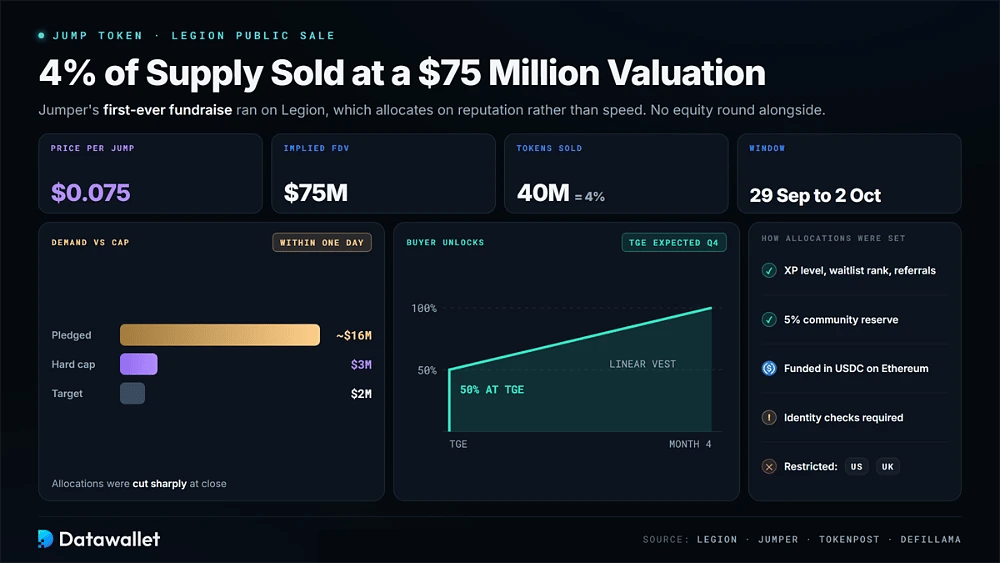
The first JUMP distribution took place through a public sale on Legion, a launchpad that allocates based on reputation rather than speed. It was Jumper's first-ever fundraising round, and the company did not conduct an accompanying equity raise.
Here are the confirmed terms of the JUMP public sale:
- Price: JUMP was sold at $0.075 per token. Applied to the fixed one billion supply, that price implies a fully diluted valuation of $75 million at launch.
- Allocation: The sale included 40 million JUMP, equal to 4% of total supply, under a $3 million hard cap. Jumper set a $2 million target, while DefiLlama recorded $3 million raised.
- Window: Pledges opened at 13:00 UTC on 29 September 2026 and closed at the same time on 2 October. Participants funded commitments using USDC on Ethereum mainnet.
- Selection: The Jumper team assigned allocations rather than using a first-come, first-served system. Legion's guidance referenced XP level, waitlist rank and referral quality, along with a 5% community reserve.
- Unlocks: Buyers receive 50% of their tokens at the generation event. The other half vests linearly over the following four months, creating a relatively short period for the remaining sale allocation to enter circulation.
- Exclusions: Legion identified the United States and United Kingdom as restricted jurisdictions. All participants also had to complete identity checks, although passing verification did not ensure an allocation.
- Demand: About $16 million was pledged within a day of the sale opening, several times the hard cap. Individual allocations consequently had to be reduced sharply when the sale closed.
Supply allocation and token utility
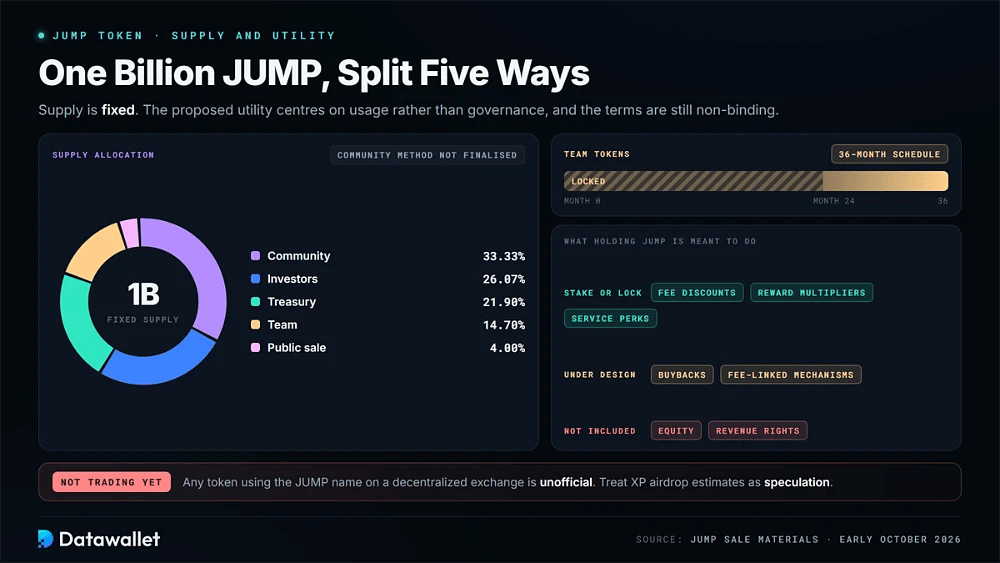
Sale materials divide JUMP supply into five allocations: 33.33% for the community, 26.07% for investors, 21.90% for the treasury, 14.70% for the team and 4% for the public sale. Team tokens are described as locked for 24 months, with vesting completed by month 36. The method for distributing the community allocation has not been finalised.
The proposed utility centres on usage rather than governance. Staking or locking JUMP is expected to provide fee discounts, reward multipliers and service perks within the app. Buybacks and other fee-linked mechanisms remain under design. Sale disclosures state that JUMP provides no equity or revenue rights in either company.
Two qualifications are important. The published thesis is indicative and non-binding, meaning terms can change before launch. JUMP also does not yet trade. Any token currently using that name on a decentralized exchange is unofficial, and readers following a possible XP distribution should regard airdrop estimates as speculation.
Supported Chains, Bridges and Wallets
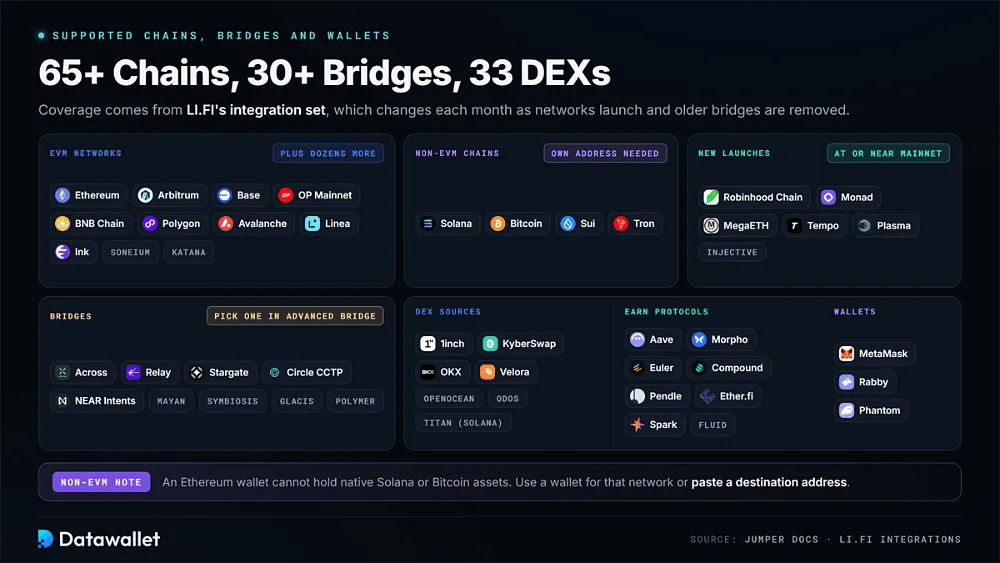
Jumper draws its network coverage from LI.FI's integration set, which changes each month as new networks launch and older bridges are removed. Its current reach includes EVM and non-EVM networks, along with intent systems, DEX aggregators and yield protocols.
These are the main networks and providers available through Jumper:
- EVM networks: Jumper supports Ethereum, Arbitrum, Base, OP Mainnet, BNB Chain, Polygon, Avalanche and Linea, plus dozens of other EVM chains. Smaller rollups such as Ink, Soneium and Katana are also included.
- Non-EVM chains: Solana, Bitcoin, Sui and Tron are available alongside EVM networks. Reaching those chains requires a compatible destination address because an Ethereum wallet cannot hold their native assets.
- New launches: More recent additions include Robinhood Chain, Monad, MegaETH, Tempo, Plasma and Injective. Routing typically becomes available on or shortly after the public mainnet launch.
- Bridges: Jumper integrates providers including Across, Relay, Stargate, Circle CCTP, Mayan, Symbiosis, Glacis, Polymer and NEAR Intents. Advanced Bridge allows users to choose a provider directly or favour speed over cost.
- DEX sources: On EVM chains, same-chain liquidity is sourced from aggregators and exchanges including 1inch, KyberSwap, OpenOcean, OKX, Velora and Odos. Solana routes also use Titan and OKX.
- Earn protocols: LI.FI's Composer can route deposits into Aave, Morpho, Euler, Compound, Pendle, Ether.fi, Spark and Fluid, among others. These integrations provide the vault inventory available through Jumper Earn.
- Wallets: MetaMask, Rabby, Phantom and other widely used self-custody crypto wallets can connect. Bitcoin and Solana routes require a wallet for the relevant network or a manually entered destination address.
Pros and Cons of Using Jumper
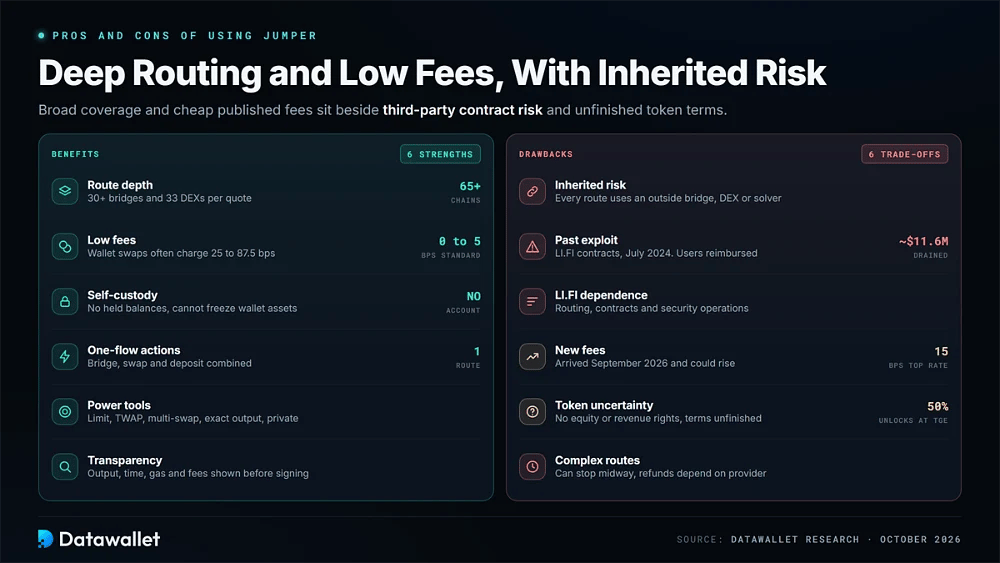
Jumper combines some of the broadest routing coverage in its category with comparatively low published platform fees. At the same time, users remain exposed to inherited contract risk, unfinished token terms and a business model that had only begun collecting fees days earlier.
Benefits of Using Jumper
Its main strengths come from the depth of its routing and clear fee information, together with a product range that lets users keep capital in one interface after a transfer completes. Those characteristics help explain Jumper's roughly 15% share of bridge aggregator volume.
These are the main benefits Jumper offers traders and DeFi users:
- Route depth: Quotes can draw from more than 30 bridges and 33 DEXs spanning 65-plus chains. In many cases, users can reach the required token or network without opening another app.
- Low fees: Standard transactions are priced between 0 and 5 bps, while stablecoin transfers carry no Jumper platform fee. Built-in wallet swaps commonly charge between 25 and 87.5 bps.
- Self-custody: Transactions execute from the user's own wallet through audited contracts. Jumper does not hold balances, requires no account and cannot freeze assets that remain in a wallet.
- One-flow actions: Bridging, swapping and depositing can be combined in one route. A user can therefore move from an asset on one chain directly into a vault or tokenized stock on another.
- Power tools: Experienced traders can use limit orders, TWAP, multi-swap and exact-output execution, as well as provider selection and private swaps. Most bridge interfaces offer fewer controls.
- Transparency: Quotes display expected output, execution time, gas and provider fees before signing. Jumper Scan also preserves a searchable history for completed and pending transfers.
Drawbacks of Using Jumper
Its main limitations are the dependence on third-party providers, a security history that includes a significant exploit, and uncertainty surrounding the newly independent company and its token. These issues become more consequential when larger balances are involved.
These are the drawbacks worth weighing before relying on Jumper:
- Inherited risk: Each route uses an outside bridge, DEX or solver. If one of those providers fails or is exploited, funds may be delayed or put at risk even when Jumper itself is functioning normally.
- Past exploit: LI.FI's contracts suffered an exploit of about $11.6 million in July 2024 involving wallets with infinite approvals. Users who were affected received reimbursement, but the incident remains relevant to the platform's security record.
- LI.FI dependence: Despite becoming independent, Jumper still depends on LI.FI for routing, contracts and security operations. An outage, pricing change or dispute between the companies would directly affect Jumper users.
- New fees: Platform fees only arrived in September 2026 and could increase as the company seeks revenue. Some Advanced tools already charge as much as 15 bps per trade.
- Token uncertainty: The JUMP community distribution, value mechanisms and launch date are still unfinished. The token provides no equity or revenue rights, and 50% of the public-sale allocation unlocks immediately.
- Complex routes: A multi-step transaction can stop midway, leaving funds in an intermediate asset. Refund procedures depend on the provider responsible for the route and may take time.
How to Use Jumper
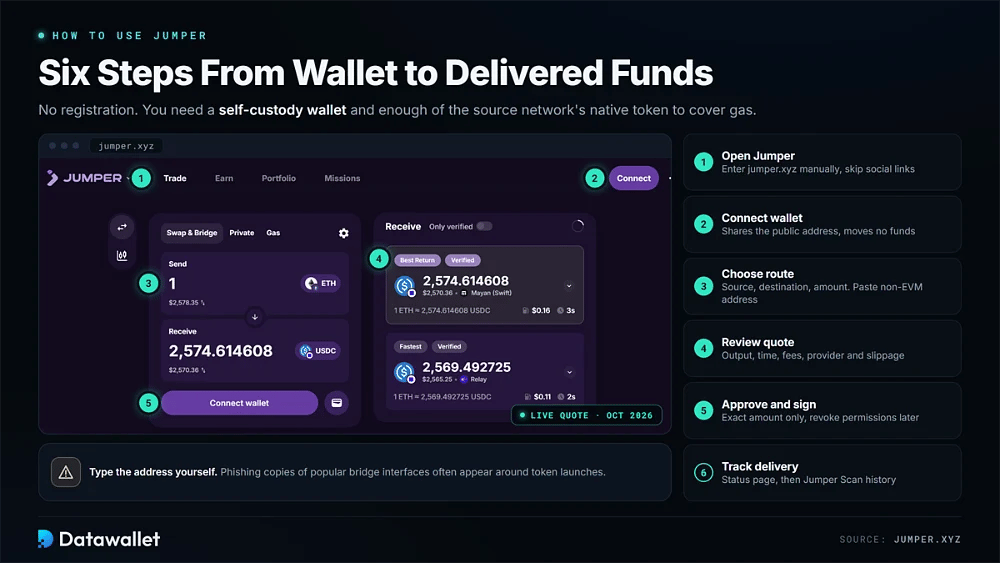
Using Jumper requires a self-custody wallet plus enough of the source network's native token to cover gas. There is no registration process, and an initial transfer usually finishes within a few minutes.
Follow these steps to complete a swap or bridge on Jumper:
- Open Jumper: Enter jumper.xyz manually in the browser rather than following a social-media link. Phishing copies of popular bridge interfaces often appear around token launches.
- Connect wallet: Select Connect and approve the request through MetaMask, Rabby, Phantom or another supported wallet. This exposes the public wallet address but does not move funds.
- Choose route: Pick the source chain and token, followed by the destination chain and token. Enter the amount. For a non-EVM destination, paste the appropriate receiving address.
- Review quote: Check the ranked options for output, estimated time and total fees. Open the route details to verify the bridge provider, Jumper fee, gas estimate and slippage setting.
- Approve and sign: Approve the precise amount requested, then confirm the transaction in the wallet. Avoid unlimited approvals and revoke token permissions once they are no longer necessary.
- Track delivery: Follow the status page until the destination funds arrive, then confirm the new balance in the receiving wallet. Jumper Scan provides complete transaction history for any address.
Jumper vs Competitors
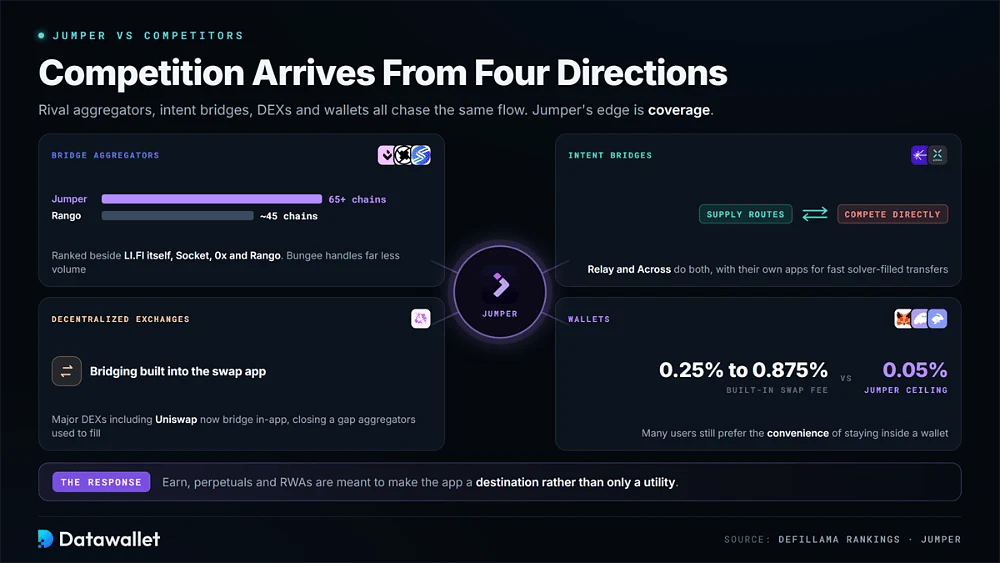
Jumper faces competition from several directions. Other bridge aggregators pursue the same cross-chain volume, while intent-based bridges increasingly reach users through their own interfaces. Wallets also package swaps into the place where assets are already stored. Following the spin-out, Jumper additionally competes with trading super-apps seeking to capture the broader onchain session.
Within aggregation, DefiLlama's monthly rankings place Jumper alongside LI.FI itself, Socket, 0x and Rango. Bungee, Socket's consumer application, processes substantially less volume than Jumper, while Rango covers about 45 chains. Jumper's advantage is coverage, supported by LI.FI's broad set of bridge and DEX integrations.
Relay and Across occupy two roles at once: both supply routes to Jumper and compete with it directly. Each offers its own interface for fast, solver-filled transfers on popular corridors. Major decentralized exchanges, including Uniswap, have also added bridging to their applications, reducing a gap aggregators previously filled.
Wallets create the clearest price comparison. MetaMask, Phantom and Rabby charge between 0.25% and 0.875% for built-in swaps, compared with Jumper's 0.05% standard ceiling. Many users still favour the convenience of staying inside a wallet. Jumper's addition of Earn, perpetuals and RWAs is intended to make the app a destination rather than only a utility.
Is Jumper Safe?
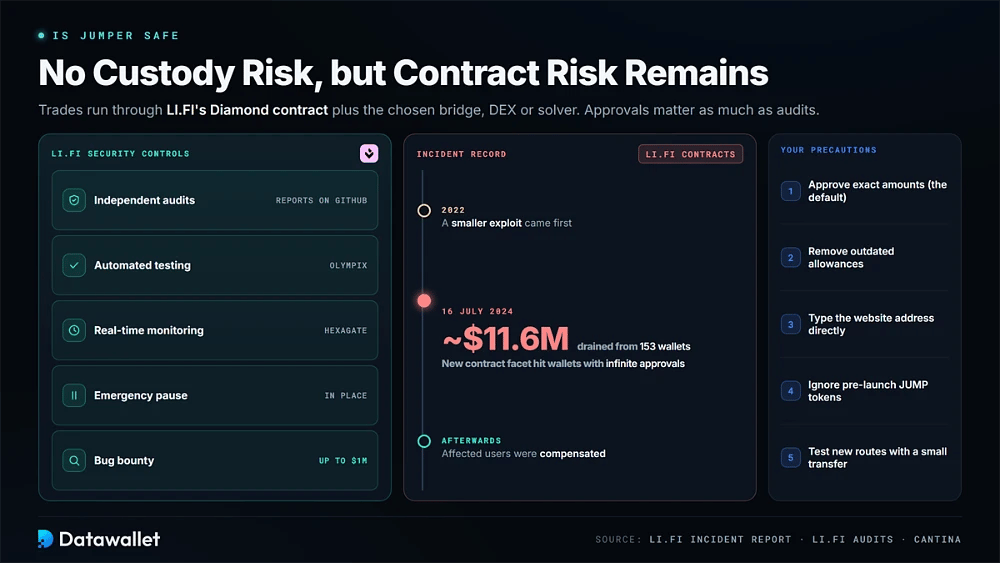
Jumper's non-custodial design removes the type of counterparty risk associated with centralized exchanges, but smart contract risk remains. Transactions run through LI.FI's Diamond contract, while each route also relies on the chosen bridge, DEX or solver. Security therefore depends both on those contracts and on how carefully users manage token approvals.
LI.FI publishes information about its security controls. Contract changes undergo independent review, with audit reports available on GitHub. The company also uses automated testing from Olympix and real-time monitoring with partners including Hexagate. Emergency pause mechanisms are in place, and its bug bounty offers rewards of up to $1 million.
Its record nevertheless includes serious incidents. On 16 July 2024, a newly deployed contract facet allowed an attacker to drain about $11.6 million from 153 wallets with infinite approvals, according to LI.FI's incident report. This followed a smaller exploit in 2022. Affected users were compensated.
Basic precautions can reduce much of the exposure. Approve exact amounts, which Jumper uses by default, and remove outdated allowances. Type the website address directly rather than relying on links, ignore JUMP tokens offered before the official launch, and test unfamiliar routes with a small transfer before committing a large balance.
What Changes After the LI.FI Spin-Out
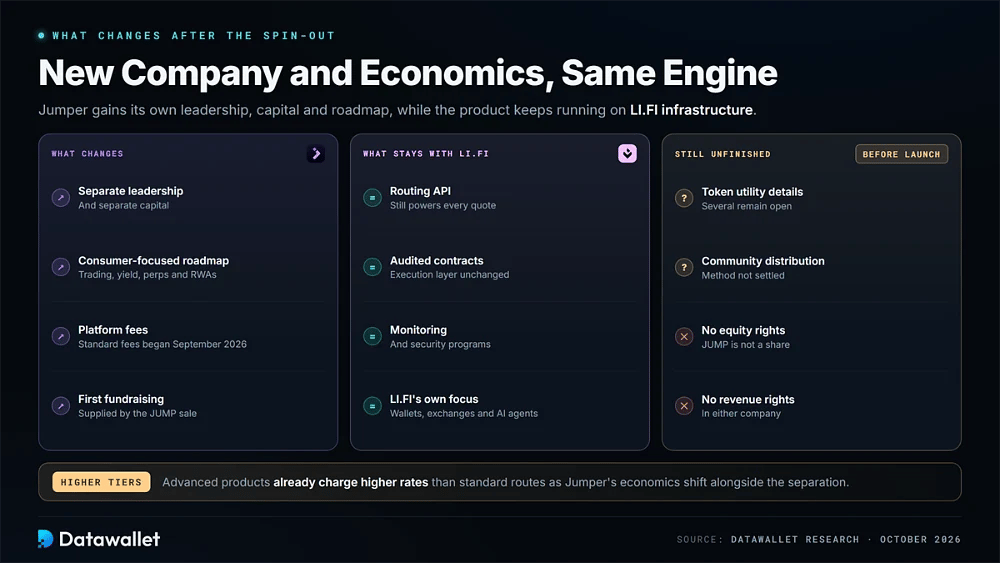
The spin-out gives Jumper separate leadership, capital and a consumer-focused roadmap, but the product continues to use LI.FI's API, audited contracts, monitoring and security programs. LI.FI remains focused on infrastructure for wallets, exchanges and AI agents, while Jumper builds around trading, yield, perpetual futures and real-world assets.
Jumper's economics are also changing alongside the separation. Standard platform fees began in September 2026, Advanced products already charge higher rates, and the JUMP sale supplied the company's first fundraising. The token does not provide equity or revenue rights, and several utility and community-distribution details remain unfinished before launch.
The Future of Jumper
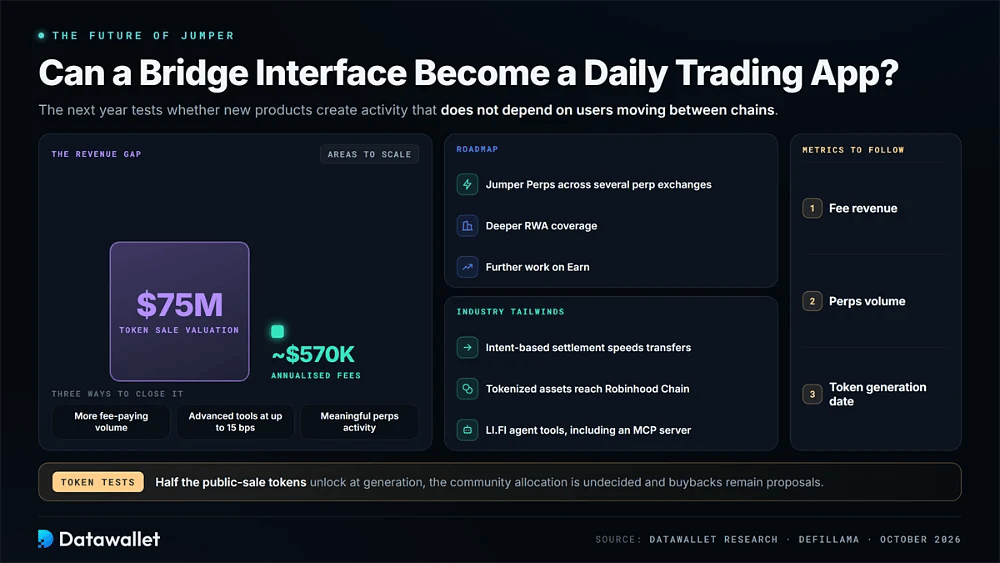
Jumper's next year will test whether a bridge interface can turn into a venue users visit for daily trading. Its roadmap includes a full Jumper Perps product aggregating several perpetual exchanges, deeper RWA coverage and further work on Earn. Each expansion is intended to generate activity that does not depend on users moving between chains.
Revenue remains an open question. Based on the early October pace, platform fees annualise to about $570,000, which is a small base relative to a token sold at a $75 million valuation. Closing that gap would require substantially more fee-paying volume, greater use of Advanced products charging up to 15 bps, or meaningful perpetual futures activity.
The token launch introduces another set of tests. Half of the public-sale tokens unlock at generation, while the community allocation has not been decided and mechanisms such as buybacks remain proposals. Sentiment will depend partly on how Jumper treats wallets holding XP, along with the final clarity of holder rights.
Several broader industry developments favour its direction. Intent-based settlement is speeding up cross-chain transfers, while tokenized assets continue spreading to newer networks such as Robinhood Chain. LI.FI is also developing agent-facing tools, including an MCP server. The clearest metrics to follow are fee revenue, perps volume and the token generation date.
Final Thoughts
Jumper has become a default route for many users moving tokens between blockchains because it addresses a specific problem effectively: comparing paths across dozens of bridges and exchanges, then executing the selected route in one flow. Its reported volume above $40 billion and roughly 15% category share reflect that scale.
The next phase is less established. Jumper is separating from LI.FI while introducing fees for the first time, preparing a token launch and expanding simultaneously into perpetuals, yield and tokenized stocks. Each change creates another possible source of revenue. It also introduces execution risks that were not present a year earlier.
For everyday users, the decision remains practical. Jumper offers a low-cost, non-custodial route for swaps and bridges when approvals are limited and transaction details are checked before signing. JUMP should be treated as a separate speculative decision. For large transactions, compare quotes with other DeFi platforms before moving funds.