

What Are Polymarket Perps?
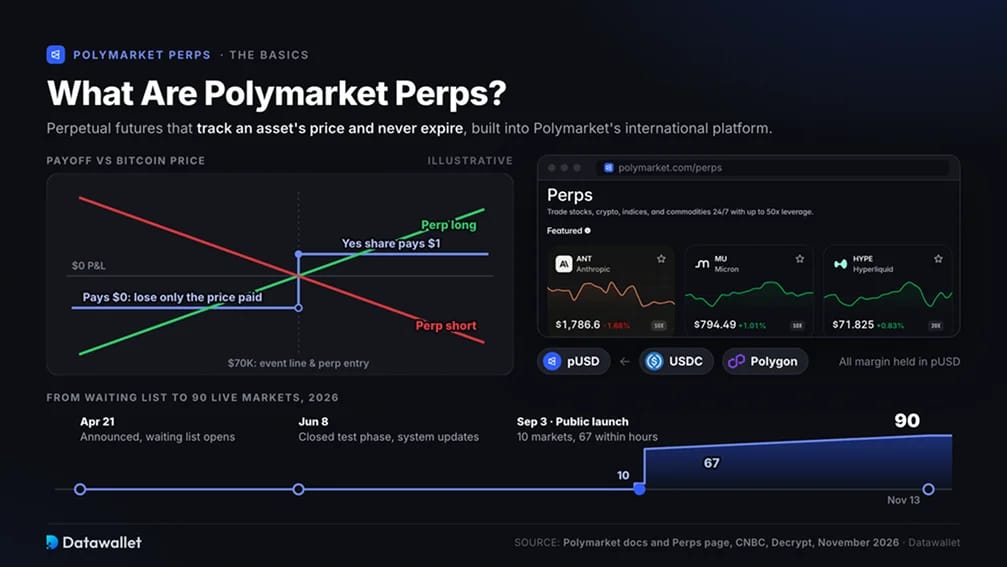
Polymarket Perps are perpetual futures contracts, or perps, which track an asset's price and never expire. A trader opens a long position to profit when the price rises, or a short position to profit when it falls. Polymarket's documentation describes contracts linked to crypto assets, company shares, stock indexes and commodities.
The product sits inside the international version of Polymarket, the platform known for prediction markets. A prediction share pays $1 or $0 after an event is decided. A perp has no event and no final payout, so its value follows the asset price while the position stays open.
Polymarket announced the product on April 21, 2026 and opened a waiting list that day. A closed test phase followed, and the official changelog records updates to the trading system from June 8. The exchange opened to the public on September 3 with 10 markets, and the list grew to 67 within hours.
Every position is backed by margin, the collateral a trader deposits to cover losses. All margin is held in pUSD, Polymarket's collateral token on Polygon, which is backed by USDC, a dollar stablecoin issued by Circle.
Leverage lets a trader control a position larger than the margin, so gains and losses both grow faster than the asset price moves. Beginners can start with our comparison of perpetual vs spot trading.
How Do Polymarket Perps Work?
What a position costs, and how long it can stay open, depends on the order book, the margin system, hourly funding and a liquidation process that closes positions when collateral runs low.
1. Order Book and Settlement
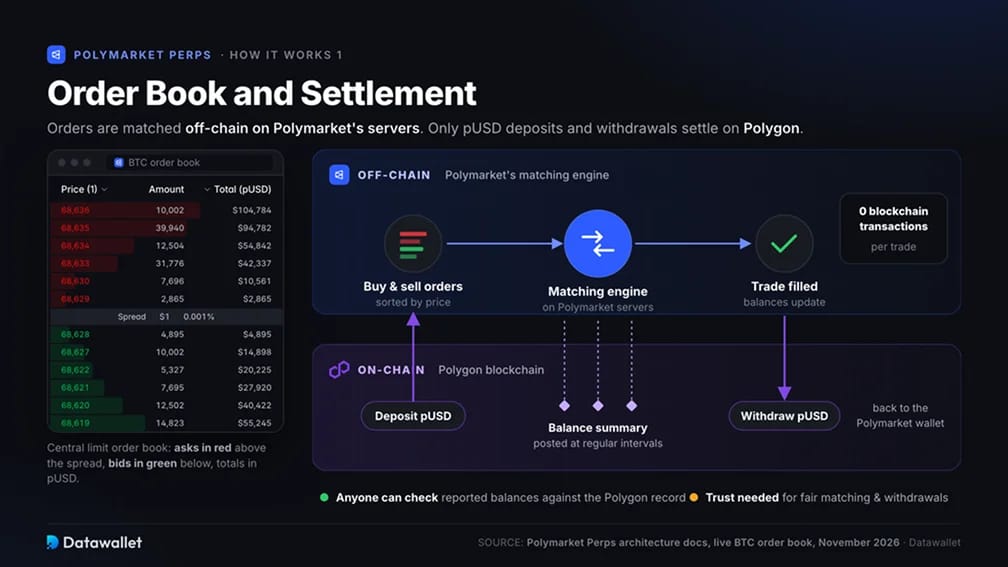
Every trade begins as an order in a central limit order book, a public list of buy and sell offers sorted by price. Polymarket's matching engine pairs these orders off-chain, which means on its own servers and outside any blockchain. The architecture notes confirm that trades do not create blockchain transactions. Only deposits and withdrawals of pUSD settle on Polygon.
The exchange also publishes a summary of all account balances to Polygon at regular intervals. Outside observers can check the exchange's reported balances against this record. Traders still depend on Polymarket to match orders fairly and to process withdrawals.
2. Leverage and Margin
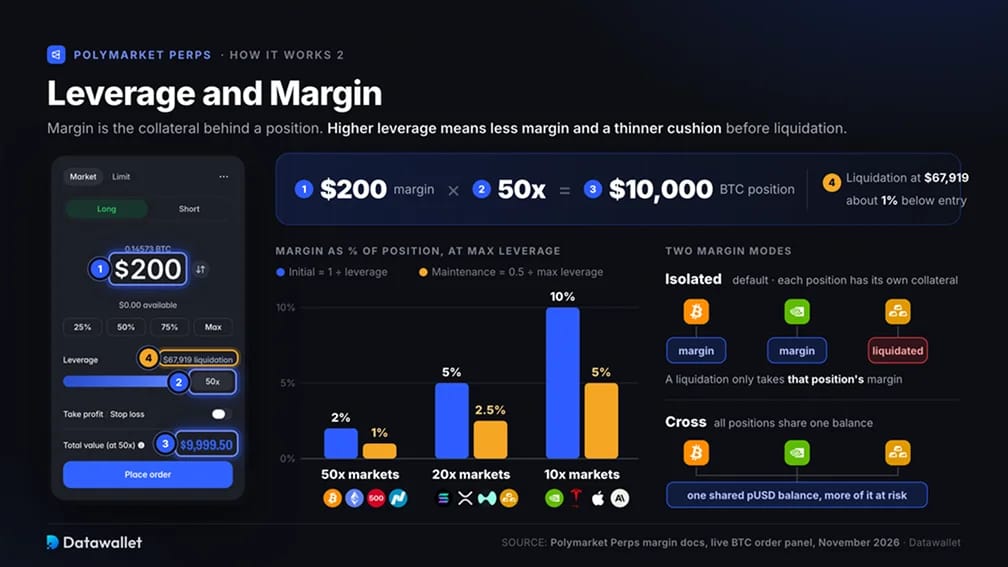
Initial margin, the collateral needed to open a position, equals the position value divided by the chosen leverage. A $10,000 Bitcoin position at 50x needs $200. Maintenance margin is the minimum collateral needed to keep the position open, and the margin rules set it at 0.5 divided by the market's maximum leverage.
That gives a maintenance rate of 1% on a 50x market, 2.5% on a 20x market and 5% on a 10x market. Larger positions face lower leverage limits through tiers. Traders choose isolated margin, where each position has its own collateral, or cross margin, where all positions share one balance.
3. Hourly Funding
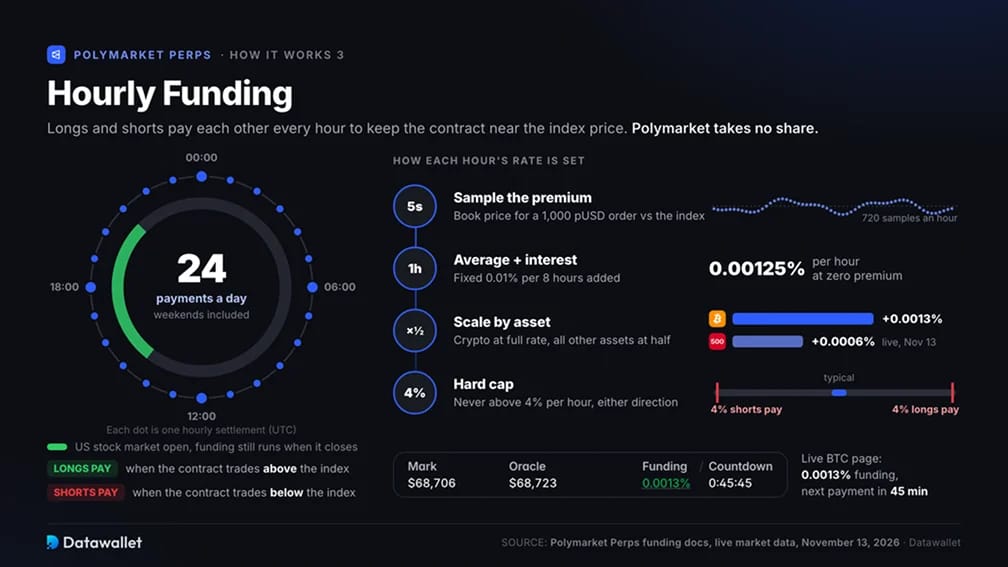
Funding is a payment between long and short traders that keeps the contract price close to the index price, which is Polymarket's estimate of the asset's fair value from outside price feeds. Polymarket takes no share of the payment, and its funding formula sets the rate each hour.
- Sampling: Every 5 seconds, the exchange measures how far the order book price for a 1,000 pUSD order sits above or below the index price.
- Hourly Average: The samples are averaged over one hour and adjusted by a fixed interest component of 0.01% per eight hours.
- Asset Scale: Crypto markets use the full result, while stock, index and commodity markets use half of it.
- Hard Cap: The hourly rate cannot exceed 4% in either direction.
- Direction: Longs pay shorts when the contract trades above the index, and shorts pay longs when it trades below.
- Closed Markets: Funding continues at night and on weekends, even when the stock or commodity exchange behind the contract is closed.
Live crypto funding rates show what other exchanges charge on the same assets.
4. Liquidation and Auto-Deleveraging
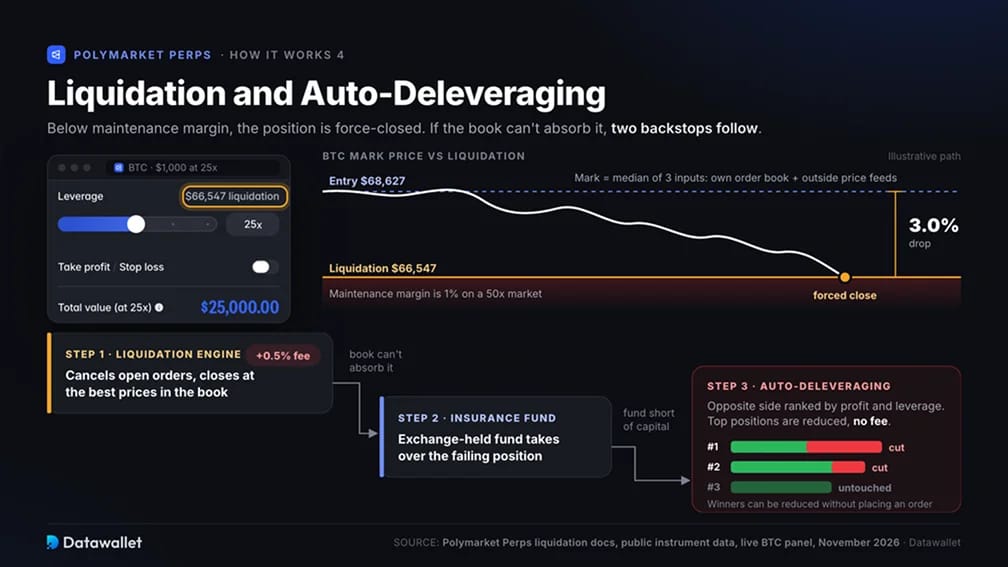
The exchange values every position at the mark price, the median of three inputs from its own order book and outside price feeds. When account value falls below maintenance margin, the liquidation engine cancels open orders and closes the position at the best available prices. Each forced trade carries an extra liquidation fee.
If the order book cannot absorb a failing position, an insurance fund held by the exchange takes it over. When that fund lacks the capital, the exchange applies auto-deleveraging, which closes part of the most profitable and most leveraged positions on the opposite side without a fee. A profitable trader can therefore see a position reduced without placing an order.
Polymarket Perps vs Prediction Markets
Both products are reached from the same Polymarket login and use the same collateral token, yet they carry different risks. A prediction share can lose only the amount paid for it. A leveraged perp can be liquidated before the trader's view proves correct, and funding adds a running cost.
Xtine Fang, who leads the product, said in an interview published by Polymarket that the aim is to let users trade many asset types without moving funds to another exchange. She also confirmed that leverage on event contracts, such as election outcomes, is not offered. Readers who prefer event contracts can review our guide to Polymarket trading strategies.
What Can You Trade on Polymarket Perps?
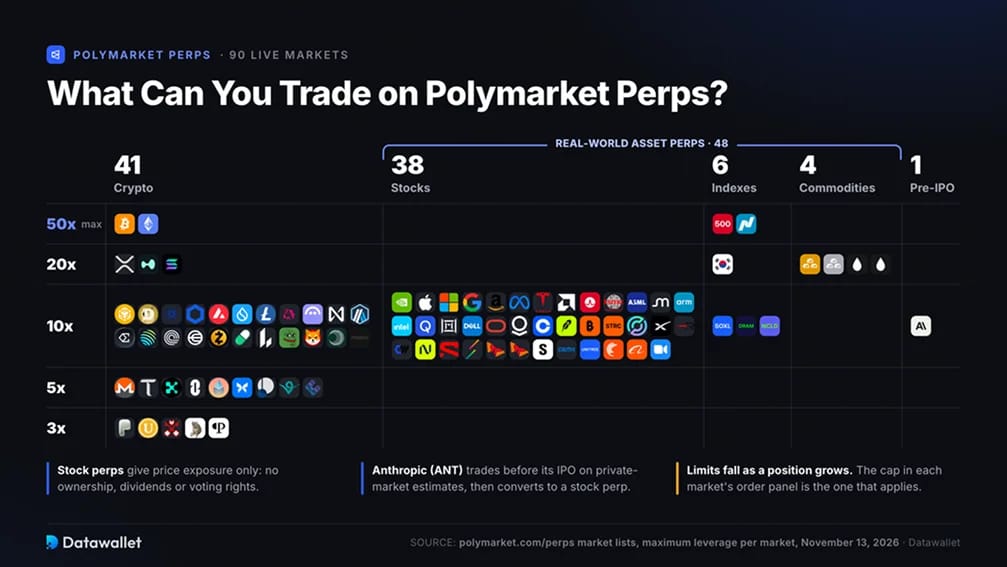
The Perps page listed 90 live markets on November 13, 2026. Maximum leverage is set for each market and falls as a position grows.
- Crypto: 41 contracts. Bitcoin and Ether allow 50x. Solana, XRP and HYPE allow 20x, and smaller tokens are limited to between 3x and 10x.
- Stocks: 38 contracts at up to 10x on companies such as Nvidia, Tesla, Apple, Micron, Samsung and SpaceX. A stock perp gives price exposure only and carries no ownership, dividend or voting rights.
- Indexes: 6 contracts. USA500 and US100, which track the S&P 500 and the Nasdaq 100, allow 50x. The other four follow sector and country baskets at 10x or 20x.
- Commodities: Gold, silver, WTI crude oil and Brent crude oil, each at 20x.
- Pre-IPO: One contract at 10x on Anthropic (ANT), listed before the company's shares began trading. Its specification converts ANT to a standard stock perp once the shares trade. Before a listing, prices rely on private-market estimates, which are less dependable than a public share price. Similar contracts on other exchanges are compared in our guide to Anthropic pre-IPO futures.
Stock, index and commodity contracts are known as real-world asset (RWA) perps, a category explained in our RWA perps guide.
In September, the highest setting was 20x for crypto, major indexes and commodities. When we checked on November 13, 2026, the product page advertised 50x, while the documentation FAQ still listed a 20x maximum. The limit in each market's order panel is the one that applies.
How Much Do Polymarket Perps Cost?
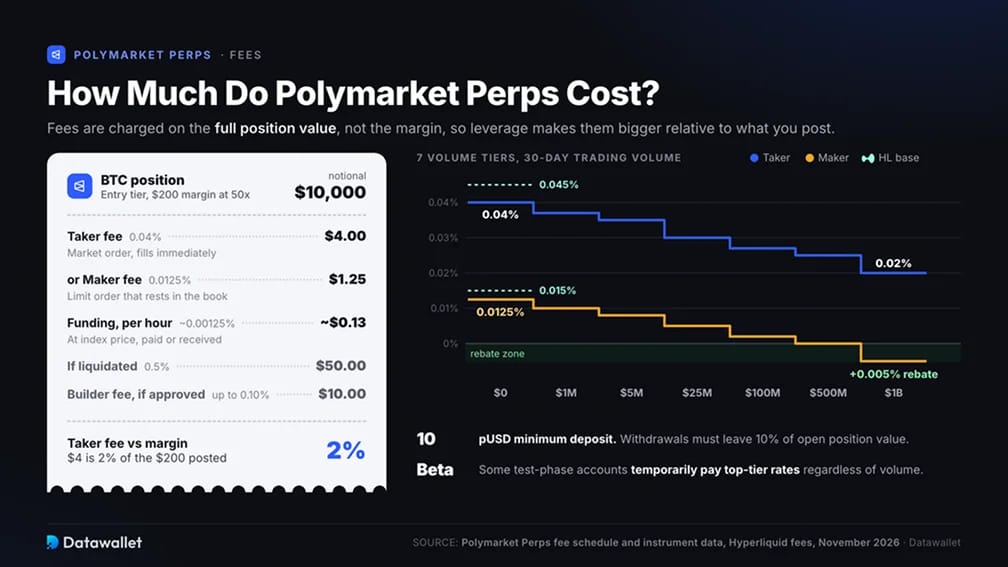
Costs come from trading fees, funding and forced closures. The fee schedule charges fees on the full position value, known as notional value, so leverage raises the fee relative to the margin posted.
- Taker Fee: 0.04% at the entry tier for orders that execute immediately, which equals $4 on a $10,000 trade.
- Maker Fee: 0.0125% at the entry tier for limit orders that wait in the order book. Our explainer on maker and taker fees covers the difference.
- Volume Tiers: Rates fall across seven tiers based on 30-day trading volume. At $1 billion, takers pay 0.02% and makers receive a rebate of 0.005%.
- Funding: Paid or received every hour. When a crypto contract trades at its index price, the formula produces a rate near 0.00125% per hour.
- Liquidation Fee: An extra 0.5% of position value on each forced trade, according to the exchange's public instrument data on November 13, 2026.
- Builder Fee: A third-party app can add up to 0.10% when the trader approves it.
- Deposits and Withdrawals: The minimum deposit is 10 pUSD. Withdrawals must leave at least 10% of open position value in the account.
- Early Accounts: Some accounts created during the test phase temporarily pay top-tier rates regardless of volume.
The entry rates are slightly below the base rates of 0.045% and 0.015% that we list in our guide to Hyperliquid fees. Active traders reach lower tiers on both exchanges, so the comparison depends on monthly volume.
Polymarket Perps Statistics
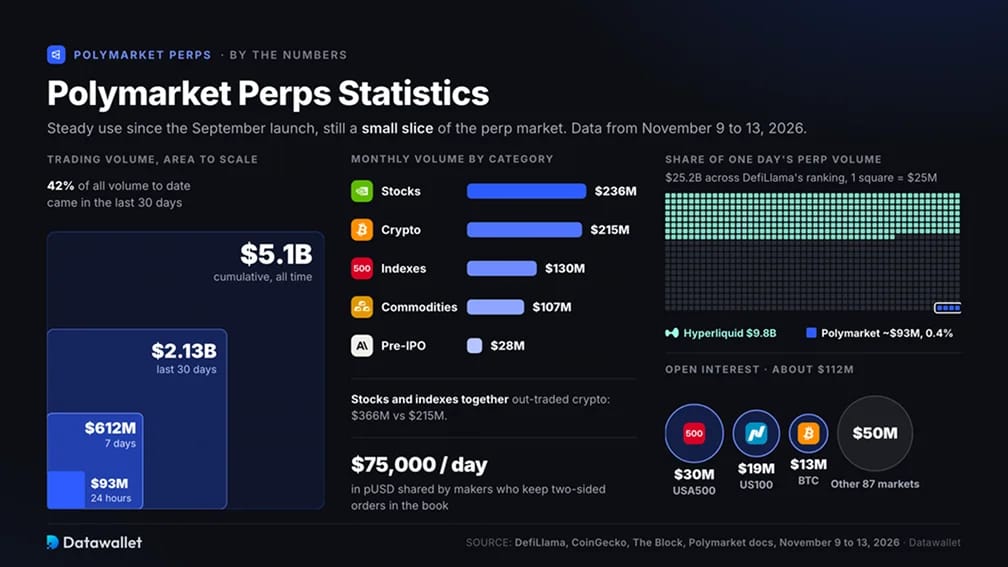
Public data shows steady use since launch and a small market share. The figures below were recorded between November 9 and November 13, 2026.
- Cumulative Volume: $5.1 billion in total perp volume, according to DefiLlama's Polymarket dashboard on November 12.
- 30-Day Volume: $2.13 billion, about 42% of all volume recorded to date.
- Daily and Weekly Volume: $93 million over 24 hours and $612 million over seven days.
- Market Share: Exchanges in DefiLlama's perps ranking traded $25.2 billion on the same day, which places Polymarket Perps at about 0.4%. Hyperliquid alone traded $9.8 billion.
- Open Interest: About $112 million across all markets in CoinGecko's exchange data. Open interest is the total value of positions that remain open.
- Largest Markets: USA500 held about $30 million of open interest in the same data, ahead of US100 at $19 million and Bitcoin at $13 million.
- Category Mix: Stock perps led monthly volume at about $236 million, ahead of crypto at $215 million, indexes at $130 million, commodities at $107 million and pre-IPO at $28 million, in The Block's category data viewed on November 13.
- Market Count: 10 markets at the public launch on September 3, 67 within hours and 90 by mid-November.
- Maker Incentives: $75,000 per day in pUSD is shared among accounts that keep both buy and sell orders in the order book, under the liquidity rewards program.
Stock and index contracts together recorded more volume than crypto contracts in that breakdown. Wider sector data is on our perpetual futures statistics and prediction market statistics pages.
Where Is Polymarket Perps Available?
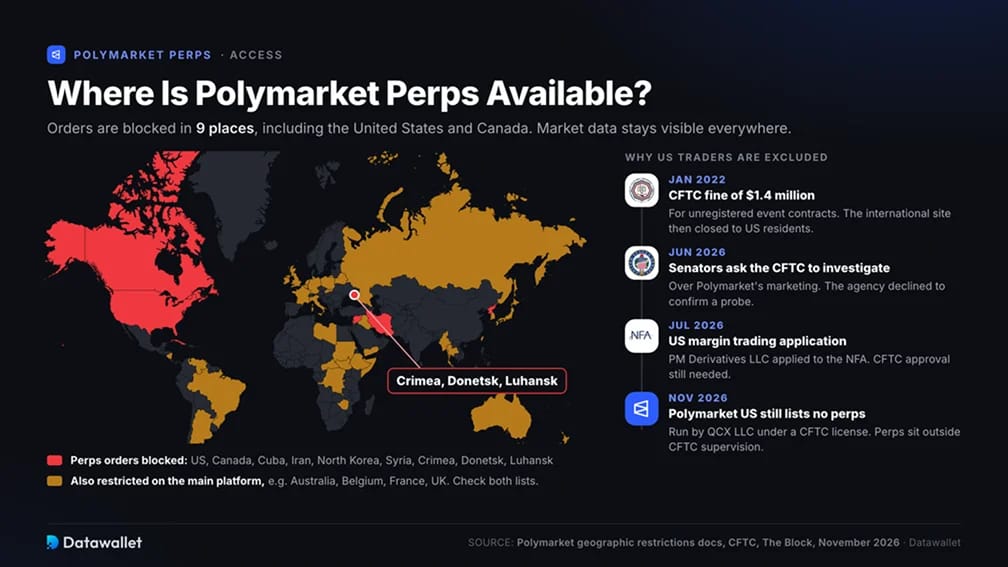
Polymarket blocks Perps orders from the United States, Canada, Cuba, Iran, North Korea, Syria, Crimea, Donetsk and Luhansk, according to its geographic restrictions page. Market data stays visible in these places. The main platform applies a longer list that includes Australia and Belgium, set out in full on our Polymarket restricted countries page.
Why US Traders Are Excluded
In January 2022, the Commodity Futures Trading Commission (CFTC), the US derivatives regulator, ordered Polymarket to pay $1.4 million for offering event contracts without registration. Polymarket closed its international site to US residents after that order. The Perps page states that the international platform is not regulated by the CFTC.
US customers use Polymarket US, a separate exchange that QCX LLC operates under a CFTC license, and it does not list perps. In July 2026, an affiliate named PM Derivatives LLC applied to the National Futures Association for the registrations needed to offer margin trading in the US. CFTC approval is still required, so leveraged products on the US exchange have no launch date.
Regulatory Pressure on Polymarket
Two US senators asked the CFTC in June 2026 to investigate Polymarket's marketing practices. The Wall Street Journal reported that an investigation was already open, and the agency has declined to confirm it. Any enforcement action could change how the international platform operates.
Residents of other countries should check local rules on leveraged derivatives before they deposit, because website access does not confirm a local license.
Polymarket Perps vs Kalshi and Hyperliquid
Kalshi offers perps under US regulation. The CFTC approved its Bitcoin perpetual in May 2026, and US residents can trade Kalshi perpetuals with lower leverage limits than Polymarket offers. The two companies are compared in Polymarket vs Kalshi.
Hyperliquid is the largest on-chain perpetual exchange and runs its order book on its own blockchain. It lists similar stock, commodity and pre-IPO markets. Polymarket's index price method names Hyperliquid as one of its price sources, together with Pyth and Chainlink Data Streams. Some Polymarket contracts therefore depend on prices formed on a competing exchange.
Polymarket's main advantage is its existing audience. Prediction traders can open perps from the same login, and the exchange adds new markets quickly when users request them. In the September interview, Fang described bringing prediction traders into perps as the long-term goal and said that experienced crypto traders keep requesting more token markets.
US residents, who cannot use Polymarket Perps, can compare regulated perpetual exchanges in the USA. Traders who prefer to hold their own keys can review the best decentralized perpetual exchanges.
How to Trade Polymarket Perps
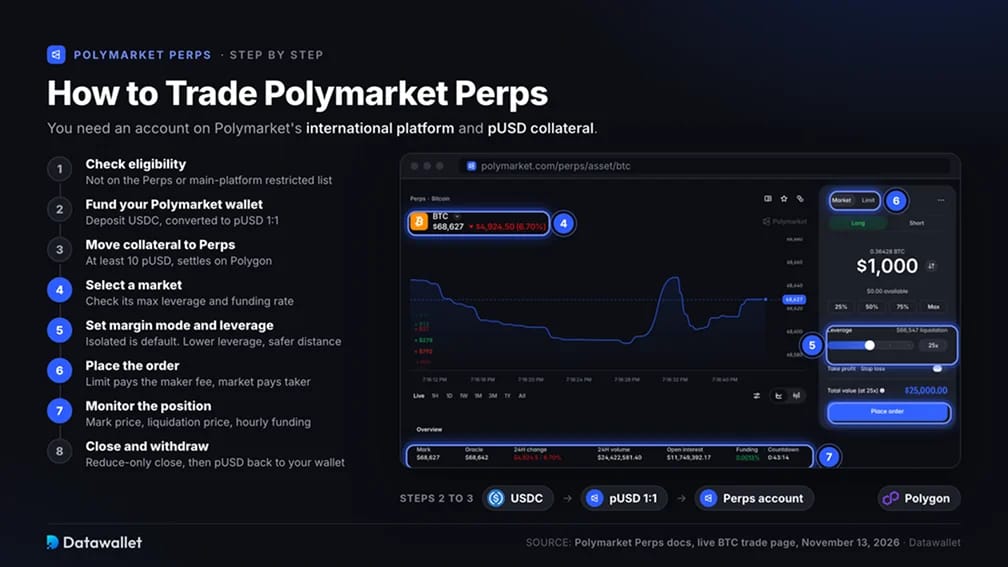
Trading requires a Polymarket account on the international platform and pUSD collateral.
- Check Eligibility: Confirm that your country is not on the restricted list for Perps or for the main platform.
- Fund Your Polymarket Wallet: Deposit USDC. The platform converts it to pUSD at a rate of one to one.
- Move Collateral to Perps: Transfer at least 10 pUSD from the Polymarket wallet to the Perps account. The transfer settles on Polygon.
- Select a Market: Open the Perps section and choose a contract. Check its maximum leverage and its current funding rate.
- Set Margin Mode and Leverage: Isolated margin is the default setting. Lower leverage places the liquidation price further from the entry price.
- Place the Order: A limit order waits at your price and pays the maker fee. A market order executes immediately and pays the taker fee.
- Monitor the Position: Watch the mark price, the liquidation price and the hourly funding rate. If account value falls below initial margin, the account can only reduce positions until more collateral is added.
- Close and Withdraw: Close the position with a reduce-only order, which can only lower your exposure. Then withdraw pUSD to the Polymarket wallet.
Who Is Behind Polymarket Perps?
Polymarket was founded in 2020 by Shayne Coplan, who remains chief executive. The company reached a $21 billion valuation in a 2026 funding round led by 1789 Capital. Intercontinental Exchange, the owner of the New York Stock Exchange, is among its largest investors. Xtine Fang leads the Perps product and previously worked at a crypto investment fund.
Risks of Trading Polymarket Perps
Leverage is the largest risk, and several others are specific to this exchange.
- Fast Liquidation: Maintenance margin is 1% on a 50x market, so a price move of about 1% against a fully leveraged position can trigger liquidation.
- Funding Spikes: At the cap of 4% per hour, one hour on a 10x position would cost 40% of the margin.
- Closed-Market Pricing: Stock, index and commodity perps trade at night and on weekends with fewer price feeds. Prices can jump when the underlying exchange reopens.
- Auto-Deleveraging: Profitable positions can be reduced when the insurance fund cannot cover a failed account.
- Operator Dependence: Matching, margin and funding run on Polymarket's systems. The documentation does not describe a way to withdraw if the exchange stops processing requests.
- Collateral Risk: pUSD works only inside Polymarket, and its token documentation describes an administrator control that can pause conversion to and from USDC.
- No US Oversight: The international platform is outside CFTC supervision, so US rules on customer funds and dispute handling do not apply.
- Platform Security: On October 29, 2026, a compromised third-party provider led to unauthorized withdrawals on the international platform, and Polymarket said it would return $3.9 million to traders.
- Thin Order Books: Open interest of about $112 million is spread across 90 markets, so large orders in smaller markets can move the price.
- Young Systems: The public exchange is less than three months old. Its changelog records fixes to funding calculations after a restart and to liquidations after an outage.
Final Thoughts
Polymarket Perps is a conventional perpetual futures exchange attached to a well-known prediction platform. Its entry fees are competitive, funding settles every hour, and the market list covers stocks and commodities as well as crypto.
The exchange is also young and small. It holds about 0.4% of the perp volume that DefiLlama tracks, its matching engine runs off-chain under one operator, and it sits outside US regulation. Traders in the United States and Canada cannot use it.
Eligible traders can start with isolated margin and low leverage after reading each market's maintenance margin and funding rate. The US margin applications and the reported CFTC inquiry are the developments to watch.