







Compare the Top Crypto Exchanges in the Middle East
1. Rain
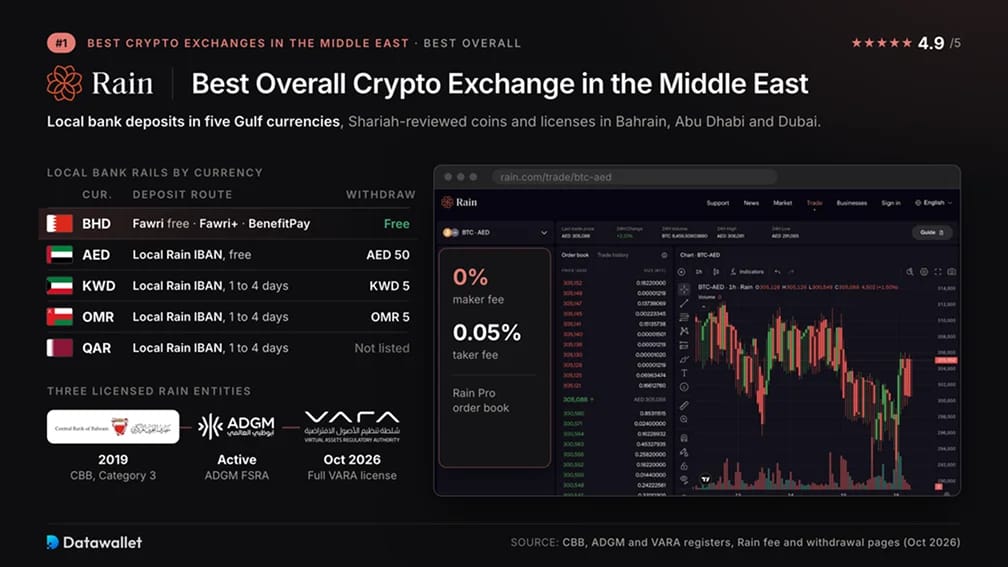
Three Gulf licenses and funding in five Gulf currencies put Rain first in our ranking. Rain Management W.L.L. has held a Central Bank of Bahrain (CBB) crypto-asset license since 2019 and now operates under Category 3. The ADGM register lists Rain Trading Limited as active for virtual asset custody and dealing. Dubai residents came under local supervision on 5 October 2026, when VARA granted Rain MENA FZE a full exchange and broker-dealer license.
In Bahrain, uncapped Fawri deposits settle in about a business day. Fawri+ supports up to BHD 3,000 a day within 24 hours, while Bahrain residents can also buy through BenefitPay with fees capped at 110 fils. Customers in the UAE, Kuwait, Oman and Qatar fund a Rain IBAN (international bank account number) by local transfer, with settlement taking one to four working days.
Rain charges nothing for local UAE or Fawri deposits. Its bank withdrawals cost KWD 5, AED 50 or OMR 5 and are free inside Bahrain. On Rain Pro, the order book screen, fees are 0% maker and 0.05% taker. The simple buy screen does not publish its spread, so we checked its quotes against Rain Pro before buying. All roughly 45 listed coins have cleared the Shariyah Review Bureau, a CBB-licensed Shariah adviser.
On 29 April 2024, attackers moved about $14.8 million out of Rain's wallets. Rain disclosed the breach two weeks later and said customer funds were secure, but did not explain how it absorbed the loss. The exchange says it keeps 98% of customer crypto in cold storage. Our Rain review also examines its exposure to Kuwait and Qatar, where it serves customers despite local crypto restrictions.
Pros
- Licensed in Bahrain since 2019, active in ADGM and fully VARA-licensed since October 2026.
- Native funding in Bahraini, Emirati, Kuwaiti, Omani and Qatari currencies, including Fawri and BenefitPay.
- Rain Pro fees of 0% maker and 0.05% taker, with every listed coin Shariah-reviewed.
Cons
- Roughly 45 coins, far fewer than global exchanges offer.
- Unpublished instant buy spreads, plus bank withdrawal charges of up to AED 50 outside Bahrain.
- Little public detail on recovery from the April 2024 wallet breach of about $14.8 million.
2. OKX
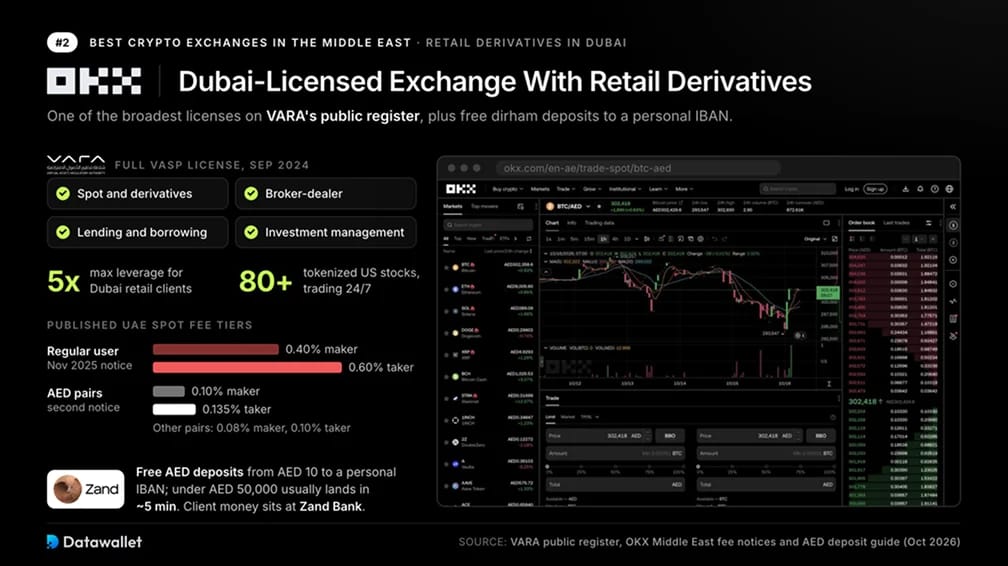
The license held by OKX is among the broadest on VARA's public register. Issued in September 2024, OKX Middle East Fintech FZE's full VASP (virtual asset service provider) license covers exchange services, including derivatives, alongside broker-dealer activity, lending and borrowing, and investment management. Since July 2025, Dubai retail clients have been able to trade futures, perpetuals and options with leverage capped at 5x.
Verified UAE accounts receive a personal beneficiary IBAN for dirham funding, with no deposit fee charged by OKX. The sending account must be at a UAE bank and in the customer's name, ruling out Wise and Revolut. Linked-account deposits start at AED 10. Amounts below AED 50,000 usually arrive within five minutes, and UAE digital bank Zand Bank holds client money.
Fees require a closer check because UAE pricing differs sharply from the global site. The OKX Middle East fee notice, effective 25 November 2025, lists regular-user rates of 0.40% maker and 0.60% taker. Another notice, apparently aimed at wholesale clients, gives rates of 0.08% and 0.10%, rising to 0.10% and 0.135% on dirham pairs. Neither names the retail tier, so check your fee screen before trading. OKX UAE has also offered more than 80 tokenized US stocks tracking share prices around the clock since October 2026.
In February 2025, OKX's Seychelles operator, Aux Cayes FinTech, pleaded guilty in New York to running an unlicensed money transmitting business. It agreed to pay more than $504 million. That case concerned US customers; VARA's enforcement notices list no action against the Dubai company. Our OKX review compares the regional and global products.
Pros
- Full VARA authorization for spot, derivatives, lending and investment services.
- Free dirham deposits to a personal IBAN, usually credited within minutes for amounts under AED 50,000.
- Retail derivatives with up to 5x leverage and more than 80 tokenized US stocks.
Cons
- UAE fees are several times the global rate if the 0.40% maker and 0.60% taker tier applies.
- Dirham funding requires a UAE bank account, leaving other Gulf residents without local deposits.
- A different group company pleaded guilty in the US in 2025 in a $504 million case.
3. Binance
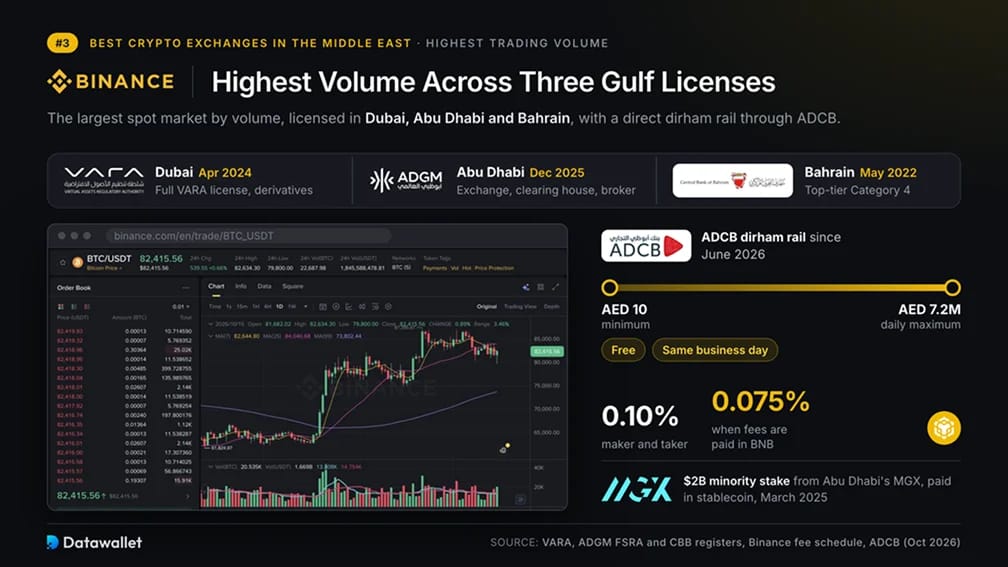
Binance holds licenses in Dubai, Abu Dhabi and Bahrain. Its Dubai company, Binance FZE, received a full VARA license in April 2024, covering exchange services with derivatives, brokerage, lending and investment management. ADGM's Financial Services Regulatory Authority (FSRA) authorized three Binance entities in December 2025 to operate an exchange, a clearing house and a broker-dealer. In Bahrain, Binance has held the CBB's top-tier Category 4 license since May 2022.
MGX, Abu Dhabi's state-backed investor, bought a $2 billion minority stake in March 2025 using stablecoin, a token pegged to the US dollar. A direct link with Abu Dhabi Commercial Bank has supported dirham deposits since June 2026. Transfers are free from AED 10, with a daily limit of AED 7.2 million and settlement the same business day. The bank's role is covered in our guide to buying crypto with ADCB.
At 0.10% for both makers and takers, spot fees fall to 0.075% when paid in Binance's BNB token. Binance has the largest spot market by trading volume, helping large orders in major coins execute close to the quoted price. It has expressed interest in working with Saudi regulators but holds no Saudi license.
Binance pleaded guilty in the US in November 2023 to anti-money-laundering, unlicensed money transmission and sanctions violations, agreeing to $4.3 billion in penalties. Founder Changpeng Zhao served four months in prison before receiving a presidential pardon in October 2025. Our Binance review examines the subsequent compliance overhaul.
Pros
- Licenses from VARA, ADGM's FSRA and the Central Bank of Bahrain.
- Free dirham deposits through ADCB from AED 10, settled the same day.
- The largest spot market by volume, with trading fees of 0.10% or 0.075% when paid in BNB.
Cons
- A $4.3 billion US settlement in 2023 for anti-money-laundering and sanctions failures.
- No licenses in Saudi Arabia, Qatar or Kuwait.
- Available products vary according to which of the three regional entities you register with.
4. Bybit
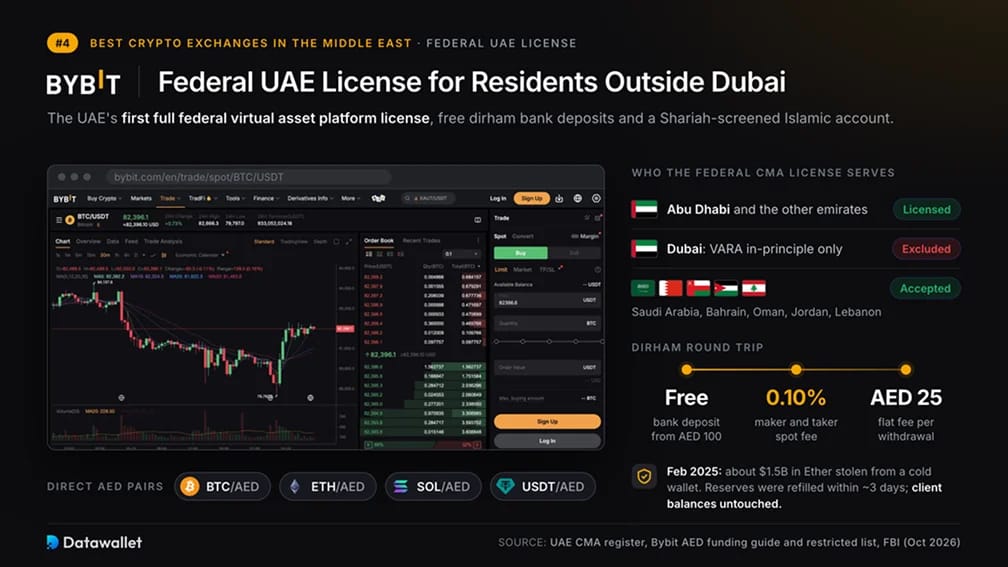
In October 2025, Bybit became the first crypto exchange to receive a full Virtual Asset Platform Operator license from the UAE's federal regulator. The Securities and Commodities Authority was renamed the Capital Market Authority (CMA) on 1 January 2026. Its license authorizes trading, brokerage, custody and dirham conversion for retail and institutional clients. Most countries' new sign-ups now register through this UAE company.
Bybit introduced dirham bank deposits in January 2026. According to its AED funding guide, deposits are free from AED 100 and withdrawals cost AED 25 each. Our test required funding from our own personal UAE bank account. Direct dirham trading pairs for USDT, Bitcoin, Ether and Solana followed in February 2026.
Dubai residents cannot use the federally licensed company under Bybit's restricted jurisdictions list. Dubai falls under VARA, where Bybit has only in-principle, or preliminary, approval. Access remains open to other emirates, as well as Saudi Arabia, Bahrain, Oman, Jordan and Lebanon. The published spot fee is a flat 0.10%. Since September 2024, Bybit's Islamic account has offered Shariah-screened spot trading and two bots.
Hackers whom the FBI attributed to North Korea stole about $1.5 billion in Ether from a Bybit cold wallet in February 2025. Cold wallets store coins offline. Bybit replenished its reserves through bridge loans within about three days, leaving customer balances untouched. As our Bybit review explains, a 2026 US lawsuit has helped recover about $48.4 million and freeze another $30.5 million.
Pros
- The UAE's first full federal virtual asset platform license, now overseen by the Capital Market Authority.
- Free dirham deposits from AED 100, plus direct AED pairs for BTC, ETH, SOL and USDT.
- A Shariah-screened Islamic account and flat 0.10% spot fees.
Cons
- Dubai residents are excluded from the CMA-licensed company because Bybit has only in-principle VARA approval.
- AED 25 per dirham withdrawal, with no partner bank named by Bybit.
- The February 2025 theft of about $1.5 billion remains the largest exchange hack on record, although customers lost nothing.
5. Crypto.com
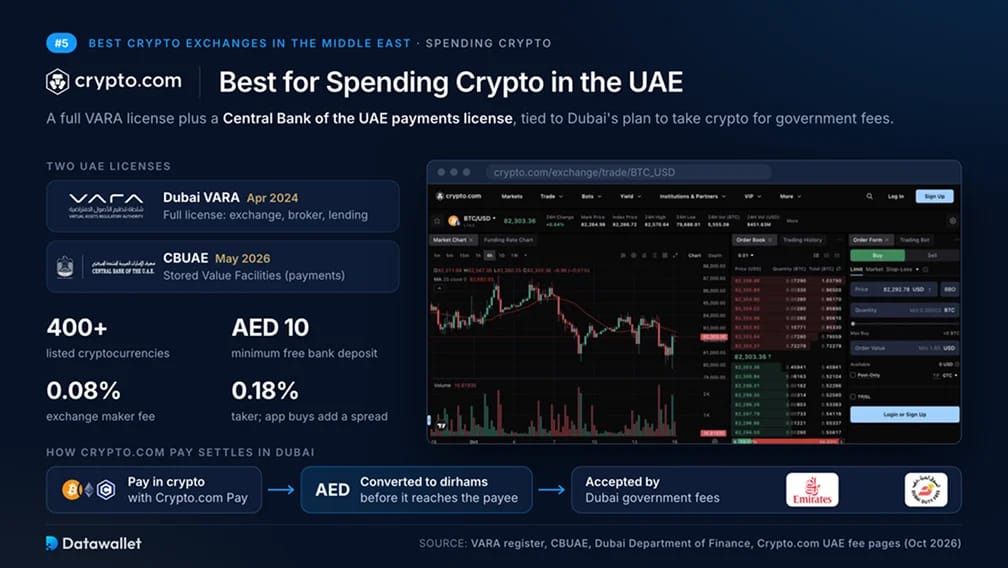
For UAE residents looking to spend crypto as well as trade, Crypto.com is a suitable choice. Foris DAX Middle East FZE has held a full VARA license since April 2024 for exchange, broker-dealer, lending and investment services. It added a Central Bank of the UAE Stored Value Facilities license in May 2026, a payments permission linked to Dubai's plan to accept crypto for government fees.
Under the May 2025 agreement that launched that plan with Dubai's Department of Finance, Crypto.com converts payments into dirhams before passing them to the government. Emirates airline and Dubai Duty Free already accept Crypto.com Pay.
The app lists more than 400 cryptocurrencies and accepts free dirham bank deposits from AED 10 to AED 4 million per transaction. Advertised exchange fees start at 0.08% maker and 0.18% taker. Purchases through the simple buy screen carry an additional spread. We found no Arabic language option on the UAE website.
Attackers bypassed two-factor authentication in January 2022, taking about $34 million from 483 accounts. Every affected user was reimbursed. For an assessment of the global platform, see our Crypto.com review; its operating markets are listed in our Crypto.com countries guide.
Pros
- Full VARA authorization alongside a Central Bank of the UAE Stored Value Facilities license.
- More than 400 cryptocurrencies and free dirham bank deposits from AED 10.
- Emirates and Dubai Duty Free accept Crypto.com Pay.
Cons
- Spreads make app purchases more expensive than trading through the exchange screen.
- No Arabic language option on the UAE website.
- A January 2022 theft of about $34 million from 483 accounts, although all affected users were reimbursed.
6. Kraken
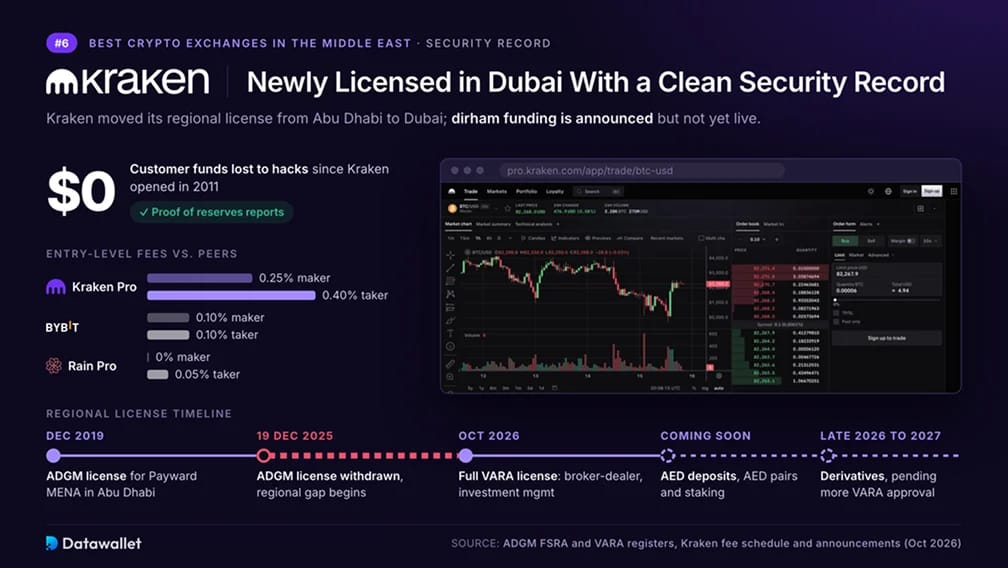
Kraken has shifted its regional licensing from Abu Dhabi to Dubai. Payward MENA Holdings, its Abu Dhabi subsidiary, held an ADGM license from December 2019 until its withdrawal on 19 December 2025, according to the FSRA register. The new Dubai company, Payward FZCO, received a full VARA broker-dealer and investment management license in October 2026.
UAE clients will soon be able to deposit and withdraw dirhams, Kraken says, with AED spot and margin pairs and staking available at launch. Derivatives remain subject to further VARA approval and are expected between late 2026 and 2027. International clients can meanwhile fund in US dollars through SWIFT, the global bank transfer network. Kraken's cash deposit page lists a free Customers Bank option from $100, though sending and intermediary banks may charge.
Entry-level Kraken Pro fees are 0.25% maker and 0.40% taker, higher than Bybit and Rain Pro. Our Kraken review details the full tiers. No customer funds have been lost to a hack since Kraken opened in 2011, and its proof of reserves reports show that it holds the assets owed to clients. Iran, Iraq and Syria are restricted, but no Gulf state, Jordan or Lebanon appears on its restricted list.
Pros
- A full VARA license since October 2026, with AED funding, AED pairs and staking announced.
- No customer funds lost to hacks since 2011, supported by proof of reserves reporting.
- International clients can make free SWIFT dollar deposits from $100.
Cons
- UAE onboarding had yet to begin when we finished testing.
- Withdrawal of the ADGM license in December 2025 interrupted Kraken's regional presence.
- Starting fees of 0.25% maker and 0.40% taker are higher than Bybit's and Rain Pro's.
How to Choose a Crypto Exchange in the Middle East
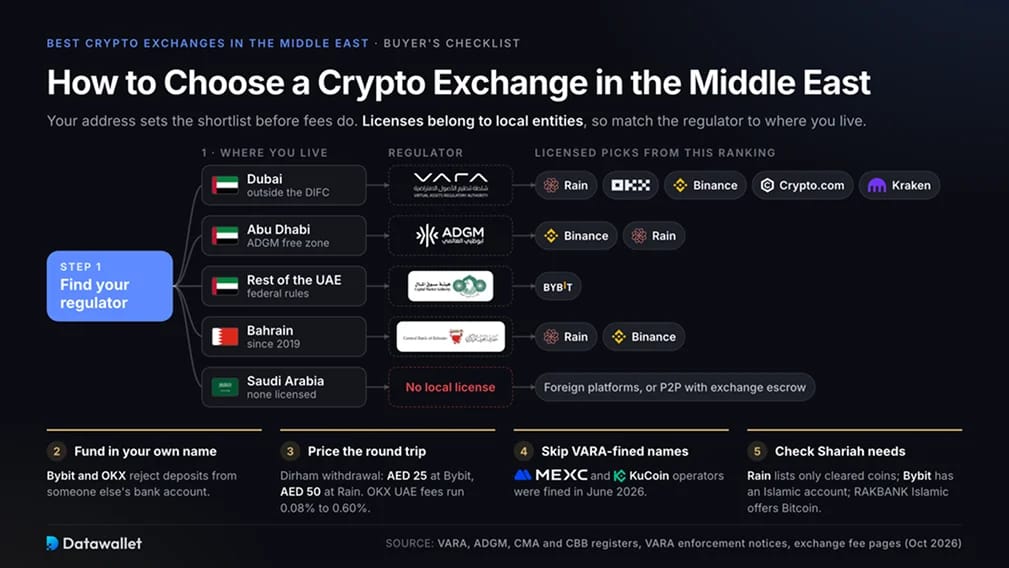
Start with your country and, in the UAE, your emirate. These determine the available licensed platforms before fees enter the comparison. We make five checks before funding an account in the region.
- Start with the regulator covering your address: Dubai residents need a VARA licensee. For Abu Dhabi's free zone, check the ADGM register; the rest of the UAE falls under the Capital Market Authority. Bahrain residents should use the CBB register. Match the company in your user agreement to the licensed entity, since licenses belong to local companies.
- Fund from a bank account in your own name: Bybit and OKX reject third-party deposits, and other licensed exchanges apply similar checks. Emirates NBD also offers crypto trading through a VARA-licensed broker in its Liv X app. Our guides for Emirates NBD and Mashreq customers explain each bank's approach to exchange transfers.
- Price the full round trip: Include withdrawal charges, which are AED 25 for dirhams on Bybit and AED 50 on Rain. OKX's published UAE trading fees range from 0.08% to 0.60% depending on the tier. Our maker and taker fees guide explains why limit orders that wait for your chosen price cost less.
- Avoid platforms VARA has fined: VARA fined the operator of MEXC in June 2026 for serving Dubai customers without a license between 2022 and April 2026. Two days later, it fined KuCoin's operator following a March warning. If an unlicensed platform freezes withdrawals, you have no local complaint channel.
- Check Shariah requirements early: Rain lists only coins cleared by a Shariah review bureau, while Bybit offers a dedicated Islamic account. RAKBANK Islamic introduced Bitcoin-only trading in August 2026. These screens generally exclude margin, futures and lending products.
With no Saudi authority licensing exchanges, Saudi residents rely on foreign platforms that accept customers from the kingdom. Riyal bank funding is unreliable. Our guide to buying USDT in Saudi Arabia compares the options. Many buyers turn to peer-to-peer (P2P) markets, where they pay another user and the exchange holds the coins in escrow. Our best P2P exchanges ranking covers safe trading.
Crypto and Bitcoin Regulation in the Middle East
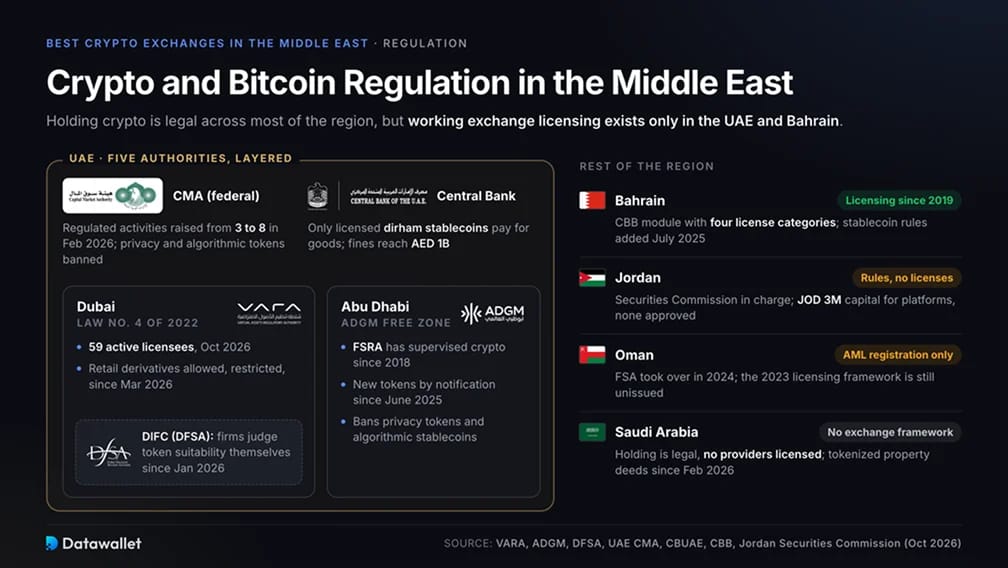
Holding crypto is legal across most of the region. Only the UAE and Bahrain, however, have functioning exchange licensing systems. Within the UAE, five authorities shape how crypto services are offered.
- VARA (Dubai): Established under Dubai Law No. 4 of 2022, VARA oversees virtual asset firms throughout the emirate except the Dubai International Financial Centre (DIFC). Its register showed 59 active licensees in October 2026. The Exchange Services Rulebook, effective 31 March 2026, made retail derivatives permanently available under restrictions.
- ADGM FSRA (Abu Dhabi): This free zone regulator has overseen crypto firms since 2018. From June 2025, firms have been allowed to notify it of new tokens rather than seek approval. It bans privacy tokens that hide transaction details and algorithmic stablecoins that use code instead of reserves.
- DFSA (DIFC): New crypto token rules took effect on 12 January 2026. Firms assess token suitability themselves under the revised regime, replacing reliance on a published list.
- Capital Market Authority (federal): The former SCA became the CMA on 1 January 2026. Effective 13 February 2026, CMA Decision No. 4/R.M/2026 increased regulated virtual asset activities from three to eight and banned privacy and algorithmic tokens. Existing licensees have one year to comply.
- Central Bank of the UAE (CBUAE): Only licensed dirham stablecoins can be used to pay for goods and services under its Payment Token Services Regulation. Federal Decree-Law No. 6 of 2025 extended central bank licensing to payment services using virtual assets, including DeFi (decentralized finance) protocols. Fines can reach AED 1 billion. The one-year transition ended on 16 September 2026.
Across the wider region, some countries license exchanges while others have frameworks that remain unimplemented.
- Bahrain: The CBB's Crypto-Asset Module, issued in February 2019, established four license categories. A stablecoin framework introduced in July 2025 covers single-currency coins backed by dinars, dollars or other approved currencies.
- Jordan: Law No. 14 of 2025 took effect on 14 September 2025 and designated the Jordan Securities Commission as the licensing authority. Trading platforms need JOD 3 million in capital under the licensing regulation gazetted in December 2025. No license had been issued by October 2026, when implementing instructions were still in draft.
- Oman: The Financial Services Authority took over from the Capital Market Authority in 2024. Providers must register for anti-money-laundering purposes, but the full licensing framework proposed for consultation in 2023 has not been issued. Transfers from Oman's largest bank are covered in our guide to buying crypto with Bank Muscat.
- Saudi Arabia: In a 2018 warning, a Capital Market Authority-led committee stated that virtual currencies are not approved and nobody is licensed to offer them. Individuals can legally hold crypto, but no exchange framework had been published by October 2026. Officials have discussed stablecoins. Tokenized real estate deed transfers began in February 2026.
- United Arab Emirates: Residents may use any platform licensed by the authority responsible for their emirate.
Where Crypto Is Banned or Restricted in the Middle East
Several neighboring countries ban activities licensed in the UAE and Bahrain. Exchanges accepting their residents operate outside local law, even when those countries do not appear on their restricted lists.
- Kuwait: Virtual assets are banned for payments and investment under CMA Circular No. 10 of 2023, which also prohibits mining and rules out licenses. During a 2025 crackdown, the Interior Ministry flagged more than 1,000 suspected mining sites.
- Qatar: In 2018, the Qatar Central Bank instructed banks not to deal in Bitcoin or process related transfers. The Qatar Financial Centre prohibited virtual asset services in 2019. Its 2024 digital asset rules apply only to tokenization.
- Lebanon: Payment providers cannot deal in or facilitate virtual assets without Banque du Liban authorization under Basic Decision 13790, dated 9 January 2026. Banks are covered by a parallel circular, although individuals may still hold crypto.
- Egypt: Issuing, trading or promoting crypto requires Central Bank of Egypt approval under Law 194 of 2020. That approval has not been granted.
- Iran: Iran appears on the restricted lists of Bybit, OKX and Kraken. Nobitex, the country's largest exchange, suffered a hack of about $90 million in June 2025. US sanctions were imposed on it and three rivals in June 2026.
Turkey and Israel have separate frameworks outside the Gulf model. Turkey's Capital Markets Board licenses platforms under Law 7518 of 2024. In Israel, crypto service providers are licensed by the Capital Market Authority.
How Is Crypto Taxed in the Middle East?
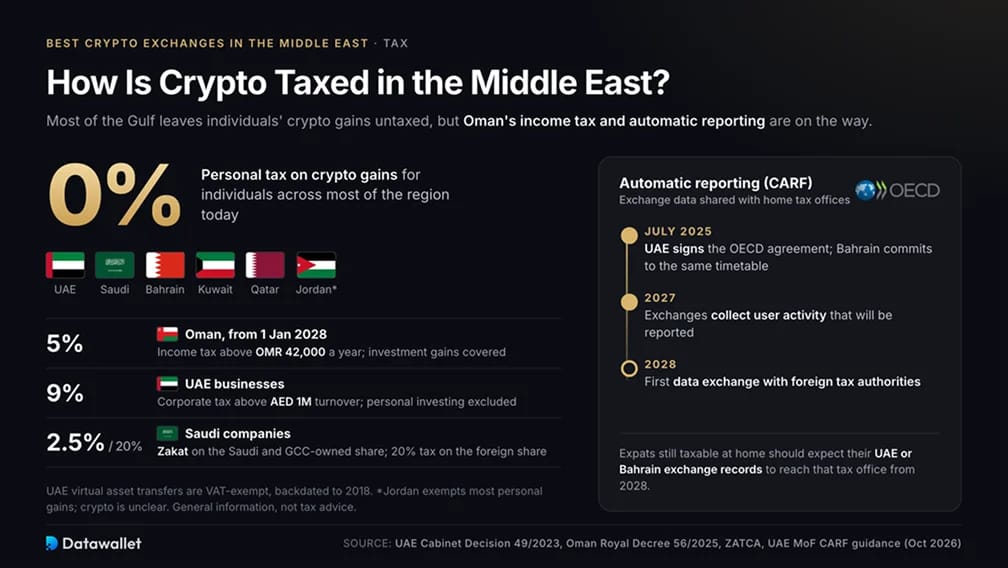
Individuals' crypto gains remain untaxed across most of the Gulf, though some rules are changing and automatic reporting is approaching. This is general information, not tax advice.
- United Arab Emirates: There is no personal income tax. Cabinet Decision 49 of 2023 brings business turnover above AED 1 million a year under the 9% corporate tax, excluding personal investment income. Frequent trading for other people could qualify as a business.
- UAE VAT exemption: Virtual asset transfers and conversions have been exempt from VAT since 15 November 2024. The exemption applies retrospectively to 1 January 2018.
- Saudi Arabia: Individuals pay no personal income tax. Companies owe 2.5% zakat on the Saudi and GCC-owned share and 20% income tax on the foreign share. The tax authority, ZATCA, has not issued crypto guidance for individuals.
- Bahrain, Kuwait and Qatar: All three countries leave personal income and individuals' capital gains untaxed. Qatar's capital gains exemption does not apply to assets belonging to a taxable business.
- Oman: From 1 January 2028, Royal Decree 56/2025 introduces 5% personal income tax on annual income above OMR 42,000. Investment gains are covered, but crypto is not specifically named.
- Jordan: Individuals' capital gains are generally exempt. The 2025 virtual assets law contains no tax provisions, leaving crypto's treatment unclarified.
- Automatic reporting: The UAE signed the OECD's Crypto-Asset Reporting Framework (CARF) agreement in July 2025. Under Ministry of Finance guidance, exchanges of data with foreign tax authorities begin in 2028 and cover activity from 2027. Bahrain has committed to the same schedule.
Expatriates who remain taxable in their home country should expect its tax authority to receive their UAE or Bahrain exchange records from 2028.
Cryptocurrency Adoption in the Middle East
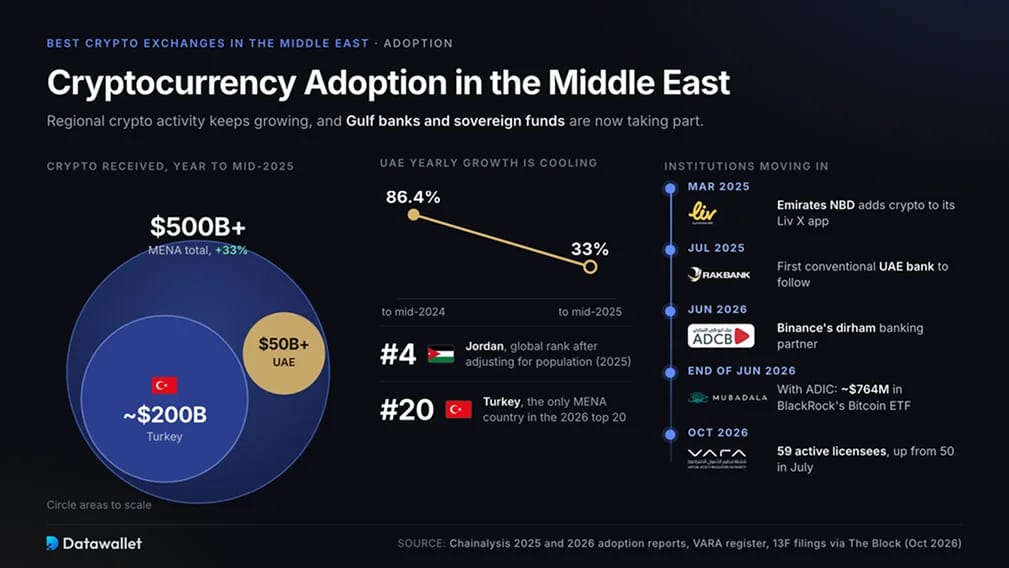
Gulf banks and sovereign funds are participating in the region's growing crypto market.
- Regional value keeps rising: According to the Chainalysis 2025 adoption index, the Middle East and North Africa received more than $0.5 trillion in crypto in the year to mid-2025, an increase of 33%. Jordan ranked fourth globally after adjusting for population.
- UAE growth is cooling: The UAE received more than $50 billion, per Chainalysis's 2025 regional report. Growth slowed from 86.4% a year earlier to 33%. Turkey led the region with about $200 billion received.
- One regional top-20 entry: At 20th, Turkey ranked above every other MENA country in the 2026 Global Crypto Adoption Index. The 2026 regional breakdown had not been published by mid-October.
- Dubai's licensed sector is expanding: After issuing its 50th VASP license in July 2026, VARA reached 59 active licensees by October.
- Sovereign money is in Bitcoin funds: Mubadala and the Abu Dhabi Investment Council held about 23 million shares in BlackRock's Bitcoin ETF. Those holdings were worth roughly $764 million at the end of June 2026. Our Bitcoin ETF tracker follows these funds daily.
- Banks are joining in: Emirates NBD introduced crypto trading in Liv X in March 2025. RAKBANK followed in July 2025, becoming the first conventional UAE bank to do so. In June 2026, ADCB became Binance's dirham banking partner.
For a global comparison, see our crypto adoption statistics.
How to Buy Bitcoin in the Middle East
A free local deposit to Rain followed by a limit order on Rain Pro is the simplest licensed route for most Gulf residents. Those in the UAE outside Dubai can take similar steps on Bybit, where Bitcoin trades directly against dirhams.
- Sign up with Rain: Register through Rain and check which licensed company is named in your terms. Residents of Kuwait and Qatar should review local restrictions first.
- Verify your identity: Submit an Emirates ID, Bahraini ID card or passport, then complete the selfie check. The name used for KYC ("know your customer") verification must match your bank account.
- Deposit in your local currency: In the UAE, link a bank using Easy Deposit or make a standard transfer. Bahrain residents can use Fawri, Fawri+ or BenefitPay. Local UAE and Fawri transfers carry no Rain deposit fee.
- Place a limit order on Rain Pro: Use our Bitcoin price page to check the live market, then enter the maximum price you are willing to pay. Orders that wait on the order book qualify for Rain Pro's 0% maker fee.
- Move long-term coins to your own wallet: Transfer a small test amount and wait for it to arrive before sending the remainder. Our best crypto wallets guide compares hardware and software choices.
When cashing out, sell through Rain Pro and withdraw to the bank account used for your deposit. Dinar withdrawals within Bahrain are free; dirham withdrawals cost AED 50. If you prefer to hold dollar stablecoins, our guide to buying USDT in the UAE compares platforms.
Final Thoughts
Rain leads our ranking because it combines three Gulf licenses with native Gulf currency funding and Shariah-reviewed coins. For Dubai residents, OKX offers the broadest license and Binance the most trading volume. Bybit's federal license serves residents outside Dubai. Crypto.com supports everyday spending, while Kraken's dirham launch is still ahead.
UAE rules became stricter this year. The federal regulator revised its virtual asset framework, and VARA fined unlicensed exchanges. September also marked the end of the central bank's transition period for crypto payment services. Jordan and Oman have laws or drafts but no licensed platforms; Kuwait, Qatar and Lebanon continue to restrict crypto.
Before transferring money, check the regulator responsible for your address. Test a small deposit and withdrawal to see how the platform handles your bank, and retain dated trade records ahead of CARF reporting in 2028.
Our Methodology
Our October 2026 assessment covered services available to residents of the UAE and wider Gulf, using six criteria.
- Trust score: Ratings out of 5 reflect regional licensing and reserve reporting, alongside security incidents and their resolution.
- License verification: We checked each operating company against the VARA, ADGM, CMA and CBB registers, then reviewed restricted lists for every Middle East country.
- Local funding: Deposit methods in dirhams, dinars and riyals were compared by cost, minimum amount and settlement time. We also noted whether platforms accept bank accounts outside the UAE.
- Total cost: For each regional entity, we combined trading fees, published spreads and withdrawal charges rather than using global platform pricing.
- Regional products: We recorded Islamic accounts, AED pairs, derivatives access and staking only when offered by the regional entity.
- Enforcement and security record: Hacks, regulatory fines and court cases reduced scores. Full customer reimbursement earned credit.
Checks were completed on 16 October 2026 using regulator registers and notices, government gazettes, tax guidance and exchange fee pages. The full review process is explained in our editorial methodology.
.webp)